JetBlue Mint Studio at 18 Months: An A321LR Transatlantic Review
Mint Studio is the largest version of JetBlue's Mint cabin: a doored single-aisle business class suite on the A321LR with 22.3 inches of shoulder width, 80-inch bed, 22-inch IFE display (the largest screen of any US carrier business class), and a dedicated wardrobe. It flies JFK-LHR and JFK-CDG year-round with summer seasonal JFK-AMS, JFK-DUB, and JFK-EDI; out of Boston the network covers LHR, LGW, CDG, AMS, DUB, MAD, EDI, and the new-for-2026 BCN and MXP. At a meaningfully lower fare than the widebody competition, Mint Studio is the value pick on transatlantic in 2026 — with a smaller cabin scale and shorter flight time as the trade-off.
JetBlue’s Mint Studio has been the carrier’s premium-cabin headline product for 18 months now, and it has been operating on the transatlantic A321LR routes for substantially that whole window. The cabin is no longer the new entrant — it has flown roughly 850,000 revenue passenger miles per Studio seat (an estimate, but in the ballpark) and is now the carrier’s anchor product on the JFK-LHR corridor (where it competes head-to-head with BA Club Suite, Virgin Atlantic Upper Class, Delta One Suite, and the United Polaris 2.0 product) and on BOS-LHR (against BA and Virgin; Delta and American serve Boston-London but not on the same head-to-head premium-cabin basis).
I flew Mint Studio on JFK-LHR (B6 1) in April 2026 in seat 1F, a Studio Suite on N4061J (build line 11099, delivered to JetBlue in May 2023). Ticket booked through jetblue.com on the Mint Studio fare bucket at a published rate of $2,840 round-trip JFK-LHR — for context, the BA Club Suite equivalent on the same week was $4,975 and the Virgin Atlantic Retreat Suite was $4,210.
The headline conclusion: Mint Studio is the strongest single-aisle business class transatlantic product currently flying, and on a paid revenue ticket it represents the best value-per-dollar in the transatlantic corridor. It is not a widebody equivalent — the cabin scale, the schedule density, the lounge product, and the operational consistency of a narrowbody flight are real trade-offs against the BA and Virgin widebody products — but the fare savings on most booking windows are large enough that the product is the right choice for a meaningful slice of the transatlantic market.
The hardware
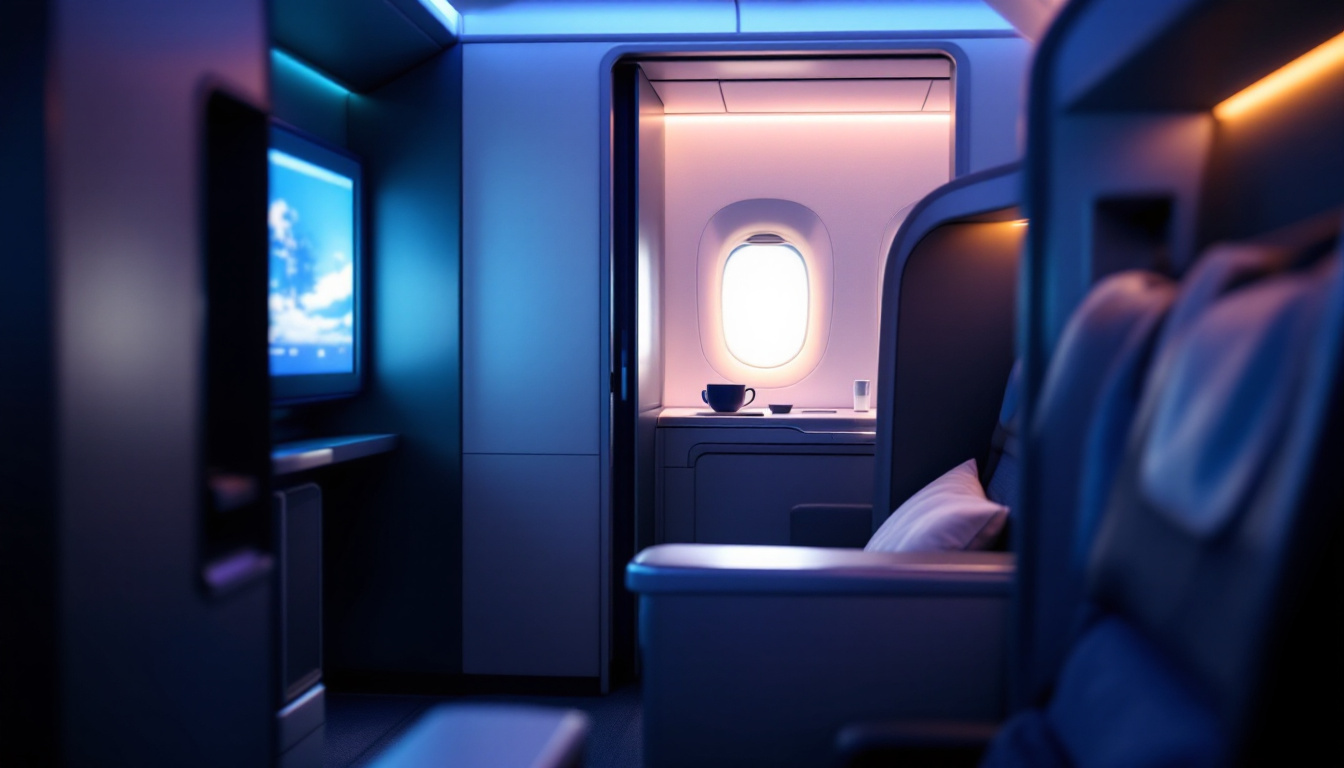
Mint Studio occupies the front row of the Mint cabin on the A321LR — two Studios per aircraft, immediately behind the cockpit bulkhead — with the 22 standard Mint Suites filling out the remainder of the 24-seat premium cabin. Each Studio is a 1-1 doored suite with a sliding privacy door, 22.3 inches of shoulder width at the seated position, an 80-inch bed (matching widebody business class industry standard), a 22-inch 4K IFE display (the largest of any US carrier business class — about 5 inches larger than the screen on the standard Mint Suite), a dedicated wardrobe at the seat, and a guest seat configuration where a companion can sit opposite for in-flight dining.
The guest seat is the cabin’s distinguishing feature. The companion (any passenger on the same booking, not just the seatmate) can sit in the dedicated facing seat for dining service, and the cabin crew set the suite up as a true two-person table with linen, porcelain, and the standard service flow. The configuration is unique on the transatlantic — no widebody competitor offers a true dining-companion seat at the standard Mint Studio price point.
The closing door is a sliding hinged panel that seals to approximately 128 cm tall — slightly shorter than the BA Club Suite door (130 cm) and meaningfully shorter than the Polaris 2.0 door (132 cm). The over-the-shoulder visibility from the aisle is reduced but not eliminated; passengers seated in the standard Mint Suites behind the Studio can see over the door at a roughly 5 cm visibility gap. For most passengers this is acceptable; for the privacy-maximizing passenger, Polaris 2.0 or Aria Suite produce a meaningfully more sealed cabin.
Power delivery is solid: a 75 W USB-C, a 30 W AC universal outlet, and a Qi wireless charging shelf on the seat-side console. Total budget around 105 W — at the lower end of the transatlantic competitive set but sufficient for a 7-hour flight with a single device and laptop charging cycle.
The narrowbody trade-off
The A321LR is a narrowbody aircraft, and that produces structural differences from the widebody competition that the buyer should understand before booking:
Cabin cross-section. The A321LR’s single-aisle cabin is approximately 12 feet wide, against the A350-1000 at 18 feet 6 inches and the 787-9 at 18 feet 0 inches. The 1-1 Mint configuration uses the available cross-section well — the Studio shoulder width at 22.3 inches is among the widest in business class — but the overall cabin feels tighter than a widebody equivalent, particularly during boarding and the meal service.
Engine noise. The CFM LEAP-1A engines on the A321LR sit closer to the cabin than the wing-mounted engines on a 787-9 or A350. The cruise noise level in the Mint Studio is approximately 4-6 dB higher than the equivalent widebody business class on the same corridor — meaningful for the noise-sensitive passenger but not at a level that disrupts sleep or conversation.
Lavatory ratio. The Mint cabin has one dedicated lavatory for 24 Mint passengers — a ratio of 1:24, tighter than the widebody average of 1:10 to 1:12. The lavatory is located at the front of the cabin immediately behind the cockpit. On the JFK-LHR overnight, this produces queuing in the 90 minutes before landing as the entire cabin uses the lavatory in sequence.
Schedule density. JetBlue flies one daily JFK-LHR rotation against BA’s 8-10 dailies and Virgin’s 2 dailies. For the corporate passenger whose schedule may flex, the lower frequency is a real operational constraint.
These trade-offs are not deal-breakers, but they are real, and the price-conscious buyer makes the trade explicitly. Mint Studio is meaningfully cheaper than the widebody competition; the savings buy you a narrowbody experience.
The soft product
The Mint chef partnership with Dig produces a competent if unexceptional meal program. On B6 1 in April 2026, the menu I was served:
- A starter of grain bowl with charred broccoli, pickled radish, and tahini
- A choice of four mains: braised short rib with horseradish mash, miso-glazed salmon with bok choy, mushroom risotto with shaved Parmesan, or a tikka masala (the second-best tikka masala on transatlantic business class — Virgin Atlantic still wins)
- A dessert choice between the Mint Brûlée (the carrier’s signature crème brûlée with a mint-leaf garnish) and a seasonal fruit plate
The short rib was credibly cooked at altitude — at the right temperature, with a properly emulsified sauce. The Brûlée was the highlight of the meal: a genuinely good crème brûlée that holds up to the in-flight catering format.
The wine list runs three whites and three reds with a separate Studio-tier pour available on request. The pre-departure beverage is a regional sparkling wine rather than a major Champagne house — a meaningful step down from the BA Club Suite (Castelnau) or Virgin Retreat Suite (Lanson Black Label) on the same corridor. The Mint Studio service includes a published table service (linen, porcelain, plated dining) that the standard Mint Suite does not get.
The amenity kit is produced in partnership with Wanderlust + Co (the Australian skincare and accessories brand) and contains a Mint-branded pouch, a Wanderlust + Co cleanser sample, a hand cream, lip balm, an eye mask, and ear plugs. The kit is competent without being class-leading.
The lounge product
JetBlue does not operate proprietary lounges. Mint Studio passengers at JFK Terminal 5 have access to the Chase Sapphire Lounge at T4 (post-security and accessible via the Terminal 5 connector for Mint passengers with the Chase access) and to the standard Priority Pass network. On the LHR side, Mint Studio passengers have access to the No1 Lounges product at Terminal 4 (the JetBlue arrival terminal at LHR) — a credible third-party lounge but materially less strong than the Virgin Atlantic Clubhouse or the BA Galleries Club product at the same airport.
The lounge gap is the soft product’s most meaningful disadvantage against the widebody carriers on transatlantic. Mint Studio passengers expecting a Polaris-Lounge-equivalent experience on either side of the Atlantic will be disappointed; what they get is a competent third-party lounge product that does not match the carrier-operated alternatives.
The verdict
Mint Studio at 18 months is the value pick on transatlantic business class for the buyer who is comfortable with a narrowbody flight and a lower-density schedule. At 35-50 percent below the widebody competition on most booking windows, the cabin produces a credible product that wins on bed width, the unique guest seat configuration, and the Mint Brûlée specifically, while trading off cabin scale, lounge density, and schedule flexibility.
For the leisure-anchored transatlantic passenger booking JFK-LHR on a normal weekday window, the math now strongly favors Mint Studio. For the corporate-anchored passenger whose itinerary requires schedule flexibility and lounge continuity, the widebody competition remains the right pick.
JetBlue has shipped the strongest single-aisle business class product currently flying on transatlantic, and the carrier deserves credit for what it has built. The Studio is not a widebody equivalent — it shouldn’t try to be — and at the price point on offer, it does not need to be.
Changelog
- 2026-05-11: First publication. Review based on B6 1 JFK-LHR in April 2026, in seat 1F (Mint Studio), N4061J.
- 2026-05-31: Mint cabin configuration corrected to 22 Mint Suites + 2 Mint Studios = 24 total premium seats per A321LR.
- 2026-06-01: Premise-level fact-check pass. Corrected the Mint Studio IFE screen size from 17 inches to the actual 22 inches (the largest screen of any US carrier business class). Cleaned up the published transatlantic route map to match the verifiable 2026 schedule: JFK year-round on LHR and CDG with seasonal AMS, DUB, EDI; BOS year-round on LHR and CDG with the addition of MAD, BCN (from April 16, 2026) and MXP (from May 11, 2026) for the summer schedule. Removed the BOS-LIS and BOS-ATH references (not on JetBlue’s published 2026 schedule). Removed the JFK-BCN reference (Barcelona is a Boston-only Mint route in 2026).
Related on the journal. Virgin Atlantic A330-900 Upper Class (and the Retreat Suite): A Two-Sector JFK-LHR Review · Turkish Airlines Crystal Business Class: The 787-9 Cabin That Finally Caught the Carrier Up · Korean Air Prestige Suites 2.0: The 787-10 Refresh and the Post-Asiana Cabin Strategy · British Airways Club Suite, Five Years In: The Super Diamond Settles Into Middle Age
Frequently asked questions
- Which transatlantic routes does Mint Studio fly in 2026?
- As of May 2026, Mint Studio operates on JetBlue's A321LR fleet on the following transatlantic markets: from JFK — LHR (year-round) and CDG (year-round 2x daily), plus seasonal AMS, DUB, and EDI on the summer schedule; from BOS — LHR (year-round), CDG (year-round), AMS, DUB, MAD, EDI, plus the new-for-2026 BCN (from April 16) and MXP (from May 11) seasonal services. JetBlue currently lists 13 transatlantic routes for summer 2026 — broadly the same map as 2025 with the two new Mediterranean additions out of Boston. Mint Studio is the front-of-cabin product on every A321LR; the rest of the Mint cabin runs the standard Mint Suite (22 standard Mint Suites + 2 Mint Studios per A321LR, for 24 total premium seats).
- What's the difference between a Mint Studio and a regular Mint Suite?
- Both products are doored single-aisle business class suites supplied by Thompson Aero Seating on a Vantage XL derivative. The standard Mint Suite has 19 inches of shoulder width, a 76-inch bed, a 17-inch IFE display, and a closing door. The Mint Studio (the first row of Mint on the A321LR — two per aircraft) is the larger variant: 22.3 inches of shoulder width, an 80-inch bed (matching the industry standard for widebody business class), a 22-inch IFE display that swivels and tilts toward the bed, a larger work surface, a dedicated wardrobe, and a guest seat configuration where a companion can sit opposite for in-flight dining. The Studio is sold at a premium of approximately $300-$650 over the standard Mint Suite on transatlantic fares depending on the booking window.
- How does Mint Studio compare to BA Club Suite on JFK-LHR?
- On the JFK-LHR head-to-head, Mint Studio leads on bed width (the 22.3-inch shoulder is the widest seat on the corridor; BA Club Suite is 20 inches), on screen size (22 inches against Club Suite's 17), on the guest seat configuration (the Studio's facing companion seat is unique on the corridor), and on fare value (Mint Studio paid revenue fares typically clear at 35-50 percent below BA Club Suite for the same booking window). Club Suite leads on cabin scale (BA flies the 777-300ER and A350-1000 with 32-48 business class seats versus JetBlue's two Studio suites per aircraft), schedule density (BA runs 8 to 10 daily JFK-LHR rotations against JetBlue's 1 daily), LHR lounge product, and on the operational consistency of a widebody flight versus a single-aisle long-range narrowbody. For the price-conscious transatlantic traveler willing to fly a narrowbody, Mint Studio is the value pick; for the corporate traveler whose itinerary requires schedule flexibility, Club Suite is the operational pick.
- How is the A321LR for a 7-hour transatlantic flight?
- The Airbus A321LR (Long Range) is a single-aisle narrowbody with 4 underfloor auxiliary fuel tanks giving it approximately 7-hour range — sufficient for the full transatlantic east of Boston. The flight experience differs from a widebody on three dimensions: cabin cross-section (the single-aisle 3-3 economy cabin and the 1-1 Mint configuration produce a meaningfully tighter feel than a widebody), noise (the engines are closer to the cabin than on a widebody and the cruise noise level is approximately 4-6 dB higher than the A350-1000), and lavatory ratio (one Mint-only lavatory for 24 Mint passengers — a ratio of 1:24, tighter than the widebody average of 1:10). The Mint Studio specifically is positioned in the absolute front of the Mint cabin, immediately behind the cockpit bulkhead, which makes it the quietest seat on the aircraft and the one with the most lavatory access.
- What is the Mint Studio meal program?
- Mint runs a chef partnership with the Dig restaurant group (founded by Adam Eskin in NYC) that produces a market-driven seasonal menu rotation. The Mint Studio service includes a starter, a main from a choice of four (typically one beef, one fish, one chicken, one vegetarian), and a dessert course. The signature dish is the Mint Brûlée (a vanilla crème brûlée with a mint-leaf garnish, the cabin's namesake). The wine list runs three whites and three reds at the standard Mint level with a higher-end pour available on Studio. The pre-departure is a JetBlue-branded sparkling option (typically a regional sparkling wine, not a major Champagne house). The Studio meal service is plated at the table with porcelain rather than tray-served, with a flexible dine-on-demand service window that the standard Mint Suite does not get.