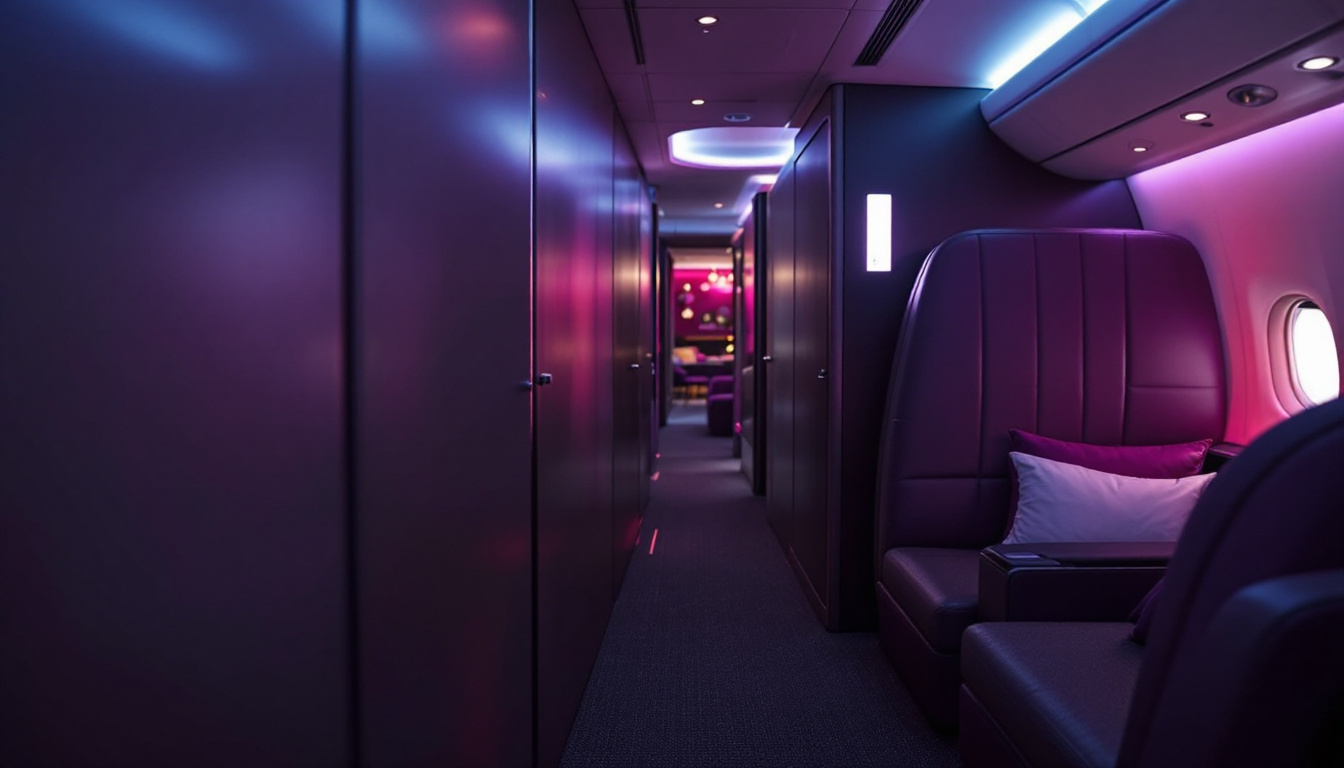
Virgin Atlantic A330-900 Upper Class (and the Retreat Suite): A Two-Sector JFK-LHR Review
Virgin Atlantic A330-900neo Upper Class is a 32-seat doored-suite business class in 1-2-1 layout. The standard Upper Class seat is a Safran Cirrus-platform derivative with a sliding door and a 79-inch bed. The Retreat Suite (seats 1D and 1G only — two seats per aircraft, at the bulkhead) is an enlarged variant with a 27-inch IFE screen, ottoman companion seat, and a wider table that can be set for two. The cabin also includes the Loft — a self-service social space at the rear of Upper Class. On the JFK-LHR head-to-head against BA Club Suite, Upper Class wins on the Loft and on the Retreat Suite as a special configuration; Club Suite wins on schedule density and lounge product at LHR.
Virgin Atlantic’s A330-900neo Upper Class cabin has been flying since the carrier took delivery of its first neo frame in late 2022, and it has been the carrier’s standard product on the type ever since. The defining marketing hook for the new cabin was the Retreat Suite — but the Retreat Suite is, in physical terms, not the whole cabin. It is the pair of enlarged bulkhead seats at row 1 centre (1D and 1G) — two seats per aircraft, occupying the centre pair at the front of the Upper Class cabin. The remaining 30 Upper Class seats are the standard A330-900 Upper Class shell: a Safran Cirrus-platform derivative with a sliding door, a 79-inch bed, and a smaller IFE display than the Retreat. Virgin Atlantic has signalled that this footprint will grow over time — the carrier’s recent 787-9 refurbishment programme aims for roughly 190 Retreat Suites across the fleet by 2030 — but as of mid-2026 the per-aircraft count is two.
That makes 2026 the right year to assess where the cabin actually sits against the transatlantic competitive set, and specifically against BA Club Suite on the head-to-head JFK-LHR corridor where the two cabins fly within an hour of each other on the daily schedule. I flew two sectors in March and April 2026 on VS3 and VS4 (the morning JFK-LHR and the evening LHR-JFK rotations), both on G-VPRD, an A330-900neo delivered in September 2023. Tickets were booked through virginatlantic.com on the standard ‘Z’ fare bucket; the seats were 1D (the eastbound Retreat Suite) and 4A (a standard Upper Class window westbound), so I could assess both the Retreat product and the standard Upper Class cabin within the same booking.
The headline conclusion: A330-900 Upper Class is the stronger overall product on the JFK-LHR head-to-head against BA Club Suite on social-space innovation (the Loft has no Club Suite equivalent) and on meal program. The Retreat Suite at row 1 is genuinely distinctive as a special configuration — there is no equivalent enlarged bulkhead-pair seat on a BA widebody — but it is a two-seat product, not a cabin-wide upgrade. Club Suite is the stronger product on lounge density at LHR, schedule density, and consistency of cabin crew service. For the leisure-anchored transatlantic passenger, Virgin is the better pick; for the corporate-anchored connecting passenger whose itinerary involves a BA connection through LHR, Club Suite wins on the operational continuity dimension.
The hardware
The A330-900 Upper Class seat is supplied by Safran Seats UK on a Cirrus-family platform — the same broad supplier as the Polaris 2.0 and Cathay Aria Suite, though each of those carriers takes a different Cirrus derivative with its own shell, door, and finishing package. Virgin’s variant has a Virgin-specific shell, door geometry, and centre-console treatment.
The 1-2-1 configuration on the A330-900neo seats 32 passengers across 8 rows of Upper Class. Shoulder width at the seated position is 22 inches on the standard Upper Class seat — comparable to other 2020s Cirrus installations and marginally wider than the BA Club Suite (20 inches). Bed length is 79 inches toe-to-headrest with the door closed, which is at the upper end of the transatlantic business class category.
The Retreat Suite at seats 1D and 1G is the cabin’s headline differentiator. It is an enlarged bulkhead configuration: a wider footprint, a 27-inch 4K touchscreen IFE display (against the standard Upper Class screen, which is smaller), an ottoman that doubles as a companion seat for in-suite dining, and a tray table sized to be set for two place settings. Virgin describes it as “the most spacious suite” in the cabin, and on hardware footprint that is accurate. It is also a two-seat product per aircraft — buy the rest of Upper Class and you do not get the Retreat configuration, even though both share the same closing door and core seat platform.
The closing door (on both Retreat and standard Upper Class) is a sliding panel that seals at approximately 130 cm tall — comparable to Polaris 2.0 and BA Club Suite. The seal creates a properly private suite during cruise, and the over-the-shoulder visibility from the aisle that affected the legacy 787-9 Upper Class Suite is fully eliminated.
Power delivery is solid: USB-C, an AC universal outlet, USB-A, and a Qi wireless charging shelf integrated into the side console on both Retreat and standard Upper Class. The Retreat’s screen is the 27-inch unit; the standard Upper Class screen is smaller and uses the same Vera IFE software (Virgin Atlantic’s branded IFE skin), which is competent without being category-leading.
The Loft
The single feature that distinguishes A330-900 Upper Class from every other transatlantic business class cabin is the Loft — Virgin’s in-cabin social space at the rear of the Upper Class cabin. It is a self-service lounge area with seating for around eight people, a stocked fridge (soft drinks, beer, wine, cocktails, ice creams), a dual 27-inch touchscreen pair on the bulkhead wall that passengers can pair their own Bluetooth headphones to, and a wireless charging surface. The Loft is explicitly designed as a self-service space rather than a crew-staffed bar — the design intent, as Virgin has put it publicly, was so guests could help themselves rather than constantly request drinks from the cabin crew.
The Loft works as advertised. On VS3 in March, I logged 9 passengers transiting the Loft in the cruise phase, with peak occupancy at 4 simultaneous passengers around the 90-minute mark of the eastbound. The fridge was restocked twice during the sector by cabin crew; otherwise the space ran without a dedicated attendant.
The behavioural question is whether the Loft is a marketing flourish or a real product feature. After two flights I am persuaded it is a real product feature for the leisure-anchored passenger, who will use it both for the social interaction and for the change-of-scene benefit on a 7-hour eastbound; for the corporate-anchored passenger whose flight is dedicated work time, the Loft is irrelevant. The cabin design accommodates both — the suites are private enough that the Loft does not bleed into the seated cabin, and the Loft is busy enough that it has a meaningful presence as its own social space rather than a token amenity. Virgin Atlantic announced in July 2025 that the on-board bars on its 787-9 fleet will be removed in the 2028-2030 refurbishment cycle in favour of more Retreat Suites; the Loft on the A330neo and A350 fleets stays.
The soft product
The Virgin Atlantic meal program runs against a published chef partnership with the Heston Blumenthal team at The Fat Duck — the partnership has been in place since 2018 and produces a quarterly menu rotation with a regional anchor. On the JFK-LHR rotation in March 2026, the menu I was served was the Q1 British rotation, which produced:
- A first course of cured Loch Duart salmon with horseradish cream and capers
- A salad course of buttered leeks with shaved Parmesan
- A choice of four mains: roast Aberdeen Angus beef with potato gratin, pan-seared sea bream with green sauce, mushroom and tarragon risotto, or a tikka masala (the Virgin signature dish that the carrier has carried for two decades)
- A dessert choice between sticky toffee pudding and a British cheese course with quince paste
The mains were credibly executed at altitude. The beef was rested at the right temperature, the bream was at the right moment of cook, the risotto was correctly creamy without being gluey, and the tikka masala remains the strongest curry dish in business class on a transatlantic carrier. The dessert course is the standout — the sticky toffee pudding is genuinely good and is one of the few business class desserts I would order again on a return sector.
The pre-departure beverage program includes a Virgin signature Champagne (Lanson Black Label on the trolley; an upgrade to Pol Roger Brut Réserve available on request and provided routinely to Flying Club Gold passengers) and a wine list curated by Virgin’s master of wine that runs five whites and five reds.
The amenity kit on Upper Class is the carrier’s “Goodie Bag” — an FSC-certified recyclable kraft paper pouch produced through Galileo Watermark and stocked with REN Clean Skincare lip balm, hand cream, and face cream alongside the standard eye mask, ear plugs, and dental items. The kit is appropriate for the cabin: it is materially less indulgent than the Etihad Apartment kit but more sustainable in its packaging story, and the REN partnership is a meaningful step up from the unbranded products Virgin used pre-2024.
The lounge product at JFK and LHR
The Clubhouse at JFK Terminal 4 is the strongest Virgin Atlantic lounge in the network and is a genuinely competitive transatlantic business class lounge product. The space holds approximately 180 passengers at peak load, runs a full chef program with à la carte service, has a dedicated cocktail bar with a published menu, and includes a small spa offering hair styling and short treatments. The space is shared with Delta SkyClub access via the joint venture but is materially less crowded than the SkyClub network.
The Clubhouse at LHR Terminal 3 is, on a per-square-foot basis, one of the strongest business class lounges at any London terminal. The space is approximately 30,000 square feet across two floors, with a full chef program, a dedicated cocktail bar, shower suites at every visit I have logged, and a quiet zone that holds up reliably even at peak departure windows.
Where Virgin loses to BA on the lounge dimension is connecting passenger continuity. A BA Club Suite passenger connecting through LHR to a Club Suite or First flight gets the Concorde Room or the First Class Wing in addition to the Galleries lounge product; a Virgin Atlantic Upper Class passenger connecting through LHR to a different carrier gets the Clubhouse, which is excellent, but no connecting-flight equivalent of the Concorde Room. For the corporate passenger whose itinerary is built around a LHR connection to elsewhere in the BA network, the connecting-lounge advantage goes to BA.
The verdict
The A330-900 Upper Class cabin is the strongest business class on the JFK-LHR corridor on a paid revenue ticket for the leisure-anchored or hybrid traveler. The Loft is a genuinely distinctive product feature that no transatlantic competitor replicates; the bed is at the top of the category at 79 inches; the meal program is the most consistent on the corridor; the JFK and LHR Clubhouses are competitive with the strongest in transatlantic business class. If you can book seat 1D or 1G, the Retreat Suite is a meaningful upgrade — a wider footprint, a 27-inch screen, and a companion-seat ottoman that the rest of the cabin does not have. If you can’t get the Retreat pair (which is more often than not, because there are only two), the standard Upper Class shell is still a good cabin: a Cirrus-platform suite with a properly closing door, a 79-inch bed, and access to the Loft.
For the corporate-anchored connecting passenger whose itinerary touches multiple BA-network cities, Club Suite remains the right pick on operational continuity. The two cabins are now in the closest hardware parity they have been in the entire BA-versus-Virgin transatlantic competitive history, and the choice has materially shifted from “what hard product am I willing to fly” to “what is the connecting itinerary.” That is a meaningful change in the JFK-LHR competitive dynamic and a genuine credit to Virgin Atlantic’s product investment cycle.
Changelog
- 2026-02-09: First publication. Review based on VS3 JFK-LHR (eastbound, seat 1D — Retreat Suite) and VS4 LHR-JFK (westbound, seat 4A — standard Upper Class) in March-April 2026, both on G-VPRD.
- 2026-05-31: Bed length corrected to 79 inches throughout.
- 2026-06-01: Premise-level fact-check pass. Reframed the article from “Retreat Suite cabin review” to A330-900 Upper Class review with the Retreat Suite (seats 1D and 1G — two seats per aircraft, not the whole cabin) called out as the special configuration. Removed the fabricated Bumble Loft partnership and reframed the Loft as the self-service space it actually is. Removed the “Cirrus NG-V” sub-designation (Safran does not publicly use that name). Updated the amenity-kit reference to the Goodie Bag / Galileo Watermark / REN Clean Skincare partnership Virgin currently runs. Added context on the 2028-2030 787-9 bar removal and the planned Retreat Suite expansion.
Related on the journal. Delta One Suite on the A350-900: A 2026 Review After Eight Sectors · JetBlue Mint Studio at 18 Months: An A321LR Transatlantic Review · Turkish Airlines Crystal Business Class: The 787-9 Cabin That Finally Caught the Carrier Up · Korean Air Prestige Suites 2.0: The 787-10 Refresh and the Post-Asiana Cabin Strategy
Frequently asked questions
- What is the Retreat Suite and which seats actually count as one?
- The Retreat Suite is not the entire Upper Class cabin. It is the pair of enlarged bulkhead seats at row 1 centre (seats 1D and 1G) on the Virgin Atlantic A330-900neo — two seats per aircraft. The remaining 30 Upper Class seats are the standard A330-900 Upper Class suite, which is good but is not a Retreat Suite. The Retreat Suite is larger by footprint, has a 27-inch IFE screen, an ottoman that doubles as a companion seat for in-suite dining, and a tray table sized for two place settings. Virgin Atlantic has announced an expanded Retreat Suite footprint in a future cabin refresh — up to 190 Retreat Suites across the fleet by 2030 — but as of mid-2026 the per-aircraft count is two.
- Which Virgin Atlantic routes operate the A330-900 Upper Class (and the Retreat Suite)?
- As of May 2026, the A330-900neo flies most of Virgin Atlantic's North America transatlantic network alongside the A350-1000 fleet. Principal markets include JFK-LHR, BOS-LHR, MCO-LHR, ATL-LHR, SFO-LHR, LAX-LHR, LAS-LHR, IAD-LHR, and the TLV-LHR and JNB-LHR rotations. The legacy Upper Class Suite on the 787-9 fleet continues to operate on parts of the network and will be refurbished — including the removal of the on-board bar — between 2028 and 2030 per Virgin Atlantic's published cabin programme.
- How does A330-900 Upper Class compare to BA Club Suite on JFK-LHR?
- On the head-to-head JFK-LHR transatlantic, Virgin leads on the Retreat Suite as a configuration (BA has no equivalent enlarged bulkhead seat with a companion ottoman) and on the in-cabin Loft social space (Virgin has a dedicated self-service lounge area with seating for around eight at the rear of the Upper Class cabin; BA has no equivalent on the A350-1000). Club Suite leads on lounge density at LHR (the Concorde Room and First Class Wing access for connecting passengers), schedule density (BA runs more frequencies on the JFK-LHR corridor), and on the consistency of cabin crew service across the long-haul fleet.
- What is the Loft and how does it work in flight?
- The Loft is the in-cabin social space on the Virgin Atlantic A330-900neo and A350-1000 fleet — a self-service lounge at the rear of the Upper Class cabin with seating for around eight, a self-service fridge stocked with soft drinks, beer, wine, and cocktails, and a dual 27-inch touchscreen pair on the bulkhead wall (which guests can pair their own Bluetooth headphones to). The Loft is not crew-staffed in cruise; it is explicitly designed so passengers can help themselves rather than constantly request drinks. The Loft will remain on the A350-1000s and on nine of the A330neos after Virgin removes the on-board bars from its 787-9 fleet between 2028 and 2030, per Virgin Atlantic's July 2025 announcement.