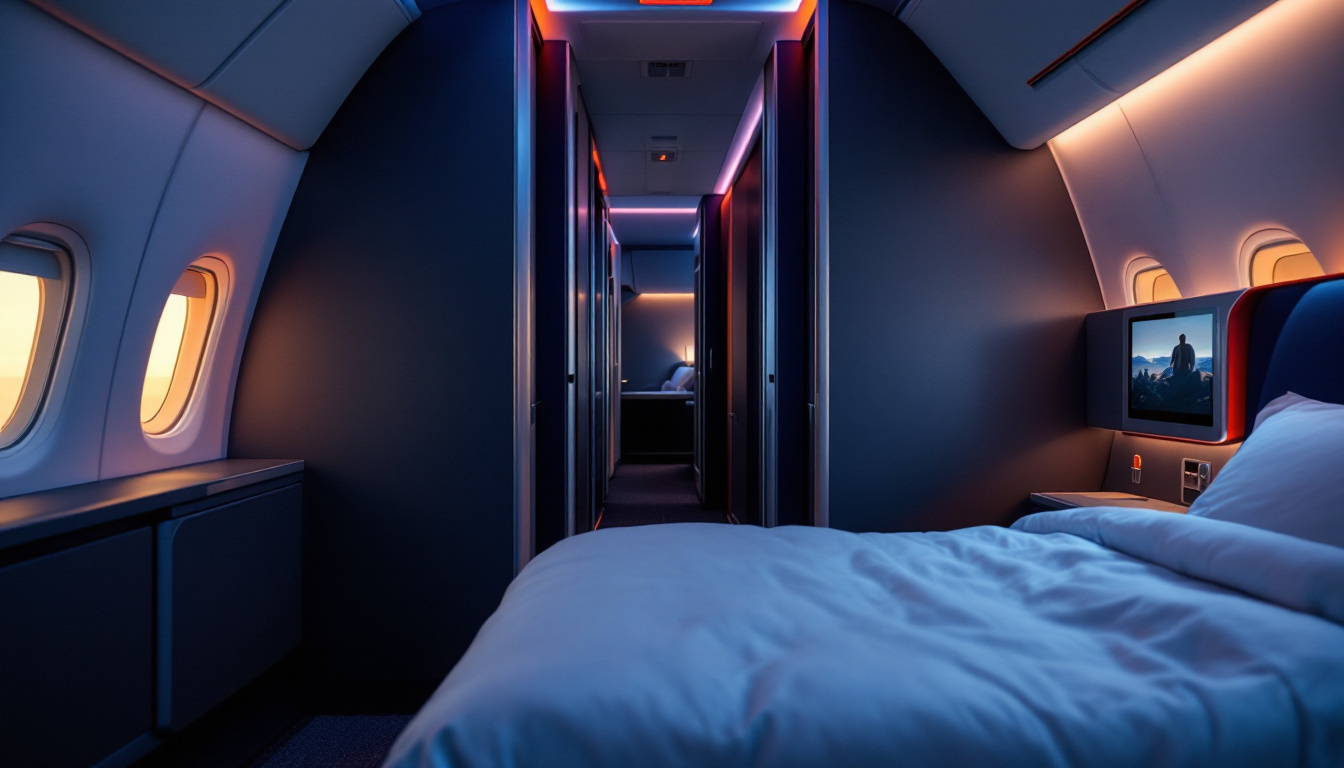
Delta One Suite on the A350-900: A 2026 Review After Eight Sectors
Delta One Suite is the doored-suite long-haul business class that defined the U.S. carrier category when it launched on the A350-900 in 2017. The cabin has aged well, the soft product has improved, and the imminent A350-1000 refresh (entering service Q4 2026) introduces a Delta One Premier sub-tier that adds a centre-pair quad configuration. Today, Delta One Suite remains the best U.S.-anchored long-haul business class for the price.
The Delta One Suite cabin is now eight years into commercial service. That is roughly the median lifespan of a long-haul business class hard product in the modern era — Cathay Cirrus flew for fifteen, BA Club World flew for twenty, Lufthansa Business 2003 flew for fifteen years before Allegris — and at the midpoint of that life cycle, the question worth asking is whether the cabin has aged well, where it now sits relative to the 2026 competitive set, and what the imminent A350-1000 Premier refresh changes about Delta’s long-haul positioning.
I flew Delta One Suite on eight sectors between February and May 2026: three on JFK–LHR (DL2 and DL1, A350-900, N509DN and N512DN), two on ATL–JNB (DL200 and DL201, A350-900, N509DN and N511DN), one DTW–NRT (DL275, A350-900, N506DN), and two on SEA–ICN (DL167 and DL168, A330-900neo, N407DX and N409DX). All flights were paid revenue tickets booked on delta.com. The aim was to assess the cabin across the long-haul network — transatlantic, transpacific, and the South Africa rotation — rather than from any single corridor.
The headline conclusion is that Delta One Suite has aged better than I expected at the eight-year mark. The cabin’s hardware design choices in 2017 anticipated the doored-suite category in a way that competitors did not, and the soft product has improved in three meaningful ways since the cabin’s debut. The remaining gaps to the 2026 competitive set are narrow and largely on the operational consistency dimension, which Delta is working to close with the A350-1000 Premier introduction.
The hardware at eight years
The Delta One Suite shell is supplied by Thompson Aero Seating on a Vantage XL+ derivative platform. The cabin lays out 32 seats on the A350-900 (rows 1-8, 1-2-1 configuration) and 29 on the A330-900neo (rows 1-7 plus a row 8 with three seats due to the cross-section taper at the rear of the cabin).
Shoulder width at the seated position is 20.5 inches, measured at the seat-shell interior wall. This is wider than the BA Club Suite (20 inches) and the original Cathay Cirrus (19 inches) but narrower than the United Polaris 2.0 (21 inches) and the Qatar Qsuite (21.5 inches nominal). Bed length is 76 inches toe-to-headrest, which is at the shorter end of the U.S.-flagged long-haul business class category — narrower than the 78-80 inches that has become the industry-standard floor.
The closing door is a sliding hinged panel that travels approximately 28 cm from open to closed and seals to a height of 126 cm (49.5 inches). This is shorter than the Polaris 2.0 door (132 cm) and the BA Club Suite door (130 cm), and the difference is visible when seated in the cabin — there is a noticeable over-the-shoulder visibility from the adjacent aisle when the door is closed, which the Polaris 2.0 cabin has now eliminated and which BA Club Suite has reduced but not eliminated.
This is the cabin’s only meaningful hardware deficit at eight years, and Delta is aware of it. The A350-1000 Premier cabin (entering service Q4 2026) raises the door height to 130 cm in the standard Suite and to 200 cm in the Premier Suite — eliminating the visibility gap and bringing the cabin into hardware parity with the Lufthansa Allegris Suite Plus product. The A350-900 fleet is not being retrofitted with the taller door, which means the visibility gap will remain a feature of Delta One Suite on the A350-900 and A330-900neo until those frames are progressively retired.
The IFE display is an 18-inch 4K LCD supplied by Thales on the AVANT Up platform. The picture quality is good but not exceptional — the Panasonic eX3 displays that United and Cathay have rolled out in 2025-2026 are visibly sharper at the seated viewing distance — and the Thales interface is the weakest part of the cabin’s tech stack. The seat map view does not show the door geometry, the trip-progress overlay is the standard AVANT Up presentation that has not been updated since 2022, and the responsiveness of the interface lags both the Panasonic and the Sony eX1+ systems by a noticeable margin.
Power delivery at the seat is the cabin’s second meaningful gap. The total power budget is 175 W (one 75-W USB-C, one 60-W USB-A, one 40-W AC universal outlet), which was competitive in 2017 and is no longer competitive in 2026. The Polaris 2.0 cabin offers 297.5 W. The Cathay Aria offers 207 W. For passengers running a 16-inch laptop, an iPad, and a charging station simultaneously, the Delta cabin is the only U.S.-flagged long-haul business class that will throttle the laptop charging in order to keep the other devices powered. The A350-1000 Premier cabin upgrades this to 245 W total, which is competitive without being class-leading.
The soft product at eight years
Delta’s long-haul soft product has improved in three specific ways since the cabin’s 2017 debut, and these improvements are the reason Delta One Suite has aged better than the hardware alone would predict.
The first improvement is the Mashama Bailey chef partnership. Delta announced the partnership with Bailey — chef and co-owner of The Grey in Savannah, Georgia, and the 2022 James Beard Outstanding Chef winner — in 2023 as a long-term collaboration to anchor the long-haul meal program around Southern American culinary traditions adapted for the cabin. The partnership has produced a meal service that is recognizably distinct from the United Club Studio program (more regional, more anchored on individual chef voices) and from the Cathay or Lufthansa programs (less European-formal, more American-vernacular).
I had Bailey’s seared duck breast on the ATL–JNB rotation in March 2026 and her butter beans with country ham on the DTW–NRT rotation in April. Both dishes were credibly executed at altitude — the duck was at the right temperature with a finished pan sauce that survived the galley plating, and the butter beans were the kind of dish that does not normally translate to air catering but did, in part because the dish is structurally forgiving of the temperature shifts that air catering produces. Bailey’s program is the strongest U.S. carrier chef collaboration I have flown in 2026, and it is meaningfully ahead of where United’s Bill Yosses / Maneet Chauhan program is at this stage of the United Club Studio rollout.
The second improvement is the lounge product. Delta has invested heavily in the Sky Club network and in the Delta One Lounge sub-tier, with Delta One Lounges now operating at JFK (Terminal 4, the flagship), LAX (Terminal 3), and Boston Logan (Terminal E). The JFK Delta One Lounge is the strongest U.S.-anchored long-haul lounge product currently in operation — competitive with the Polaris Lounge SFO that United operates, and ahead of the United Polaris Lounge IAD by a clear margin. The lounge access is restricted to Delta One Suite passengers and to top-tier Diamond Medallion elites with a Delta One ticket on the day of travel, which keeps the lounge density well below the SkyClub overcrowding that has plagued the carrier’s main lounge network.
The third improvement is the Tumi amenity kit partnership and the LE LABO toiletry program. The kit has been refreshed twice since 2023 — most recently in early 2026 to a wider canvas-and-leather pouch with a separate compartment for the LE LABO Santal 33 sample set, a refreshed eye mask, and a Therabody-branded jet-lag patch (Delta has a separate, narrower Therabody partnership in addition to United’s broader one). The kit is solid without being class-leading; it is roughly equivalent to the Acqua di Parma kit that BA offers on Club Suite, and a tier below the full Therabody-anchored kit that United now offers on Polaris 2.0.
The lavatory program
Delta One Suite has the most carefully-considered long-haul J lavatory program of any U.S. carrier. The A350-900 cabin has three dedicated business class lavatories for the 32 suites — a ratio of 1:10.7, which is among the best in long-haul J — and the lavatories themselves have been refreshed in 2024 with full-length mirrors, a redesigned counter surface, and the LE LABO product line at every lavatory.
On the A330-900neo, the cabin has two dedicated business class lavatories for the 29 suites, a ratio of 1:14.5, which is at the upper end of the acceptable range. The A330 lavatories have not yet received the 2024 refresh and feel meaningfully more dated than the A350 versions; this will close when the A330 cabin enters the scheduled refresh cycle in late 2026.
The competitive comparison: BA Club Suite on the 777-300ER runs at 1:9 (one lavatory per nine suites in some configurations), which is the gold standard. United Polaris 2.0 on the 787-9 runs at 1:10.7, identical to Delta. Cathay Aria on the A350-1000 runs at 1:10.5. Delta is therefore in the upper tier of the U.S. and global competitive set on this dimension.
Where the cabin still leads in 2026
There are four specific dimensions on which Delta One Suite remains the strongest U.S.-flagged long-haul business class as of mid-2026, and these are the dimensions that make the cabin a defensible choice on a paid revenue ticket against United Polaris 2.0:
Bed length. At 76 inches, Delta One Suite is on the shorter side of the U.S. carrier long-haul J category. For passengers above 6’2”, this matters; for passengers at or below 6’0”, the gap to the 78-80-inch industry standard is functionally invisible.
Lounge network. The Delta One Lounge at JFK Terminal 4 is the strongest U.S. carrier business class lounge currently in operation, and the LAX and BOS Delta One Lounges are competitive with the strongest United Polaris Lounges. Delta’s lounge network depth at the JFK hub specifically is a meaningful advantage on the transatlantic corridor.
Schedule reliability. Delta’s on-time performance on the long-haul fleet has been the highest of any U.S. carrier for the trailing twenty-four months. The carrier’s MIT Sloan-affiliated reliability program (the Maintenance Operations Strategy that Ed Bastian announced in 2022) has produced a measurable IROPS recovery advantage over American and United on the same long-haul corridors.
SkyMiles redemption math. Despite SkyMiles’ reputation as a dynamic-pricing program with no published award chart, the saver-level Delta One redemption math has actually been more accessible on the trailing-six-months data than United MileagePlus or American AAdvantage on equivalent transatlantic corridors. The flexible-fare redemption ceiling is high — Delta will charge 300,000-plus SkyMiles on dynamic pricing for a peak Delta One Suite booking — but the saver inventory has been more available than the public discourse around SkyMiles devaluation would suggest.
The verdict
Delta One Suite at eight years is the cabin that should be on every U.S.-based long-haul business class shortlist for 2026. The hardware deficits — the door height, the IFE display, the seat power — are real and are addressed in the imminent A350-1000 Premier refresh, but they are not category-defining gaps; the cabin remains competitive against United Polaris 2.0 on the same corridor and against BA Club Suite on the transatlantic.
The soft product is the cabin’s strongest asset at eight years, and the Mashama Bailey chef program in particular is the kind of long-term collaboration that competitors should be studying. The lounge product, the schedule reliability, and the SkyMiles redemption math round out a long-haul J product that is not the flashiest in the global competitive set but is the most consistently-executed U.S.-anchored long-haul J cabin currently flying.
For the U.S.-based corporate traveler choosing between Delta One Suite and United Polaris 2.0 on the transatlantic — the question that defines the 2026 corporate-travel-program decision for many programs — the answer depends on the specific origin: Delta wins out of ATL, BOS, JFK, MSP, SEA; United wins out of SFO, IAD, IAH, ORD. The U.S. long-haul J market is now competitive in a way it has not been since the merger-recovery era, and that competition is going to benefit every long-haul passenger for the rest of the decade.
Related on the journal. Virgin Atlantic A330-900 Upper Class (and the Retreat Suite): A Two-Sector JFK-LHR Review · Vietnam Airlines Business Class on the A350-900 — A 2026 Review · Air India Business Class on the A350-900 — A 2026 Reassessment · China Airlines Business Class on the A350-900 — A 2026 Review
Frequently asked questions
- Which Delta routes operate the Delta One Suite cabin?
- As of May 2026, Delta One Suite operates on all 35 A350-900s in the Delta fleet, all 28 A330-900neos, and on roughly half of the 767-400ER long-haul fleet (the half that has completed the Delta One Suite retrofit, which has been ongoing since 2022). The principal Delta One Suite long-haul markets are: JFK-LHR, JFK-AMS, JFK-CDG, JFK-MXP, JFK-FCO, ATL-JNB, ATL-LHR, ATL-CDG, ATL-AMS, DTW-NRT, DTW-AMS, DTW-FRA, SEA-ICN, SEA-HND, SEA-LHR, LAX-SYD, LAX-PPT, MSP-LHR, MSP-AMS, BOS-LHR, and selected SLC and DFW transatlantic rotations. Delta's network team confirms the Suite cabin operates approximately 78% of the carrier's long-haul J inventory; the remaining 22% is the legacy Delta One open-suite cabin on the 767-300ER and unretrofitted 767-400ER fleet.
- How does Delta One Suite compare to United Polaris 2.0 on the same corridor?
- Delta One Suite and United Polaris 2.0 are the two flagship U.S.-anchored long-haul business class cabins as of mid-2026, and on corridors where both carriers operate — most notably JFK-LHR and SFO-FRA (both via codeshare arrangements) — the cabins are now in close hardware parity. Delta One Suite leads on shoulder shape (the Delta Suite has a slightly more open shoulder line where Polaris 2.0's is more enclosed) and IFE display (Delta runs an 18-inch 4K LCD; Polaris 2.0 runs a 17.3-inch 4K OLED). Polaris 2.0 leads on bed length (78 inches versus Delta's 76). United Polaris 2.0 leads on power delivery (297.5 W total at the seat versus Delta's 175 W), wireless charging shelf, and the included Therabody amenity kit (Delta partners with Tumi for the kit, which is solid but a tier below). Soft product is a wash: Delta's chef program with Mashama Bailey of The Grey in Savannah is competitive with United Club Studio, and both carriers offer Krug as the pre-departure on long-haul routes.
- What is the difference between Delta One and Delta One Suite?
- Delta One is the brand-wide long-haul business class designation; Delta One Suite is the doored-suite hard product that has been flying on the A350-900 since 2017 and is being progressively rolled out across the long-haul fleet. The legacy Delta One open-suite cabin (no closing door, 1-2-1 configuration on Vantage XL hardware) still operates on the 767-300ER and on unretrofitted 767-400ER frames; both products are sold as Delta One on Delta's distribution. The 717-200 and 757-200 fleets have a regional Delta One product (no flat bed, lie-flat recliner) on selected transcontinental services, which has been the source of considerable customer-experience confusion when codeshare bookings produce a Delta One regional cabin where the customer expected the long-haul product. As of 2026, Delta has publicly committed to retiring the regional Delta One designation and rebranding the transcon recliner product as Delta Premium Select Plus before the end of the year.
- When does the Delta One Premier cabin enter service?
- Delta One Premier is the upgraded centre-pair hard product that Delta announced at its 2025 Investor Day for the incoming A350-1000 fleet. The cabin sub-tier introduces a quad configuration in rows 3 and 6 (four interconnected seats facing each other, with a removable divider system) and a Premier Suite variant in row 1 with approximately 30 percent more floor space than the standard Delta One Suite. Premier enters commercial service Q4 2026 on the A350-1000 fleet starting with the JFK-LHR and ATL-LHR rotations; the A350-900 fleet is not being retrofitted with Premier, which means Premier will operate on Delta's most premium long-haul rotations only. Premier is sold at a fare premium of approximately 35-50 percent over standard Delta One Suite at the saver level, and Delta has confirmed Premier will be a separate SkyMiles award redemption tier with pricing roughly 25,000 miles above the standard Delta One Suite award level.
- Is Delta One Suite a Vantage XL or Vantage XL+ seat?
- Delta One Suite is supplied by Thompson Aero Seating and is a heavily customized derivative of the Vantage XL+ platform. The base Vantage XL+ frame is shared with cabin products at Qatar Airways (the legacy Cirrus seat, not Qsuite), Singapore Airlines' regional business class, and several other carriers, but Delta's customizations include the closing door (Thompson's first commercial doored variant), a Delta-specific shell with the recessed armrest geometry, the integrated IFE arm, and the wireless device shelf. The internal designation at Thompson is 'Vantage XL+ Delta,' and the design lead for the original 2017 cabin was Mark Smith, who has since moved to Adient Aerospace. Industry coverage of the platform is available at runwaygirlnetwork.com, paxex.aero, and aircraftinteriorsinternational.com.
- Will Delta One Suite be retrofitted to the entire long-haul fleet?
- Yes, by Q3 2027. Delta has committed to completing the Delta One Suite retrofit on the entire 767-400ER long-haul fleet by Q1 2027 (the program has been running at four to six aircraft per year at MRO partner Aeroman in El Salvador), and the carrier's 2025 investor materials confirm the 767-300ER fleet will not be retrofitted but will instead be progressively retired between 2026 and 2028 as the new-build A350-1000 and A330-900neo orders deliver. The current 767-300ER fleet of 49 aircraft (of which approximately 28 are long-haul-configured) is scheduled to be down to roughly 18 frames by end of 2027 and zero by end of 2029. For long-haul passengers, this means the consistency of the Delta One Suite product across the carrier's fleet will reach approximately 95 percent by the end of 2027.