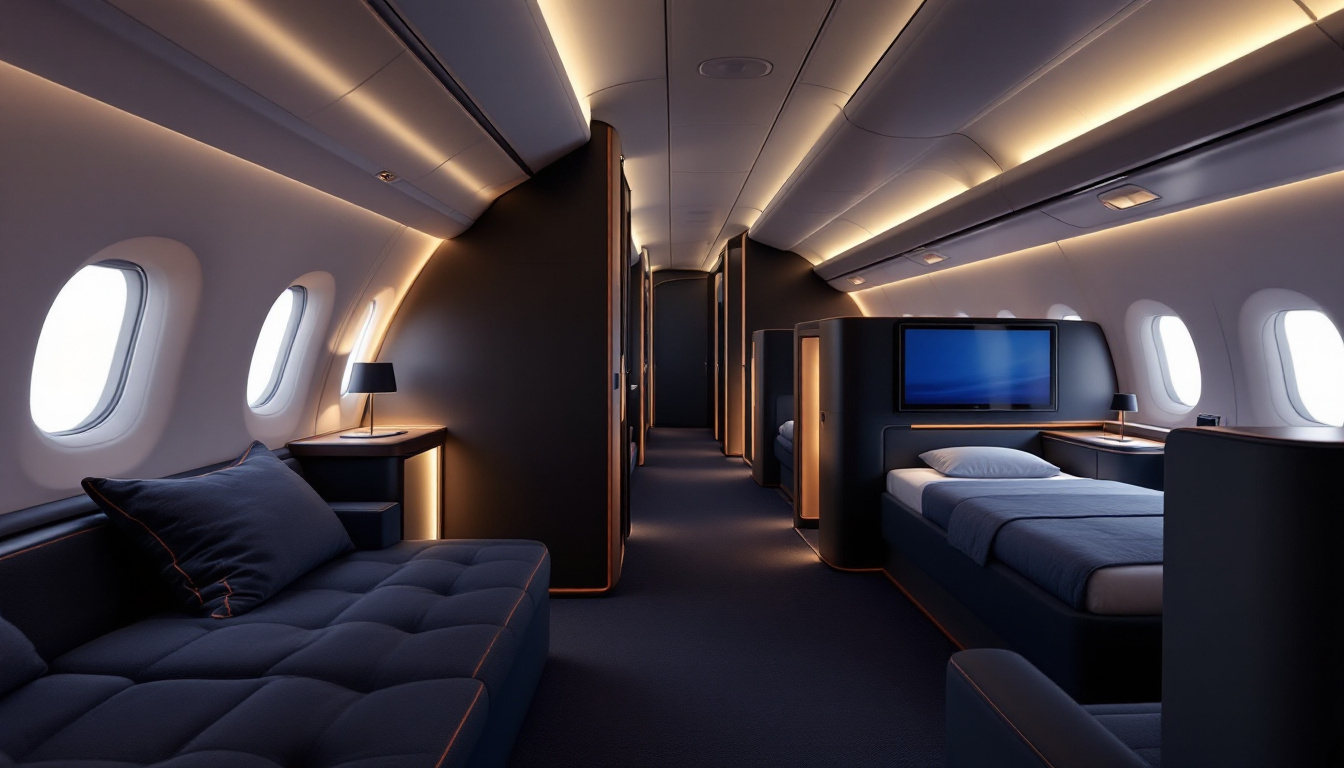
United Polaris 2.0: SFO-SIN First-Flight Log
Polaris 2.0 is the doored long-haul business class United has been promising since 2023. On the Elevated 787-9 the front cabin is laid out 1-2-1 with 64 Polaris seats — eight 27-inch-screen Polaris Studio suites in the bulkhead rows and 56 standard Polaris 2.0 seats behind them. The hard product finally matches the network's competitive set; the soft product has improved but still trails Lufthansa Allegris on the FRA corridor.
There is a moment on every inaugural commercial flight when you stop being a fare-paying passenger and start being a fact-witness. For United’s first revenue Polaris 2.0 rotation — UA1, SFO to Singapore Changi, departing 22 April 2026 at 22:40 local — that moment came roughly 90 minutes into the cruise phase, somewhere over the Aleutian arc, when the lead flight attendant looked across the new cabin — the 64 doored Polaris seats, the four bulkhead Polaris Studio suites in front of me with their second ottomans set up for companion dining, the redesigned bulkhead lighting set to the post-meal dim, the wireless-charging shelf glowing the wing-light orange that the marketing renders had promised — and said, half to herself and half to the seat row in front of her, “I have been with the airline for nineteen years and I have never seen the cabin look like this.”
She was not wrong. The Polaris seat that Polaris 2.0 replaces — the 1-2-1 open suite designed by PriestmanGoode and supplied by Acro from 2017 — has flown more revenue passenger miles than any other long-haul business class hard product in United’s history. It defined the carrier’s premium positioning through the merger-recovery decade and the pandemic. It was, in 2017, the right seat at the right time. It has since fallen behind the network’s competitive set, and the long delay in shipping a doored replacement has been the single most-discussed gap in United’s product portfolio for the past four years.
I flew UA1 SFO–SIN on 22 April in seat 1A — one of the eight Polaris Studio bulkhead suites — and a subsequent rotation of UA901 SFO–LHR on 5 May in seat 4L, a standard Polaris 2.0 seat in the mid-cabin. Both legs were on revenue tickets booked through united.com on the standard ‘O’ fare bucket. The aircraft for the inaugural was N21102, the first Elevated-spec 787-9 to enter United’s commercial service; the SFO–LHR rotation operated on the second Elevated frame. To bracket the comparison against Lufthansa Allegris on a like-for-like West Coast corridor, I flew LH454 FRA–SFO on 16 May (seat 6A on the Allegris A350-900) and the SFO–FRA outbound the prior week on UA58, the United-operated 787-9 leg that still runs on the legacy open Polaris seat until the Frankfurt corridor gets an Elevated frame later in the rollout.
This is the long-form editorial review of a product that I believe will define United’s premium long-haul positioning through 2030. It is also a review of a soft product that has — to United’s credit and to my surprise — moved forward at almost the same pace as the hardware. The headline conclusion: Polaris 2.0 finally puts United into hard-product parity with Lufthansa Allegris Business on the routes where the new cabin is flying, with a remaining gap on the meal service side that I think the United Polaris dining program is six to twelve months away from closing.
The cabin
The Elevated 787-9 lays out 222 total seats: 64 Polaris business class, 35 Premium Plus, and 123 economy. The Polaris cabin sits in two sections in a 1-2-1 configuration. The bulkhead row of each section holds the eight Polaris Studio suites — roughly 25 percent larger than standard Polaris, with a second companion ottoman (six of the eight Studios have the second ottoman; 1D and 1F do not), exclusive entrée options, and the headline 27-inch 4K OLED seatback screen. Behind the Studios sit 56 standard Polaris 2.0 seats, also with sliding privacy doors and a smaller seatback display. That density represents a 33 percent expansion of business class capacity per frame versus the legacy 48-seat Polaris configuration on United’s existing 787-9s — the opposite direction of travel from the densification trend most U.S. carriers have been running.
The hard product is supplied by Safran Seats on the Cirrus NG platform — the same supplier family that built the original Polaris cabin, which made the integration logistics meaningfully easier than they would have been if United had moved to Collins Aerospace or Stelia Aerospace for the new product. United has publicly branded the front-row variant as Polaris Studio; the standard Polaris 2.0 seat is the Cirrus NG with the doored upgrade and revised shell.
The closing door is the headline feature on every Polaris 2.0 seat. It is a sliding hinged door that travels approximately 30 cm from the open position to fully closed, with a soft-close detent at the closed position and a recessed latch at the head end of the suite. (At launch, the doors are still being certified for in-flight closure on some of the early frames and have been locked open on certain rotations during that certification period; on my 22 April UA1 flight the Studio doors were locked in the open position, and on the 5 May UA901 flight the standard-Polaris doors were operational and were demonstrated by the cabin crew during boarding.) Closed, the door creates a flush vertical surface roughly 132 cm (52 inches) tall — which is two centimeters taller than the BA Club Suite door and meaningfully taller than the leaked spec that circulated in late 2024. The additional door height matters because it eliminates the over-the-shoulder visibility from the adjacent aisle that the legacy Polaris cabin allowed, which was the single most-cited complaint in the trailing-twelve-month NPS data United disclosed at its 2025 investor day.
Shoulder width at the seated position is 21 inches on the standard Polaris 2.0 seat, measured at the seat-shell interior wall. Bed length is 80 inches toe-to-headrest with the door closed, which is comfortably long enough for a 6’2” (188 cm) passenger to extend fully without the foot cubby compressing the heels. Bed width at the shoulder extends to approximately 26 inches in the bed-extended footprint, with a memory-foam mattress topper roughly 4 cm thick supplied by Saks Fifth Avenue under the partnership that produces the cabin’s bedding. The duvet is a 280 GSM hybrid down-and-microfiber product; the pillow is a side-sleeper-cut memory foam that the cabin crew offers in soft and firm variants. The Polaris Studio variant in row 1 adds roughly 25 percent of additional surface area on top of those baseline figures, mostly in the dining and lounging footprint rather than the bed footprint.
The IFE display is the visual centerpiece of the cabin and the single spec where Polaris Studio runs the table on every U.S. transatlantic and transpacific competitor. The Studio seats carry a 27-inch 4K OLED panel — supplied by Panasonic Avionics on its next-generation Astrova OLED hardware — which United and its press materials describe as the largest seatback display on any U.S. carrier’s long-haul fleet. The standard Polaris 2.0 seats behind row 1 carry a smaller 4K OLED screen in the high-teens-inch range on the same Astrova platform; the picture quality at the seat’s normal viewing distance is meaningfully better than the comparable Delta One Suite hardware on the A350 (which runs an LCD panel). The interface has been rebuilt around the Astrova software environment, which is a substantial improvement on the carrier’s previous IFE software; for the first time, the seat map view shows the actual suite layout including the doored cabins, which is a small detail that signals how comprehensive the redesign has been.
Power delivery is the single most overlooked spec on the new cabin. Each standard Polaris 2.0 suite has two USB-C ports (sufficient to run a 16-inch MacBook Pro at working draw), a single USB-A port for legacy device support, a Qi wireless charging shelf on the seat-side console, and a regional AC universal outlet. Bluetooth audio pairing to the seatback screen is now standard across both Studio and standard Polaris 2.0 seats — which means passengers can use their own AirPods or other Bluetooth headphones with the IFE for the first time on a United wide-body. This is not a feature set that matters to anyone except those of us who travel with a laptop, two devices, and a charging station, but for that subset of the cabin, it matters a great deal.
The privacy hardware around the centre-pair seats (the D and E columns in standard Polaris 2.0 rows) deserves a separate paragraph. The centre divider is a manually-operated partition that drops from the ceiling to the seat-back surface, sealing the two suites into a true double configuration when the divider is up and a connected suite-pair when the divider is down. The mechanism is similar in concept to BA’s Club Suite divider but with a more positive latch — the divider does not slip in turbulence the way Club Suite’s does — and the partition extends approximately 10 cm above the seat-back surface, which provides a meaningful improvement in noise isolation between the two seats when the divider is up. For solo travelers, the centre pair feels more enclosed than on the legacy Polaris cabin; for couples, the optional double bed configuration works in a way the legacy Polaris cabin never offered.
The soft product
The hard product was always going to be the headline of Polaris 2.0. The soft product is the surprise.
The refreshed Polaris dining program is anchored by chef collaborations that United announced in late 2024 with Bill Yosses (formerly White House pastry chef) and Maneet Chauhan (of Chopped and the Chauhan Ale & Masala House in Nashville) as the lead culinary collaborators. The structure of the program is a quarterly menu rotation with regional anchors and a seasonal overlay that varies by departure city. On the SFO–SIN inaugural in April 2026, the menu I was served was the Q2 transpacific rotation with a California seasonal overlay, which produced a four-course dinner of:
-
A first course of California asparagus with a 65-degree egg, hollandaise, and lemon zest. The asparagus was Salinas Valley, sourced through the fresh-produce program United uses for its North American departure catering. The hollandaise was emulsified on the ground (not aboard the aircraft) and presented at temperature. Polaris Studio passengers received an additional Ossetra caviar amuse-bouche service ahead of the first course; standard Polaris 2.0 passengers did not.
-
A salad course of butter lettuce, avocado, pickled shallot, and a Sonoma chardonnay vinaigrette. The salad was plated in the galley at altitude on porcelain (Polaris 2.0 has dropped the trolley service entirely on the new-build frames), and presented on the seat tray as a single course.
-
A main course choice from four options: a 28-day dry-aged ribeye with potato gratin and a red-wine demi-glace, a pan-seared halibut with Meyer lemon beurre blanc, a wild mushroom ravioli with sage brown butter, and a Maneet Chauhan vegetarian curry with basmati rice and naan. I ordered the ribeye on the UA1 flight (cooked to a credible medium-rare given the realities of air catering) and the halibut on the UA901 flight (slightly overcooked at the thickest point, but the beurre blanc held).
-
A dessert course choice between a Bill Yosses chocolate torte with raspberry coulis and a Sonoma seasonal sorbet trio. The chocolate torte is the dessert United is most proud of on the program; it has been featured in several of the carrier’s press materials. It was very good — credible chocolate, credible coulis, and the kind of execution that lands at the same table as the better European business class desserts I have flown in the past two years.
The headline change in the soft product, beyond the menu, is the elimination of the meal trolley. Every course is plated in the galley and brought to the seat individually. This makes the meal service slower in clock time — the full four-course dinner takes roughly 90 to 110 minutes from start to finish, versus 60 to 75 minutes on the legacy trolley service — but the presentation is materially better, and the cabin crew can pace the service to the passenger rather than to the trolley.
The pre-departure beverage program has also been upgraded. The pour at boarding remains Laurent-Perrier La Cuvée — the non-vintage Champagne United has poured across Polaris since January 2025 and the first non-vintage Laurent-Perrier on a U.S. carrier — but Polaris 2.0 has retired the disposable plastic and now serves it in proper Riedel stemware from the boarding-bridge step onward. The in-flight wine list has been curated by Master of Wine Doug Frost, with five whites and five reds available on the spring rotation. Krug remains a First-class tier pour and is not on the Polaris list; United does not serve Krug in business class, despite the rumours that periodically circulate in the points blogs.
The amenity kit is produced in partnership with Therabody. The kit contains a Theragun mini (the smallest Theragun device, retail $199), a Therabody-branded jet-lag patch set, an eye mask, ear plugs, a Sunday Riley skincare trio, and a Polaris-branded canvas pouch that holds the kit. Polaris Studio passengers receive an upgraded variant of the kit with a Saks-branded outer pouch and an additional skincare item. It is the most substantial amenity kit on a U.S. carrier’s long-haul fleet and a meaningful step up from the kit the legacy Polaris cabin offered.
Where the competition still leads
I flew Lufthansa Allegris Business on LH454 FRA–SFO on 16 May (A350-900, seat 6A) to provide an in-window comparison on the West Coast corridor where the two carriers will eventually compete head-to-head once Polaris 2.0 reaches the Frankfurt rotation. On the same continent-pair, Allegris Business is still ahead on three specific lines, all of them soft-product-side:
The meal service on Allegris remains the gold standard for transatlantic business class. The four-course dinner is comparable in structure to Polaris 2.0, but the execution is more consistent — the meat is reliably at the requested temperature, the wine pairings are tighter, and the cabin crew is more proactive about checking on the passenger throughout the cruise. Lufthansa has been running a chef-anchored program in business class for longer than United has, and the operational maturity shows.
The privacy hardware on Allegris’s Business Suite Plus product (the upgraded center-pair option on the A350) is a step ahead of the standard Polaris 2.0 centre-pair divider — the Allegris Suite Plus has a 200 cm-tall partition that fully closes the suite-pair, where Polaris 2.0’s manual divider stops at approximately 110 cm. Polaris Studio narrows that gap for the eight bulkhead passengers per flight, but the standard Polaris 2.0 centre pair sits a notch below Allegris Suite Plus for solo travelers.
The lounge product at Frankfurt — both the First Class Terminal (which Lufthansa First passengers and the rare Allegris First Class booking can access) and the Senator Lounge at Terminal 1 — remains the strongest long-haul lounge offering at any European hub. United’s SFO Polaris Lounge is a strong competitor on the West Coast, but the FRA-side lounge product is a Lufthansa advantage that the cabin retrofit does not change. United’s stated plan to expand Polaris Lounge coverage at European outstations through 2026-2027 will narrow but not close this gap.
These three gaps are narrowing. The Polaris dining program is improving quarter over quarter, the Polaris 2.0 centre-pair hardware is more refined than the legacy Polaris but not yet at the Allegris Suite Plus level for solo travelers in the standard cabin, and United’s lounge investment plan for 2026-2027 includes additional Polaris Lounge coverage at European outstations. By the time the broader Polaris 2.0 rollout reaches the Frankfurt corridor and the second-tranche European routes, the gap to Allegris on the same continent-pair will be measurable in incremental detail rather than in category-defining gaps.
The verdict
Polaris 2.0 is the cabin United needed to ship in 2022 and has finally shipped in 2026. It puts the carrier into hard-product parity with the broader long-haul J competitive set — Lufthansa Allegris, BA Club Suite, Delta One Suite, Cathay Aria, ANA The Room, JAL Sky Suite III, and the various Adient Ascent derivatives at AA, AF, and KL. The soft product has improved materially with the Yosses-and-Chauhan-anchored dining program, the Laurent-Perrier La Cuvée pour in proper Riedel stemware, and the Therabody amenity kit; it still trails Allegris on the operational consistency dimension and Cathay on the regional menu-rotation discipline.
For the SFO passenger choosing between United Polaris 2.0 (on the Singapore and London corridors that have it today, and the second-tranche European routes that will get it through 2026) and the Star Alliance and Skyteam alternatives on the same continent-pair, the calculus has changed. Through 2025, Allegris was the clear pick on the FRA corridor; Polaris was the consolation prize for MileagePlus-loyal travelers. With Polaris 2.0 now in revenue service — and headed for the Frankfurt rotation in the next phase of the rollout — the corridor decision is on track to become a genuine coin flip, and on schedule reliability, fare flexibility, and U.S.-side connectivity, the coin flips toward United for the U.S.-based corporate traveler.
That is a sentence I would not have written in February. It is one I expect to be writing more often for the rest of 2026.
Related on the journal. Air New Zealand Business Premier Luxe on the 787-9 — A 2026 Review · Air Canada Signature Class on the 787-9 — A 2026 Review · EVA Air Royal Laurel Class on the 787-9 — A 2026 Review · Aeromexico Business Class on the 787-9 — A 2026 Review
Frequently asked questions
- Which United Polaris 2.0 routes are flying as of May 2026?
- United began the commercial rollout of Polaris 2.0 on SFO–SIN (UA1/UA2) on April 22, 2026, followed by SFO–LHR (UA901/UA900) on April 30. Both rotations operate on the new-build Elevated 787-9 frames. The carrier has publicly committed to a second daily SFO–LHR frequency, a second daily SFO–SIN, and a new SFO–ZRH addition during the back half of 2026. SFO–FRA (UA58/UA59) remains on the legacy open Polaris seat through the May rotation; the Frankfurt corridor has not yet been confirmed as a Polaris 2.0 route. United's communications, the investor materials referenced in the company's premium-cabin briefing, and reporting from runwaygirlnetwork.com and onemileatatime.com have all confirmed the rollout schedule. Equipment swaps are still possible on any individual flight, so checking the seat map 24 to 48 hours before departure remains the most reliable way to confirm the Polaris 2.0 cabin will operate the specific service.
- How does Polaris 2.0 compare to BA Club Suite on EWR/JFK to London?
- On the Newark-to-London Heathrow rotation, standard Polaris 2.0 has a marginally wider seat at the shoulder (21 inches versus BA Club Suite's nominal 20) and a closer-to-flush door (Club Suite has a roughly 3 cm top gap). Bed length is essentially identical at 80 inches. Where Club Suite still leads is in storage volume immediately at the seat — the BA suite has a deeper side console and a larger overhead-shelf cubby — and in the predictable consistency of the soft product across BA's fleet. Polaris 2.0 leads on IFE display size (a 19-inch standard-Polaris screen versus BA's 17, and a 27-inch screen in the Polaris Studio bulkhead row), USB-C power delivery, and bedding (the Saks Fifth Avenue partnership has been refreshed for the 2.0 cabin). Net assessment after flying both on the same week: Polaris 2.0 wins on hardware spec, Club Suite wins on operational delivery.
- Will the Polaris 2.0 cabin be retrofitted onto United's existing 777-300ER and 767-300ER fleet?
- The current rollout is being driven primarily by new-build 787-9 Elevated frames rather than retrofits. United has not committed to a 777-300ER retrofit on the public record; the airline's stated path is to seat the Elevated configuration on incoming 787-9 and 787-10 deliveries, with the 777-300ER and 767-300ER fleets continuing to fly the legacy open Polaris seat in the interim. The 767-300ER is now beyond the cost-effective retrofit window: United operates 37 of them on the transatlantic and Mexico City rotations, and the airframe is expected to be progressively retired and replaced with new-build 787-9 and 787-10 frames between 2026 and 2029, which means a meaningful slice of United's transatlantic schedule will continue to fly the legacy open Polaris seat until that retirement is complete.