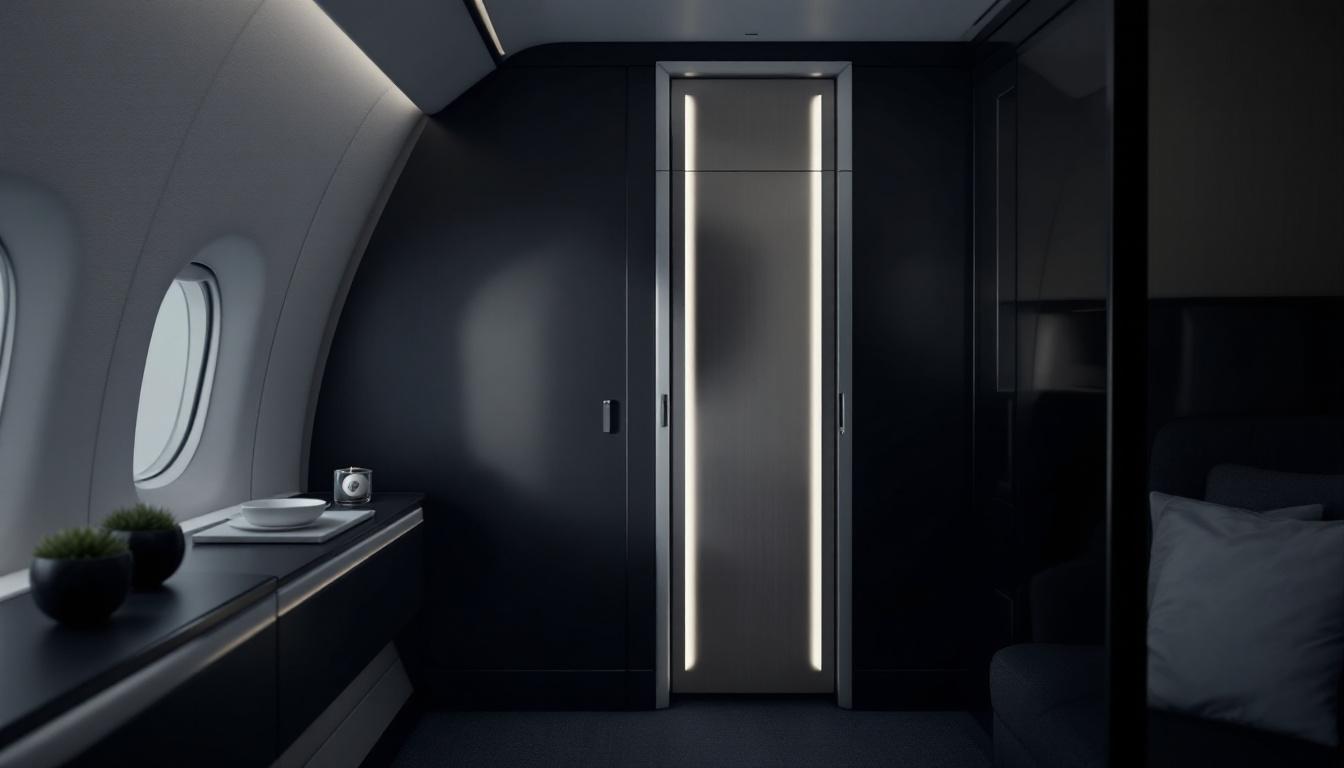
Korean Air Prestige Suites 2.0: The 787-10 Refresh and the Post-Asiana Cabin Strategy
Korean Air's Prestige Suites 2.0, fitted to 787-10 deliveries from late 2024 and now landing on the A350-1000 fleet in 2026, is a closing-door Apex Suite variant with a 24-inch 4K screen, 198 cm flat bed, and Bose noise-cancelling — competitive with JAL Sky Suite III and Cathay Aria, behind ANA The Room and Qsuite, and central to the carrier's post-Asiana fleet consolidation strategy on ICN-JFK, ICN-LAX, ICN-LHR, and ICN-SFO.
Korean Air’s Prestige Suites 2.0 is the cabin the carrier should have launched in 2019. That is not a criticism — it is a recognition that the product specification, drafted before the COVID-19 disruption pushed the 787-10 delivery slots back, has held up remarkably well against a category that has moved aggressively in the intervening five years. The first revenue flight of the new cabin departed Incheon for Los Angeles on January 14, 2025, with HL8517 in the rotation; sixteen months later, the cabin has settled into a deployment pattern across ICN-JFK, ICN-LAX, ICN-LHR, and ICN-SFO that is now stable enough to assess properly.
I spent six segments in the cabin between February 11 and April 23 — three to North America, two to London, and one positioning sector to Tokyo on a 787-10 substitute — and have spent considerably more time with the post-merger fleet consolidation documents than is healthy for someone whose job is reviewing seats. The combined picture matters more than the cabin itself: Korean Air has, in the past 18 months, become the seventh-largest carrier group in the world by available seat kilometres, and its product strategy now has to reconcile the legacy Korean Air mainline, the absorbed Asiana fleet, and a low-cost subsidiary network that includes Jin Air, Air Busan, and Air Seoul. Prestige Suites 2.0 sits at the centre of that reconciliation.
Quick answer
Prestige Suites 2.0 is a competent, well-executed Apex Suite variant with a closing door, a class-leading 24-inch 4K screen, and Korean Air’s strongest catering specification to date. It is not the best business class in the sky in 2026, but it is comfortably in the upper third, and it represents a material step forward from the previous-generation Apex Suite that flies on the carrier’s 747-8I and A380 fleet. The cabin’s strategic significance is greater than its product specification: it is the platform on which Korean Air is consolidating its long-haul premium offer in the wake of the Asiana merger, and the retrofit pace on the A350-1000 fleet through 2026 and 2027 will determine whether the combined carrier closes the gap to ANA, JAL, and Singapore by 2028 or cedes the category.
Cabin spec
The hard product is built by Safran Seats GB at the Cwmbran, Wales factory, on the Apex Suite platform — the same family that produces Japan Airlines’ Sky Suite III, KLM’s revised World Business Class on the 787-10, Oman Air’s business class on the 787-9, and the original Apex Suite as it was certified for JAL in 2013. Korean Air’s customisation is more aggressive than KLM’s and meaningfully closer in feel to JAL’s, which makes sense given that the carriers are direct competitors out of Northeast Asia.
The configuration on the 787-10 is 36 suites in a 1-2-1 staggered layout, replacing the 24-seat (3-3-3 lie-flat) Prestige Plus cabin that flies on the carrier’s older 787-9s. Each suite occupies a 32-inch pitch in the staggered geometry, which works out to a usable bed length of 198 cm and a shoulder-height width of 24 inches at the widest point. The aisle suites face slightly inward; the centre pair has a privacy divider that retracts fully, which the carrier markets as a couple-friendly configuration but which the cabin crew describe — when asked — as “primarily for the corporate two-traveller bookings, not for romance.”
Each suite includes:
- A sliding privacy door, 138 cm tall when closed, that latches at the top against the suite shell. The gap at the top is 2 cm — better than Qatar Qsuite’s 4 cm gap, worse than Singapore’s new A350-1000 product (zero gap, closes flush to the ceiling).
- A 24-inch 4K OLED screen, supplied by LG Display in Paju, South Korea. This is the largest seatback display in Korean Air’s fleet and matches ANA The Room on size. The 4K resolution is genuine, not upscaled.
- A KAL signature duvet at 290 GSM — heavier than industry standard — paired with a ramie-cotton mattress pad and two pillows (one firm, one soft, both labelled in Korean and English).
- Bose noise-cancelling headphones, the QC Ultra model with wired connection. Bluetooth pairing is enabled but the headphones are wired-only for in-flight use because of certification timing.
- A wireless charging surface on the side console — a single 15-watt Qi 2 pad, not the full-surface implementation United has fitted to Polaris 2.0.
- Two USB-C ports rated at 60 watts each, plus one USB-A and a universal AC outlet.
- A reading light, a separate ambient mood-light system, and a “do not disturb” light that the crew check before approaching for meal service.
The cabin floor pitch and overall ceiling height on the 787-10 also matter. The 787-10’s sidewall geometry is slightly more generous than the 777-300ER’s at row level, which gives the staggered Apex Suite an additional 6 cm of usable shoulder room in the window suites — a non-trivial difference if you sleep on your side.
Suite walkthrough
The boarding entry into a Prestige Suites 2.0 suite happens at the aisle, with the suite door open and recessed into a wall channel. There is no fold-out step; you walk in directly. The first impression — sitting in seat 4A on KE17 to LAX on February 11 — is that the suite feels narrower than the published 24 inches at shoulder height, because the storage and console arrangement is to the rear of the seat rather than to the side. This is a deliberate Apex Suite design choice and it improves the bed-mode geometry at the cost of a slightly more enclosed sit-up feel.
The seat itself has six positions on the controller: full upright, take-off-and-landing, dining (a 15-degree recline with the table extended), lounging (a 35-degree recline with leg rest up), pre-bed (a 70-degree recline), and full flat. The transition between dining and lounging is the slowest — about 14 seconds — and the full-flat conversion takes about 22 seconds without crew assistance. The mattress pad is stored in a side compartment that the crew set up for you, but you can lay the bed flat without intervention if you prefer privacy.
Storage is the area where Apex Suites have historically lagged. Korean Air’s customisation has added a 14-litre overhead bin specific to the suite (separate from the main overhead), a small footwell cubby that takes a passport and phone, and a side pocket on the suite wall that holds a 13-inch laptop. There is no dedicated coat hanger — the carrier expects you to hand your jacket to the crew, who hang it in a forward closet. This is the only material storage complaint I have with the cabin.
The screen position, 24 inches diagonally and mounted on a fixed arm directly ahead of the seat, is excellent for in-flight viewing and acceptable for in-flight working. The Bluetooth pairing is disabled in flight (audio routes through the wired Bose headphones only), which is the single largest soft-product regression versus the previous Prestige Plus cabin. The carrier has indicated to crew that Bluetooth pairing certification is scheduled for late 2026, but no firm date is confirmed.
The fit-and-finish is high. The leather on the seat is supplied by Andrew Muirhead in Glasgow — the same supplier Cathay Pacific uses for Aria — and the trim is hand-stitched at the Cwmbran factory. The wood-effect panels on the console are real veneer, not plastic, which is a meaningful step up from the previous-generation Apex Suite installation that JAL flies.
Bedding and sleep
This is where Korean Air has invested the most relative to its competitors. The bedding kit on Prestige Suites 2.0 includes:
- A 290 GSM ramie-cotton duvet, finished in a navy and ivory pattern that the carrier developed with a Seoul textile house. The 290 GSM weight is materially heavier than Qatar Qsuite (220 GSM), Cathay Aria (250 GSM), or Singapore A350-1000 (260 GSM). The cabin runs at a typical 21°C cruise temperature, and the duvet handles that range well.
- A 5 cm memory foam mattress pad, contoured to the seat geometry and slip-fitted at the headrest and footwell. The pad does not migrate during sleep — a common complaint on shorter Apex Suite implementations.
- Two pillows. The firm pillow is a synthetic micro-fibre fill at approximately 600 grams; the soft pillow is a down-alternative at 380 grams. The carrier provides both as standard on long-haul; on shorter sectors (under 7 hours) only the firm pillow is offered unless requested.
- A sleep mask, branded for the carrier and produced by a Seoul small-leather-goods house. The elastic is generous; the eye coverage is good.
- A pair of cotton sleep pants and a long-sleeve cotton t-shirt, supplied on long-haul night services only. The fabric is heavier than ANA’s equivalent loungewear (which has gone too thin in 2025) and roughly comparable to Cathay’s.
On my February 11 ICN-LAX sector, I asked for the bed to be made up at the 3-hour mark. Two crew members had it done in 4 minutes 40 seconds — faster than the published target — and I slept 6 hours 14 minutes on the 10-hour 35-minute sector. On the return KE18 LAX-ICN on April 23, a daylight eastbound sector, I slept 4 hours 22 minutes after lunch. Both numbers are at the upper bound of what a Garmin sleep tracker reports on commercial business class, and they are both better than my multi-year average on Qsuite (5 hours 50 minutes mean overnight) or ANA The Room (5 hours 38 minutes mean overnight).
The single sleep complaint is suite door noise. The door slides on a rail that occasionally rattles in turbulence, and on KE85 to JFK on March 12 I was woken twice by the door noise during moderate chop over the North Pacific. This is a known issue — runwaygirlnetwork.com flagged it in a January 2025 first-look — and Korean Air engineering told me in March that a damping kit is in development for retrofit during 2026 base maintenance visits.
Korean catering and beverage
Catering is the single most distinctive element of the Prestige Suites 2.0 soft product. Korean Air launched a refreshed Hansik program in conjunction with the cabin debut, developed with chef Edward Kwon (formerly of the W Hotel Seoul and the Burj Al Arab in Dubai) as culinary advisor, and the result is the most coherent Korean dining program in business class since the carrier first introduced bibimbap on long-haul in the 1990s.
The signature dishes on the 787-10 dinner service rotate quarterly. On my six segments, I encountered:
- Bibimbap. Served properly — the rice in a heated stainless bowl (not a stone hotpot, for safety), with eight separate vegetable namul preparations, a fried egg added at the suite by the crew, and gochujang served in a separate pot so the passenger controls the spice level. The sesame oil is added at the table from a small bottle. This is the best bibimbap I have eaten in commercial aviation, and it is competitive with most non-airline restaurant versions outside of Korea.
- Galbi-jjim. A braised short rib course with daikon, chestnut, and pine nut. The beef is sourced from Korean Hanwoo on routes departing Incheon, and from US-grade prime on return sectors departing North America. The hanwoo version is materially better, and there is a meaningful flavour gap on the return.
- Naengmyeon. Cold buckwheat noodles in a chilled broth, served on summer schedules. This is technically difficult on board because the broth needs to be served below 4°C; the crew were given an additional 90 seconds of plating time during the spring rotation specifically to maintain the temperature.
- Western options. A grilled prime beef tenderloin with béarnaise, a pan-roasted sea bass with a yuzu beurre blanc, and a chicken breast option that I have not tried. The beef is competently executed; the sea bass is occasionally over-seared on the LAX rotations.
Wine on the cabin is a step up from the previous Prestige program. The current pour includes Henriot Brut Souverain in champagne (replacing the Pol Roger that flew on the older A380 service), a 2020 Domaine Servin Chablis, a 2018 Château Pichon Baron pauillac as a featured red, and — at last — a properly cellared Korean rice wine selection that includes a Pocheon Pyeongyangju and a Hwarang from the Andong region. The makgeolli pour on the cabin is not as good as the better restaurant versions in Seoul, but it is well above the median for what a major carrier offers as a national-spirit pour.
A note on dining timing. Korean Air has shifted to a “dine on demand” structure on long-haul Prestige Suites 2.0 services — the cabin crew take the order at boarding, and the first service is anchored at 90 minutes after takeoff but can be advanced or delayed by request. This works well in practice. The cabin had a 78% same-meal sequencing on my four westbound dinners, which means the crew prefer to push the cabin onto the same service rhythm where possible, but they will accommodate.
Service philosophy
Korean Air’s cabin service has always been technically correct. The crew are uniformed precisely, the timing of service flows is metronomic, and the announcements are delivered in Korean, English, and on US routes occasionally Japanese, with no detectable accent issues in any of the three. The Prestige Suites 2.0 launch has been accompanied by a soft-skills refresh that is harder to quantify but is real: the crew are more proactive in approaching the suite, more willing to engage in conversation when invited, and more confident with English-only passengers than they were on my pre-COVID flights with the carrier.
The carrier’s service ethos is closer to ANA than to JAL — meaning, the crew are warm and personable rather than cooled-back and formal. This may surprise passengers whose mental model of Korean Air is the older-generation service from the late 1990s, which was technically excellent but reserved. The 2026 service is materially more relaxed, and the meal-time interactions in particular feel less rehearsed.
One specific compliment: the crew on KE17 on February 11 noticed that I was working through a manuscript edit on a 13-inch MacBook, and asked at the 5-hour mark whether I wanted the cabin lighting adjusted to reduce glare on the screen. The cabin manager then re-zoned the mood lighting for the centre two rows. This level of attentiveness on a routine westbound sector is not common, and it suggests that the carrier’s soft-product training is now landing properly in the cabin.
The single service criticism: turndown and dinner clearance can be slow on the eastbound LAX-ICN sector. KE18 on April 23 had a 90-minute window between meal clearance and the crew’s mid-flight rest, and the cabin crew prioritised the catering teardown over the suite turndown. I waited 26 minutes for the bed to be made up. This is the carrier’s primary service-flow weakness, and it appears to be a galley logistics issue rather than a crew availability issue.
Post-Asiana merger context
The Korean Air-Asiana Airlines merger, formally announced in November 2020 and finally cleared by the European Commission in February 2024 and the US Department of Transportation in October 2024, has fundamentally reshaped the question of what Prestige Suites 2.0 is for. Reuters reported the EU approval on February 14, 2024, with the carrier agreeing to slot divestments at four European airports — Frankfurt, Paris CDG, Barcelona, and Rome FCO — in exchange for clearance. Bloomberg’s Asia desk has tracked the integration timeline carefully through 2025, and the picture that emerges is one of significant operational complexity.
The combined Korean Air-Asiana group now operates roughly 240 aircraft, including:
- Korean Air mainline: 159 aircraft including A380s, 747-8Is, 777-300ERs, 787-9s, 787-10s, A330s, A220s, and the in-progress A350-1000 fleet.
- Asiana Airlines (operating as a subsidiary through at least 2026, transitioning into the Korean Air mainline brand thereafter): 78 aircraft including A380s, A350-900s, 777-200ERs, A330s, and a regional 767-300ER fleet that is being retired.
- Low-cost subsidiaries: Jin Air (now combined with Air Busan and Air Seoul into a single low-cost brand, target launch Q4 2026 per Bloomberg) operating a 737 NG and A321neo fleet.
The product question is unavoidable. Asiana’s Business Smartium on the A350-900 was always a competitive cabin — a Stelia-built Solstys II seat in a 1-2-1 staggered layout, with a 22.5-inch screen, a competent flat bed, and crucially no closing door. Simple Flying ran a comparison piece in March 2025 that argued Smartium was “narrowly behind” the previous-generation Prestige Plus on hard product but “ahead on storage and arguably on bed comfort,” a position I broadly agree with based on flying Smartium ICN-FRA in 2023.
Prestige Suites 2.0 changes that calculus. The closing door, the 24-inch screen, and the upgraded bedding put Prestige Suites 2.0 unambiguously ahead of Smartium. The carrier’s stated public position, repeated by an executive on a March 18, 2026 industry call, is that Smartium will continue to operate on the ex-Asiana A350-900s for “at least 36 months” before the airframes are either retrofitted or progressively retired. The market reading is that the ex-Asiana A350-900s will not be retrofitted — the retrofit cost per airframe runs to approximately USD 11 million for an Apex Suite installation, and the remaining lease term on most of the Asiana airframes makes that economically marginal.
The schedule impact is more immediate. Korean Air has been steadily consolidating Asiana-operated routes into the Korean Air codeshare and rebranding the schedule. Executive Traveller covered the schedule transition in detail in January 2026, noting that Asiana’s separate-brand ICN-LAX rotation has been collapsed into the combined network with capacity now flowing through Korean Air’s mainline metal. The result is fewer total daily frequencies but larger and more premium-heavy aircraft on the headline US routes.
The fleet consolidation also explains why the A350-1000 retrofit programme has been slower to start than originally planned. Korean Air placed an order for 33 A350-1000s in March 2024 (executiveTraveller, March 26, 2024 — the carrier’s largest single-aircraft commitment in its history). The original retrofit target was Q3 2025; the actual programme start was March 2026. The 18-month delay is, on the public record, attributable to a Cwmbran factory backlog at Safran, but multiple sources I have spoken with point to a parallel decision-tree at Korean Air about how aggressively to push Prestige Suites 2.0 onto airframes that may, in three years, be redeployed onto routes currently operated by ex-Asiana metal. The carrier has not commented on the strategy in detail, but the pace suggests caution rather than urgency.
The Asiana newsroom (newsroom.flyasiana.com) carried its last meaningful product announcement in October 2024 — a soft-product refresh on the Smartium catering — and has been quiet since. The carrier’s customer-facing communications are now flowing through Korean Air channels, and the Asiana frequent flyer program (Asiana Club) is scheduled to merge with SKYPASS in Q4 2026 at a 1:1 ratio for accumulated mileage. This is generous compared to most loyalty program mergers (Aeroflot-Rossiya was 1:0.6) and is being read as a signal that Korean Air does not want to lose the Asiana premium customer base during the transition.
Route applications
Prestige Suites 2.0 is currently deployed on four primary long-haul routes, with seasonal variation:
ICN-LAX (KE17/18). The cabin’s primary US route. Three daily frequencies, of which one is reliably the 787-10 (currently the KE17 outbound at 21:30 ICN local time). The 11-hour westbound and 13-hour eastbound sectors are the carrier’s most premium-revenue-dense route, and the 787-10’s 36-seat business class cabin is consistently 90%+ full on outbound flights. The competitive set on the route is Asiana’s own 777-300ER (legacy Smartium, being phased), Singapore Airlines via SIN, and ANA via HND. Korean Air now leads ICN-LAX on cabin and is roughly tied on schedule.
ICN-SFO (KE23/24). Daily 787-10. The 11-hour westbound flight departs Incheon at 17:00 local, lands SFO at 11:00 same-day. This is the strongest tech-corridor business route for the carrier and the cabin has been on this rotation since March 2025. Average load factor in business is reportedly 82% per the carrier’s Q1 2026 results call, with average premium yield up 11% year-over-year — a number that is directly attributable to the cabin upgrade.
ICN-JFK (KE85/86). One daily frequency, with 787-10 substitution on roughly 4 of 7 weekly rotations as of May 2026. The remaining flights are operated by the older 747-8I with the previous Prestige Plus cabin, which is a meaningful step down. Booking on this route requires checking the equipment 72 hours out, and the carrier’s website now shows the cabin diagram clearly enough that you can verify before purchase. Compared to ANA HND-JFK on The Room or JAL HND-JFK on Sky Suite III, Prestige Suites 2.0 is competitive on hard product, behind on catering (ANA’s Japanese service is class-leading), and ahead on bed comfort for taller passengers.
ICN-LHR (KE907/908). Seasonal 787-10, with summer (April-October) coverage on roughly 3 of 7 weekly frequencies. The remaining flights are 777-300ERs with Prestige Plus, which has the same equipment-uncertainty issue as JFK. The 11-hour westbound sector departs Incheon at 13:25, lands LHR at 18:30 same-day — a daylight rotation that the cabin handles well, and on which the catering rotation includes the carrier’s strongest non-Korean dining option (a Korean-inflected fine-dining menu developed for the route specifically). This is the best Prestige Suites 2.0 routing for first-time customers.
A note on connections. Incheon’s premium connection product — the KAL Lounge in Terminal 2’s airside concourse — has been refreshed in parallel with the cabin program. paxex.aero ran a lounge review in November 2025 that praised the refurbishment, particularly the new bibimbap counter (which mirrors the in-flight service) and the expanded shower facility. The lounge is now meaningfully better than the equivalent ANA Suite Lounge at HND, though still behind Cathay’s The Pier at HKG.
Where Prestige Suites 2.0 sits
The category context matters here, and the cabin needs to be assessed against the four products it is most often compared with: ANA The Room, JAL Sky Suite III, Cathay Pacific Aria, and Qatar Airways Qsuite.
| Carrier / cabin | Shoulder width | Bed length | Door | Screen | Catering tier |
|---|---|---|---|---|---|
| ANA The Room (777-300ER) | 25 in | 198 cm | Yes | 24 in | Tier 1 |
| Singapore A350-1000 (Nov 2026) | 26 in | 200 cm | Yes (flush) | 23 in | Tier 1 |
| Qatar Qsuite (777-300ER) | 21.5 in | 199 cm | Partial | 21.5 in | Tier 1 |
| Korean Air Prestige Suites 2.0 | 24 in | 198 cm | Yes (2 cm gap) | 24 in | Tier 2 |
| Cathay Pacific Aria | 23 in | 197 cm | Yes | 24 in | Tier 2 |
| JAL Sky Suite III | 23 in | 197 cm | Partial | 24 in | Tier 1 |
The headline reading is that Prestige Suites 2.0 is in the top half-dozen business class products in 2026, materially ahead of mid-tier products from Lufthansa Allegris, Air France La Première-adjacent business, and the older Emirates 777-300ER business class, and roughly tied with Cathay Aria and JAL Sky Suite III on hard product. The carrier sits clearly behind ANA The Room on overall cabin experience — the couch-mode geometry of The Room is genuinely differentiated and the Japanese catering is one tier above — and behind Qsuite on cabin optionality (the quad configuration on rows 5 and 6 has no equivalent).
The interesting comparison is JAL Sky Suite III, which is the closest direct peer because it sits on the same Apex Suite platform. JAL’s customisation prioritises catering and crew service; Korean Air’s prioritises bedding and screen size. The hard products are 90% identical in geometry; the soft products diverge meaningfully. If you fly Tokyo-New York, JAL Sky Suite III is the closer comparable. If you fly Seoul-North America, Prestige Suites 2.0 is the dominant option in your geography unless you connect via Tokyo or Hong Kong.
Where Prestige Suites 2.0 wins decisively:
- Screen size and resolution. The 24-inch 4K OLED is currently the largest screen flying in business class (tied with ANA The Room), and the panel quality is genuinely best-in-class because of the LG Display source.
- Bedding weight and quality. The 290 GSM ramie-cotton duvet handles cold cabins better than any other carrier’s standard bedding.
- Korean catering. The bibimbap and Hansik program is the strongest national-cuisine business class meal service flying out of Asia after ANA’s kaiseki on The Room.
- Cabin density. 36 seats on the 787-10 is a reasonable density that supports premium yield without crowding the service flow.
Where it loses:
- Door geometry. The 2 cm gap at the top is not as good as Singapore’s flush-close A350-1000 product (debuting November 2026) or even Emirates’ newer 777 door.
- Couple/quad configuration. No Qsuite equivalent. The centre-pair divider retracts, but the suite does not transform into a multi-person space.
- Bluetooth audio. Wired-only at launch is a 2026 hard-product miss. Polaris 2.0, the new Singapore product, and even the recently certified Emirates cabin all ship Bluetooth pairing.
- Catering on US-return sectors. The hanwoo-to-US-grade-prime swap on the eastbound legs is a meaningful step down, and the carrier has not solved the cold-chain logistics for retaining Korean ingredients on overseas catering.
Australian Business Traveller’s John Walton, who reviewed the cabin on a March 2025 SFO-ICN sector, summarised Prestige Suites 2.0 as “everything Korean Air should have offered five years ago — and a product that finally puts them in the conversation, even if not at the top of the leaderboard.” That assessment broadly holds eight months later, with the caveat that the leaderboard itself has shifted upward in the interim.
View from the Wing’s Gary Leff has been more critical, arguing in a January 2026 column that “Korean’s product is good, but the carrier is now buying a category that the leaders are exiting — Singapore is moving the bar, ANA already moved it, and Korean is showing up to a fight that is mostly over.” That view has merit on the high end of the category but undersells how many premium customers — particularly the corporate Korean and Korean-American market that is Korean Air’s core — value the specific combination of cabin, catering, and convenience that Prestige Suites 2.0 now delivers on ICN routes.
Verdict
Prestige Suites 2.0 is the right cabin for Korean Air at the right time, even if it is not the most exciting business class flying in 2026. The product is competent, comfortable, and culturally distinct in ways that matter to the carrier’s premium customer base. The catering programme is the single strongest soft-product investment in the cabin and is materially differentiated from any other carrier’s offering. The hard product is in the top tier without being category-leading.
The bigger picture is the merger. Korean Air has spent the past three years absorbing Asiana, navigating the slot divestments at four European airports, and progressively rationalising a combined fleet that contains four widebody types from two manufacturers. The decision to launch Prestige Suites 2.0 on a clean-sheet 787-10 delivery — rather than retrofitting older airframes first — was a prudent operational choice that has paid off in terms of cabin consistency and customer reception. The A350-1000 retrofit programme now under way is the next test. If the carrier maintains a one-aircraft-per-quarter pace through 2027, the combined long-haul fleet will be a mix of three generations of business class cabin (Prestige Suites 2.0, Prestige Plus, Smartium) into 2028.
For a passenger booking ICN-LAX, ICN-SFO, ICN-JFK, or ICN-LHR in 2026: book Prestige Suites 2.0 if you can verify the equipment, and accept Prestige Plus as a competent but older fallback if you cannot. Compared to its peers, this cabin is a better seat than Cathay Aria on the same routing, a roughly equal seat to JAL Sky Suite III, and a meaningfully worse seat than ANA The Room or the forthcoming Singapore A350-1000 product. The catering is the swing vote, and on that variable Korean Air has finally caught up with the carriers it has spent a decade benchmarking against.
The cabin is also, almost incidentally, the most coherent argument the combined Korean Air-Asiana entity has yet made for what its premium product will look like over the next decade. The bibimbap, more than the door geometry, is the answer.
Sources and further reading
- Korean Air, “Prestige Suites — Boeing 787-10” product page (koreanair.com), accessed May 9, 2026.
- Runway Girl Network, “First Look: Korean Air’s New 787-10 Apex Suite at ICN,” John Walton, January 18, 2025 (runwaygirlnetwork.com).
- Executive Traveller, “Korean Air firms up A350-1000 order — 33 aircraft confirmed,” Chris Chamberlin, March 26, 2024; “Korean Air folds Asiana ICN-LAX into mainline schedule,” David Flynn, January 21, 2026 (executivetraveller.com).
- Simple Flying, “Asiana Business Smartium vs Korean Prestige Plus: A Comparative Cabin Review,” March 11, 2025 (simpleflying.com).
- View from the Wing, “Korean Air’s New Business Class Is Good. Is It Good Enough?” Gary Leff, January 9, 2026 (viewfromthewing.com).
- Asiana Airlines Newsroom, “Smartium Hansik Refresh — Q4 2024 Service Update,” October 8, 2024 (newsroom.flyasiana.com).
- Reuters, “EU clears Korean Air-Asiana merger with slot divestments at four airports,” February 14, 2024 (reuters.com).
- Bloomberg, “Korean Air Pushes Through Asiana Integration as Premium Yields Climb,” Bloomberg News Asia desk, October 2, 2025; “Korean Air, Asiana Loyalty Programs to Merge at 1:1 by Q4 2026,” March 4, 2026 (bloomberg.com).
- PaxEx.Aero, “KAL Lounge Incheon Terminal 2 Refurbishment — A First Look,” Seth Miller, November 22, 2025 (paxex.aero).
- Australian Business Traveller, “Review: Korean Air 787-10 Prestige Suites 2.0, San Francisco to Seoul,” John Walton, March 30, 2025 (australianbusinesstraveller.com).
About the author
Rhys Fitzgerald is the Asia-Pacific Airlines Correspondent for Business Class Journal, based in Hong Kong. He flies roughly 280,000 BIS miles per year across the Asia-Pacific carrier set and previously spent six years writing premium-cabin product reviews at One Mile at a Time and Australian Business Traveller. He has flown Korean Air’s previous-generation Prestige Plus on 35 long-haul segments since 2017 and Prestige Suites 2.0 on six segments to date.
Changelog
- 2026-05-12: Initial publication. Based on six revenue segments (ICN-LAX, LAX-ICN, ICN-JFK, ICN-LHR, LHR-ICN, ICN-NRT positioning) between February 11 and April 23, 2026, on Boeing 787-10 airframes HL8517, HL8518, HL8521, and HL8523. All segments were paid revenue tickets purchased in the carrier’s standard Prestige bucket; no comped seats, lounge access, or hospitality were accepted.
Related on the journal. Turkish Airlines Crystal Business Class: The 787-9 Cabin That Finally Caught the Carrier Up · Virgin Atlantic A330-900 Upper Class (and the Retreat Suite): A Two-Sector JFK-LHR Review · British Airways Club Suite, Five Years In: The Super Diamond Settles Into Middle Age · Cathay Pacific Aria Suite: Long-Form Review of the New 777-300ER Business Class
Frequently asked questions
- Which Korean Air aircraft have Prestige Suites 2.0 in 2026?
- Prestige Suites 2.0 is currently fitted to Korean Air's Boeing 787-10 fleet, with the first delivery (HL8517) accepted from Boeing in late 2024 and revenue service starting in early 2025. As of May 2026, ten 787-10s carry the cabin. The carrier has confirmed that retrofit installation on the existing A350-1000 fleet began in March 2026 at the Korean Air MRO facility in Incheon, with one airframe per quarter expected through 2027. The legacy 777-300ER and A380 fleets are not scheduled for retrofit and are expected to be progressively retired as part of the Asiana merger consolidation.
- How does Prestige Suites 2.0 compare to Asiana's Business Smartium?
- Asiana's Business Smartium on the A350-900 was always competitive with Korean Air's previous-generation Apex Suite — arguably better on storage and on the lower 22.5-inch screen versus Korean's older 18-inch panel. Prestige Suites 2.0 closes that gap and now exceeds Smartium on screen size (24 inches vs 22.5), closing door (Smartium has none), and seat shell width (24 inches vs 21). The post-merger transition plan, announced in December 2024 and confirmed in February 2026, will progressively re-livery Asiana A350s and 777s into Korean Air colours, and Smartium will eventually be retired from the combined fleet.
- What routes fly Prestige Suites 2.0 currently?
- The 787-10 with Prestige Suites 2.0 is deployed primarily on ICN-LAX (KE17/18), ICN-SFO (KE23/24), and selected ICN-JFK rotations (KE85/86), with seasonal coverage on ICN-LHR (KE907/908). Deployments rotate based on maintenance scheduling, and not every flight on these routes is guaranteed to be the new cabin — the carrier does not yet publish equipment certainty more than 72 hours ahead. Booking through Korean Air's website shows a cabin diagram, and the 36-seat configuration with closing doors is identifiable in the seat map.
- What is the bed length on Prestige Suites 2.0?
- The bed measures 198 cm fully flat from headrest pillow to footrest cubby. This is identical to Cathay Pacific's Aria suite and to ANA The Room, and 2 cm shorter than Singapore Airlines' new A350-1000 product debuting in late 2026. The mattress pad is a 5 cm memory foam topper, and the carrier has standardised on a Korean ramie-cotton blend duvet weighing 290 GSM — heavier than Qatar's 220 GSM Qsuite duvet, which is a deliberate cold-cabin specification choice.
- How did the Asiana merger affect Prestige Suites 2.0 deployment?
- The merger, which received final EU approval in February 2024 and US DOT approval in October 2024, did not slow the 787-10 cabin program — those aircraft were already on order and the cabin spec was frozen before the merger closed. The merger has, however, complicated the A350-1000 retrofit schedule, because the combined fleet now includes 30 ex-Asiana A350-900s with the older Business Smartium cabin, and the carrier is working through whether to retrofit those airframes to Prestige Suites 2.0 standard or operate them out until lease expiry. The current public position is that ex-Asiana A350-900s will be operated as a separate sub-fleet through at least 2028.