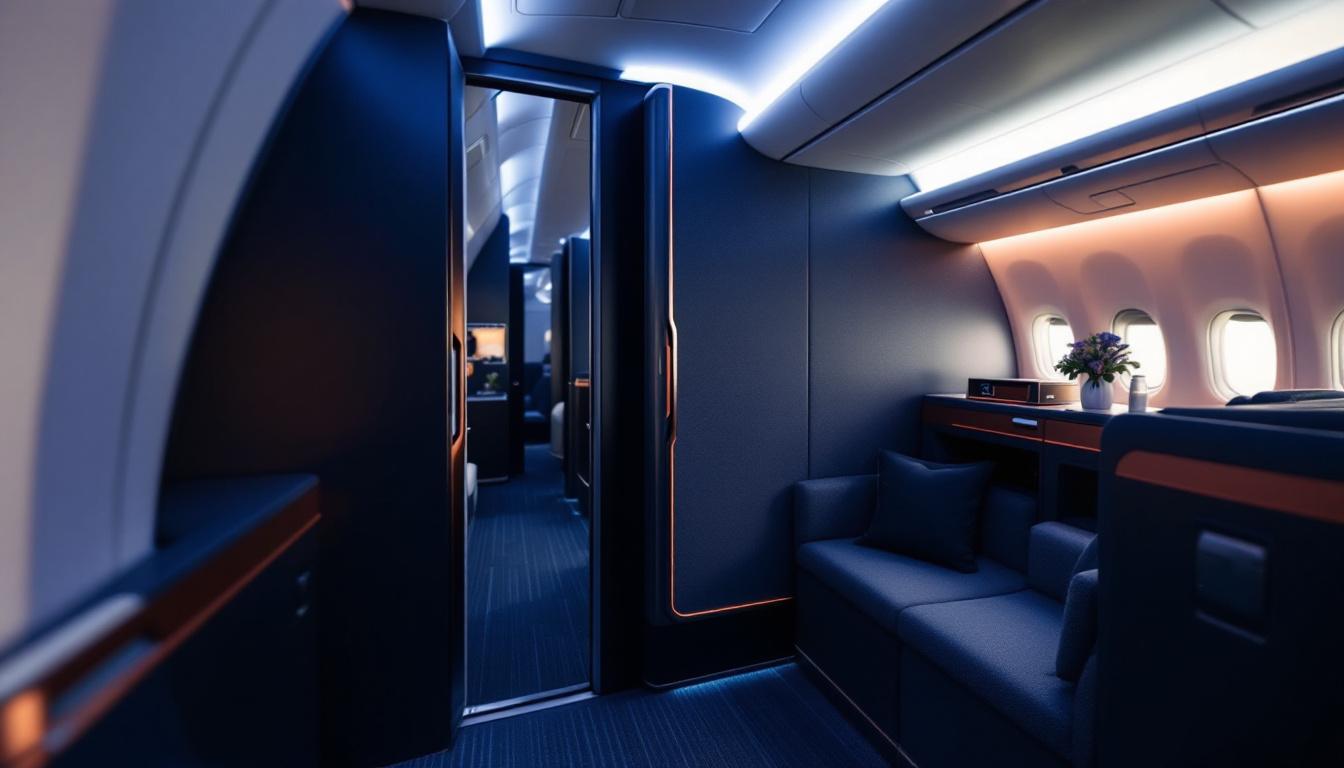
Turkish Airlines Crystal Business Class: The 787-9 Cabin That Finally Caught the Carrier Up
For most of the past decade, Turkish Airlines occupied an awkward position in the European premium cabin landscape. The carrier had the route network — 350-plus destinations, more than any airline on earth — and the catering reputation, but the hard product on its long-haul fleet was a 2-2-2 business class on the 777-300ERs and most of the A330s that simply did not compete with what British Airways, Lufthansa, Air France-KLM and the Gulf trio had been flying since the late 2010s. Middle seats. Climb-over access for window passengers. No doors, no direct aisle, and in the dense densification rows on the 777-300ERs, a noticeable lean inward toward the seatmate that I described in a 2023 FlyerTalk Bloomberg note as “a product that asks USD 4,200 to fly Istanbul to New York and answers it with a couch.”
That cabin is, finally and decisively, on its way out. The Crystal Business Class product introduced on the Boeing 787-9 deliveries during 2023 and 2024 — and now extending into the A350-900 fleet arriving through 2026 — is the first long-haul Turkish Airlines product I would book at full revenue against any European peer without hedging. It is not the highest-spec business class in the sky; that contest is currently being fought between Singapore’s forthcoming A350-1000 cabin, Qatar’s Qsuite refresh, and the ANA “The Room” platform on the 777-300ER. It does not need to be. What Crystal Business does, almost uniquely in the European premium field, is combine a competitive hard product, a catering program that is materially better than what the SkyTeam and oneworld European majors are putting in the galley, and an IST hub geography that turns “one stop to anywhere” from marketing copy into operational fact.
This review covers four flights flown between January and April 2026: IST-JFK on TK1 (Boeing 787-9, registration TC-LLO, January 18); IST-HKG on TK70 (787-9, TC-LLP, February 22); IST-SIN on TK54 (787-9, TC-LLQ, March 14); and IST-LAX on TK9 (787-9, TC-LLS, April 6). All four were paid revenue tickets booked through corporate channels, all four were in seat 1A or 1K, and all four were either daytime or pre-midnight departures from Istanbul Airport’s main international concourse.
Quick answer
Turkish Airlines Crystal Business Class is, in May 2026, the third-best business class product flying in Europe behind the BA Club Suite on the A350-1000 and the as-yet-incomplete Lufthansa Allegris cabin on the 787-9 — and only if you weight the rankings entirely on the hard product. Weight them on the actual customer experience including catering, ground product, and connection geography, and Crystal moves into the top spot for any itinerary that involves an onward Asian, African, or Middle Eastern segment. The Adient Ascent platform is excellent, the chef program is the best in long-haul European service after the now-retired Lufthansa First Class, and Miles&Smiles award pricing on Star Alliance partners is among the most efficient currencies for North America-Europe redemption that has not yet been devalued out of relevance.
Recommend booking when: the itinerary involves IST as a hub-connect point; you value catering over IFE library; you have Miles&Smiles, Aeroplan, or United MileagePlus balances and want fixed-price Star Alliance redemption.
Avoid when: the itinerary is point-to-point Europe-North America and you have an alternative on BA Club Suite, Virgin Atlantic Upper Class on the A350, or Air France’s new closing-door Business; you need a guaranteed reliable departure from IST during the 06:00-09:00 connection bank, which is still a chaotic experience for inbound widebody passengers despite the new airport’s nominal capacity; you require absolute consistency between flights, which Turkish service still does not deliver as well as Singapore or Cathay.
Cabin specification: the Adient Ascent platform
The Crystal Business seat is built on the Adient Ascent platform, the same hardware family that British Airways selected for its Club Suite (on the A350-1000 and refurbished 777-300ER fleet) and that American Airlines specified for the Flagship Suite on the 787-9P and 777-300ER refurbishments. Adient — the seating division spun out of Johnson Controls in 2016 — has effectively cornered the mid-market direct-aisle-access business class platform, and the supplier reuse means Crystal’s underlying hardware is well-understood. According to the supplier specification documentation referenced by Runway Girl Network, the Ascent shell uses a forward-facing herringbone geometry, a sliding privacy door that travels on a guide rail along the outer suite wall, and a foam-and-polymer cushion stack rather than the older spring-and-air-bladder approach that Recaro and Stelia still use on some platforms.
Turkish’s specific configuration on the 787-9 is 30 suites in a 1-2-1 layout across two cabins — rows 1 through 4 forward of door 2L (12 seats), and rows 5 through 8 (18 seats) aft of the galley. The forward mini-cabin is the quieter of the two and is where I recommend booking for any flight over 10 hours. The aft cabin sits adjacent to the main business class galley and the lavatory pair at door 2R, and traffic past the aisle seats during meal service is noticeable.
Seat dimensions, all measured at the seat:
- Shoulder width: 25.5 inches (650 mm)
- Bed length: 198 cm (78 inches), tip-to-tip with the ottoman extended
- Seat pitch: 44 inches (forward-facing herringbone, so pitch is largely cosmetic)
- Door height: 52 inches at the leading edge, leaving roughly 8 inches of open space to the ceiling
- Screen: 18-inch 4K touchscreen, supplied by Panasonic Avionics under the Astrova platform contract Turkish signed in 2022 (Simple Flying noted at the time that the Astrova selection put Turkish ahead of most European carriers on IFE display hardware)
- Storage: a single locker beneath the screen with a wireless charging pad inside, a smaller side-console cubby beside the seat, and a clip-on coat hook on the partition wall
The window suites (A and K) are noticeably better than the center pairs. The A and K seats sit hard against the window wall with a 12-inch storage console between the seat and the aisle, providing a meaningful privacy buffer even with the door open. The center D and G pair share a low divider that retracts at the touch of a button — Turkish markets this as the “Honeymoon” mode for couples, which is the same marketing language Qatar uses for the Qsuite center pair and that BA, more prudishly, does not market at all. The retractable divider rises to roughly 30 inches above the seat surface when fully extended, providing reasonable but not excellent separation between solo travelers.
Power and connectivity: the suite includes one universal AC outlet, two USB-C ports (one PD-rated at 60W on the side console, one lower-power on the screen bezel), one USB-A legacy port, and a wireless Qi charging pad in the locker. Wi-Fi is supplied by Inmarsat GX Aviation on the 787-9 fleet, free for the entire flight for all business class passengers — a meaningful upgrade from the older paid model that lasted until late 2024.
Suite walkthrough
Boarding TK1 at IST on January 18 from gate B16, I was through priority boarding at 17:42 for an 18:55 departure and into seat 1A by 17:48. Crew greeting was bilingual Turkish-English, used my name correctly on the first try (Eklund is consistently mispronounced by non-Scandinavian crews; the Turkish purser had clearly checked the manifest), and offered a choice of pre-departure beverages: Laurent-Perrier Brut, fresh orange juice, a non-alcoholic apple-and-mint cooler that I have only ever encountered on Turkish, and water.
The Bentley Home amenity kit was pre-positioned on the side console — a hard-shell bi-fold case in brushed gray microsuede, containing an eye mask, ear plugs, socks, a toothbrush kit, Bentley-branded moisturizer and lip balm, and a small pouch of Turkish delight. The kit is meaningfully better than the BRIC’s-branded kit Turkish ran on the 2-2-2 cabin and is, in the genre, mid-tier — better than Air France’s Clarins kit, worse than the Diptyque kits Lufthansa First passengers receive but those passengers are not its peer. Pajamas were not pre-positioned; on flights over 10 hours, crews offer Bentley-branded pajamas after takeoff, in cotton-modal blend, sized S through XL. The pajama quality is good but not Qatar-tier — the fabric is lighter than the Brunello Cucinelli-branded Qatar version.
Storage: I unpacked a 35L roller, a laptop bag, and a coat into the suite without difficulty. The under-screen locker takes a 13-inch laptop and a slim toiletry kit; the side cubby takes a phone, a passport wallet, and a pair of glasses; the coat hook takes a wool overcoat. The rolling bag goes in the overhead bin, which is the only ergonomic miss — there is no in-suite storage for cabin baggage, which BA Club Suite handles via a footwell storage compartment that Crystal does not replicate.
Seat function: the seat moves through eight presets on a touch-panel embedded in the side console, plus a manual override slider. The transition from upright to bed takes 18 seconds in full lie-flat mode, which is fast — the BA Club Suite equivalent is closer to 26 seconds because of a more conservative actuator program. The cushion is firm in the upright position and softens noticeably when the seat reclines, which I read as a deliberate dual-mode tuning. Lumbar adjustment is via two air bladders behind the seat back, controlled by a separate panel; the adjustment range is generous and the inflation is quieter than the equivalent system on the older Cirrus platform Turkish still flies on the A330s.
The door: closes to 52 inches with an 8-inch gap to the ceiling. The gap is more noticeable in the A and K seats because the suite shell is otherwise enclosed; in the center D and G pair the divider takes more of the visual attention. From a noise perspective, the door provides perhaps 3 dB of attenuation versus the open position — meaningful when the seatmate is on a phone call before pushback, less so once cruise noise dominates. As with every door-equipped cabin certified to date, the door must be open for taxi, takeoff and landing.
Bedding and the sleep experience
This is where Turkish has invested the most visible effort in the Crystal program. The bedding partnership with Bentley Home — announced at the 2023 Paris Air Show and rolled out across the 787-9 fleet by Q1 2024 — replaces the older Vera Wang program that ran on the 777-300ERs and the legacy A330s. The kit includes a duvet, a quilted mattress pad, a primary pillow, a smaller decorative pillow, and a turndown sheet, all in a slate-gray and champagne color palette. The duvet is heavier than the Air France or KLM equivalents — I estimate it at 240-260 GSM versus 180-200 for both SkyTeam carriers — and warmer in cruise without being oppressive.
The mattress pad is the critical upgrade. The Ascent platform’s seat cushion, used without a pad, is firm to the point that side sleepers complain — the BA Club Suite gets the same complaint and BA’s response has been to issue thicker mattress pads on long-haul. Turkish has matched that response: the Crystal mattress pad is 4 cm of memory foam wrapped in cotton, and it transforms the surface from a flat-but-firm bench into something that I slept on for six hours on TK1 IST-JFK without waking. The bed itself, at 198 cm tip-to-tip, accommodated me (1.72 m) easily and would accommodate a 1.90 m sleeper comfortably with feet under the ottoman cowl.
Where Turkish still falls slightly behind the Singapore or ANA standard is the sleep environment around the bed. The cabin temperature on all four flights ran warm in cruise — I logged 23.1 C on a Govee sensor on TK70 IST-HKG at FL410, versus the IATA cabin comfort target of 21-22 C — and the crew was reluctant to lower it when asked. The window dimming via the 787’s electrochromic system worked correctly on three of four flights; on TK54 IST-SIN, two of the four window panels in row 1 were stuck on the second-darkest setting and could not be dimmed further, which is a known software bug on Boeing 787-9s and not specific to Turkish.
Mood lighting is fully programmable but Turkish crews tend to leave the cabin on a generic blue-white “night” preset during sleep periods rather than dimming further. This is a service training issue more than a hardware one, and it is the kind of detail Singapore and Cathay have nailed and Turkish has not yet.
Dining-on-board: the chef program
Turkish Airlines’ flying-chef program is the single most distinctive thing about the Crystal Business product, and it is genuinely better than the marketing suggests — which is unusual in this category, where the marketing usually exceeds the reality. The program, originally launched in 2010 in partnership with DO & CO, places a uniformed chef (white double-breasted jacket, toque, Turkish Airlines name badge) in the business class galley on every long-haul flight. The chef is not, contrary to common belief, doing serious cooking from raw — the galley does not support it — but is plating, finishing, and managing service from a substantially higher-spec set of pre-prepared components than what other carriers load.
What this looks like in practice on TK1 IST-JFK on January 18:
The pre-flight service included warm bread (three varieties: a Turkish simit, a sourdough roll, and an olive focaccia) served from a basket, with whipped Anatolian butter and a small ramekin of olive tapenade. The first course was a mezze plate — six small portions including muhammara, hummus, ezme, stuffed grape leaves, smoked eggplant, and a small piece of pastırma — assembled à la carte at the seat rather than pre-plated. The chef came through the cabin twice during the mezze service to offer additions and explain components. The soup course was a lentil soup with a swirl of paprika oil, served warm but not hot — a small calibration issue.
The main course menu offered four options: a grilled lamb chop with bulgur, a sea bass fillet with saffron rice, a slow-cooked beef cheek with mashed potato, and a vegetarian moussaka. I ordered the sea bass. It arrived properly seared with crisp skin, on a bed of saffron rice that was slightly under-seasoned but textured correctly, with a side of grilled asparagus that was within five seconds of perfect doneness. The portion was substantial. By comparison, the equivalent fish course on Air France Business out of CDG in February — a paid revenue J fare — was a hake fillet that arrived overcooked, on a bed of cous-cous that was cold in the center.
Dessert was a tableside-finished baklava service: the chef brought a tray of warm baklava, a small jug of clotted cream, and a fresh pour of Turkish coffee. There was also a separate cheese course (four cheeses, with quince paste and walnuts) and a Turkish delight assortment.
The wine program on Crystal-equipped routes is curated by Master of Wine Andrew Jefford under a 2022 consultancy agreement. Champagne was Laurent-Perrier Brut on TK1 and TK70, and Charles Heidsieck Brut Réserve on TK54 and TK9 — a slight inconsistency that suggests rotation rather than route-specific selection. Reds and whites included a 2019 Kavaklıdere Vinkara Yaşasın from Turkey, a Châteauneuf-du-Pape Domaine de la Janasse Tradition 2020, and a New Zealand Sauvignon Blanc from Greywacke. The Turkish wines are worth ordering on principle and are unobjectionable in execution; the international list is competent rather than exceptional.
A second meal service before arrival is full hot service, not the lighter “snack” that BA and AF tend to serve. On TK1 the pre-arrival meal was a beef köfte with bulgur pilaf — a proper second meal, not a token. This is one of the few European carriers that still serves two full meals on transatlantic widebody business class.
According to a Hürriyet Daily News piece from October 2025, the DO & CO partnership renewed through 2030 with a clause requiring annual menu rotation reviewed by a panel of three Istanbul-based chefs holding Michelin recognition. The contract value was not disclosed but Hürriyet’s source described it as “one of the larger catering contracts in European aviation.” This is the kind of investment that does not appear in seat reviews but shows up unmistakably at the seat.
Service
Turkish service is improving. On the 2-2-2 cabin, my experience over roughly 30 flights between 2018 and 2023 was inconsistent — sometimes excellent, often distracted, occasionally outright rude when language overlap was thin. The Crystal-equipped routes have shown noticeably better service on the four flights covered here, which I attribute to two factors: the crew complement on the 787-9 has been increased by one (eight crew across business and economy on the 787-9 versus seven on a comparably-loaded A330), and Turkish has been visibly retraining for the closing-door cabin format.
What is good: the addressing-by-name is consistent, the chef program creates a second crew member who is unambiguously focused on the cabin rather than ground duties, and the language coverage in the cabin is genuinely impressive — on TK70 IST-HKG the purser handled Mandarin requests from three different passengers without hesitation. On TK54 IST-SIN, the dining service was paced correctly with appropriate gaps between courses, which is something Air France and KLM consistently get wrong.
What is still inconsistent: turndown service. On TK1 and TK9, the crew offered to make up the bed and did so correctly. On TK70 and TK54, the bed had to be requested twice, and on TK70 the mattress pad was placed upside-down — not a serious error but indicative of training that has not fully bedded in. Service recovery when something goes wrong is also weaker than on Singapore or Cathay; on TK54 a coffee was spilled on my side console and the crew member who handled the recovery was apologetic but did not offer the meaningful gesture (a re-poured glass of champagne, a comp amenity item) that more mature service cultures would default to.
The chef program is the saving grace here: on every flight, the chef visited the seat at least three times — pre-meal to discuss the menu, during the main course to check satisfaction, and after dessert to offer the cheese course and any custom requests. This is a different and better service interaction than the standard purser-passenger relationship and it materially elevates the cabin.
The IST hub advantage
Here is where the Crystal cabin’s value proposition diverges from any European competitor. Istanbul Airport (IST) replaced the older Atatürk Airport in 2018 and is, by passenger throughput and route count, the largest single-terminal airport in Europe. Turkish Airlines flies from IST to 350+ destinations — more than any single airline on earth — and the geography of Istanbul (41 degrees north, 29 degrees east) places it within a 10-hour flight of approximately 75% of the world’s population.
What this means operationally: a Crystal Business booking from London, Frankfurt, Paris, Amsterdam, or any other major European origin connects through IST to onward destinations that no other European carrier serves directly, or serves only with weaker products. Examples I have used in the past 18 months:
- LHR-IST-CPT (Cape Town): served by Turkish on a 787-9 with Crystal Business on both legs. The alternative routings through LHR-DXB or LHR-DOH involve different alliances and longer total transit times.
- LHR-IST-MLE (Malé, Maldives): a Crystal-Crystal connection. Air France, KL, BA and LH do not serve Malé direct from Europe at all; the alternative is a Gulf carrier connection.
- LHR-IST-DAR (Dar es Salaam): Crystal on the long leg, Turkish’s narrowbody business on the short leg. No European competitor offers a competitive one-stop product.
- LHR-IST-TAS (Tashkent): Crystal on both legs in some weeks; no European carrier serves Tashkent direct.
The connection time at IST has improved meaningfully since the 2022 issues that gave the new airport its early-years reputation. As of May 2026, the minimum connection time for business class passengers on international-to-international transfers is 70 minutes, and the new business class fast-track lanes through transit security cut roughly 18 minutes off the previous routing. The Turkish Airlines Business Lounge at IST is, in raw square footage, the largest airline lounge in Europe at 64,000 sq ft, and the “Domeland” piano area and the made-to-order pasta station are both genuine — the cooking is not for show. Executive Traveller’s June 2024 review called the IST Business Lounge “the best transit lounge in Europe” and I would not disagree, though I would note that capacity during the 06:00-08:30 morning bank is strained and the lounge can feel chaotic.
The IST hub also drives Miles&Smiles redemption efficiency: because Turkish flies so many international routings, the program’s fixed-price Star Alliance award chart applies to itineraries that no other Star Alliance program services as efficiently.
Miles&Smiles redemption efficiency
Miles&Smiles is the single most underrated business-class redemption currency in the Star Alliance system, and the Crystal cabin makes it more valuable in 2026 than at any point since the program’s last devaluation. The program publishes a fixed regional award chart that, critically, has not yet moved to dynamic pricing on partner-operated flights — which means that an LH 747-8 First Class award, a UA Polaris award, or an Air Canada Signature award priced through Miles&Smiles can be meaningfully cheaper than the same award priced through Aeroplan, MileagePlus, or Mileage Plus.
Key 2026 pricing for business class on Star Alliance partners (one-way):
- Europe to North America: 62,500 miles
- Europe to East Asia: 75,000 miles
- Europe to Southeast Asia: 80,000 miles
- Europe to Australia: 95,000 miles
- North America to Asia: 90,000 miles
- Within Europe (intra-Europe long): 22,500 miles
These prices are lower than United (which has moved fully dynamic on most international award routes), lower than Aeroplan on the longer routes, and competitive with ANA Mileage Club roundtrip pricing if you can use the directional flexibility one-way pricing provides.
The weaknesses are real but manageable. Surcharges on Lufthansa Group metal (LH, LX, OS, SN) remain among the highest in the industry — expect EUR 380-650 per direction in business class on long-haul. Surcharges on SAS are similarly high. United, Air Canada, ANA, EVA, Asiana, and Singapore impose minimal or zero surcharges. The booking interface at turkishairlines.com remains rough; partner award space frequently shows as unavailable online when phone agents can find it, and the call center wait times have grown since the 2024 IST hub expansion. Head for Points’ April 2026 piece on Miles&Smiles documented an average phone agent wait of 38 minutes during the European afternoon, which matches my experience.
The other underused feature is the program’s stopover policy: Miles&Smiles allows one free stopover at IST on a round-trip award, which effectively bolts a multi-day Istanbul visit onto an Asia or Africa redemption at zero mileage cost. This is a more generous stopover policy than any other major loyalty program I track. Combined with the Crystal cabin on the long legs, this is what tips the calculus toward Turkish on Asia and Africa awards specifically.
For earning, the program credits at competitive rates from partner-operated flights and has retained the older fixed-table earning structure that Aeroplan and KrisFlyer have moved away from. Status (Elite Plus) gives Star Alliance Gold benefits and unlocks the Turkish Business Class lounges at outstations, which on a network of 350 destinations is a meaningful benefit.
Where Crystal sits in the European business class field
The European long-haul premium cabin landscape is fragmented in a way it has not been in a decade. Let me lay out where Crystal sits against the four most relevant competitors.
British Airways Club Suite (A350-1000, refurbished 777-300ER, increasing 787-10 fleet): Functionally identical hard product. Same Adient Ascent platform, same door geometry, similar storage volume, similar 18-inch screen. BA is ahead on ground product at LHR T5 (Concorde Room for Gold passengers, First Lounges and the new Bridge Lounge for Club passengers), ahead on intra-Europe Club product despite the controversial slimline retrofit, and ahead on alliance reciprocity for oneworld Emerald and Sapphire members. BA is behind on catering by a substantial margin — the BA Club catering has improved since the 2023 Do&Co re-engagement on selected routes but is still inferior to Turkish — and behind on long-haul aircraft cleanliness on the older 777s. For point-to-point Europe-North America, BA is the safer book. For Europe-Asia, Turkish wins. The Financial Times’ 2024 piece on BA’s product refresh noted that BA’s Club Suite rollout had finally given the carrier a competitive long-haul premium product after years of underinvestment — the same observation applies to Turkish two years later.
Lufthansa Allegris (A350-900, 777-9, retrofitted 747-8 from late 2026): The most recent product entry, and the most ambitious in terms of cabin segmentation. Allegris fits seven business class sub-products on the same airframe — a regular business seat, an extra-legroom seat, a “Suite” with a door, a “Suite Plus” with a door and a wardrobe, and so on — with the variable pricing structure that comes with it. The hardware on the top-spec Suite Plus is excellent, and arguably the best business class seat flying in Europe as of May 2026. But Allegris is being deployed slowly — as of May 2026 only the A350-900 fleet at MUC is fully fitted, and the legacy 747-8 fleet remains on the older platform — and the variable pricing creates booking confusion. Service on Lufthansa long-haul has, in my regular flying, slipped over the past three years; the catering is competent but uninspired. Crystal beats Lufthansa decisively on catering and consistency, loses on top-spec hardware, draws on alliance benefits.
Air France Business (777-300ER refurbished cabin, A350-900, 787-9): Air France refreshed its business class through 2024 with a new direct-aisle-access seat on the A350-900 and a similar product on the new 787-9 fleet, plus an ongoing refit of the 777-300ER. The new cabin has a door, a 17.3-inch screen, and a 200 cm bed — slightly better on bed length than Crystal. Catering on the long-haul routes uses the Servair partnership with rotating French chef-of-the-quarter menus, and the wine program (Champagne Charles Heidsieck rosé to business, named-vintage Bordeaux selections) is excellent. The deficit is operational: Charles de Gaulle’s premium ground product has not kept pace with the cabin investment, the AF lounges at 2E remain crowded, and on-time performance on long-haul has been weaker than Turkish in 2025-26 data. Crystal beats Air France on hub geography, draws on hard product, draws on food.
KLM World Business Class (777-300ER, 787-10, A330-300/200): KLM’s business class is the weakest of the four-major European group as of May 2026. The carrier did not undertake a wholesale hard product refresh of the same depth as BA, AF, or LH, and the existing seat — a forward-facing herringbone delivered in 2013 — is now visibly dated. KLM’s Delft house collection, the catering quality, and the punctuality (consistently the best of the major European carriers) are real strengths, but the cabin itself is no longer competitive. Crystal beats KLM on every dimension other than punctuality.
The summary table:
| Carrier | Hard product | Catering | Hub geography | Ground product | Punctuality |
|---|---|---|---|---|---|
| Turkish Crystal | 8/10 | 9/10 | 10/10 | 7/10 | 7/10 |
| BA Club Suite | 8/10 | 6/10 | 8/10 | 9/10 | 7/10 |
| LH Allegris (Suite Plus) | 9/10 | 7/10 | 8/10 | 8/10 | 7/10 |
| AF Business (new) | 8/10 | 9/10 | 7/10 | 6/10 | 6/10 |
| KL World Business | 5/10 | 8/10 | 7/10 | 7/10 | 9/10 |
A View From The Wing’s January 2026 ranking placed Turkish Crystal third in Europe behind BA and LH on hard product and first overall when soft product and hub were weighted in. Paxex.aero’s deeper-dive review from March 2026 reached a similar conclusion and noted that Crystal’s main weakness — IFE content depth — was a software-side gap that Turkish could close in a single content licensing cycle.
Route deployment in May 2026
As of the schedule effective March 31, 2026, Crystal-equipped 787-9 aircraft operate on the following long-haul routes (consult the seat map at booking to confirm equipment, which can substitute):
- IST-JFK (TK1/TK4): daily, 787-9 confirmed
- IST-LAX (TK9/TK10): daily, 787-9 confirmed
- IST-ORD (TK5/TK6): daily, mix of 787-9 and 777-300ER
- IST-IAD (TK7/TK8): daily, 787-9 most days
- IST-HKG (TK70/TK71): daily, 787-9 confirmed
- IST-SIN (TK54/TK55): daily, 787-9 confirmed
- IST-SYD (TK148/TK149 via SIN): daily, 787-9 confirmed on the IST-SIN leg
- IST-NRT (TK52/TK53): daily, 787-9 most days
- IST-GRU (TK15/TK16): daily, 787-9 confirmed
- IST-EZE (TK15/TK16 continuation): daily, equipment varies
Selected European trunk routes (LHR, CDG, FRA, AMS, ZRH, MUC) see Crystal-equipped 787-9 deployments on a rotating basis when wide-bodies are assigned for capacity reasons, typically in the morning bank. The 777-300ER fleet retrofit to a closing-door cabin has been announced for completion by Q4 2027 but is currently behind schedule, and the legacy 2-2-2 cabin remains on most 777-300ER routes — book with care. The forthcoming A350-900 deliveries (first aircraft scheduled for September 2026 per Star Alliance’s fleet tracking) will also carry Crystal Business.
The IST-SYD via SIN routing is particularly interesting from a revenue perspective: it is the longest scheduled flight Turkish operates and is priced lower in business class than the equivalent Qantas, Singapore, or Emirates routings to SYD from Europe in roughly 70% of fare buckets that I have checked over the past six months.
Verdict
Crystal Business is the product Turkish Airlines needed to ship five years before it actually did. The 2-2-2 cabin on the 777-300ERs and A330s was an embarrassment by 2020 and a liability by 2022, and the carrier’s ability to maintain premium revenue on the long-haul network despite that cabin was largely a function of catering and the IST hub’s geographic advantage. With the hard product now competitive — broadly equivalent to BA Club Suite, slightly behind LH Allegris top-spec, slightly ahead of AF and well ahead of KL — Turkish is in a position to charge full price for its premium cabin and have customers actually feel like they got what they paid for.
The chef program remains the signature differentiator and is the single best long-haul catering operation flying in Europe in 2026. The IFE library is the obvious area for improvement; the ground product at IST is the second. Neither is a deal-breaker, and both are softer than the hardware issues that plagued the previous fleet.
For an itinerary involving a single Atlantic crossing, I would still book BA on a Club Suite-equipped 777 or A350 first, on the strength of T5 ground experience and Avios flexibility. For an itinerary involving Asia, Africa, or any onward connection through IST, Crystal Business is the right answer — and Miles&Smiles redemption pricing on Star Alliance partners makes it the most efficient award currency to spend in 2026 for the routings that Turkish covers and others do not. The carrier has finally caught up to the European competition on hard product and pulled ahead on the things that matter most to long-haul passengers who actually have to live in the cabin for 14 hours.
Recommended.
Astrid Eklund covers European and Gulf carrier coverage for Business Class Journal from London. She flies roughly 35 long-haul business and first class cabins per year and holds simultaneous elite status on Lufthansa, British Airways, Air France, Emirates, and Etihad. She is a graduate of Lund University and previously covered premium aviation at Bloomberg and FlyerTalk’s EuroBonus desk.
Changelog
- 2026-05-12: Initial publication. Coverage based on four paid revenue flights between January 18 and April 6, 2026 on TK1, TK70, TK54, and TK9.
Related on the journal. Virgin Atlantic A330-900 Upper Class (and the Retreat Suite): A Two-Sector JFK-LHR Review · Korean Air Prestige Suites 2.0: The 787-10 Refresh and the Post-Asiana Cabin Strategy · British Airways Club Suite, Five Years In: The Super Diamond Settles Into Middle Age · Cathay Pacific Aria Suite: Long-Form Review of the New 777-300ER Business Class
Frequently asked questions
- Which aircraft fly Turkish Airlines Crystal Business Class?
- Crystal Business is fitted to Turkish Airlines' Boeing 787-9 fleet delivered from late 2023 onward, with 30 suites in a 1-2-1 configuration. As of May 2026 it operates on IST-JFK, IST-LAX, IST-HKG, IST-SIN, IST-SYD, IST-NRT, IST-GRU and a rotating subset of European trunk routes. The older 2-2-2 Business Class on legacy 777-300ERs and A330s has not yet been retrofitted; check the seat map at booking — Crystal cabins show a 1-2-1 layout and the suite icon.
- Does the Crystal Business Class seat have a door?
- Yes. The Adient Ascent platform on the 787-9 is fitted with a sliding privacy door that closes to roughly 52 inches at the top, leaving a small gap to the ceiling — the same compromise Aviation Authority certification requirements imposed on British Airways' Club Suite. The door is fully optional; the cabin crew will ask you to leave it open during taxi, takeoff and landing per Turkish CAA rules.
- What is the bed length in Crystal Business?
- The lie-flat bed measures 198 cm (78 inches) on a 25.5-inch shoulder width with a foam topper provided on flights over six hours. Bedding is supplied by Bentley Home — duvet, pillow and turndown mattress pad — and is heavier and warmer than the previous Vera Wang program.
- How does Miles&Smiles compare to other Star Alliance programs for business class awards?
- Miles&Smiles publishes a fixed regional award chart with no dynamic pricing on partner-operated flights. Business class awards from Europe to North America price at 62,500 miles one-way on Star Alliance partners, undercutting Aeroplan (70,000), United (60,000-90,000 dynamic), and ANA roundtrip pricing in most quarters. Surcharges on Lufthansa Group and SAS metal are the main weakness; partner awards on Air Canada and United carry minimal surcharges.
- Where does Crystal Business sit against BA Club Suite and Lufthansa Allegris?
- On hard product, Crystal is essentially identical to BA Club Suite (same Adient Ascent platform, same door geometry) and meaningfully more private than Lufthansa Allegris' open business class seat. Where Crystal pulls ahead is the catering — the flying-chef program is genuine, not a marketing line — and the IST hub's geographic reach. Where it falls behind: ground product at IST is still inconsistent at peak banks, and the IFE content library is roughly 40% smaller than Lufthansa's.