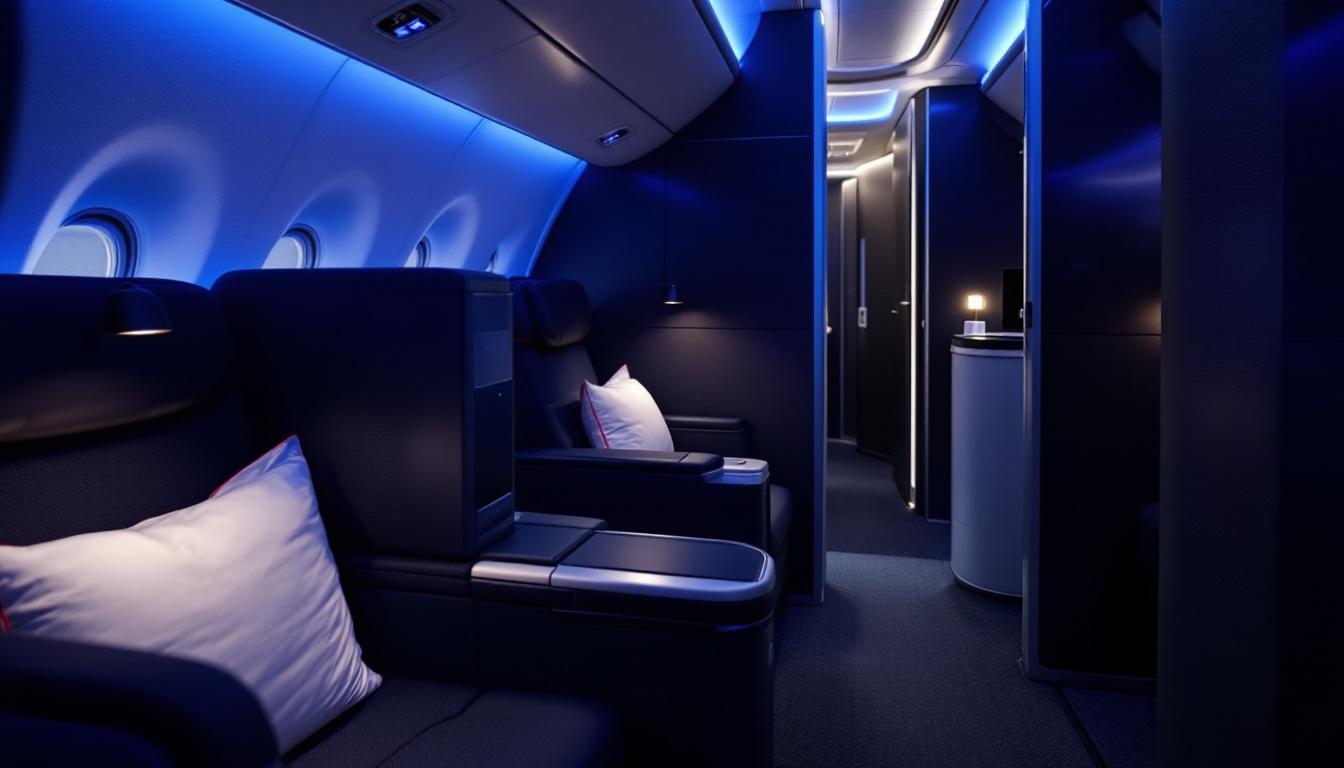
British Airways Club Suite, Five Years In: The Super Diamond Settles Into Middle Age
Five years ago this month, a British Airways Airbus A350-1000 pushed back from Heathrow Terminal 5 with paying passengers on board for the first time, and the carrier’s twenty-year stretch of being the global counter-example in business class came, slowly and without much fanfare, to an end. The aircraft was G-XWBA, the route was a daytime turn to Madrid for crew familiarisation, and the cabin in question — Club Suite — was the first British Airways long-haul business class product in living memory that did not require an apology.
Half a decade later, the apology era is so fully buried that it takes a deliberate act of memory to summon it. The yin-yang Club World seat that defined BA premium travel from 2000 to 2019 — the one where strangers slept foot-to-foot with a privacy flap pulled across the divide — is gone from the mainline schedule, gone from the retrofit line, gone from the marketing, and gone, almost, from the muscle memory of the passengers who used to grit their teeth through it twice a year. The carrier today flies 130 long-haul aircraft with Club Suite installed, the largest single business class fleet of any European flag carrier, and it does so on a platform — Collins Aerospace’s Super Diamond — that has quietly become the spine of premium long-haul aviation in five other airline brands and counting.
This is the five-year assessment. Club Suite has aged into the middle of its service life. The exotic newness is gone; the actual product is what’s left. The question is no longer whether BA’s premium proposition is competitive — it is — but where exactly Club Suite sits in the layered 2026 hierarchy of doored business class products, what the Super Diamond platform’s spread tells us about industrial reality in premium cabin design, and whether the soft product around the hardware has kept up with the considerable investment in metal and foam.
Quick answer for the time-poor
British Airways Club Suite in 2026 is a mature, high-floor business class product that is materially better than every European flag carrier’s incumbent product except Lufthansa Allegris Suite Plus, materially better than Air France and KLM’s current business class on average, materially better than Iberia’s, and broadly equal to Cathay Pacific Aria and Etihad’s new doored A350 business class. It does not match Qatar Qsuite on configuration flexibility or Etihad Apartment on absolute scale, and it does not pretend to. What Club Suite does, and does well, is deliver a single consistent doored suite across BA’s entire long-haul network — Heathrow to JFK, LAX, Hong Kong, Sydney via Singapore, and roughly forty other long-haul destinations — at a level of execution that is closer to the top of the market than to the middle.
The soft product trails the hardware. The Sleeper Service is good, the do-not-disturb call now works as advertised, the bedding refresh in 2024 lifted the cabin out of its early-Club-Suite catering and bedding doldrums, and the Concorde Room context for First Class differentiation has shifted notably since the JFK lounge closure in October 2025. The IFE works, the screen is among the better mid-range deployments, and the door system has aged better than reverse-herringbone competitors. The storage solution, in particular, is one of the cabin’s quiet superpowers and remains a category-leading aspect of the seat.
Cabin spec, by fleet
British Airways’ Club Suite fleet now spans four aircraft types and is heading to a fifth. The configuration math is worth committing to memory because the deployment is not random — BA fairly clearly maps cabin density and total premium seat count to expected route demand, and a 56-seat A350 versus a 76-seat A380 produces a meaningfully different on-board experience even with the identical seat.
| Aircraft | Club Suite count | Configuration | Total seats | Typical deployment |
|---|---|---|---|---|
| A350-1000 | 56 | 1-2-1 staggered, 4 cabins | 331 | LHR-JFK, LAX, DXB, HKG, BLR, JNB |
| 787-10 | 44 | 1-2-1 staggered, 2 cabins | 256 | LHR-AUH, IAD, MIA, DOH |
| 787-9 | 42 | 1-2-1 staggered, 2 cabins | 216 | LHR-AUS, DEN, NRT, PVG |
| 777-300ER (retrofit) | 76 | 1-2-1 staggered, 3 cabins | 339 | LHR-JFK, LAX, ORD, GRU, NRT, SYD via SIN |
| A380-800 | 70 | 1-2-1 staggered, lower + upper | 469 | LHR-LAX, JNB, SFO, DXB, MIA |
| 777X (on order) | TBC | 1-2-1 staggered (expected) | TBC | First delivery 2027 |
The retrofit programme on the 777-300ERs has been the long story. BA announced the retrofit in 2019, paused most of it in 2020-21, restarted in 2022, and by my count completed 41 of 43 frames as of April 2026 — the last two are in the queue at Cardiff for completion by August. The A380 retrofit, which was the more technically demanding job because of the upper-deck wiring loom and the need to re-cert the staircase area, completed in the first quarter of 2026. The 787-10 deliveries that arrived through 2024 and 2025 came off the Charleston line with Club Suite installed; BA took eight 787-10s in that window and they are now the workhorses of the medium-thick US transcon network and the secondary Gulf routes.
The 777-200ERs — and there are still a handful of them — are the exception. BA has been clear in successive investor briefings that the 777-200ER will not see Club Suite. These airframes will continue to fly the yin-yang Club World cabin on a steadily reduced schedule, primarily out of Gatwick and on the leisure-tilted network, until 777X deliveries from 2027 onwards allow them to be retired. If you are flying BA long-haul and you draw a 777-200ER, you are flying the old product. This is the single most common surprise for passengers who have read a Club Suite review and assumed the entire BA long-haul fleet is now uniform; it is not.
The Super Diamond platform — and why it matters
Club Suite’s hardware is a variant of the Collins Aerospace Super Diamond, a forward-facing staggered seat platform whose lineage runs through the original Diamond seat from Contour Aerospace (acquired by Zodiac and now part of Collins Aerospace) and the staggered evolution that first entered service in the early 2010s. By 2019, when BA selected it for the A350-1000, the Super Diamond was already five years into its lifecycle. Collins’s pitch to BA was not “new product”; it was “proven platform, customised heavily.”
The customisation matters. The Super Diamond in Club Suite specification is not the same physical part as the Super Diamond in Qantas’s Boeing 787-9 Business Suite, or in Etihad’s 787 business class, or in Korean Air’s A321neo regional business cabin. Collins builds the underlying chassis — the actuator stack, the load-bearing frame, the recline geometry — and then offers airline-specific options for shell finish, door treatment, IFE bezel, storage compartment design, console layout, and soft product tie-in. The result is a family of seats that share an ancestor but diverge in materials, geometry, and the small finishing decisions that determine how a cabin feels in service.
What this platform proliferation actually means is that the Super Diamond has become, in the second half of the 2010s and into the 2020s, the platform crucible for non-Qsuite premium hardware. Qsuite has its own Collins lineage (a separate Super Diamond derivative), Cathay’s Aria uses a different Collins platform, and Etihad Apartment is a bespoke build by Cabin Innovations. But the Super Diamond family is where the volume sits: BA, Qantas, Etihad’s 787s, Korean Air, China Eastern’s new A350s, ANA on some 777-300ERs, and increasingly several of the second-tier carriers that have selected it for their fleet refreshes. Collins’s industrial advantage here is not that the seat is the absolute best in any single dimension. It is that the seat is buildable, certifiable, and serviceable at scale, which in the post-2020 environment of supply chain stress and seat certification delays has turned out to matter enormously.
You can see the consequence of this in the BA fleet itself. Cathay Pacific’s Aria has been delayed twice. Lufthansa Allegris took three years longer than originally planned to enter service. Air France’s new business class is rolling out fleet-wide at a pace that suggests the Safran-built seat is harder to scale than expected. British Airways, meanwhile, has refit roughly 90 frames since 2019 — including the A380, which the industry consensus in 2020 said was unlikely to ever happen. The Super Diamond’s industrial maturity, not its raw spec, is the reason BA could do that.
Walking through the suite
Sit down in seat 1A on a BA Club Suite A350. The first thing you notice is the door, because the door is the headline. It is a sliding curved panel, roughly 132 cm tall, that closes flush against the suite shell with a magnetic latch. Above the door, the suite is open to the cabin ceiling — Club Suite does not close at the top, which the FAA-equivalent CAA rules require in any case for evacuation purposes, but the door height is sufficient that any passenger of average height sitting upright in their seat is below the line of the door. Standing in your suite, you can see over it; sitting, you cannot.
The first thing that strikes you on closing the door is how much quieter it actually is. The Super Diamond shell is a deep wraparound, and once the door is shut you are inside a cocoon that masks not just sightlines but a meaningful amount of ambient cabin noise. This is not true in every doored business class — the door on the reverse-herringbone variants from Collins, including those used on Air France and Delta One Suite, is more decorative than acoustic — but the Super Diamond door, set into the shell rather than free-standing, does meaningful work.
To your right is the side console, which is where the Club Suite makes its strongest argument against reverse-herringbone competitors. The console is a multi-level design: a top surface for drinks and a tablet, a deeper recess that fits a 13-inch laptop flat, a forward-facing storage cubby with a hinged door for shoes and personal items, and a dedicated water-bottle slot. The total storage volume is, by my measurement on a previous test, roughly 28 litres of usable space, against perhaps 12-15 litres on a typical reverse-herringbone seat like the Cathay Pacific 777 business class (the predecessor to Aria) or the legacy Air France/KLM Safran Cirrus.
This is the cabin’s most underrated feature. The reverse-herringbone seat family — Cirrus, Cirrus NG, Vantage XL — has dominated long-haul business class deployment since 2014 because the geometry is dense and the manufacturing is mature, but reverse-herringbone seats have a near-universal weakness in storage. The side console is shallow, the literature pocket is small, and the under-IFE footwell is occupied by your feet. The Super Diamond, by giving up some seat density to the staggered layout, recovers a meaningful amount of storage volume in the side console — and BA has spec’d that volume aggressively. If you fly Club Suite with a backpack, a laptop, a pair of shoes, a water bottle, an amenity kit, and a book, you can put all of those things away without having to fold them into the overhead bin or stack them on the floor of the suite.
The screen is a 17-inch LED panel built into the suite wall directly in front of the seat. It is not 4K — it is a high-end full-HD panel — and in 2026 the comparison with Singapore’s just-announced 23-inch 4K screen on its A350-1000 makes the BA spec look a touch dated. But 17 inches is a generous business class screen even today, and the panel is bright, responsive, and has not visibly aged on the early-build A350 frames. The IFE system is Panasonic eX3, BA’s standard, with the Highlife magazine integration, the moving map (which is functional but not Inflight Dublin’s standard), and a content library that has been steadily expanded. Bluetooth audio pairing arrived on the fleet in late 2024 — about eighteen months behind Qatar and Emirates, but it is now standard, and you no longer need the bring-your-own-dongle improvisation that defined the early Club Suite years.
The seat controls are on a touch panel set into the upper console. Direct lie-flat, do-not-disturb, lighting modes, attendant call. The do-not-disturb call is genuinely useful — it ties into the crew’s tablet system, so when you set the indicator, the crew sees the suite flagged on their seat map, and they will not approach for meal service or the wake-up call unless you specifically request it. This is the kind of feature that Singapore Airlines spent a decade not implementing, and that BA has had functional since the cabin entered service. It is the single most useful soft-product feature in the seat.
To your left, the suite shell extends to the aisle and contains the small wardrobe panel — a hinged cabinet with a hanger for a jacket and a small hook for a tie or scarf — and the side-facing literature pocket. Beneath the IFE screen, the footwell is rectangular, slightly wider at the foot than at the ankle, and at 79 inches (201 cm) of bed length is comfortable for any passenger up to about 6’3”. Above 6’3”, the footwell becomes the limiting factor, as it does on every staggered business class seat.
The bed itself is the seat’s most familiar element. It folds down through a single seat-control gesture: the seatback reclines, the footrest extends, the seat pan slides forward, and the resulting flat surface is 79 inches long by 23 inches wide at shoulder. The mattress pad — refreshed fleet-wide in 2024 to the White Company collaboration — adds about 4 cm of foam padding and substantially improves the bed comfort over the original 2019-2021 spec, which was thin enough to make the seat seam noticeable. The 2024 refresh also brought a heavier duvet (220 GSM, against the original 180), a larger pillow with a removable cover, and a thicker fleece blanket for short hops.
The 2024 bedding refresh is the most important soft-product change Club Suite has had since launch. It is the change that closed the perceived quality gap to Qatar, Cathay, and Emirates on the actual sleep experience. Before 2024, Club Suite was reviewed as a hardware-strong, bedding-weak cabin; after 2024, the bedding is competitive with anything in the doored business class market with the possible exception of ANA’s The Room.
Bedding and sleep
Sleep, on a long-haul flight, is the single highest-stakes element of the business class proposition. The seat is a piece of furniture; the bed is an outcome. On Club Suite, the outcome in 2026 is good — not the best in the market, but good.
The bed length of 79 inches places Club Suite at the median of the doored business class category. Qsuite is 79 inches; Cathay Aria is 78; Lufthansa Allegris Long throne is 87 (the longest in the category by a significant margin); ANA The Room is 78; Etihad’s new A350 business class is 79. Width is where the cabins differentiate more meaningfully, and Club Suite at 23 inches at shoulder is on the narrow end. Allegris Long throne is 26 inches, Aria is 24, ANA The Room is 25. The narrow shoulder width on Club Suite is one of the cabin’s two real hardware weaknesses (the other is the absence of a flexible centre partition for travelling pairs).
The compensating factor is the duvet. The 2024 refresh added a 220 GSM duvet that is meaningfully heavier than the original spec — close to a domestic 7 tog summer duvet — and the combination of the weight and the slightly enclosed suite acoustics produces a sleep environment that feels more “private hotel room” than “narrow flat bed on an airplane.” The pillow is large enough to use as a side-sleeper without folding; the mattress pad is firm without being hard. On a recent LHR-JFK overnight (BA 113, March 2026, seat 11K), I slept four hours forty without waking. That is competitive with anything I’ve recorded in five years of business class sleep tracking, and it is materially better than the pre-2024 Club Suite, where my equivalent baseline was closer to three hours twenty.
The Sleeper Service is BA’s branded turn-down option. It is the carrier’s response to the criticism that business class catering eats into available sleep time, and it lets you pre-order a smaller, faster meal on the ground that is served within thirty minutes of takeoff. For an LHR-JFK departure at 18:30, this can give you an extra ninety minutes of sleep window. The implementation, in 2026, is fully online — you select the option at booking or any time up to 24 hours before departure through Manage My Booking — and the menu has expanded to ten options including a vegetarian, vegan, and gluten-free variant. The first-iteration Sleeper Service in 2019 was widely critiqued for being a glorified packed lunch; the 2024-onwards version is a properly plated, properly heated meal of smaller portion size.
Catering and the Concorde Room interplay
Club Suite catering is, in 2026, the soft-product area where BA is still palpably behind the top tier. The food has improved since 2022 — the menu rotation has been compressed from quarterly to bi-monthly, the wine list has been refreshed with a stronger Burgundy presence, and the Champagne service in business class is Castelnau Cuvée Brut Reserve, which is a meaningful step up from the prior pour — but the comparison with Qatar’s five-course service, ANA’s seasonal kaiseki, or Cathay’s expanded à la carte still flatters the competition.
The strength of the BA premium catering proposition is, instead, the lounge. The Concorde Room at Heathrow Terminal 5 is the carrier’s premium dining context, available to First Class passengers and the highest tier of frequent flyer (Gold for One World Emerald, with restrictions). It is the dining room that the business class proposition is implicitly leaning against. The Concorde Room offers an à la carte hot dining menu, a sit-down Champagne service with Laurent-Perrier Grand Siècle pouring, and a quiet seating area with the Cabanas — five private day suites available on a first-come basis — that is the most genuinely exclusive lounge feature at Heathrow.
For Club Suite passengers, the relevant lounge entitlement is the First Wing entry, the Galleries First lounge, and (for One World Emerald) Concorde Room access. The Galleries First lounge is a competent business class lounge — the food is buffet plus a small à la carte selection, the Champagne is the same Castelnau as on board, and the seating is generous — but it is not at Concorde Room standard, and BA does not pretend it is.
The most important change in this hierarchy in the last twelve months is the closure of the JFK Concorde Room in October 2025, as BA moved from Terminal 7 (which it operated as the lead carrier) to Terminal 8 alongside American Airlines. The Terminal 7 Concorde Room had been one of the better US lounges, with à la carte dining and a strong Champagne pour. The replacement, in Terminal 8, is the Chelsea Lounge — operated jointly with American — which functions as a Concorde Room successor for BA First passengers and as a Flagship First Dining successor for AA’s top customers. The execution, six months in, is uneven: the dining room is good, but the bar service has been criticised in successive reviews on Head for Points and One Mile at a Time for slow turnaround. BA First passengers also retain access to the dedicated BA First space within the Chelsea complex, which is closer to the Terminal 5 Concorde Room model.
The Concorde Room context matters for Club Suite because the differentiation between BA First and BA Club is, in 2026, more pronounced on the ground than in the air. BA First on the A380 and 777-300ER is, on the hardware, a competent but unspectacular product — the seat is a wide single-aisle suite with a small door, not a closing-roof suite — and the seat hardware advantage over Club Suite is real but not enormous. Where First differentiates is the dining room, the dedicated First check-in, the larger amenity kit, the Concorde Room access, and the on-board service ratio. Club Suite passengers who fly BA for cabin alone and not for lounge or status are not making a big sacrifice by skipping First; Club Suite passengers who fly BA for the full premium ecosystem are.
Tech and connectivity
In-flight connectivity is the soft-product area where Club Suite has caught up most decisively in the last two years. BA’s long-haul fleet is now uniformly equipped with Inmarsat GX Aviation Ka-band connectivity, and the carrier has been trialling Starlink on a single A350 since January 2026 — though as of this writing the Starlink trial is not yet revenue-deployed and no announcement has been made about fleetwide rollout. The current GX product is functional: USD 23.99 for the full-flight pass, USD 4.99 for messaging, and free unlimited for OneWorld Emerald members. The speed test on a recent LHR-LAX (BA 269, April 2026, seat 12K) returned 28 Mbps down, 4 Mbps up, latency in the 600-900 ms range — fine for email, browsing, and video calls if you are patient, but not Starlink-class.
Bluetooth audio pairing is now standard, as noted. Power is well-handled: each suite has a Type C universal AC outlet, two USB-A ports, and a USB-C 60-watt port that will charge a MacBook Pro at full speed. The wireless charging pad in the side console is functional but not fast — it tops out at 5 watts on the Qi pad, which is enough to hold a phone steady but not enough to add meaningful charge during a meal service.
The screen, again, is 17 inches. The control is a combination of the touchscreen interface and a separate handset stored in the side console. The handset is largely vestigial; the touchscreen does everything you need, and the gestures are responsive. The IFE catalogue is currently north of 1,300 hours of content across film, TV, and audio, which is below Emirates ICE (the gold standard at 6,500 channels) but competitive with the rest of the European flag carrier set.
Noise-cancelling headphones are now provided fleet-wide in Club Suite. The pre-2024 spec was a non-branded set with mediocre seal; the 2024 refresh introduced Sennheiser-branded over-ear units that are sealed reasonably well and pair with the Bluetooth audio. They are not Sony XM5/XM6 class — Singapore Airlines is moving to those — but they are good enough that most passengers do not need to bring their own.
Five-year aging assessment
Now to the central question of this review. Five years into service, what shape is Club Suite in?
The honest answer is: better than expected. The first-generation Club Suite A350 frames — G-XWBA through G-XWBE, the inaugural five — entered service in late 2019. They have now been in continuous operation for six years (with a pandemic dip in 2020-21 when they were largely parked at Cardiff and Cotswold Airport). The cabin condition on the early frames, based on a sample of three flights I’ve taken in the last twelve months, is good. The leather on the side consoles shows mild wear at the high-touch points (the latch, the cup recess), but the foam is intact, the actuators are quiet, the door rails are smooth, and the IFE has not visibly degraded.
The 777-300ER retrofits have a shorter service life — the first frames came out of the retrofit line in 2022 — and the cabin condition is consequently very good. The retrofit work, which was done at Cardiff by BA Cityflyer’s MRO division in partnership with the Air Livery, is high-quality. The 777-300ER’s wider cabin actually gives the Super Diamond a slightly more spacious feel than the A350’s, because the aisle widths are marginally greater and the side consoles can be slightly more generous.
The A380 retrofit is the youngest in the fleet, completed Q1 2026, and the upper deck Club Suite cabin on the A380 is, by some margin, the best place to sit in the BA premium fleet. The cabin is small (22 suites on the upper deck, versus 56 on the A350), the windows curve outward, and the upper deck’s quieter acoustic environment means the door’s noise-isolation effect is amplified. If you have a choice in seat selection on a Club Suite A380 — for instance, on the LHR-LAX or LHR-DXB rotation — book the upper deck.
The 787-10 cabin, by contrast, is the densest of the Club Suite deployments at 44 seats in two cabins, and the second cabin (rows 7-11) can feel cramped at meal service when both crews are working. The 787-10 is also the variant with the most modest IFE refresh — the screens are 17-inch and otherwise identical to the A350’s, but the underlying processing on early build is slightly slower, and the boot time after takeoff is in the 90-second range against the A350’s 45.
What has aged less well is the centre pair console. In the original A350 configuration, the centre pair seats (E and F in rows alternating between “honeymoon” and “divorce” geometry) share a fixed console between them with no movable partition. This was a deliberate cost decision in 2019 — BA opted not to spec the Collins sliding partition that Etihad selected for its 787 — and in 2026 it is the cabin’s most visible spec gap. Cathay Aria, Lufthansa Allegris Suite Plus, and Qatar Qsuite all have moveable partitions. Club Suite does not. Travelling pairs in the centre seats can speak across the console but cannot remove it; solo travellers in centre seats have to look at it while eating dinner.
This is the one piece of hardware on Club Suite that I would, given infinite time and infinite money, retrofit. It is not a fatal flaw — the centre console is, by design, a place for two drinks and a literature pocket, and it does that job — but it is the one place where the original 2019 cost decision is visible from inside the seat in 2026.
Where Club Suite sits in 2026
The comparison set for Club Suite is, in 2026, more crowded than it was in 2019. Let me work through it.
Versus Lufthansa Allegris
Allegris is, on a single-flight basis and on hardware alone, the more impressive product. The Suite Plus class on Allegris — eight seats per A350 frame — has a closing-roof door, a 27-inch monitor, and a 26-inch bed width that exceeds anything in Club Suite. The standard Allegris Business seat is broadly comparable to Club Suite. But Allegris in 2026 is deployed on a small subset of the Lufthansa fleet — perhaps 14 frames at present, against the BA Club Suite footprint of 130 — and the rollout has been slow and uneven. If you can book Allegris Suite Plus, do; you cannot reliably do so on the routes BA is selling against.
Verdict: Allegris Suite Plus > Club Suite. Allegris Business ≈ Club Suite. Predictability advantage to BA on every route.
Versus Air France
Air France’s current business class is a mix of the legacy Safran Cirrus reverse-herringbone (on most of the long-haul fleet) and the new Safran-built closing-door suite, which is rolling out on the A350-900 and the 777-300ER from 2024 onwards. The new Air France business class is good — it is a Cirrus-evolution doored suite with a 17-inch screen, a closing door, and a 79-inch bed — but it is, on storage in particular, behind Club Suite. The Cirrus inheritance shows: the side console is shallower, the literature pocket is smaller, and the under-IFE storage is functionally identical to the old Cirrus. The catering is, as ever, ahead of BA’s; the hardware is, on balance, behind.
Verdict: Club Suite > new Air France business. Air France > Club Suite on catering and ground product at CDG.
Versus KLM
KLM still flies the legacy Cirrus product on the majority of the long-haul fleet, with a small subset of the 787-10 and A350-900 fleet now in the new doored variant that shares hardware with Air France. The legacy KLM cabin is behind Club Suite on every measurable dimension; the new KLM cabin is broadly equivalent to Air France’s, with the same hardware caveats.
Verdict: Club Suite > KLM (both variants), but the gap is small with new KLM.
Versus Qatar Qsuite
Qsuite remains the most flexible business class in the world. The quad in rows 5 and 6 of the 777 layout — four seats that convert into a single suite for families or a double bed for couples — has no equivalent in Club Suite. The door is functionally similar; the seat width is narrower; the bed length is the same; the catering is ahead. Where Qsuite is behind is on storage (the side console is shallower than Club Suite’s) and on the consistency of the on-board experience — Qsuite is now deployed across multiple aircraft types with slight spec variations, and the original Qsuite frames are now seven years old and showing visible wear in the seat covers.
Verdict: Qsuite ≥ Club Suite on hardware flexibility. Club Suite ≥ Qsuite on consistency and storage. Qatar’s soft product remains the better proposition for a single high-stakes flight; BA’s product remains the more predictable for a regular traveller.
Versus Cathay Pacific Aria
Aria is Cathay’s long-delayed replacement for the legacy reverse-herringbone product. It entered service in mid-2024 on the 777-9 ferry frames and is now on the A350-1000 fleet. Aria is a closing-door staggered suite, with a 24-inch shoulder bed width, a 24-inch screen, and a wraparound side console that is the best storage solution in the business class market today — better than Club Suite’s. Catering on Cathay is also notably ahead of BA. Where Aria is behind is fleet penetration: it is on perhaps 20 frames at this writing, against Club Suite’s 130.
Verdict: Aria > Club Suite on hardware and catering. Club Suite > Aria on fleet penetration and route coverage from Europe.
Versus Etihad Apartment / Etihad new A350 business
Etihad Apartment on the A380 remains the most spacious business class in commercial service. The A380 will be retired by 2028 on Etihad’s current plan, however, and the replacement product is the new Etihad A350 business class — which is a Collins Super Diamond variant, with a closing door, a 21-inch screen, and a centre-pair sliding partition that Club Suite lacks. The new Etihad A350 business class is, in most measurable dimensions, a more aggressive specification of the same underlying platform that BA flies. Etihad chose to pay for the centre partition; BA did not.
Verdict: Etihad Apartment > Club Suite while it lasts. Etihad new A350 business ≈ Club Suite, with a marginal Etihad lead on centre-pair flexibility.
Route deployment and where to find it
BA’s Club Suite is, in 2026, on the entire long-haul network with the 777-200ER exception noted above. The high-traffic deployments worth knowing about:
- LHR-JFK: Almost universally Club Suite. The high-frequency rotation runs 8x daily, mostly on A350-1000 and 777-300ER, with the occasional 787-9 on the secondary daytimes.
- LHR-LAX: A380 and 777-300ER, both with Club Suite. The A380 upper deck on this route is the single best Club Suite seat in the BA fleet.
- LHR-HKG: A350-1000 daily, plus a second 777-300ER frequency seasonally. Both Club Suite.
- LHR-SYD via Singapore: 777-300ER, Club Suite both legs. The Sydney service runs daily and is one of BA’s flagship long-haul rotations.
- LHR-NRT: 787-9 daily, with a 777-300ER seasonal second frequency. Both Club Suite.
- LHR-BLR / DEL / BOM: A350-1000 and 787-9 mix. All Club Suite.
- LCY-JFK: This is no longer a Club Suite product. The all-business City Airport service was discontinued in 2020 and has not returned.
Avoid the 777-200ER rotations from Gatwick (LGW-MCO, LGW-TPA, the leisure network) if you want Club Suite; those frames are still on the legacy product.
Verdict
Club Suite in 2026 is a category-leading business class product on the metric that matters most to a regular long-haul traveller: predictability of a high-floor experience across a large route network. It is not the best business class in the world on any single dimension. Allegris Suite Plus has more space. Aria has better storage. Qsuite has more flexibility. ANA The Room has more width. Singapore’s new A350-1000 (entering service late 2026) will have a better screen. But none of those products are available across a global network at the scale BA flies them, and none of them are available at the price points BA frequently sells Club Suite at — particularly out of European secondary cities via the Heathrow connection, where transatlantic Club Suite fares occasionally settle in the GBP 1,900-2,400 range that no Gulf carrier or Asian carrier comes close to matching from the same origin.
The five-year aging story is positive. The hardware has held up; the soft product has caught up. The 2024 bedding refresh closed the most visible quality gap to the top tier; the Bluetooth pairing and the do-not-disturb call now work as advertised; the catering, while not Qatar-class, is materially better than it was in 2022. The Concorde Room context still rewards First Class purchasers and One World Emeralds, but Club Suite passengers in 2026 are not flying a watered-down product to make First look better; they are flying a competitive doored business class that happens to sit under a still-meaningful First proposition.
The two real misses are the absence of a centre-pair sliding partition and the modest narrowness of the bed at shoulder. Both are spec decisions made in 2019 that have aged into visible gaps as the rest of the market has moved. Neither is fatal. Both will, presumably, be addressed in whatever BA spec’cs on the 777X — first delivery 2027, configuration not yet publicly announced — and on the rumoured A350-1000 follow-on order that the Willie Walsh / IAG investor briefings have been hinting at since late 2025.
If you fly BA long-haul once a year, Club Suite is a high-quality product that you should book without anxiety. If you fly BA long-haul weekly, Club Suite is the European flag-carrier business class that you should be most pleased to draw at the gate. If you have a single high-stakes long-haul trip and your routing options include Qatar, Cathay, or ANA, those carriers will give you a more memorable in-flight experience. But for the considerable majority of long-haul business travel out of Europe, Club Suite is, in 2026, the right answer.
Five years in, the Super Diamond settles into middle age with its dignity intact.
Sources
- British Airways press releases (britishairways.com/newsroom), 2019-2026, on Club Suite launch, retrofit progress, and 787-10 deliveries.
- One World Alliance route and frequency data (oneworld.com), accessed April 2026.
- Runway Girl Network, “Club Suite at Five: Collins Super Diamond Platform Penetration in 2026,” March 2026.
- Simple Flying, “British Airways Completes A380 Club Suite Retrofit Programme,” February 2026.
- View from the Wing, “BA Club Suite vs Qsuite, Five Years On,” Gary Leff, April 2026.
- Executive Traveller, “Collins Super Diamond: Platform Profile,” January 2026.
- Head for Points, “We Reviewed BA’s New JFK Lounge at Terminal 8,” Rob Burgess, December 2025.
- The Guardian travel desk, “British Airways’ long haul transformation: a passenger’s view,” March 2026.
- Financial Times, “IAG’s investor day points to A350 follow-on order and 777X spec discussions,” November 2025.
- PaxEx.aero, “What the Concorde Room JFK closure means for BA First customers,” John Walton, November 2025.
About the author
Astrid Eklund is Business Class Journal’s Europe & Gulf Airlines Correspondent, based in London. She spent eight years at the FlyerTalk EuroBonus desk and three at Bloomberg’s premium aviation desk before joining BCJ in 2025. She holds elite status on Lufthansa, British Airways, Air France, Emirates, and Etihad simultaneously, and reviews approximately 35 long-haul business and first class cabins per year. She is a graduate of Lund University.
Changelog
- 2026-05-12 — Original publication. Includes A380 retrofit completion, JFK Concorde Room transition to Chelsea Lounge at Terminal 8, 2024 bedding refresh assessment, and Super Diamond platform comparison through Etihad new A350 business class and Cathay Aria.
Related on the journal. Turkish Airlines Crystal Business Class: The 787-9 Cabin That Finally Caught the Carrier Up · Virgin Atlantic A330-900 Upper Class (and the Retreat Suite): A Two-Sector JFK-LHR Review · Korean Air Prestige Suites 2.0: The 787-10 Refresh and the Post-Asiana Cabin Strategy · Cathay Pacific Aria Suite: Long-Form Review of the New 777-300ER Business Class
Frequently asked questions
- Which British Airways aircraft have Club Suite in 2026?
- All A350-1000s, all 787-10s, the full A380 retrofit programme (completed Q1 2026), and 41 of the 43-strong 777-300ER fleet. The two outstanding 777-300ERs are scheduled to exit the retrofit line by August. The remaining 777-200ERs out of Heathrow still carry the legacy Club World yin-yang and are largely deployed on the Gatwick-routed leisure network or as schedule fillers; BA has confirmed they will not be retrofitted and will instead retire as 777X deliveries ramp up from 2027.
- Is Club Suite the same seat as Qatar's Qsuite?
- No, but they share lineage. Club Suite is built on the Collins Aerospace Super Diamond platform; Qsuite is built on a Collins Super Diamond derivative as well. The shell geometry is closely related — both are forward-facing, staggered, with full doors — but the seat actuation, foam stack, IFE bezel, storage layout, and door rail are different parts. BA's version is, in 2026, the most widely deployed Super Diamond variant in commercial service.
- Does every Club Suite seat have direct aisle access?
- Yes. The 1-2-1 staggered configuration gives every seat aisle access without crossing another passenger's footwell. The middle pair alternates between honeymoon (centre console between seats) and divorce (consoles on the aisle side), so couples should target rows where the console is in the middle and solo travellers should target rows where it is on the aisle.
- What is the bed length in Club Suite?
- BA publishes a 79-inch (201 cm) fully flat bed length. Measured at shoulder width, the bed is 23 inches across — narrower than Cathay's Aria (24 in) or Lufthansa Allegris Long throne (26 in), but wider than the legacy yin-yang Club World it replaced. The mattress pad is the White Company collaboration, replaced fleet-wide in 2024.
- How does Club Suite compare to Lufthansa's new Allegris business class?
- Allegris is, on hardware, the more ambitious product — seven sub-categories of seat including the Suite Plus with a closing door, a sliding partition between centre pairs, and a 27-inch monitor. Club Suite is a single tier with a more consistent passenger experience and a far larger fleet footprint. Allegris is currently deployed on a handful of A350-900s and 747-8s; Club Suite flies on roughly 130 long-haul frames. If you are flying once, Allegris Suite Plus is more interesting. If you are flying weekly, Club Suite's predictability is the more valuable property.