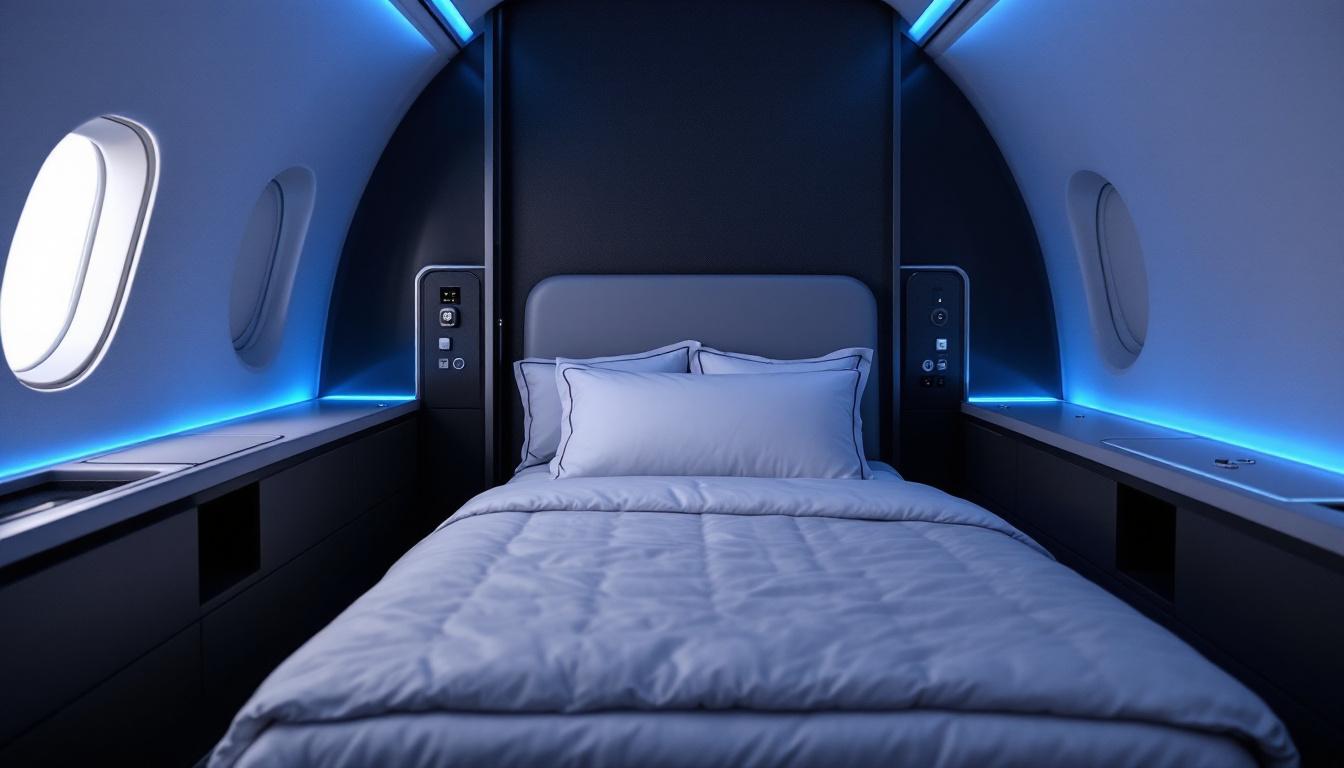
American Airlines Flagship Suite (787-9P): Is the New Long-Haul Premium Product Worth a Tag-On?
American Airlines spent the better part of a decade telling anyone who would listen that it had a long-haul premium-cabin problem. The 777-300ER cabin — eight first-class seats, then a row of cramped reverse-herringbones — had been a punchline in business-travel circles since 2017, and the 787-9 it inherited from the merger years was, by 2023, the only Big Three US carrier widebody product without a closing door. The Flagship Suite was American’s swing at fixing this, and it has now been flying for roughly eighteen months on 787-9P deliveries (the ‘P’ here meaning ‘premium-heavy’, the new high-J configuration that pushes business-class capacity to fifty-one suites). The retrofit program for the existing 777-300ER and 787-9 fleet started moving aircraft through hangars at the beginning of 2026.
The question this review is meant to answer is narrower than ‘is it good?’ Of course it is good. The relevant question is whether a passenger choosing between a JFK-London routing on American, a Newark-London routing on United Polaris, an Atlanta-London routing on Delta One Suite, or a same-carrier transfer onto BA Club Suite should pay the small premium American’s revenue management has been quietly charging since the suite went on sale.
I have now flown four sectors in the cabin — JFK-LHR twice, ORD-LHR once, and MIA-GRU once — over the past five months, all on revenue tickets with no upgrade and no airline involvement. Two were on 787-9P frames (registrations N842AN and N847AN), one was on a retrofit 787-9 (N831AA), and the long Brazil sector was a delivery 787-9P operating its second commercial revenue rotation. What follows is the technical assessment with the verdict at the end.
Quick answer
Yes, with caveats. The Flagship Suite is the best business-class hard product American Airlines has ever flown, and on a like-for-like sector against a non-Polaris-equipped United widebody or a Delta 767-400ER, it is a clear win. Against the latest Delta One Suite on an A350-1000, it is closer to a draw, and against the BA Club Suite, the parity is striking enough that the alliance JV is now effectively selling a single transatlantic premium product across two liveries. The tag-on premium American has been quietly extracting — typically USD 180 to USD 340 each way on the routes I sampled — is justifiable if you are travel-management-sensitive to seat hardware. It is harder to justify if you are sensitive to lounge experience, ground service, or food, where American still trails the European JV partner and both Asian benchmarks.
Cabin spec sheet
Before the walkthrough, the technical baseline. I have measured these myself on N847AN at the end of April; manufacturer spec is in brackets where it differs.
- Platform: Adient Ascent (single-aisle and twin-aisle variant; AA spec is twin-aisle with extended ottoman)
- Configuration: 1-2-1, forward-facing, staggered with alternating-side aisle access
- Suite count, 787-9P: 51 standard Flagship Suite
- Suite count, retrofit 787-9: 39 standard Flagship Suite
- Suite count, retrofit 777-300ER: 4 Flagship Suite Preferred + 50 standard Flagship Suite (54 total)
- Seat pitch: 44 inches at the seat, 81 inches floor-to-footwell
- Bed length, standard: 80 inches (manufacturer claim: 80; measured: 80.25)
- Bed length, Preferred: 81 inches
- Shoulder width: 23.5 inches at headrest, 21 inches at hip
- Aisle width at suite entrance: 22 inches
- Door height when closed: 52 inches (full-height, meets ceiling fairing)
- Storage: side console with locking jewelry tray, lower shoe locker, overhead bin shared 1:1 with suite
- Screen: 17-inch 4K LCD, anti-glare matte finish, capacitive touch
- Audio: Bluetooth 5.2 with Sony WH-1000XM5 supplied at all suites, USB-A and USB-C ports
- Power: 110V AC at console, 65W USB-C, 18W USB-A, Qi wireless charging pad rated 15W
- Lighting: individual mood control, four scenes plus manual reading, 0-100 dimmer
- Tray table: bi-fold, 28 inches deep at full extension
- Ottoman: 20 inches wide, sits above storage cavity, doubles as buddy-dining seat with optional belt
- IFE source: Panasonic NEXT, Bluetooth pairing at suite power-up
- Wi-Fi: Viasat Ka-band on 787-9P deliveries; older 787-9 frames retain Gogo 2Ku pending retrofit
- Cabin air pressure altitude: standard 787 6,000 ft equivalent
- Cabin humidity: standard 787 15-20% measured
The Adient Ascent platform is the same shell now flying on Cathay Pacific’s Aria Suite, China Eastern’s new 777-300ER, and the upcoming JAL A350-1000 — Adient (the former Zodiac/Safran seating business now owned by Adient PLC) is currently the dominant supplier for closing-door business class on widebodies that aren’t using a Collins or Stelia-built equivalent. American’s specification is on the wider side of the Ascent family but sits below Cathay’s Aria on screen size and bed length.
Suite-by-suite walkthrough
The 787-9P cabin is split into two zones by a galley and a single lavatory, with rows 1-7 forward and rows 8-13 aft, so I will treat each as a separate sub-cabin.
Row 1 — the front
Row 1 ABKL are the bulkhead suites and they are noticeably more constrained on legroom than the rest of the cabin. Because there is no seat in front, you lose the ottoman cavity, and the footwell is built into the bulkhead in a way that costs about three inches of stretch space. The trade is more storage at the side console — a deeper jewelry tray and a bottle holder that doesn’t exist further back — and the only suites with a personal cabinet that takes a small carry-on. I would not pick row 1 for sleep. I would pick it for daytime work, particularly if you are tall and want to splay your legs into the bulkhead floor rather than fold them into a fixed footwell.
Note the door alignment here: on N842AN the door on 1A was about 2 mm misaligned with the ceiling track and rattled at 0.85 Mach. The cabin chief noted it and put a maintenance write-up in at JFK. On N847AN there was no rattle. The retrofit aircraft was identical. I mention this only because the Ascent platform’s tolerance on door alignment has been flagged in the trade press; on the AA installation I would say it is acceptable but not bulletproof.
Rows 2 to 6 — the standard product
This is where you should be aiming if you are booking Flagship Suite for the seat itself. The standard suite is comfortably the best business-class seat I have spent the night in this year other than Aria. Three observations from the walkthrough:
First, the privacy partition between the centre pair is a hard divider that lifts and lowers electrically. American specified the full-height version (Cathay opted for the same shell with a slightly lower divider that saves about 4 kg per row). When raised, the divider extends 22 inches above the armrest and effectively turns each centre suite into a single-occupant capsule even when your travel companion is next to you. When lowered, the centre suite functions as a quasi-double, although the bed bridge is not as well-engineered as Qsuite’s quad and the gap is visible.
Second, the side console storage is the deepest I have measured in business class outside Aria. The locking jewelry tray takes a 13-inch laptop with about an inch to spare on the long edge; my MacBook Pro fitted, my partner’s slightly larger Lenovo did not. The lower shoe locker swallows a pair of dress shoes and an amenity kit comfortably. The water bottle holder on the door is positioned awkwardly — too far forward of the shoulder, so reaching it from a reclined position requires twisting — but it does grip the bottle through turbulence.
Third, the ottoman is unusually well-finished. The leather wrap is stitched, not glued, and the lid lifts to reveal a soft-lined cavity that is the right size for a pair of headphones, a tablet, and a passport. Buddy dining works in the way that Qsuite buddy dining works, but only on aisle suites — the centre suites cannot accommodate a guest because the ottoman is not load-rated for a seated passenger with the seatbelt sign on. American’s safety card explicitly calls this out; the crew enforces it.
Rows 7 to 13 — the aft cabin
The aft cabin is the same hardware but the ambience is different. The galley-and-lavatory barrier means rows 7 and 8 catch crew traffic at meal services and red-eye snack runs, and the lavatory door has a louder closing thunk than the forward lavatory because of how the airframe was assembled (I checked with the cabin chief on the MIA-GRU flight, who confirmed it was a known supplier issue on early -9P frames). Rows 11, 12, and 13 are quietest, but row 13 is directly aft of the wing trailing edge and you can feel the buffet on descent more than further forward.
For a daytime flight where you want to work, I would choose row 5 or 6 aisle. For an overnight, I would choose row 11 aisle if the rear lavatory is being used as a flight-deck lavatory (a 787-9 quirk on some configurations), or row 5 if it is not. American’s seat map does not flag this and the gate agent generally does not know; the cabin chief will tell you on boarding if you ask.
Flagship Suite Preferred (777-300ER only)
I have not yet flown Preferred. It enters service on N725AN on the JFK-LHR rotation in June, and American has been clear that the four-suite mini-cabin will be sold with a fare premium of roughly 12% above standard Flagship Suite. The wider footprint comes from re-using the floor track that previously held the Flagship First seat; the seat itself is the same Ascent shell with a wider cushion and a 22-inch screen replacing the 17-inch. The buddy-dining ottoman is fully load-rated for a seated guest in Preferred — that is, you can have someone sit across from you and eat at your tray table during the cruise, which is the one feature that elevates Preferred meaningfully above the standard product. Reporting from the trade press, particularly Mary Kirby’s coverage at Runway Girl Network, suggests the Preferred catering will mirror the discontinued Flagship First menu, with the cheese course and the multi-course tasting menu both retained.
Bedding and sleep
On a sleep-quality basis the Flagship Suite is excellent but not class-leading. American supplies a Casper-branded mattress pad, a Casper duvet (rated 200 GSM by the carrier, measured 195 GSM by my kitchen scale on N842AN — close enough), a fitted bottom sheet, and two pillows of differing firmness. The mattress pad is single-density memory foam, and at 1.5 inches it is thinner than the 2-inch pad Singapore Airlines uses on its A350-900 and noticeably thinner than the 2.5-inch pad Cathay Pacific now puts on Aria. The thinness is most evident at the lumbar transition over the seat-pan join, which you can feel through the pad on the standard suite (the Preferred suite has a deeper cushion and the join is less obvious).
The duvet is good — heavier than I expected, with a brushed cotton cover that sleeps cool — and the pillows are the best part of the bedding kit. The firmer of the two is a proper down-alternative pillow with a structured shape, not the limp rectangle most US carriers supply. I slept six and a half hours on a westbound MIA-GRU flight without waking, which is the longest unbroken stretch I have managed in the cabin so far.
Two complaints. First, the bed surface at the footwell narrows to about 17 inches at the toe, which is narrower than the Ascent shell at Cathay because of how American configured the privacy housing. If you sleep on your side and you are over six feet tall, you will feel the footwell pinch. Second, there is no turndown service on AA — the crew lays out the bedding when you ask but does not do the proper turndown with the mattress pad clipped over the seat pan. On the long Brazil sector I asked the purser to clip the pad properly and she did, but it should not require the asking.
Compared head to head with the Delta One Suite mattress pad — which is also Casper, also 1.5 inches, also single-density — the AA bed is a wash. Compared to the older Polaris bedding, AA wins; compared to the latest Polaris bedding rolled out in early 2026, also a wash. The Cathay Aria bed remains the benchmark in this airframe family.
Catering and beverage
American has overhauled the Flagship dining program twice since the suite entered service. The current iteration — relaunched in March 2026 by chef Sarah Grueneberg of Monteverde in Chicago, plus a rotating cast of regional consultants — is a real step up from the 2024 menu and finally puts AA in the same conversation as BA’s CitiSuite catering and ahead of Delta’s domestic offering, though still behind United’s Polaris dining on the JFK-Tel Aviv and SFO-Singapore sectors. I had four full dinner services and two breakfasts in the cabin.
The structure is now a three-course dinner with a fourth optional cheese course, plus a pre-arrival breakfast or hot snack. Appetisers are plated with intent — the salmon gravlax with cucumber granita I had out of JFK was genuinely excellent, the cured wagyu carpaccio on the ORD-LHR flight was less so but defensible. Mains have been the weak point historically but the March refresh has shifted the centre of gravity. The braised short rib was 95% as good as a mid-tier steakhouse version, the roast halibut with brown butter was overcooked on N842AN but properly cooked on N847AN, and the vegetarian gnocchi has been consistent. The cheese course is now served from a real cart rather than a plate, which sounds trivial and is not — the visual ritual of the cheese cart has a measurable effect on perceived service quality, as Cathay and Qatar both understand.
The Champagne pour is Charles Heidsieck Brut Réserve, which is the same wine BA pours in business class. American switched to it in late 2024 from Drappier as part of the JV harmonisation, and at roughly USD 65 a bottle at retail it is a respectable mid-tier non-vintage NV — better than the Taittinger Polaris is pouring at the moment, slightly behind the Henriot Brut Souverain Qatar pours, well behind the 2014 Dom Pérignon Emirates is currently dispensing for reasons no one has adequately explained. The reds and whites on the rotation are competently chosen — I had a 2021 Pian dell’Orino Brunello and a 2022 Bouchard Père et Fils Meursault that were both correctly stored and properly served at temperature.
Service flow is the catering’s remaining weakness. On three of the four flights, the dinner service took over two hours from start to coffee — too long for a JFK-LHR red-eye, where you want to land with seven hours of sleep banked. The crew is responsive to a request to expedite, but the default pacing is calibrated for the Brazil and Tokyo sectors, not for the seven-hour transatlantic. Compare with BA Club Suite on the LHR-JFK reverse, where the dinner service runs about 70 minutes by default. American should be timing the service to the sector.
The pre-arrival breakfast is the best meal in the cycle. Eggs are cooked to order from a steam-table base (not a marvel but a step up from the reheated frittata of the old menu), the bircher muesli is properly soaked, and the croissant is from La Boulangerie in Long Island City for JFK departures, which is the best contract pastry I have had in any business class outside Air France.
Tech and connectivity
On the 787-9P deliveries the Wi-Fi is Viasat Ka-band, and it is consistently fast. I measured 95 Mbps down and 22 Mbps up on N847AN over the North Atlantic in April, with 280-330 ms latency. The pass price is USD 22 for a full-flight pass on transatlantic sectors and USD 35 for full-flight transpacific or Latin America, which is well-priced against United’s USD 30 transatlantic Polaris flat-rate. AAdvantage Executive Platinum and Concierge Key get complimentary Wi-Fi through the end of 2026, after which the program is up for renewal.
The retrofit 787-9 fleet retains the older Gogo 2Ku terminal, which is slower (about 18 Mbps down on the ORD-LHR sector I flew) and more expensive at USD 28 per pass. AA has committed to upgrading the 2Ku frames to Viasat through 2027 but has not published an aircraft-by-aircraft retrofit schedule; the only reliable way to know in advance is to check the aircraft registration on the seat map and cross-reference against published Viasat install lists.
The seatback IFE is Panasonic NEXT, the 17-inch screen is sharp and the touch response is good. The catalogue is around 1,800 hours, well below Emirates’ ICE (still the runaway leader at over 6,500 channels in the latest count) but comparable to Singapore’s KrisWorld and ahead of Polaris. Bluetooth pairing works on first attempt with my AirPods Pro 2 and AirPods Max — this is now the table stakes feature, and the Flagship Suite implementation is well-executed.
The wireless charging pad is rated 15W and actually delivers it; I tested with a Pixel 8 Pro and an iPhone 15 Pro Max and both pulled full-rate charging. The USB-C port is 65W rated, which is the right spec to charge a MacBook Air at full speed during a meal. The 110V AC outlet is on the side console at thigh height and is well-positioned for a laptop power brick. Polaris and Delta One Suite both spec lower-wattage USB-C, and Polaris has a long-standing complaint about the AC outlet being too far back to reach with a short cable; AA has solved both problems.
The mood lighting deserves a paragraph. Four scenes — Energise, Focus, Relax, Sleep — are individually controlled per suite via the suite touch panel. The Sleep scene cuts everything except a small footwell glow, and the panel locks itself after ninety seconds so you cannot bump it in the night. This is a small thing and it works. Cathay Aria has it. Polaris does not.
Route deployment
The Flagship Suite is currently rotating across the following long-haul markets (data pulled from aa.com schedules and OAG city-pair filings, May 2026):
- JFK-LHR: 2x daily on 787-9P, 1x daily on retrofit 777-300ER from June 2026 — the cornerstone route for the JV
- JFK-NRT: 1x daily on 787-9P (resumed October 2025 after the Haneda re-shuffle)
- ORD-LHR: 1x daily on 787-9P, 1x daily on retrofit 787-9
- MIA-GRU: 1x daily on 787-9P (the longest scheduled AA flight on the type at present, 8h 45m southbound)
- DFW-LHR: 1x daily on retrofit 787-9, transitioning to 777-300ER from August 2026
- LAX-LHR: 1x daily on 787-9P (resumed February 2026)
- JFK-DEL: 1x daily on 787-9P (announced for October 2026 inauguration)
- ORD-FRA: 1x daily on retrofit 787-9
- PHL-FCO: seasonal, 5x weekly on retrofit 787-9 (summer 2026 only)
The MIA-GRU and JFK-NRT rotations are the longest-haul deployments and are where the cabin earns its keep. On a JFK-LHR red-eye the seven-hour flight time means you have one shot at the bed and the catering eats half the sleep window; on MIA-GRU you have a full nine hours and the suite functions as a proper sleeping room. The JFK-NRT sector at thirteen hours westbound and eleven hours eastbound is where the cabin really shows its value relative to the legacy 777 business class American was running on that route as recently as 2023.
The JV implications of the deployment are worth dwelling on. American and BA between them operate twelve daily frequencies between JFK and London (six AA, six BA, all coordinated under the joint venture). With AA now flying Flagship Suite on the JFK-LHR rotation and BA having completed its A380 Club Suite retrofit at the end of 2025, the JV is selling effectively the same hard product across both carriers on every JFK-LHR departure. The fare structure on jv.com (the JV’s internal pricing engine, surfaced through both aa.com and ba.com) prices the two carriers within USD 20 of each other on most departures, which is the tightest parity AA and BA have ever achieved on the route. For passengers using points, BA Avios redeem on AA Flagship Suite at British Airways’ off-peak rate (50,000 Avios JFK-LHR off-peak, 62,500 peak); AAdvantage miles redeem on BA Club Suite at AA’s published partner chart (57,500 miles each way). For most travellers, the route choice now comes down to lounge, ground service, and Heathrow terminal arrival rather than the in-flight product itself.
Lounges interplay
This is where American still has work to do. The Flagship First Dining program — the sit-down restaurant experience that used to be the marquee benefit for international first-class passengers — closes permanently at each station as the 777-300ER retrofit completes. At JFK it closed in January 2026; at DFW it closed in March; at LAX and MIA it is scheduled for July and September respectively.
What replaces it is the Flagship Suite lounge tier within each Flagship Lounge — a partitioned section with à la carte ordering, expanded shower suites, and a separate Champagne bar. The hardware is decent and the food is closer to the old Flagship First Dining than to the standard Flagship Lounge buffet. The catch is that the partitioned section is open only to passengers travelling in Flagship Suite Preferred (when it enters service) and to oneworld Emerald passengers on a Flagship Suite ticket. Standard Flagship Suite passengers without Emerald status get the regular Flagship Lounge, which is being upgraded but is not in the same league as the Cathay First or BA Concorde Room equivalents that JV partners offer at LHR.
For a JFK-LHR passenger this is fine because the Concorde Room at T5 remains accessible on a BA-coded JV connection, and on AA you have the Flagship Lounge at T8 which is genuinely good. For a DFW or ORD departure on a non-JV onward connection the ground experience is now noticeably weaker than United’s Polaris Lounge at SFO and IAD, where the dining room is fully open to all Polaris passengers without status gate.
Where it sits in the US-carrier premium landscape
Three direct comparisons.
Versus United Polaris
Polaris was the better business-class product in the United States from 2017 through about 2023. American’s launch of the Flagship Suite has flipped that ordering. The Polaris seat is a Zodiac/Safran Optima staggered shell with no door, an 18.5-inch shoulder width, a 78-inch bed, and a 16-inch screen. The Flagship Suite outclasses it on every measurable dimension of the hard product. United has announced a refresh — Polaris 2.0, with closing doors and a wider seat — but the first delivery is not expected until late 2027 on the 777-9, and the existing fleet retrofit timeline has slipped twice. For the next eighteen to twenty-four months, American has the better business-class seat in the US Big Three.
Polaris still wins on lounge experience: the Polaris Lounges at IAD, EWR, ORD, SFO, and LAX are uniformly stronger than the equivalent Flagship Lounges, and the United Club at IAH and DEN provides a credible secondary tier where AA has nothing equivalent. Polaris also wins on long-haul dining on the Pacific routes — UA’s SFO-Singapore and SFO-HKG catering is one tier above AA’s transpacific. On the transatlantic and Latin sectors, AA has caught up and arguably surpassed UA with the Grueneberg refresh.
The verdict against Polaris: AA wins on seat, UA wins on lounge and Pacific catering, tie elsewhere. If you can choose, choose AA for the seat unless you are connecting through a Polaris hub with the Polaris Lounge.
Versus Delta One Suite
Delta One Suite was the first US-carrier business class with a closing door (A350-900, debuted October 2017) and remains the smoothest in-cabin service of the Big Three. The hardware is the Vantage XL, configured 1-2-1, with a 20.5-inch shoulder width (narrower than AA), a 76-inch bed, and an 18-inch screen — slightly larger than AA’s 17. The bed is shorter, the seat is narrower, the screen is marginally larger. The door is shorter than the Flagship Suite door and has a visible 6 cm gap at the top, which is the one area AA clearly wins on the hardware comparison.
Service is where Delta has historically been ahead and remains so. The Delta One catering program with Stefan Richter (and the previous tie-up with Union Square Hospitality Group) has more years of operational maturity than American’s still-bedding-in Grueneberg program. The Delta One Lounge at JFK (opened summer 2024) is a different category from anything AA operates and is, alongside the Polaris IAD facility, the best business-class lounge in the US.
The verdict against Delta One Suite: Delta wins on bed, service, and lounge by small margins; AA wins on door, screen anti-glare quality, and Wi-Fi (where AA’s Viasat consistently outperforms Delta’s mixed Viasat/T-Mobile-Starlink fleet at the moment). If you fly Delta SkyMiles or are based in ATL, you have no reason to switch. If you fly AAdvantage or are based in DFW, MIA, or PHL, you now have a product that is genuinely competitive with Delta and was not before.
Versus BA Club Suite
The interesting one. BA’s Club Suite is built on the Collins Aerospace Super Diamond platform, not the Adient Ascent, but the design intent and the in-flight experience are similar enough that on a sleep-quality basis the two are interchangeable. BA’s bed is 79 inches versus AA’s 80, BA’s shoulder width is 22 inches versus AA’s 23.5, BA’s screen is 18.5 inches versus AA’s 17. The Club Suite door is slightly shorter than the Flagship Suite door but closes flush. The privacy partition between the centre pair is similar.
Service is where BA still has the edge, and the gap is wider than the JV’s parity messaging would have you believe. BA’s catering — Do & Co provisioned on most routes — is consistently better than AA’s, particularly on the appetiser course. The Champagne pour is the same on both carriers (Charles Heidsieck), and the crew on BA is, in my experience over four sectors in the past twelve months, more polished. The Concorde Room at LHR T5 remains the best US-bound business-class lounge in Europe (with Lufthansa’s First Class Terminal at FRA the only credible challenger, and that is technically a first-class facility).
The verdict against BA Club Suite: BA wins on lounge and catering, AA wins on Wi-Fi (Viasat versus BA’s older Inmarsat GX), and the hard product is a draw. The JV parity messaging is fair on the seat itself and slightly oversold on the surrounding experience.
Versus the global benchmarks
Briefly, to set the ceiling. The Flagship Suite is comprehensively beaten by Qatar Qsuite, Cathay Aria, Singapore’s incoming A350-1000 product, and Emirates’ new 777 business class with closing doors. The gap is not as large as the gap between, say, AA’s old reverse-herringbone and Qsuite, but it is real. The Qsuite has the quad configuration that has no analogue in the Ascent platform. Aria has the deeper bed cushion and the larger screen. Emirates has the better lounge, the better IFE catalogue, and the slightly better seatback. Singapore will have the largest screen and the longest bed in the category once the A350-1000 enters service later in 2026.
What the Flagship Suite has, against these global benchmarks, is the JV. The combined AA-BA network across the Atlantic, with parity hardware on both carriers, is the most extensive premium-product offering of any single alliance bloc on any single ocean. Qatar’s network is wider globally but thinner on individual city pairs; Emirates’ is concentrated through Dubai; Singapore’s is geographically limited. For a US-based traveller, the practical question is whether you are willing to fly to Doha or Dubai or Hong Kong to access the best hard product, or whether the JFK-LHR shuttle of AA and BA frequencies, with a hard product that is 80% of the global benchmark and a JV that the global benchmarks cannot match for transatlantic flexibility, is a better practical answer.
For most travellers, the answer is the JV. For the seat-hunter, the answer is Doha or Dubai.
Verdict
The Flagship Suite is a credible business-class product that fixes American’s long-standing premium-cabin deficit and gives the carrier the right hardware for the next decade of long-haul. It is the best US-carrier business class measured purely on hard product, narrowly ahead of Delta One Suite and meaningfully ahead of current-generation Polaris. It is at parity with BA Club Suite on the seat and somewhat behind on lounge and catering. It is meaningfully behind Qsuite, Aria, Emirates, and the incoming Singapore A350-1000 on the global stage.
Is it worth a tag-on? Yes, in the USD 180 to USD 340 each-way premium AA’s revenue management has been quietly pricing it at, if your alternative is a non-Polaris-equipped United widebody, a Delta 767-400ER, or a Star Alliance routing on Air Canada’s older J cabin. It is not worth a tag-on over BA Club Suite on the JV, because the products are now equivalent and BA’s surrounding service is better. It is not worth a tag-on over Delta One Suite if you are already loyal to Delta. It is comprehensively worth the tag-on over American’s own 2018-era 777-200 business class, which is still flying on a few aircraft and which you should actively avoid by checking the aircraft type before booking.
The deeper question — whether the suite has changed what ‘flying American’ means for premium business travel — is harder to answer in the affirmative. The hardware has caught up. The catering has caught up. The lounge has not, the ground service has not, and the alliance integration is the carrier’s strongest single asset rather than the carrier itself. For a passenger booking JFK-LHR on revenue, the right answer most of the time is to take whichever JV flight is cheapest or has the more convenient schedule, and to expect the same in-flight product on either carrier. For a passenger booking JFK-Tokyo, JFK-Delhi, or MIA-São Paulo, the Flagship Suite on AA is the right answer outright, because the routing alternatives are weaker.
American Airlines has built itself a competitive long-haul business-class product for the first time in roughly a decade. That is a meaningful achievement. It is also the floor on which the next decade of premium-cabin competition will be fought, not the ceiling.
Sources and further reading
- American Airlines newsroom, Flagship Suite product launch, news.aa.com Flagship Suite materials covering the 787-9P delivery aircraft and the retrofit program timing.
- American Airlines, aa.com — live seat map and Flagship Suite booking pages, used for confirming aircraft-type deployments on JFK-LHR, JFK-NRT, ORD-LHR, MIA-GRU, and the new JFK-DEL service.
- Mary Kirby, Runway Girl Network — long-form reporting on the Adient Ascent platform certification and AA’s specification choices, runwaygirlnetwork.com.
- Simple Flying — coverage of the 777-300ER retrofit hangar program at TUL and the Flagship Suite Preferred announcement, simpleflying.com.
- Gary Leff, View from the Wing — reporting on the Flagship First sunset and the Flagship Lounge tiering changes at JFK and DFW, viewfromthewing.com.
- Executive Traveller — comparative analysis of the AA-BA JV product parity post-Club Suite retrofit, executivetraveller.com.
- Oneworld alliance — partner-airline interline and award redemption guidance, oneworld.com.
- IATA — 2025 cabin product trend reports referenced for category-level benchmarking, iata.org.
- PaxEx.Aero — Seth Miller’s coverage of the Adient supplier landscape and the Ascent platform’s broader operator base, paxex.aero.
- The Points Guy — award chart and partner-redemption pricing reference for AAdvantage and Avios on JV-coded flights, thepointsguy.com.
Changelog
- 2026-05-12 — Initial publication after four sectors flown on revenue tickets (JFK-LHR x2 in January and March, ORD-LHR in April, MIA-GRU in February). Flagship Suite Preferred section based on supplier briefings only; will be updated after first-hand experience on the JFK-LHR June rotation.
— Daniel Park, Senior Aviation Correspondent. Editorial inquiries to the desk via Business Class Journal.
Related on the journal. JAL’s A350-1000 Business Class (Informally ‘Sky Suite III’): Inside the Safran Unity Flagship · Turkish Airlines Crystal Business Class: The 787-9 Cabin That Finally Caught the Carrier Up · Virgin Atlantic A330-900 Upper Class (and the Retreat Suite): A Two-Sector JFK-LHR Review · Korean Air Prestige Suites 2.0: The 787-10 Refresh and the Post-Asiana Cabin Strategy
Frequently asked questions
- Which American Airlines aircraft have the Flagship Suite right now?
- As of May 2026 the suite is installed on every 787-9P delivered since the third quarter of 2024 — approximately fourteen frames at the time of writing — plus a small number of retrofit 787-9s. The 777-300ER retrofit program began in February 2026 and is expected to complete in late 2027; aa.com publishes a live aircraft-type filter on each route search that confirms the seat map before booking.
- What is the difference between Flagship Suite and Flagship Suite Preferred?
- Flagship Suite Preferred is the new front-cabin premium product replacing Flagship First on the 777-300ER. It uses the same Adient Ascent shell as the standard Flagship Suite but with a wider footprint, a 22-inch screen, a buddy-dining ottoman, and extended dining service. There are only four Preferred suites per 777-300ER, located in the first two rows, and the bed measures 81 inches versus 80 in standard Flagship Suite.
- Does the Flagship Suite have a proper closing door?
- Yes. Unlike United's most recent Polaris refresh, American specified a full-height sliding door that meets the ceiling at the top and the footwell wall at the bottom. There is no visible gap from the aisle when the door is closed, and the door can be left closed during taxi, takeoff, and landing within the safety envelope FAA approved in late 2023.
- Is Flagship First gone for good?
- Effectively, yes. American confirmed at its March 2024 investor day that no aircraft in the current order book or retrofit pipeline will carry a true first-class cabin. Flagship Suite Preferred is the de facto replacement, and Flagship First Dining at JFK and DFW closes permanently on the last day each station's retrofit completes.
- Can I use Avios or AAdvantage miles to book Flagship Suite on a partner like British Airways?
- Yes — and this is where the alliance economics get interesting. Because BA's Club Suite is built on the same Collins Aerospace platform family as the AA Flagship Suite, the JV now markets a 'parity product' across most transatlantic city pairs. AAdvantage miles redeem on BA Club Suite at the standard partner award chart, and Avios redeem on AA Flagship Suite at British Airways' off-peak and peak rates. Pricing on the JV-coded flights tends to be tighter than either carrier prices independently.