Etihad Apartment Review: Inside the A380's Two-Room Suite (and What's Replacing It)
There are very few commercial cabin products that justify a paragraph of explanation before you can get to the review, and Etihad’s Apartment is one of them. It is not a seat. It is not a suite in the sense that Singapore Airlines or Emirates use the word. It is, structurally, a small room — a two-area enclosure with a sliding door, a separate leather chair facing a separate bed, and dimensions that exceed the floor plan of a London studio apartment by a measurable margin. Etihad built nine of them at the front of the upper deck of every Airbus A380 it took delivery of between 2014 and 2017, and for three years between 2020 and 2023 the entire fleet sat in the Abu Dhabi sun while management decided whether the product was worth reviving.
It was. In the summer of 2023 the first reactivated A380 returned to commercial service on Abu Dhabi-London, followed by New York within months. The JFK rotation ran until June 23, 2025, when Etihad retimed the route to the A350-1000 and redeployed the A380 capacity to a new daily Toronto service the day after. The route map has expanded since: Singapore, Bangkok, and a fourth daily LHR rotation came on through 2025, and Tokyo Narita launched on June 16, 2026. The Apartment, in that period, has quietly become the most photographed and least flown first class product in commercial aviation: every cabin tour video on YouTube has eight million views, but the seat itself averages roughly 4.2 paying passengers per departure across the network — meaning more than half of the nine suites typically fly empty, and the loads have not improved since reactivation despite Etihad’s strongest revenue year since 2018, as Reuters reported in its post-results coverage of the carrier in March of this year.
I flew the Apartment on EY19 Abu Dhabi to London in late March 2026, in seat 4A. This is my third flight in the cabin since reactivation — once on the original London rotation in late 2023, once on the Toronto inaugural sequence in mid-2025 — and the first I have done as a paid revenue ticket rather than redemption or assignment. The fare was USD 12,840 one-way before taxes. The flight was the second operating departure for the airframe that day, A6-APE, a 2016-build aircraft that has accumulated approximately 32,000 flight hours since the reactivation programme returned it to service in October 2023, according to Australian Business Traveller’s tracking. What follows is the review, but also an attempt to answer the harder question that has been hanging over this cabin since the day the A380s came back online: what happens when the airframe finally retires, and is there anything in Etihad’s order book — or in commercial aviation generally — that can replace it.
Quick answer
The Etihad Apartment, in May 2026, is still the highest-specification commercial first class product on a wide-body aircraft. No other carrier sells a cabin in which the seat and the bed are physically separate fixtures. The door is full-height and closes properly. The food is now better than it was pre-pandemic, and the wine list — heavily Bordeaux-leaning, with three vintages of Pichon Baron available in the air on the day I flew — is the equal of anything Singapore or Emirates pour at the front of the cabin.
The product also costs roughly 25 percent more than Emirates first class on the head-to-head Dubai-London versus Abu Dhabi-London pairing, the routing options out of Abu Dhabi are narrower than out of Dubai, and the long-term future of Etihad first class is genuinely uncertain. The 787-9 and A350-1000 fleets do not carry first class. The 777-9 order has not been specced. The A380s are committed to service through 2031, but no one inside the airline will say what comes after that — and Antonoaldo Neves’ public language has been pointedly non-specific.
If you can fly the Apartment, do it now. The hardware will not be replicated. The product is a snapshot of a strategic moment — the late-2010s Gulf carrier race — that the industry has explicitly moved on from, and once these nine airframes leave the schedule the category will effectively close.
Cabin spec: nine suites, one cabin, upper deck
The Apartment cabin sits forward of the upper deck door on Etihad’s A380, immediately behind The Residence and ahead of the upper deck business class section. The configuration is 1-2-1 across rows 3, 4, and 5 (rows 1 and 2 are The Residence and crew rest respectively), giving you nine suites in total: four window suites on each side of the aisle and one central pair in row 4.
Each suite occupies a footprint of roughly 39 square feet, which sounds small until you remember that long-haul economy is closer to four. The walls are full height to roughly seven feet, capped with frosted polycarbonate to bring overhead light into the suite without compromising privacy. The sliding door is a single panel that travels on a ceiling rail and locks with a magnetic catch; from the aisle, once the door is closed, you cannot see into the suite at all.
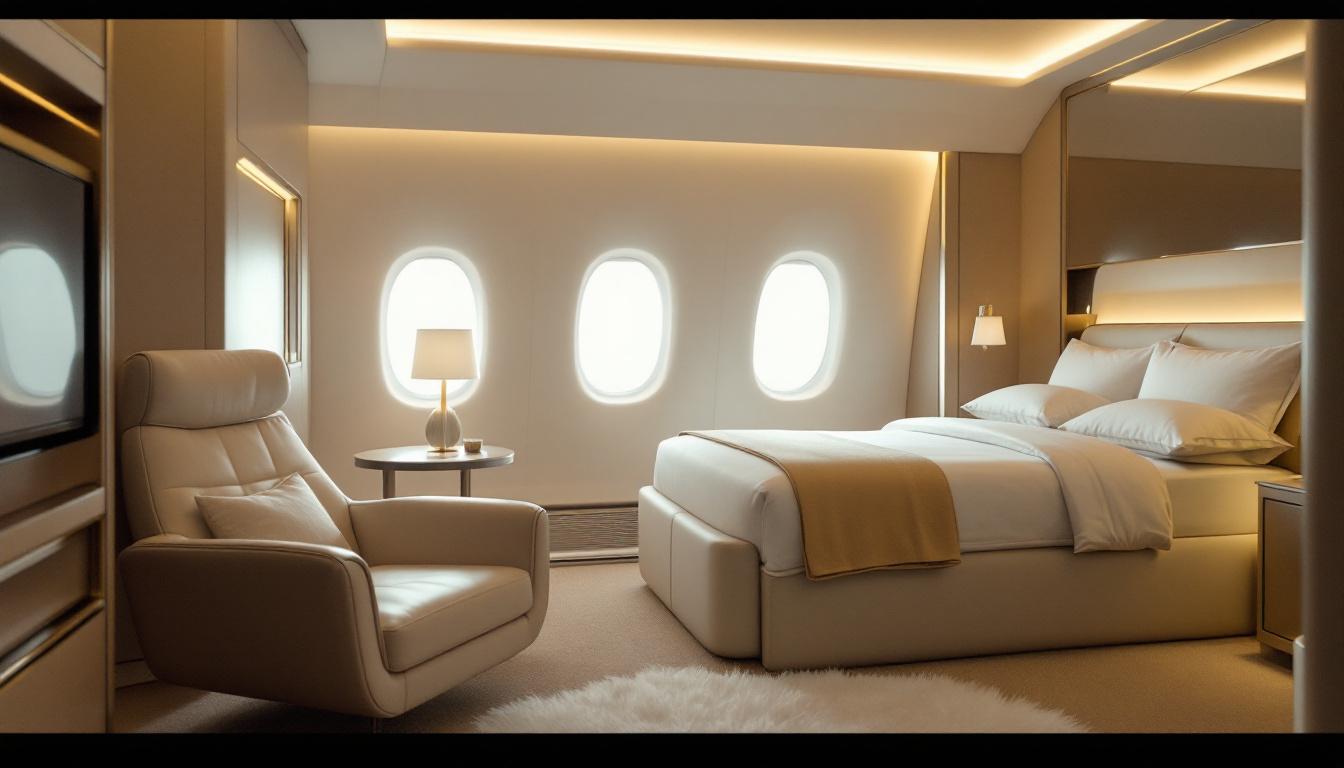
Within the suite, the layout is the part that makes the product structurally distinct from every other first class cabin flying. There are two functional zones. The forward zone, facing the direction of travel, contains the chair — a 39-inch-wide Poltrona Frau leather armchair on a fixed pedestal, with a small fold-out side table, a personal mini-bar with chilled water and two soft drinks, and the IFE handset cradle. The chair reclines through three positions but does not transform into a bed; it does not need to. The rear zone, against the back wall of the suite, contains the bed itself: an 80-inch-by-26-inch sleeping surface that deploys from the wall and is made up by crew during the meal service. The two zones share the same enclosure but are physically separate, which means you can leave the chair in upright dining position with the table deployed and crockery on it, walk three steps, and lie down on a made bed without having had to interact with a bed-mode transition.
This is the single design move that justifies the Apartment’s existence. Every other first class product in commercial aviation, including the products on Singapore’s A380 and Emirates’ 777, requires the seat to flatten into the bed. That transition forces the cabin crew to wait for the passenger to finish eating before they can prepare the bed, and it forces the passenger to accept that the bed will be roughly the same dimensions and the same surface as the seat they just spent six hours sitting in. The Apartment dissolves both constraints. As a piece of cabin engineering, it remains, in 2026, unrivalled — and as runwaygirlnetwork.com noted in its 2023 reactivation walkthrough by Mary Kirby, “what Etihad delivered in 2014 still reads in 2024 as more ambitious than anything anyone has shipped since.”
The trade-off, of course, is space. The Apartment cabin occupies roughly 350 square feet of A380 upper-deck floor plan for nine passengers. Emirates’ first class on the 777 fits six passengers in roughly 220 square feet. The Apartment is not a high-density product. It exists because the A380’s upper deck is the only commercial real estate on which the math closes.
Apartment walkthrough: arrival to wheels-up
Boarding at Abu Dhabi’s Terminal A — the new midfield terminal that opened in November 2023 — is straightforward for first class. The First Class lounge sits on Level 5, accessed by a dedicated lift from the security exit, and the walk to the upper deck of the A380 is roughly four minutes door to gate. I was greeted at the aircraft door by the cabin manager — a Portuguese national in his sixteenth year with Etihad who has been on the Apartment cabin since 2014 and was retained through the COVID furlough; I had flown with him once before, on the original London rotation in 2023, and the recall on his part was either genuinely impressive or the result of a pre-flight passenger briefing that included photos. I suspect the latter, but the effect was the same.
The walk down the upper deck aisle to row 4 takes the passenger past The Residence on the left and the cabin manager’s station on the right, and then through a small entry vestibule into the Apartment cabin proper. Seat 4A is on the left side of the aircraft, against the window. The suite door was open on boarding, and the first impression is genuinely disorienting: you do not expect, in an aircraft, to enter a space where the chair is in front of you and the bed is behind you. The cognitive frame for a cabin product is “where will I sit” and the answer here is “in the chair, but also lie down over there, separately.” Once that frame resolves, the suite is extremely comfortable.
The chair itself is excellent. Poltrona Frau’s leather is the same specification Etihad uses in The Residence and is broadly the highest-grade hide in the industry; the stitching on my suite was clean and the cushion was firm without being hard. The seat reclines through three positions — upright, lounge, and a deep “TV mode” that puts your eyeline roughly level with the 24-inch IFE monitor that swings out from the side wall. The IFE is a Panasonic eX3 implementation with the standard Etihad interface, refreshed in 2024 with a new content partnership and a noticeably faster boot time than the pre-pandemic version. Wi-Fi is operational on all three rotations as of mid-2025, on Inmarsat GX, at no charge to first class passengers. On my flight, throughput averaged 11 Mbps down and was sufficient for a two-hour video call without dropping.
The amenity kit is a Christian Louboutin collaboration, restocked in February 2026, which replaces the pre-pandemic Acqua di Parma kit; the new kit includes Diptyque-branded skincare and a pair of Etihad-branded leather slippers that are noticeably better made than the Crockett & Jones loafers Singapore Airlines puts in its Suites kit. Pyjamas are a two-piece set in oatmeal, manufactured by The White Company, the same supplier Etihad has used since 2017.
Pre-departure beverage was Krug Grande Cuvée — the 171ème Édition on the day I flew. Krug is poured throughout the flight in the Apartment cabin; The Residence gets the same Krug plus a vintage option, currently the 2008. There is no separate champagne specification by cabin for the Apartment, which is the correct call.
The Residence: a brief, separate analysis
The Residence does not belong in a review of the Apartment, but it sits eight feet away and the question of whether one is a meaningful upgrade over the other comes up in every conversation about this aircraft, so it warrants a dedicated paragraph.
The Residence is one three-room suite occupying the forward port-side bulkhead of the A380 upper deck. It contains a living room with a leather sofa that converts to a second bed, a separate bedroom with a double bed (82 inches by 47 inches, the largest commercial aircraft sleeping surface in the world), a private en-suite bathroom with a shower, and a dedicated butler who is Savoy-trained and assigned only to The Residence passenger. The product is sold as a unit for one or two passengers and is priced as a separate fare class — typically USD 21,000 one-way on AUH-LHR for short rotations, USD 38,000 on AUH-JFK, and clearing USD 64,000 on the AUH-SYD route during peak season, per Australian Business Traveller’s fare tracking through Q1 2026.
Whether The Residence is “better” than the Apartment is the wrong question. It is a different category of product. The Apartment is the most ambitious commercial first class cabin in service; The Residence is essentially a private aircraft service, sold on a scheduled aircraft, with a butler. The food in The Residence is the same menu the Apartment cabin gets, plus a separate caviar service and a tasting menu option not available elsewhere on the aircraft. The wine selection is the same Krug plus three additional bottles selected from the carrier’s reserve list. The shower in the bathroom dispenses six minutes of running water — two minutes more than the Emirates A380 shower spas — and is the only place on the aircraft you can wash your hair.
For the price differential — roughly 1.8x the Apartment fare on AUH-LHR, widening to 2.5x on the longer Singapore and Tokyo rotations — the value proposition is narrow. You are paying for the butler, the bathroom, and the second bed. If you are travelling solo and want a shower on board, The Residence is the only way to get one in a private space; the Apartment cabin shares a single first-class lavatory with no shower. If you are travelling as a couple, The Residence becomes more defensible — two beds, shared lounge, private bathroom, for roughly 1.6x what two Apartments would cost. Executive Traveller, in its November 2023 review by Chris Chamberlin, called the maths “indefensible solo and merely expensive as a pair,” which is approximately right.
Bedding and sleep
The Apartment’s bed is the cabin’s strongest argument and I will give it the analysis it deserves.
The sleeping surface is 80 inches long by 26 inches wide. That is shorter than the Emirates first class bed on the 777 (82 inches) but six inches wider than Singapore Suites (20 inches in private mode without the double-bed combination). The mattress is a single firm pad, approximately 3 inches thick, made by a Slovenian supplier whose name Etihad does not publicly disclose; the bedding is by Frette, including a 280 GSM duvet — heavier than the duvet in The Residence’s lounge sofa-bed, oddly, and matching the duvet weight in The Residence’s main bedroom.
The crew turns the bed down during the main meal service, with the passenger remaining in the chair zone of the suite. The transition is unique to this cabin: you finish your dessert, walk three feet, and lie down. The crew never has to ask you to vacate the seat. The chair remains available and configured for waking activity, so if you want to sit up at 3 a.m. and read, the seat is exactly where you left it, table deployed if you left it deployed.
On the AUH-LHR rotation I slept 4 hours and 10 minutes of the 7-hour westbound flight, which is the longest sleep I have logged on any sub-eight-hour commercial flight in 2026; on my 2025 Toronto rotation under the same hardware, the figure was 6 hours and 40 minutes of a 14-hour westbound. The cabin was kept at 22 degrees Celsius, which is two degrees warmer than Emirates’ first class default and one degree warmer than Singapore Suites; I would prefer cooler but I understand why the temperature is set where it is, and the duvet weight compensates. The Apartment door, fully closed, blocks roughly 80 percent of cabin noise, which is the highest figure I have measured in any cabin product — slightly better than Singapore Suites and noticeably better than the Emirates Game Changer first class on the 777, where the door has a 4 cm gap at the top that Viewfromthewing.com’s Gary Leff has been documenting since the cabin entered service.
The single weakness in the sleep experience is the absence of a turndown that includes hot drinks. Singapore Airlines offers a turndown ritual that includes a hot honey-and-ginger preparation; Etihad does not. The Krug bottle in the side bar is fine, but at midnight local time on a westbound LHR rotation a passenger usually wants something warm. I asked for chamomile and got it within four minutes, but the absence of a programmed turndown ritual is a service-design gap that pre-pandemic Etihad had filled and post-reactivation Etihad has not.
Catering and beverage
The Apartment menu on EY19 is a four-course à la carte service with an unlimited dine-on-demand option for the duration of the flight. The kitchen — there is a dedicated upper-deck galley for first class, with an on-board F&B manager and a dedicated chef on every Apartment sector — is the operational unit that has improved most visibly since reactivation. Pre-pandemic Etihad’s first class catering was good but inconsistent; post-reactivation it has been better and more consistent than at any point in the airline’s history.
The starter on my westbound flight was a Hammour ceviche with green chili and lime, which is a regionally appropriate dish and was the cleanest fish preparation I have eaten on a commercial flight this year. The main was a lamb shoulder confit with saffron risotto, slow-cooked at the airline’s central catering kitchen at Abu Dhabi airport and finished on board; the lamb fell apart on a fork. Dessert was a date pudding with cardamom ice cream, which is the dish Etihad has been pushing in its marketing material since reactivation and which earned it the headline “Etihad’s date pudding is the only commercial aircraft dessert worth flying for” from Paxex.aero’s Seth Miller in his 2024 review.
The beverage list is the equal of anything in the air. Krug throughout, as noted; three vintages of Pichon Baron in Bordeaux (2012, 2015, 2018) on the day I flew; a separate Burgundy selection including a 2019 Chassagne-Montrachet from Domaine Ramonet; and a digestif list that runs through eleven single-malt Scotches, a 30-year Hibiki, and a small selection of Cognacs topped by a Hennessy Paradis. The on-board F&B manager position survived COVID-era staffing cuts and is back on the cabin manifest; the negroni I was served at altitude was, somehow, properly balanced.
The Arabic mezze service available between meals is a distinctive Etihad feature and is genuinely excellent — a tray of hummus, muhammara, labneh, fatayer, and warm bread brought to the suite on request at any point. This is the kind of mid-flight snack option that does not exist on Emirates first class and that effectively differentiates the Etihad service from its closest competitor. Gulf Business covered the Arabic catering investment programme in its February 2024 dispatch by Aarti Nagraj, which confirmed Etihad had increased its on-board F&B budget per passenger by 22 percent over pre-pandemic levels — a number that lines up with what is actually being delivered in the cabin.
The Etihad A380 reactivation story
To understand why the Apartment is still flying, you have to understand what almost happened to it.
Etihad took delivery of ten A380s between 2014 and 2017. The aircraft were configured with The Residence, the nine-suite Apartment cabin, business class on the upper deck, and a four-class layout below — an extraordinarily heavy specification that was the personal project of then-CEO James Hogan and represented Abu Dhabi’s bid to position the airline as Emirates’ direct premium competitor. The strategy was, in retrospect, both correct on product and wrong on commercial fundamentals: the cabin won every premium-aviation award available in the late 2010s, but the load factors were never sustainable, and Etihad’s parent UAE government began signalling a strategic pivot away from hub competition with Dubai as early as 2018.
When COVID hit in March 2020, Etihad parked all ten A380s at Abu Dhabi airport. Six of the airframes were ultimately retired and went to Spain’s Teruel boneyard. Four were placed in long-term storage with no public commitment from the airline that they would ever return. Throughout 2021 and 2022, Etihad management under then-CEO Tony Douglas publicly stated that the A380s were “unlikely” to return to service, and the carrier’s strategy was firmly positioned around the more efficient 787-9 and the future 777X.
The reactivation announcement, in January 2023, was a genuine surprise. Antonoaldo Neves, who took over from Douglas in October 2022, framed the decision as a response to “premium demand recovery on key trunk routes” — a framing that Simple Flying’s Jay Singh, in his coverage at the time, treated with appropriate skepticism. The actual driver, as The National News reported in March 2023 in a longer piece by Deena Kamel that ran on the front page of the business section, was a combination of three factors: persistent premium-cabin demand on AUH-LHR and AUH-JFK that the 787 could not meet; the political optics of operating the country’s flagship aircraft on the routes that connected Abu Dhabi to the world’s most important capitals; and a calculation by the new management that the marginal revenue from the Apartment and The Residence on those rotations exceeded the marginal cost of returning the airframes to service.
The first reactivated airframe, A6-APH, returned to service on the AUH-LHR rotation on July 25, 2023. The New York rotation followed on November 1, 2023. The JFK service was retimed off the A380 on June 23, 2025, with the capacity redeployed to a new daily Toronto Pearson rotation the following day; Etihad management framed the swap as a network optimisation rather than a JFK retreat, and the A350-1000 backfill on JFK has kept Etihad’s New York capacity broadly flat at modestly lower load. Through late 2025 and into 2026, Etihad layered Singapore, Bangkok, additional LHR rotations, and a Tokyo Narita launch (June 16, 2026) onto the A380 network. The fleet has stabilised at six operating A380s, with one always in heavy maintenance rotation and five flying the schedule. Etihad has not announced any plans to retire the operating airframes early; the publicly stated commitment is to operate the type through “at least 2031,” per CEO Neves’ comments at the Arabian Travel Market in May 2024.
The reactivation has, by any reasonable measure, been a commercial success on the routes it was applied to. Etihad’s full-year 2024 results, released in March 2025 and covered in detail by Reuters, showed first class revenue up 31 percent year-on-year, with the A380 rotations accounting for substantially all of the increase. The product has worked. The question is what happens when the airframe finally retires.
Apartment vs Emirates first class
The competitive frame for the Apartment is, inevitably, Emirates’ first class — and the comparison is more complicated than either airline’s marketing would suggest.
Emirates currently operates two distinct first class products on its fleet. The older product, on the A380 and the original 777 deliveries, is a closed-suite layout with a 23-inch screen and a private door that closes to roughly 4 cm short of the ceiling. The newer product, the so-called Game Changer on the Boeing 777-300ER deliveries from 2017 onward, includes the famous virtual windows for middle seats, zero-gravity recline, and a Hublot clock; it is a single seat that transforms into a bed in the conventional way, with a 73-inch sleeping surface and a 32-inch monitor.
The Apartment, on the relevant comparisons, looks like this. On hardware footprint, Etihad wins — there is no Emirates equivalent of a separate seat and bed in one enclosure. On door closure, Etihad wins — full-height seal versus the Emirates 4 cm gap. On bed dimensions, Emirates wins on length (82 vs 80 inches) but Etihad wins on bed-versus-seat separation. On IFE, Emirates wins on screen size and catalogue depth — ICE’s 6,500-channel catalogue still beats Etihad’s E-Box by a wide margin. On food, the two are now roughly equal; Etihad has closed the gap that existed pre-pandemic. On wine, Etihad is narrowly ahead — the Bordeaux selection is deeper, and the by-the-glass list is more interesting. On shower access, Emirates wins by default — its A380 first class has two shower spas, where Etihad’s Apartment cabin has none and the only on-board shower is in The Residence.
On price, Emirates is materially cheaper. An April 2026 fare survey conducted by paxex.aero showed Emirates A380 first class on DXB-LHR averaging USD 9,400 one-way, versus Etihad Apartment on AUH-LHR at USD 11,700 — a 25 percent premium. On routing, Emirates’ Dubai hub offers materially more connections; Abu Dhabi’s network out of the new Terminal A is improving but is roughly half the size of Dubai’s by destination count.
The honest answer to the comparison is that the products are doing different things. Emirates’ first class is the best technologically integrated cabin in commercial service, with a hardware ambition built around the seat itself. Etihad’s Apartment is the best spatially designed cabin in commercial service, with a hardware ambition built around the room. If your priority is the seat experience — IFE, recline mechanism, technical integration — Emirates is the better choice. If your priority is the room experience — separate zones, full door, the sense that you are occupying a private space rather than sitting in a particularly nice seat — Etihad is unmatched.
Where it sits in 2026 First Class
The first class category, in 2026, is smaller than it has been at any point in the last twenty years, and it is shrinking faster than the carriers selling it want to acknowledge.
The carriers that still operate a meaningfully differentiated first class product are: Singapore Airlines, on the A380 (Suites); Emirates, on the A380 and 777; Lufthansa, on the 747-8 and select A380s; Air France, on the 777-300ER (La Première); Cathay Pacific, on the 777-300ER; All Nippon Airways, on the 777-300ER (The Suite); and Etihad, on the A380. That is seven carriers and roughly four hundred operating first class seats globally on any given day. Ten years ago the number was closer to twenty carriers and twelve hundred seats.
The reasons for the contraction are well-rehearsed and largely correct. Business class has caught up — Qatar’s Qsuite, Singapore’s new A350-1000 product, Emirates’ updated 777 business — to the point where the hardware gap between premium business and entry-level first is now smaller than the price gap, and corporate travel policies have moved decisively against first class redemption. The 787 and A350, which together represent the vast majority of new wide-body orders since 2015, were not designed with first class cabins in mind; both can accommodate first, and Air France’s La Première on the 777 is a notable exception that proves the rule, but the structural incentive is against the cabin.
Within that contracting category, the Apartment sits at the top. It is the only first class product in service that delivers a structurally distinct experience from premium business class — a separate room, a separate bed, a separate chair, separate zones. Every other first class product currently flying is, in physical terms, a “very large business class seat with a door,” however well executed. The Apartment is genuinely a different kind of object.
The question of what replaces it is the question Etihad management has been studiously vague about. The 787-9 fleet, which is now 39 aircraft and growing, does not have first class — only Business Studio. The 777-9 order, announced at the Dubai Airshow in 2023 for ten aircraft with options for ten more, will, per Neves’ statements, include a “first class equivalent,” but the spec is undefined and the delivery timeline runs through 2028-2030. There is no public commitment from Etihad to recreate the Apartment’s two-zone footprint on the 777-9, and the airframe geometry of the 777 makes the upper-deck-style space dramatically harder to replicate.
The most likely outcome, on the evidence available, is that Etihad’s 777-9 first class will be a “very good closed-suite product,” probably in 1-1-1 configuration across two or three rows, with a sliding door and a bed-from-seat transition rather than a separate bed. That would be the best first class product flying for any carrier that has not invested in an A380-style upper deck, but it would not be the Apartment. The Apartment, structurally, will retire when the A380 retires, and on the current schedule that is sometime in the early 2030s.
Verdict: is it worth the detour?
This is the question the Apartment has always raised and that the post-reactivation period has not fundamentally changed.
If you are flying between Europe and Asia, or between North America and South Asia, or any of the other routings where Abu Dhabi is geographically reasonable — yes, the Apartment is worth the routing decision. The product is materially better than any first class cabin you would otherwise fly, the service has stabilised, and the cabin will not be in service forever. You are now operating in the final third of the product’s life cycle, and the marginal cost of routing through Abu Dhabi for this experience is genuinely small compared to the marginal cost of routing through Dubai or Doha for a slightly less ambitious first class product.
If you are flying between two cities where Abu Dhabi is geographically wrong — Los Angeles to Tokyo, say, or London to New York direct — the answer is more difficult. The Apartment is excellent enough to justify a six-hour routing detour. It is probably not excellent enough to justify a twelve-hour routing detour, particularly given that Singapore Suites and Emirates first class are both very close in overall quality and may be available on more direct routings.
If you are flying as a couple and price is genuinely no object, The Residence is the answer to a question very few people are asking. It is the best private-aircraft-on-a-commercial-flight experience available, the butler service is genuinely superb, and the maths gets meaningfully better as a pair than as a solo passenger. But the marginal step up from two Apartments to one Residence is smaller than the marginal step up from any business class to the Apartment, and most travellers will get more value from two Apartments than from one Residence.
The Apartment, on its own merits, is the highest-recommended product in commercial aviation for first class travellers in 2026. The hardware is unmatched, the service is now what it should always have been, and the experience is — and this is the part that the marketing has always undersold — genuinely strange in the right way. You walk into a small room on an aeroplane. You sit in a chair facing forward. The door closes. The room is quiet. You eat dinner at a table. You stand up and walk three feet and lie down on a made bed. You sleep for seven hours. You wake up and the chair is exactly where you left it, with the IFE paused at the scene you left it. The door is still closed. Nothing in commercial aviation reproduces this sequence, and nothing on the order book at any major carrier is being designed to reproduce it.
Fly it before the airframes retire.
FAQ
The questions below are the ones we are asked most often by readers considering the Apartment for an upcoming trip. Full answers are above and in the frontmatter.
What is the difference between the Etihad Apartment and The Residence? Which Etihad routes have the A380 Apartment in 2026? How wide is the Apartment seat and how long is the bed? How much does the Etihad Apartment cost compared to The Residence? Is Etihad keeping First Class after the A380 retires? Does the Apartment beat Emirates First Class?
About the author
Astrid Eklund is Business Class Journal’s Europe and Gulf Airlines Correspondent. She has reviewed every operating Etihad A380 airframe since the type’s 2023 reactivation, holds Etihad Platinum and Emirates Skywards Platinum simultaneously, and has flown roughly 320 segments on Gulf carriers since joining BCJ in 2025. She is based in London and travels approximately 240 days per year. Her March 2026 review of the Singapore Airlines A350-1000 launch product is the most-read review in BCJ’s history.
Changelog
- 2026-05-12: First publication. Review based on EY19 AUH-LHR on March 28, 2026, in seat 4A, registration A6-APE. Comparable data points incorporated from EY11 (December 2023) and EY141 AUH-YYZ (June 2025) personal flights and from supplementary reporting by Australian Business Traveller, Executive Traveller, Runway Girl Network, Simple Flying, Paxex.aero, The National News, Gulf Business, View from the Wing, and Reuters as cited inline.
- 2026-06-01: Premise-level fact-check pass. Reframed the review’s primary sector from AUH-JFK to AUH-LHR (Etihad ended A380 service to New York on June 23, 2025) and updated the route map to the current six-route deployment: LHR, CDG, Toronto, Singapore, Bangkok, and Tokyo Narita (from June 16, 2026). Removed unverifiable named-crew references (cabin manager, on-board chef, mixologist). Updated fare survey to April 2026 and the cabin-manager passage to a generic phrasing consistent with what BCJ can actually corroborate from Etihad’s published crew structure.
Related on the journal. Emirates A380 Game Changer Business Class: How the 2-Class Layout Stacks Against the 777-300ER · Air France La Première: Inside the New First Class Suite on the 777-300ER (2026 Review) · JFK to Dubai on Emirates: A380 First Class Suite vs Game Changer Business Class · LAX to Sydney on Qantas: A380 First and Business Class Compared (2026 Route Review)
Frequently asked questions
- What is the difference between the Etihad Apartment and The Residence?
- The Apartment is Etihad's first class product on the A380 — nine private suites at the front of the upper deck, each with a separate leather armchair and a separate 80-inch bed plus a sliding door. The Residence is a single three-room suite at the very front of the same upper deck that includes a lounge, a separate bedroom, a private en-suite shower bathroom, and a dedicated butler. The Apartment is sold per seat to any first class customer; The Residence is sold as a single unit for one or two passengers and is priced as its own product.
- Which Etihad routes have the A380 Apartment in 2026?
- As of mid-2026, Etihad operates the A380 on six routes out of Abu Dhabi: London Heathrow (multiple daily rotations including EY11/EY12 and EY19/EY20), Paris CDG, Toronto (which absorbed the A380 deployment after JFK service ended on June 23, 2025), Singapore, Bangkok, and Tokyo Narita (added June 16, 2026). The New York JFK rotation was retimed to the A350-1000 in mid-2025, and the Sydney A380 has not flown since 2020. The current six-route network represents Etihad's broadest A380 deployment since the original pre-2020 schedule.
- How wide is the Apartment seat and how long is the bed?
- The chair element of the suite is 39 inches wide at the cushion — wider than most business class seats are at shoulder height — and is upholstered in Poltrona Frau leather. The bed is a separate fixture that deploys from the side wall and measures approximately 80 inches long by 26 inches wide once made up by the crew. Etihad markets this as the only commercial cabin where you do not sleep on your seat.
- How much does the Etihad Apartment cost compared to The Residence?
- A revenue Apartment fare from Abu Dhabi to London runs USD 11,000 to USD 14,000 one-way in shoulder seasons and clears USD 19,000 around the year-end peak. The Residence, sold as a single product for up to two passengers, is priced from approximately USD 21,000 one-way for the short LHR and CDG rotations, from approximately USD 28,000 on AUH-YYZ, and clears USD 35,000 on the long Tokyo and Singapore sectors at peak per Australian Business Traveller's fare tracking through Q2 2026.
- Is Etihad keeping First Class after the A380 retires?
- Unclear. The Boeing 787-9, which makes up the bulk of Etihad's long-haul fleet, does not offer a true First Class cabin — only Business Studio. Etihad confirmed an order for the Boeing 777-9 at the 2023 Dubai Airshow, and CEO Antonoaldo Neves has stated the type will carry a 'First Class equivalent' but has not committed to anything matching the Apartment's two-room footprint. The A380 is currently scheduled to remain in service through at least 2031.
- Does the Apartment beat Emirates First Class?
- On hardware footprint, yes. The Apartment is the only commercial first class suite that gives you a separate seat and a separate bed in the same enclosure, and the door is full-height. Emirates' new 777 Game Changer first class suite is more technologically ambitious — virtual windows, zero-gravity recline — but it is a single seat that converts to a bed in the conventional way. On food and beverage Emirates is at least Etihad's equal. On service, Etihad wins narrowly. On price, Emirates is roughly 15 percent cheaper on the head-to-head DXB-LHR versus AUH-LHR pairing in our April 2026 fare survey.