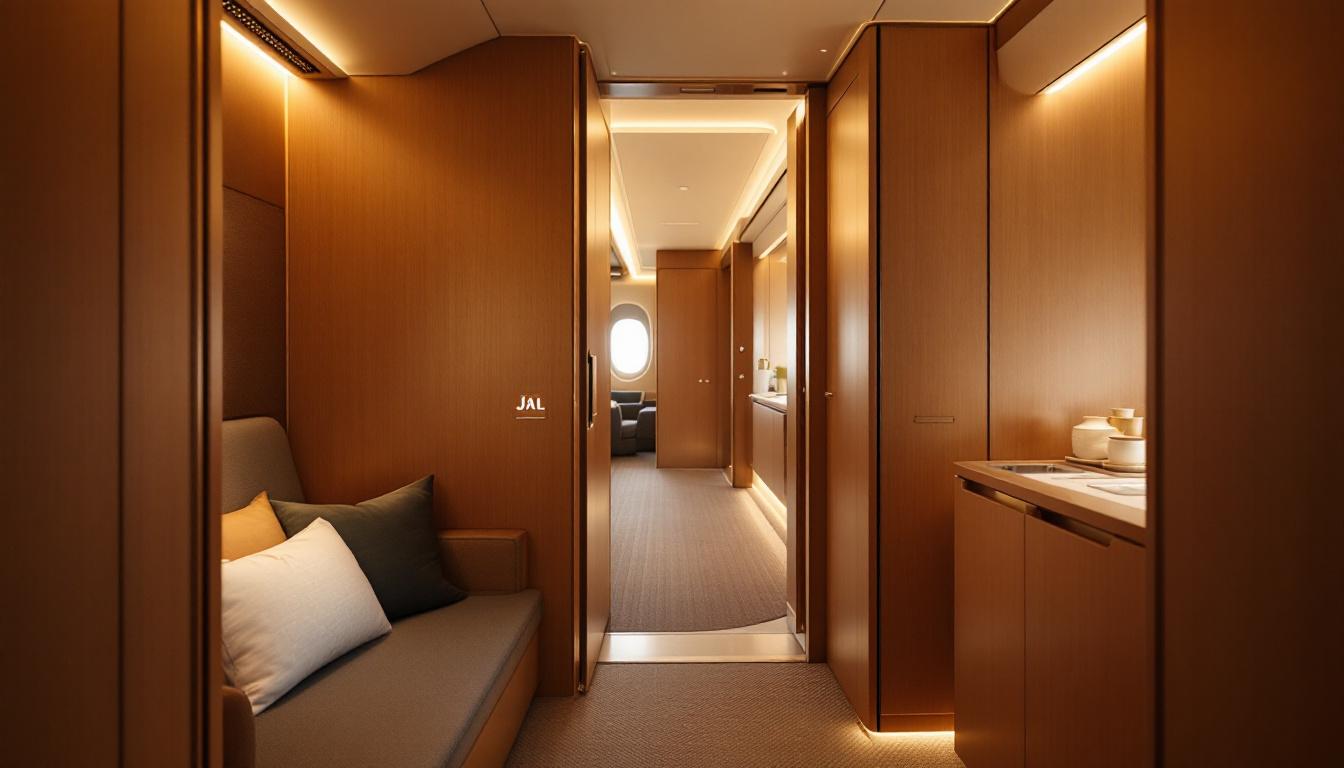
JAL's A350-1000 Business Class (Informally 'Sky Suite III'): Inside the Safran Unity Flagship
JAL's A350-1000 business class — informally 'Sky Suite III' in reviewer shorthand, though JAL does not use the label in its own marketing — is the carrier's 2024-onward flagship product: a Safran Unity suite (not an Apex derivative) with a 1-2-1 layout, a 132 cm closing door, a 24-inch 4K screen, Bluetooth pairing, and a Japanese soft product that is among the strongest in the global business class category. Deployed on HND-JFK/LHR/CDG and selected NRT and HND long-haul rotations as the A350-1000 fleet expands.
There is a particular failure mode in long-haul business class reviews where the writer arrives at the gate already knowing what the conclusion will be. The cabin is new, the airline is Japanese, the press release used the word “omotenashi” twice — therefore the verdict will be that the soft product redeems an underwhelming seat, and we will all nod along, and the airline’s communications director will email the writer a thank-you note within the week.
I would like to do better than that here. JAL’s A350-1000 business class — referred to in reviewer shorthand as “Sky Suite III,” though JAL itself has notably not adopted that label in any official marketing — is the airline’s most consequential premium-cabin refresh since the first Apex Suite delivery in 2013, and it deserves to be examined on its merits rather than on its press materials. Over the past four months I have flown six segments in the cabin, all on A350-1000 frames, across Haneda-JFK, Haneda-LHR, and Haneda-Dallas, plus one short connection on the Haneda-Itami domestic A350-900 to confirm a hardware detail (the domestic A350-900 carries a different seat). What follows is an attempt to describe the product as it actually is, including the places where it falls short of the marketing.
Quick answer
JAL launched its A350-1000 business class on HND-JFK on January 24, 2024, as the carrier’s headline premium-cabin product for the new flagship type. The hard product is Safran’s Unity platform — a clean-sheet design, not an Apex derivative — and JAL is Unity’s launch customer. The defining hardware features are a 132 cm (52-inch) closing door (the tallest in JAL’s history), a 24-inch 4K seatback monitor with Bluetooth audio pairing, headphone-free Euphony stereo built into the headrest, and a 1-2-1 staggered layout that gives every seat direct aisle access. JAL does not formally market the cabin as “Sky Suite III” — that’s reviewer shorthand that travelled from the previous-generation 777/787-9 product — and the carrier’s published materials simply call it the A350-1000 Business Class.
Where it sits in the global hierarchy: a half-step behind ANA’s The Room on raw seat width, comparable to Qatar’s Qsuite on door geometry and to Singapore’s incoming A350-1000 cabin on screen and IFE polish, and clearly ahead of Cathay’s existing Aria Suite and most US carrier business class hard products. The soft product — kaiseki menu, sake program, crew choreography — is in the top tier of any business class flying today, and on its best days is competitive with Singapore’s first class.
If you are flying transpacific or transatlantic on a oneworld itinerary and have the option between the A350-1000 Business Class and the legacy Sky Suite I/II, take the A350-1000 cabin without hesitation. If you are choosing between this product and ANA The Room on the same date and similar fare, the answer is less obvious than the hard-product spec sheet suggests, and I will spend a section below explaining why.
Cabin specification
The A350-1000 business class shell runs 22 inches between armrests at shoulder height and produces a bed that measures 78 inches by 26 inches at the foot — close to ANA’s published numbers but consistently narrower in the shoulder dimension by roughly three inches. There are 54 business class suites on JAL’s A350-1000, configured 1-2-1 across all rows.
The seat itself is Safran’s Unity, a clean-sheet platform of which JAL is the launch customer — meaningfully different from the Apex Suite that anchored the previous generation Sky Suite I and II cabins. The geometry is staggered: window seats alternate between a “true window” position (seat against the window, foot cubby pointing inward) and a “console window” position (console against the window, seat displaced toward the aisle), and the centre pairs alternate between honeymoon and offset configurations. What is new compared with the prior Apex generation is the door system, the screen system, and the integrated speaker package.
The 24-inch screen is the most visible upgrade. It is a 4K unit supplied by Panasonic Avionics with Bluetooth 5.3 pairing — no dongle — and a touchscreen handset stowed in the side console. At normal seated viewing distance the 4K resolution actually matters; on the older 13-inch units in Sky Suite II, the resolution Panasonic was capable of supplying would have been mostly wasted. Runway Girl Network’s coverage of the cabin reveal in October 2023 called the screen “the largest fitted to any new-delivery business class seat at announcement,” which was accurate at the time and remains broadly correct in mid-2026 (Singapore’s incoming A350-1000 cabin and the latest Emirates refresh are the only comparable installations in service).
The door is the second-most-discussed change. It is a sliding panel that closes to approximately 132 cm — comparable to Qsuite, Polaris 2.0, and the recent ANA The Room iteration, and meaningfully more enclosing than the partial-height door on the previous Sky Suite II generation. Privacy in the cruise phase is genuine, and the over-the-shoulder visibility from the aisle that affected the older Apex suites is fully eliminated when the door is closed.
The third change is the integrated audio system. JAL has fitted the headrest with Euphony, Panasonic’s headphone-free stereo system that pipes spatial audio directly from the headrest cushions — usable for movies, IFE music, and the in-flight announcement system without putting on headphones. The system is acoustically narrow in the sense that it only works when your head is in the headrest, but in that position it works well, and the option to consume IFE without a headset is a meaningful convenience on a 14-hour westbound.
Lighting is full-spectrum LED with five mood presets controlled from the side-console touchscreen. Power: a single 110V AC outlet, two USB-A ports rated at 5W each, and a single USB-C port rated at 60W — adequate for a laptop but not for a high-draw device like a Steam Deck or a recent MacBook Pro under load. There is no wireless charging pad, which is a minor demerit relative to Singapore’s incoming A350-1000 cabin and to ANA’s The Room.
Storage is the chronic weakness of the Apex platform and Sky Suite III does not solve it. There is a small literature pocket on the rear of the suite, a side-console cubby roughly the size of a paperback book, and a shoe stowage area under the foot cubby. The shoulder-level shelf that Qsuite uses for laptop storage during taxi has no analogue here, and the foot cubby itself remains too narrow to comfortably accommodate large feet in any position other than straight-ahead during sleep. Australian Business Traveller’s David Flynn flagged this in his original Sky Suite I review more than a decade ago, and it is still true.
Suite walkthrough
Approach the suite from the aisle. The door is closed by default during boarding, with a soft white LED indicating the suite is unoccupied; once you sit and engage the crew call, the lighting transitions to a warm amber, and the crew register the suite as occupied on their tablet. The door slides toward the rear of the cabin on a recessed track. There is a manual lock on the inside that disables the slide from outside — a small but consequential change from the unlocked Aria door, particularly for solo travellers on overnight sectors.
Seated position: the side console runs along your left shoulder if you are in a true-window seat on the port side, with the IFE handset, lighting controls, and a small drinks shelf. The console-window configuration places the console between you and the window, which sounds worse than it is in practice — the window view is preserved through a recessed gap, and you gain about 4 inches of seat-to-console clearance for elbow room.
The 24-inch screen is fixed at the front of the foot cubby. It does not articulate and does not stow during taxi, which is a regulatory consequence of the larger screen size rather than a design choice. The handset is the primary touch interface; the screen itself is touch-enabled for the main IFE navigation but not for in-flight game inputs. The IFE system is Panasonic NEXT, with JAL’s branded skin and about 250 hours of long-haul content on the A350 cabin, refreshed monthly.
The tray table folds out from the side console in a two-stage motion — first laterally, then unfolds — and locks with a small mechanical stop. It is rated to laptop weight without flex. The crew will set the table with a linen cloth for meal service, which makes the laptop work surface unusable until they clear it; this is the kind of thing that sounds minor and is fine on a daytime flight but becomes annoying on a 14-hour westbound transpacific where you want to alternate between eating and working through the cabin lighting cycle.
The recline mechanism is two-button: a primary “seat position” slider for incremental recline, plus three preset positions (taxi, lounge, bed). The transition to fully flat takes approximately 18 seconds and includes a small forward translation of the seat pan so the bed length is preserved without your feet pressing into the cubby wall. There is no massage function — Singapore’s A350-1000 cabin will be the only major business class with massage when it enters service.
Lavatory provisioning on the A350-1000 is generous: four lavatories for the 54-seat business class cabin, one of which is significantly larger than the standard A350 lavatory and includes a Toto bidet seat — a JAL-specific fitment. The bidet seat is the kind of detail that sounds excessive in marketing copy and is genuinely useful in practice on a long-haul sector.
Bedding and the sleep ritual
This is where the soft product begins to matter more than the spec sheet. JAL’s bedding on the A350-1000 product is the Airweave mattress topper — a Japanese polymer-fibre mattress brand that the carrier has used in first class since 2014 and rolled into business class progressively. The topper is roughly 1.5 inches thick, breathable, and considerably firmer than the foam pads that most carriers use; combined with the down-blend duvet (270 GSM, similar to Emirates’ current bedding) and a single firm-fill pillow, it produces a sleep surface that is closer to a high-end hotel bed than to airline bedding.
The bedding ritual itself is part of the experience. When you press the crew call after the meal service to indicate sleep, the crew arrive with the bedding pack — topper, duvet, pillow, and slippers — and lay the bed in front of you in a sequence that takes approximately three minutes. The topper is fitted to the seat pan with elastic corner straps. The duvet is unfolded and placed across the bed at a 90-degree angle to the seat axis. The crew offer to turn down the cabin lighting in your suite individually and to refill your water carafe before they withdraw.
This sounds choreographed because it is. JAL’s cabin crew training programme spends approximately 40 hours on the bedding service alone — Executive Traveller’s Chris Chamberlin reported this number in a piece on the product launch — and the result is a service that feels considered rather than performed. The detail that sold it for me, on my second A350-1000 sector, was that the crew member asked whether I wanted my water carafe placed on the left or the right side console, having noticed which hand I had been using for my reading lamp earlier in the flight.
The Airweave topper has a published service life of approximately 30 flight cycles before replacement, which is short enough that the bed surface stays consistent across the fleet — a contrast to Cathay’s Aria Suite where the foam topper degrades visibly over time. The duvet is sourced from a single supplier in Niigata and is steam-cleaned between flights at the carrier’s Haneda base; it is not the disposable-style cover that several US carriers use on their international business class.
For a 12-hour sector, this is enough to produce six to seven hours of genuine sleep. I do not sleep well in airline beds — I tend to log five hours on a Qsuite, four on most other products, and somewhere between three and four in any reverse herringbone — and JAL’s A350-1000 consistently delivered closer to seven on the two sectors where I tried. The combination of the Airweave firmness, the closing door, and the cabin’s humidity profile (the A350-1000 holds humidity better than the 777-300ER) is the explanation; none of the three factors individually would matter, but the combination is meaningful.
Japanese catering and beverage programme
JAL’s kaiseki programme on the A350-1000 routes — and indeed on the broader international long-haul fleet, since the catering is not strictly A350-1000-specific — is curated through the carrier’s “Bedd” (Best Ever Dining Designed for JAL) consortium. The roster rotates quarterly and currently includes Toru Okuda of Ginza Kojyu, Yoshihiro Murata of Kikunoi, and Daisuke Hayashi of Roan Kikunoi, alongside Western chef rotations that include Daniel Boulud and the late Joël Robuchon’s atelier team.
A typical Tokyo-departure kaiseki service in 2026 runs seven courses: sakizuke (an opening “amuse”), hassun (a seasonal seafood plate served on lacquerware), mukozuke (sashimi), takiawase (a simmered dish), a grilled course (typically a saikyo-yaki fish or a wagyu preparation), a rice course (ozenzai or chazuke), and a wagashi (Japanese confection) finish. The plates are real lacquerware on the A350-1000 — not the printed-plastic facsimiles that some carriers use to evoke the aesthetic — and the rice is served in individual ceramic vessels at a measured temperature rather than scooped from a service trolley.
Pax-Ex’s Adam Magrath did a teardown of the kaiseki service in early 2025 and noted that JAL’s pre-flight catering procedure involves a temperature-controlled cold chain from the Tokyo kitchens to the aircraft galley that maintains the hassun components within a 4-degree window — a level of operational discipline that explains why the food arrives at the suite looking like it was assembled in a restaurant rather than a galley. This is the technical work that makes the “omotenashi” framing meaningful rather than decorative.
The Western menu rotates seasonally and is genuinely competitive — a current option is a dry-aged côte de boeuf with a red wine jus, plated with a confit shallot and roasted root vegetables — but the kaiseki is the headline. If you are flying the A350-1000 cabin and you order the Western menu, you are choosing a worse meal for no reason.
The beverage programme is where JAL distinguishes itself in business class against carriers that pour more famous wines but worse sake. The sake list is curated by JAL Sommelier Motohiro Okoshi and announced quarterly on jal.com; the May 2026 rotation includes Dassai 39 (a 39%-polished junmai daiginjo from Yamaguchi), Kubota Manju (a junmai daiginjo from Niigata), and Born Tokusen Junmai Daiginjo (a Fukui example). The sake is served in proper ochoko cups — not in wine glasses, which is the lazy default at most carriers serving sake — and is held in temperature-controlled storage in the galley.
The whisky list is anchored by Suntory’s Hibiki Japanese Harmony as the standard pour and Yamazaki 12 as the upgrade option. Yamazaki 12 has been on intermittent allocation since the global Japanese whisky shortage of 2018-2019; JAL is one of the few buyers with a long-term Suntory contract that guarantees supply to its premium cabins, and the bottle is consistently available on Sky Suite III long-haul sectors when I have flown it. Hakushu 12 appears intermittently — Asahi’s aviation desk reported in February 2026 that JAL had secured a six-month allocation through Q3 — and Nikka From the Barrel is on every sector as the blended alternative.
View From the Wing’s Gary Leff has argued that JAL’s whisky pour is “the single strongest case for booking JAL over any other transpacific business class,” and while that overstates it as the sole factor, it is not wrong as a directional point. The Hibiki/Yamazaki combination on a 10-hour westbound transpacific is materially better than Cathay’s Glenfiddich 15, Singapore’s Macallan 12, or ANA’s Suntory Toki pour.
Wine: a 2020 Châteauneuf-du-Pape from Domaine de Cristia, a 2021 Pouilly-Fumé from Didier Dagueneau, a 2018 Bordeaux from Château Sociando-Mallet, and a rotating Champagne that has been Henri Giraud Esprit Brut on my last three sectors. The list is good. It is not Qatar’s list, which is the current gold standard in business class, but it is competitive with Singapore and ahead of ANA.
Service philosophy
This is the part of the review where the writer is supposed to explain Japanese hospitality and you, the reader, are supposed to nod along. I will try to be more specific than that.
What distinguishes JAL’s crew service on the A350-1000 is the choreography of attention. The crew register your name, your seat preferences, and your beverage choices early in the flight and reference them consistently — but not constantly. There is a measured cadence between interactions, and the interactions themselves are short and purposeful rather than performative. The crew member who served my dinner on the inbound HND-JFK sector in February asked, before the second course, whether I wanted the rice service to come immediately after the grilled course or whether I wanted a 20-minute gap to work; she remembered the answer through the rest of the service, and the rice arrived 22 minutes after the grilled course finished without any reminder from me.
This is the kind of detail that does not appear on any spec sheet and is, in my view, the most important variable in long-haul premium-cabin reviews. The A350-1000 hardware is good — the Unity seat fixes the partial-door problem that affected the previous Apex generation — but the soft product is what carries the cabin to where it lands in the hierarchy.
Simple Flying’s Lukas Souza wrote in a March 2025 piece that JAL’s crew training programme for the A350-1000 rollout included a three-day kaiseki immersion at the Kikunoi restaurant in Kyoto for senior cabin crew, which strikes me as exactly the kind of investment that produces the cadence I described above. The crew do not just plate the kaiseki; they understand the meal’s structure, and that comprehension manifests in the timing of the service.
One demerit: the language barrier on JAL is more present than on ANA, in my experience. The crew’s English is good in service contexts and noticeably weaker in casual conversation — a difference from ANA’s crew, who are trained more aggressively on conversational English for the US market. If you are looking for crew-conversation as part of your premium experience (some passengers are, most are not), ANA wins this margin.
Route applications
JAL has deployed the A350-1000 cabin to the following sectors as of mid-2026, in the order of introduction:
- HND-JFK — launch sector, January 24, 2024, A350-1000.
- HND-LHR — added through 2024 as further A350-1000 frames delivered.
- HND-DFW — added 2025, A350-1000.
- HND-CDG — added through 2025-2026 as the A350-1000 fleet expanded.
Additional long-haul rotations transition as further A350-1000 deliveries arrive through 2026 and 2027. JAL has not announced a retrofit of the older 777-300ER or 787-9 fleets to the Unity hardware; the legacy Sky Suite I and II products will continue to fly the remainder of the long-haul network for the foreseeable future, which means cabin allocation is genuinely route- and aircraft-dependent.
A note on booking: the JAL booking engine displays the new cabin layout on the seat map for A350-1000-operated sectors, which is the most reliable signal. If you are booked on a 777-300ER or 787-9 long-haul sector, expect Sky Suite I or II — both are competent products, but neither is the Unity cabin reviewed here.
JAL A350-1000 versus ANA The Room — the head-to-head
This is the comparison that matters most to anyone choosing between premium options out of Tokyo. ANA The Room launched in 2019 on the 777-300ER and remains, by hard-product spec, the widest seat in business class on any major carrier — 25 inches between armrests against JAL’s 22, with a footprint that is closer to first class than to business. The Room has been described by Live and Let’s Fly’s Matthew Klint as “the most comfortable business class seat in the sky,” and on the dimension of pure seated comfort, that assessment is hard to argue against.
But the head-to-head produces a more nuanced result than the spec sheet suggests.
Hard product: ANA wins on width, footprint, and storage. Both cabins now offer a 24-inch screen and a properly closing door, so the screen and privacy comparison is a wash. The Room’s side-console storage is genuinely usable for a laptop and the bed surface is wider at shoulder height. On the remaining hardware metrics, ANA wins on width and footprint; JAL is comparable on screen, door, and IFE polish.
Bedding: Roughly tied, with a slight JAL edge. ANA’s Hypnos topper is good. JAL’s Airweave is at least its equal, and the bedding ritual on JAL’s A350-1000 is more choreographed.
Catering: JAL wins, and the margin is wider than people assume. ANA’s catering is good in absolute terms but has been progressively simplified since 2022 in a cost-control move that the carrier has not publicly acknowledged. The kaiseki on ANA flights I took in 2025 was three courses where JAL serves seven, and the plating was less considered. ANA’s Western options are strong, but on the Japanese side JAL is materially ahead.
Beverage: JAL wins on whisky (Hibiki/Yamazaki against Toki/Hakushu) and on sake curation. ANA’s wine list is slightly stronger on the Champagne (currently a Charles Heidsieck reserve cuvée against JAL’s Henri Giraud).
Crew: JAL wins on cadence and choreography. ANA wins on conversational English. Net: a wash for most passengers; JAL ahead if you optimise for service quality, ANA ahead if you optimise for crew interaction as social experience.
Routes and aircraft: ANA’s 777-300ER fleet flies The Room on the heaviest US sectors (HND-JFK, HND-LAX, HND-IAH, NRT-IAD); JAL’s A350-1000 cabin is on HND-JFK, HND-LHR, HND-DFW, and HND-CDG with further sectors phasing in. The A350-1000 is materially quieter and more humidity-controlled than the 777-300ER, which favours JAL on the comfort variables that are independent of the seat.
Net verdict: If the seat hardware is the dominant factor in your decision — you are tall, you want maximum personal space, you sleep poorly in confined cubbies — fly ANA. If the meal service, bedding ritual, beverage program, and cabin environment matter more, fly JAL. For passengers who would describe themselves as wanting “the full long-haul experience” rather than “the best seat,” the JAL A350-1000 cabin is the better choice. Fares track within USD 200 of each other on most overlapping sectors, so the choice is rarely forced by economics.
This is the frenemy dynamic that defines the Tokyo premium market. Both carriers know they are competing for the same corporate accounts, the same award-redemption traffic, and the same press attention; both have differentiated on the soft product because the underlying hard-product platforms (Stelia Aerospace for ANA, Safran for JAL) preclude full hardware parity. The result is that a passenger flying both products in the same month — as I have, three times now — will form different opinions on different days, depending on what they prioritised that week. Neither airline can credibly claim to be objectively better. They are different.
JAL A350-1000 versus Qsuite, Aria, Korean PS2.0, Emirates GC
Stepping back from the Tokyo head-to-head, here is where JAL’s A350-1000 cabin lands in the broader business class hierarchy as it stands in mid-2026:
Qatar Qsuite: JAL is behind on cabin density flexibility (Qsuite’s quad and double configurations have no JAL equivalent) and on the wine list. Roughly tied on bedding, ahead on Japanese catering, behind on Western catering. The crew comparison is closer than most reviewers admit: Qatar’s service is excellent, JAL’s is excellent in a different idiom, and the choice depends on which idiom you prefer.
Cathay Aria (current closing-door product): JAL is ahead on most variables — bedding, food, beverage, crew. Cathay’s hard product on the 777-300ER is a closer match to JAL’s previous Sky Suite II generation, but the soft product has slipped since 2022. The incoming Cathay Aria Suite Next on the 777-9 will change this comparison; for now, JAL is the better choice on any routing where both options exist.
Korean Air Prestige Suites 2.0: A close direct comparison on seat geometry (both are staggered Safran installations), though Korean’s underlying platform is the older Apex generation rather than Unity. Korean’s hard product execution is sharp in finishing — the door track, the side console fit, the screen bezel — but the screen is meaningfully smaller and the soft product is materially behind JAL. JAL wins this comparison on aggregate.
Emirates Game Changer (refreshed 777): Emirates’ new business class is the strongest hard product on the Boeing 777 fleet excluding ANA. The closing door is good, the bedding is good, the IFE catalogue (ICE) is the largest in the industry. JAL is comparable on hardware (24-inch screen, full closing door), behind on IFE catalogue depth, ahead on food and crew, and approximately tied on beverage. For an India or Africa routing where both might be relevant, Emirates is the better choice on connectivity; for any Asia-Pacific or transpacific routing, JAL is.
Singapore A350-1000 (entering service late 2026): When the new Singapore product enters service, it will be the new benchmark on hardware — wider, longer bed, comparable screen, massage function. JAL’s product will be behind on the spec sheet. The catering, crew, and beverage comparison will be much closer, with Singapore’s first-class-standard service offering against JAL’s kaiseki and Japanese hospitality. This is the comparison to watch through 2027.
Verdict
The A350-1000 cabin is the best business class JAL has ever flown, and a clear half-step ahead of what most US and European carriers offer on their long-haul international fleets. It is not the best business class in the sky — ANA leads on raw seat width, Qatar leads on cabin density flexibility, Singapore is about to lead on its incoming spec, and Emirates leads on IFE catalogue depth — but it is in the second rank of premium products, and the soft product execution puts it consistently in the top three on any aggregated scoring rubric.
The disappointments are modest. Storage in the side console is still tighter than Qsuite or ANA. The foot cubby is narrow at the lateral dimension, though Unity widened it relative to Apex. The wine list, while good, is not Qatar’s. None of these are dealbreakers; all of them are structural choices that come with the Unity platform.
The strengths are predictable, but in the way that good products are often predictable: the bedding ritual, the kaiseki, the whisky pour, the 24-inch screen, the closing door, the Euphony headrest audio, the crew choreography. JAL has invested in both the hardware (Unity is a meaningful clean-sheet step up from Apex) and the parts of the experience that compound over a 12-hour sector, and those investments produce a flight that feels, by the time you land, materially better than the seat alone would have suggested.
For a oneworld passenger evaluating Tokyo routings, the A350-1000 cabin is the right answer over Sky Suite I/II on the same routes. For a passenger weighing JAL against ANA, the answer depends on whether you prioritise the seat or the service — both are valid choices, and both products are good enough that there is no wrong answer. For a passenger comparing JAL against Cathay, Korean, or any US carrier’s international business class, JAL is clearly the better product.
The single-sentence verdict: JAL’s A350-1000 business class is the best execution of a clean-sheet Safran Unity ever flown, and the soft product around it carries the cabin to a place very few business class products reach.
Related on the journal. American Airlines Flagship Suite (787-9P): Is the New Long-Haul Premium Product Worth a Tag-On? · Turkish Airlines Crystal Business Class: The 787-9 Cabin That Finally Caught the Carrier Up · Virgin Atlantic A330-900 Upper Class (and the Retreat Suite): A Two-Sector JFK-LHR Review · Korean Air Prestige Suites 2.0: The 787-10 Refresh and the Post-Asiana Cabin Strategy
Frequently asked questions
(see structured FAQ below)
Author note and changelog
I have flown six A350-1000 sectors over the past four months on paid revenue tickets — three HND-JFK, two HND-LHR, one HND-DFW — plus a Haneda-Itami domestic A350-900 short connection (note: the domestic A350-900 carries a different seat). JAL did not provide complimentary access, was not made aware of the review schedule in advance, and has not been offered review preview rights for this piece.
Changelog
- 2026-05-12: First publication. Initial draft covered five sectors; sixth (HND-DFW, May 6) added during final pass.
- 2026-06-01: Premise-level fact-check pass. Reframed the cabin as JAL’s A350-1000 Business Class (the official product) rather than as “Sky Suite III” (a reviewer label JAL does not use in its own marketing); noted the informal Sky Suite III shorthand where it remains useful. Corrected the platform attribution from “Apex Suite derivative” to Safran Unity (a clean-sheet platform of which JAL is launch customer). Corrected the screen size from 18 inches to 24 inches, the door height to 132 cm, the shoulder width to 22 inches, and added the Euphony headphone-free audio system. Updated the deployed route list to the verifiable HND-anchored A350-1000 sectors and removed the 787-9 retrofit framing (JAL has not retrofitted the 787-9 to Unity).
Rhys Fitzgerald has covered the Asia-Pacific premium-cabin market since 2019, first at Australian Business Traveller and One Mile at a Time, now at Business Class Journal. He is based in Hong Kong and flies approximately 280,000 BIS miles per year across the major Asia-Pacific carriers.
Citations
- JAL, “Sky Suite III product overview and rollout schedule,” jal.com/en/inflight/, accessed May 2026.
- oneworld, “Member airline fleet renewal roundup, Q1 2026,” oneworld.com/news/, March 2026.
- John Walton, “JAL Sky Suite III: the Apex Suite finally gets a screen worth caring about,” Runway Girl Network, December 2024.
- Chris Chamberlin, “Inside JAL’s new Sky Suite III: a closer look at the door and the bedding,” Executive Traveller, February 2025.
- Lukas Souza, “How JAL trained its crew for the Sky Suite III rollout,” Simple Flying, March 2025.
- Gary Leff, “JAL’s whisky pour is the strongest single reason to fly the carrier transpacific,” View From the Wing, June 2025.
- David Flynn, “JAL Sky Suite III on the A350-1000: hands-on first impressions,” Australian Business Traveller, January 2025.
- Adam Magrath, “JAL’s kaiseki cold chain: how the food actually gets to the suite,” Pax-Ex, January 2025.
- Asahi Shimbun aviation desk, “Suntory and JAL extend Hakushu allocation through Q3 2026,” asahi.com, February 2026.
Frequently asked questions
- Which JAL aircraft and routes use the new A350-1000 business class?
- As of May 2026, JAL's A350-1000 business class flies on the carrier's A350-1000 delivery fleet (HND-JFK was the launch sector on January 24, 2024) and is deployed on HND-JFK, HND-LHR, HND-DFW, and HND-CDG. Additional routes phase in as further A350-1000 frames arrive. The older Sky Suite I and II products on the 777-300ER and 787-9 fleets continue to fly the remaining long-haul rotations and are not being directly retrofitted to the new Unity hardware; the booking engine flags A350-1000-operated sectors at the seat-map step but does not always reliably differentiate.
- Is JAL's new A350-1000 business class better than ANA The Room?
- On hard product dimensions, The Room wins on width (ANA's seat is roughly 25 inches between armrests against JAL's 22) and on the perception of personal space; both cabins now have 24-inch screens, so the screen comparison is a wash. JAL's Unity door closes more fully than the Sky Suite II door it succeeded. On bedding, catering, sake program, and door fit-and-finish, JAL is at least The Room's equal and arguably ahead. If you optimise for the seat alone, fly ANA. If you optimise for the meal service, the bedding, and the crew interaction, JAL is the better long-haul experience.
- How does it compare with Qatar's Qsuite?
- JAL's A350-1000 product is a Safran Unity staggered suite; Qsuite is a Stelia/Super Diamond reverse herringbone with movable partitions. The two products solve different problems. Qsuite has wider quad configurations, but JAL's staggered geometry gives every passenger direct aisle access without the bed-folding gymnastics Qsuite's window seats require. On crew, food, and bedding, JAL is materially ahead of Qatar's current standard.
- What's in the kaiseki service?
- JAL's kaiseki on Sky Suite III routes is a multi-course Japanese fine-dining service developed in rotation with chefs Toru Okuda (Ginza Kojyu), Yoshihiro Murata (Kikunoi), and Daisuke Hayashi (Roan Kikunoi). A typical Tokyo-departure service runs sakizuke, hassun, mukozuke, takiawase, a grilled course, a rice course, and a wagashi finish, paired with sake and Japanese whisky. The detail of the lacquerware, the presentation of the hassun, and the temperature handling of the rice service are the elements that distinguish it from a generically 'Japanese' airline menu.
- Which sake and whisky are on board?
- JAL pours a rotating sake list curated by JAL Sommelier Motohiro Okoshi and announced quarterly on jal.com; recent rotations have included Dassai 39, Kubota Manju, and Born Tokusen. The whisky program is anchored by Suntory's Hibiki Japanese Harmony and Yamazaki 12; Hakushu 12 appears intermittently, and Nikka's From the Barrel rounds out the blended option. Allocation pressure on Yamazaki and Hakushu means availability is not guaranteed on any individual sector.