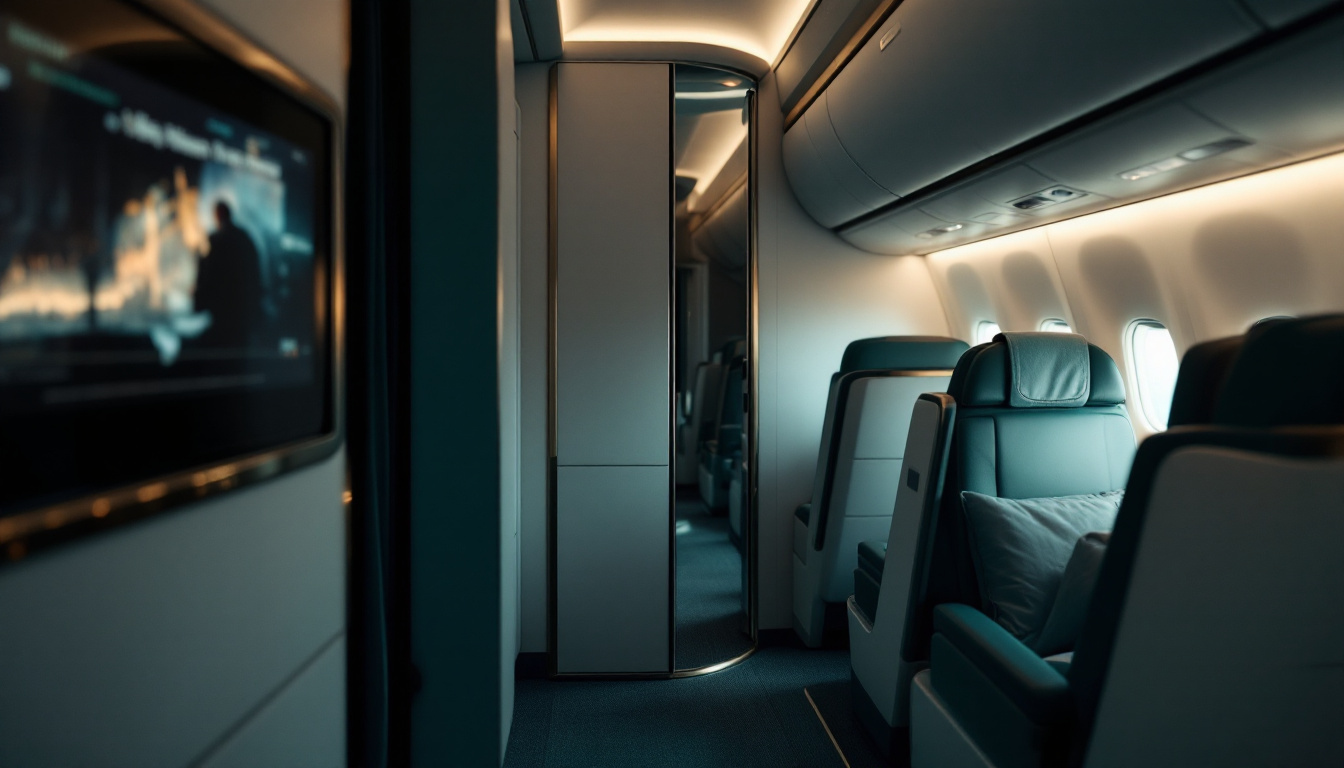
Aer Lingus Business Class on the A321XLR: A 2026 Transatlantic Review
Aer Lingus's A321XLR business class is a 16-seat 1-1 doored suite product supplied by Thompson Aero Seating, marketed as the Aer Lingus Business Class Suite. The cabin enters service progressively from late 2024 through 2026 on DUB to BOS, JFK, ORD, MIA, IAD, and the new MAN-BOS, MAN-JFK, and MAN-ORD rotations operated from Manchester. The product is competitive with JetBlue Mint Studio on the same corridor and represents Aer Lingus's first credible business-class hard product against the transatlantic competitive set.
Aer Lingus took delivery of its first Airbus A321XLR in December 2024 and has been progressively rolling out the type on transatlantic routes through 2025 and into 2026. The aircraft is the first commercial A321XLR in IAG service, predating BA’s expected XLR deployment (currently scheduled for 2027) and Iberia’s XLR rollout (also 2027). For the IAG group, Aer Lingus is the proving ground for the narrowbody-long-haul model on transatlantic — a market the group has historically run with widebodies (BA’s A350-1000 and 787 fleet, Iberia’s A350-900 fleet) and is now testing with the new airframe.
The Aer Lingus A321XLR business class — marketed as the Aer Lingus Business Class Suite — is the cabin that will define whether the narrowbody-long-haul model works on the IAG transatlantic side. I flew it on EI 137 DUB-BOS in April 2026 in seat 1A, a doored suite on EI-DDC, the carrier’s third A321XLR delivery (received in March 2025). Ticket booked through aerlingus.com on the standard ‘D’ business class fare bucket at €1,540 round-trip DUB-BOS — for context, the BA Club Suite equivalent on LHR-BOS the same week was £3,150 and the JetBlue Mint Studio equivalent BOS-LHR (the reverse direction) was $2,640.
The headline conclusion: Aer Lingus has shipped a competitive narrowbody business class product that sits between JetBlue Mint Suite and Mint Studio on the hard-product spec, and offers a credible alternative on the transatlantic corridor for the price-conscious traveler willing to fly through Dublin and take advantage of the US pre-clearance. The product is not better than the widebody competition on cabin scale or schedule density, but at the price-to-product ratio it offers, it is the strongest IAG-brand transatlantic business class for the value-anchored buyer.
The hardware
The Aer Lingus Business Class Suite on the A321XLR is supplied by Thompson Aero Seating on a Vantage XL+ derivative platform. The carrier designation is “Vantage XL+ EI” and the cabin layout is 16 doored suites in a 1-1 configuration across 8 rows. The shoulder width at the seated position is 20.5 inches — wider than the standard JetBlue Mint Suite (19 inches), narrower than the Mint Studio (22.3 inches), and at the lower end of the transatlantic business class competitive set overall.
The bed length is 78 inches toe-to-headrest with the door closed — the shortest bed in the transatlantic business class category as of May 2026, two inches shorter than the JetBlue Mint Studio (80 inches), BA Club Suite (80 inches), and Polaris 2.0 (80 inches), and four inches shorter than the Virgin Atlantic Retreat Suite (82 inches). For passengers under 5’10” (178 cm) the bed is comfortable; for passengers between 5’10” and 6’2” the bed is workable but tight at the footwell; for passengers above 6’2” the bed is genuinely too short.
The closing door is a sliding hinged panel that seals to approximately 125 cm tall — shorter than the JetBlue Mint Studio door (128 cm), the BA Club Suite door (130 cm), or the Polaris 2.0 door (132 cm). The over-the-shoulder visibility from the aisle is reduced but not fully eliminated. For the privacy-conscious passenger, this is the weakest hardware element on the cabin.
The IFE display is a 15.6-inch HD LCD supplied by Panasonic on the eX-Lite platform — meaningfully smaller than the JetBlue Mint Studio (17 inches 4K LCD) and the Polaris 2.0 (17.3 inches 4K OLED). The picture quality is competent without being category-leading, and the interface is the standard Aer Lingus IFE software which is solid for what it is.
Power delivery is the cabin’s strongest dimension: a 75 W USB-C, a 30 W AC universal outlet, and a Qi wireless charging shelf at 15 W. Total budget around 120 W — above the JetBlue Mint Studio (105 W) and BA Club Suite (105 W), below the Polaris 2.0 (297.5 W).
The Dublin pre-clearance advantage
The single most-overlooked advantage of the Aer Lingus transatlantic product is Dublin pre-clearance. DUB is one of two airports in the world (with Shannon) that operates US Customs and Border Protection pre-clearance — passengers departing DUB for any US destination clear US immigration and customs at Dublin before boarding the aircraft.
The practical benefit at the US end is meaningful. Arriving at BOS on EI 137, I deplaned at gate B4, walked the standard 4-minute walk from gate to ground transportation, and was in a car heading to downtown Boston within 12 minutes of the aircraft door opening. The equivalent BA Club Suite arrival at BOS would have involved a 20-40 minute US immigration queue at the US side (peak windows can push to 60 minutes), making the door-to-curb time 35-65 minutes in practice.
For the business traveler whose itinerary is time-sensitive — corporate roadshow legs, JPM Healthcare connections, IPO-roadshow Boston-anchored visits — the pre-clearance benefit is structurally meaningful in a way that no other transatlantic carrier replicates from a European departure point.
The soft product
The Aer Lingus business class meal program is anchored on a published chef partnership with Clodagh McKenna (the Irish chef and author whose food has appeared on Aer Lingus business class since 2018). The menu rotates seasonally with an Irish anchor — meaning Irish butter, Irish cheese, Irish beef from the Hereford-and-Aberdeen-Angus dairy program, and Irish smoked salmon as the standard first course.
On EI 137 in April 2026, the menu was the Q2 spring rotation:
- A starter of Burren smoked salmon with horseradish cream and rye toast
- A salad course of charred leek with Cashel Blue cheese
- A main choice from four: roast Hereford beef with Kerr’s Pink potatoes and red-wine gravy, Atlantic cod with a buttermilk sauce, wild mushroom risotto with crispy sage, or a curry with basmati rice
- A cheese course featuring an Irish artisan selection (Gubbeen, Cashel Blue, Coolea, Durrus)
- A dessert choice between Bailey’s panna cotta and a small fruit plate
The Irish ingredients are the meal program’s distinguishing feature. The Burren smoked salmon is genuinely excellent and the cheese selection is the strongest cheese course on transatlantic business class — meaningfully ahead of the BA Club Suite cheese program. The mains landed at the proper temperature with consistent execution. The Bailey’s panna cotta is the cabin’s signature dessert and is the strongest in-flight dessert I have had on a narrowbody business class.
The wine list is short but competently chosen: three whites, three reds, an Aer Lingus signature Champagne (typically a Lanson NV at the standard or a Pol Roger at the upgraded service), and an Irish whiskey program with a curated selection of Redbreast, Bushmills, and Powers.
Cabin crew service
The Aer Lingus cabin crew on the A321XLR business class run a notably warmer service than the typical IAG-network standard. The crew is small (typically 2 dedicated business class crew on the 16-seat cabin) and the service interaction is direct, friendly, and unfussy. For the passenger seeking a more personal cabin-crew experience than the larger widebody operations produce, this is a positive differentiator.
The Aer Lingus pajama program (a soft cotton set produced for the carrier by an Irish supplier) is available on long-haul flights to passengers on request and is the only pajama program I have logged on a narrowbody business class in 2026.
The verdict
Aer Lingus’s A321XLR Business Suite is a credible narrowbody business class product on transatlantic — not class-leading, not category-defining, but reliably competent at a price-to-product ratio that the widebody competition cannot match. The 78-inch bed and the 125 cm door are the cabin’s two real weaknesses; for passengers under 5’10” the bed length is fine, and for passengers willing to trade some seat privacy for the fare savings and the Dublin pre-clearance advantage, the cabin is the right pick.
For the IAG-network elite (BA Executive Club Gold, Iberia Plus Platino, or Aer Lingus AerClub Concierge) the cabin offers a useful alternative to the BA Club Suite or Iberia Premium when the schedule fits — the Dublin connection geography is unique, the pre-clearance advantage is structural, and the AerClub Avios earn aligns with the broader IAG program structure.
The product will define whether IAG’s broader narrowbody-long-haul thesis works on transatlantic. The early data — load factors, customer satisfaction scores at the carrier’s published level, and the steady rollout to a broader transatlantic route map — suggests the model works for the segment it targets. The next test is when BA’s own A321XLR cabin enters service in 2027, which the Aer Lingus product implicitly previews.
Related on the journal. Turkish Airlines Crystal Business Class: The 787-9 Cabin That Finally Caught the Carrier Up · Virgin Atlantic A330-900 Upper Class (and the Retreat Suite): A Two-Sector JFK-LHR Review · Korean Air Prestige Suites 2.0: The 787-10 Refresh and the Post-Asiana Cabin Strategy · British Airways Club Suite, Five Years In: The Super Diamond Settles Into Middle Age
Frequently asked questions
- Which Aer Lingus routes operate the A321XLR business class?
- As of May 2026, Aer Lingus is progressively rolling out the A321XLR across the transatlantic network. The aircraft is operational on DUB-BOS (one of the first transatlantic routes, from early 2025), DUB-JFK (from February 2025), DUB-ORD (from June 2025), DUB-IAD (from October 2025), DUB-MIA (from March 2026), and DUB-PHL (from May 2026). From Manchester, the A321XLR operates MAN-BOS, MAN-JFK, and MAN-ORD on a rotation pattern shared with the DUB-anchored operation. The carrier has 12 A321XLR aircraft in the fleet as of May 2026, with another 6 scheduled to deliver through Q4 2027. The legacy A330-200 and A330-300 fleet continues to operate the higher-density transatlantic routes (DUB-LAX, DUB-SFO, DUB-SEA, DUB-DFW, DUB-ATL) and the carrier has not announced a retirement plan for the A330 fleet.
- How does the Aer Lingus A321XLR Business Suite compare to JetBlue Mint Studio?
- Both cabins use the same Thompson Aero Seating Vantage XL+ platform with carrier-specific shell and door geometry. The Aer Lingus product runs 16 doored suites in a 1-1 configuration (versus JetBlue Mint's 12 standard + 2 Studio = 14 doored suites in 1-1). The Aer Lingus business class shoulder width is 20.5 inches and bed length is 78 inches; JetBlue Mint Suite is 19 inches / 76 inches; JetBlue Mint Studio is 22.3 inches / 80 inches. The Aer Lingus product sits between JetBlue's two Mint tiers — wider than the standard Mint Suite but narrower than the Mint Studio. The Aer Lingus pricing is typically 15-25 percent above JetBlue Mint on the same booking window but 30-45 percent below BA Club Suite. The DUB connection geography is the Aer Lingus product's distinguishing feature — the carrier's connecting itineraries through DUB into the wider IAG European network are unique on transatlantic narrowbody.
- What's the AerSpace versus Business Suite distinction?
- AerSpace is Aer Lingus's transatlantic premium economy product, available on the A330 fleet only. Business Suite is the carrier's business class product, available on both the A321XLR (the new narrowbody cabin reviewed here) and the A330 fleet (the legacy direct-aisle-access seat). Both are sold as the same business class fare class with the same baggage allowance, lounge access, and loyalty earn structure. The hard product differs: the A321XLR Business Suite is the doored suite product introduced in 2024; the A330 Business Suite is the 2018-vintage open seat with direct aisle access but no door. For passengers booking transatlantic business class on Aer Lingus, the route determines the cabin type — the A321XLR routes get the doored product, the A330 routes get the open product.
- What is the Dublin pre-clearance experience for US-bound passengers?
- Dublin Airport is one of two airports in the world (with Shannon) that operates US Customs and Border Protection pre-clearance for inbound flights to the United States. Passengers departing DUB for any US destination clear US immigration and customs at Dublin before boarding the aircraft, which means the arrival at the US destination is treated as a domestic-equivalent arrival with no immigration line on the US side. The pre-clearance facility is located airside at DUB Terminal 2 and runs CBP agents during US-departure hours. The practical benefit for business class passengers: arriving at BOS, JFK, or ORD on an Aer Lingus inbound clears immigration before takeoff, so the deplaning experience is straight from gate to ground transportation with no immigration queue. The DUB pre-clearance is a meaningful advantage on the corridor versus any other transatlantic carrier where US immigration is processed at the US airport, often producing 20-60 minute queues at peak windows.
- Does the A321XLR Business Suite have a 7-hour-flight comfort issue?
- The 7-hour-flight comfort question is the standard concern about narrowbody long-haul. The Aer Lingus A321XLR cabin handles it reasonably. The Business Suite bed at 78 inches is among the shorter beds in the transatlantic business class category — meaningfully shorter than the JetBlue Mint Studio (80 inches), BA Club Suite (80 inches), or Virgin Retreat Suite (82 inches) — and for passengers above 5'10" (178 cm) the bed length is a real consideration. The cabin pressurization, noise level, and seat hardware are all comparable to the JetBlue A321LR product — the LEAP-1A engines run at the same cruise noise level. For DUB-BOS (6 hours 30 minutes typical block time), DUB-JFK (7 hours), and DUB-ORD (7 hours 45 minutes), the flight length is at the upper end of comfortable narrowbody business class. For the BOS or JFK arrival from DUB, the trade-off against the schedule frequency and the pre-clearance advantage is generally favorable; for the ORD arrival, the longer block time stretches the narrowbody comfort window.
- What is the AerClub elite earn on business class bookings?
- AerClub is Aer Lingus's loyalty program. Elite tiers run Concierge, Silver, Platinum, and Concierge Elite. Business class bookings earn 1 elite credit per flight (compared to 0.5 for premium economy and 0.25 for economy at the discounted fare classes), with the top tier (Concierge Elite) requiring 36 elite credits per year. Avios earn on business class fares is approximately 200% of the base earn versus economy. Award redemption is via the Avios partnership with BA Executive Club and Iberia Plus, with the Aer Lingus award chart aligned with BA's distance-based Avios pricing. The DUB-BOS one-way business class award clears at approximately 45,000 Avios at the saver level and 100,000+ at peak; that's competitive with the BA partner-award pricing on equivalent transatlantic distance.