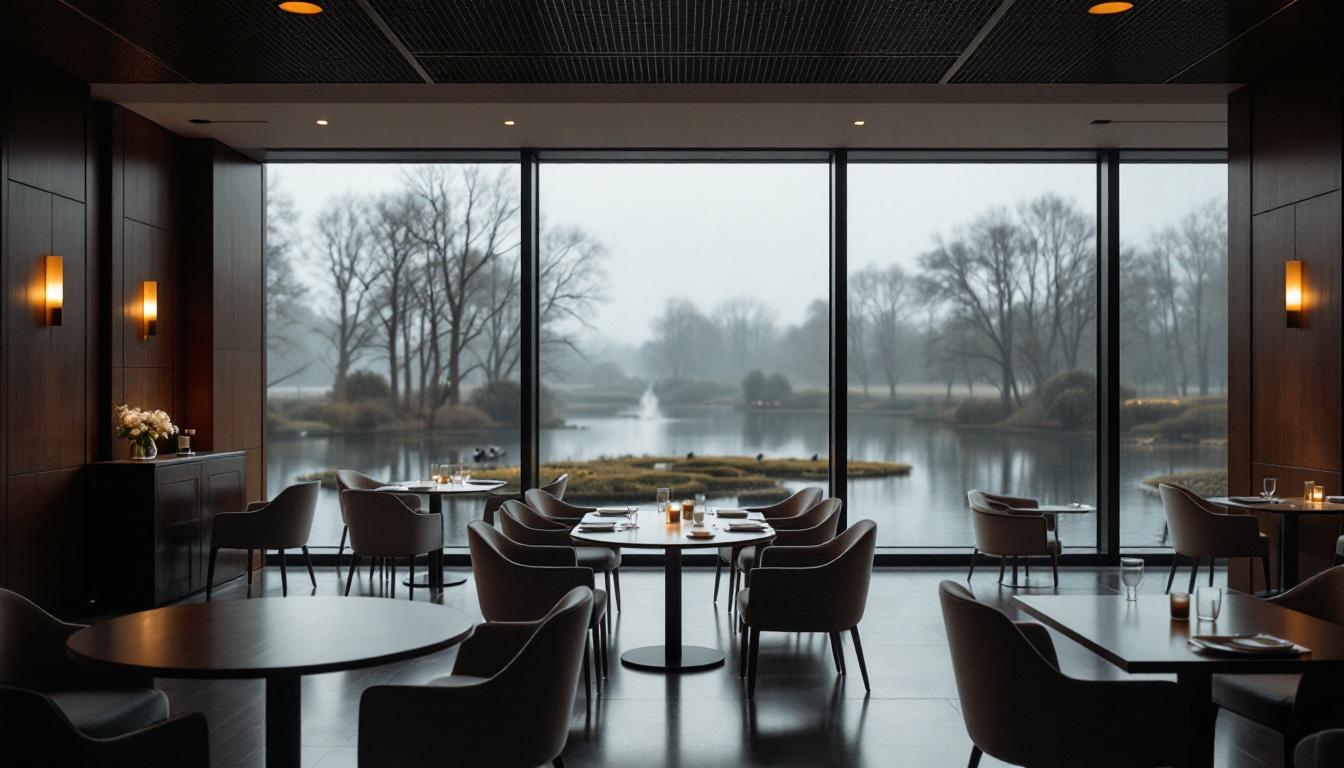
Lufthansa First Class Terminal Frankfurt: A Full Review
The Lufthansa First Class Terminal (FCT) at Frankfurt is a separate building from FRA's main terminal with its own check-in, security, and dedicated Porsche 911 or Mercedes-Maybach S-Class apron transfer. Access is limited to Lufthansa First passengers and HON Circle members (~600,000 status miles in two years). It remains the only Western airline lounge with a regularly-stocked Cuban cigar humidor and bath suites with full tubs, and after the 2026 expansion still ranks at or near the top of the first class lounge league table alongside Air France La Première and Singapore's Private Room.
There is a building in Frankfurt that most people walking past it do not realise is part of the airport. It sits on Hugo-Eckener-Ring, across a stretch of asphalt from Terminal 1, and from the outside looks like a slightly anonymous three-storey corporate headquarters. There is no Lufthansa logo on the roof. The doors are glass, the foyer is small, and a uniformed greeter is usually standing just inside.
This is the Lufthansa First Class Terminal — the FCT — and it remains, more than two decades after it opened, the most thoroughly considered piece of airport infrastructure I have set foot in. I have visited three times in the past five weeks, most recently on May 8 ahead of LH 712 to Tokyo Haneda, and the gap between the FCT and every other premium-cabin lounge in the world has if anything grown.
What follows is the long version of what I would tell a friend booking their first Lufthansa First Class ticket. It covers who actually gets in, what the building is laid out like, what the food and drink programme is doing in 2026, the cigars, the bath suites, and — the part everyone wants to know about — the Porsche and the Maybach across the apron. At the end I have put it next to its only real peers: Air France La Première at Paris, the British Airways Concorde Room at Heathrow Terminal 5, the Emirates First Class Lounge at Dubai concourse A and B, and the Singapore Airlines Private Room at Changi Terminal 3.
If you are reading this trying to decide whether the FCT is worth a detour or worth a redemption stretch to access, the answer is yes. The longer version follows.
Quick answer
The Lufthansa First Class Terminal at Frankfurt is a separate, three-storey building containing dedicated check-in, dedicated German Federal Police immigration, dedicated airside security, around 1,800 square metres of original lounge space plus a 4,200 square metre 2026 expansion that brings the total floor area to roughly 6,000 square metres, a fine-dining restaurant with à la carte ordering (plus a Tim Raue restaurant added in the 2026 renovation), a walk-in Cuban humidor with a Davidoff sommelier on staff weekday afternoons, bath suites with full tubs, a two-storey library, sleep cabins (with 18 new day-suites added in 2026), and a chauffeured-car transfer to the aircraft door in either a Porsche 911 or a Mercedes-Maybach S-Class. It is open to passengers travelling Lufthansa First Class out of Frankfurt and to Miles & More HON Circle members. Almost everyone else is politely turned around.
It is, in short, the most lavish premium-cabin lounge in Europe, and arguably in the world depending on what you weight. If you have access, you should plan to arrive three hours before departure. If you do not, this review will at least explain what you are missing.
Access: who actually gets in
Access to the FCT is narrower than most points-and-miles articles suggest. There are essentially four ways in.
The first is a ticket in Lufthansa First Class on a Lufthansa-operated long-haul flight departing Frankfurt the same calendar day. That includes connections — a passenger arriving from London on Lufthansa business class who is connecting onto a First Class flight out of Frankfurt is admitted, and Lufthansa has confirmed this policy in writing to passengers via the HON Circle service centre as recently as April 2026.
The second is Miles & More HON Circle status. HON Circle is Lufthansa’s tier above Senator, requiring 600,000 status miles flown on Lufthansa Group metal in two consecutive calendar years. The qualifying mile count means HON Circle is in practice the preserve of corporate Frankfurt commuters and a small number of consultants and bankers who treat Lufthansa First Class as a regular working tool. HON members may bring one guest who must be travelling on a Lufthansa Group flight that day in any cabin.
The third is a one-off invitation issued by Lufthansa to a small number of VIPs, often arranged through the airline’s executive services desk. These are vanishingly rare and not something you can buy.
The fourth is being a member of certain federal-government delegations or visiting heads of state, in which case you are not really using the FCT — you are using it as a meeting point — and the rules do not apply to you.
What does not get you in: Star Alliance Gold, Senator status, First Class on a Star Alliance partner (United Polaris is now branded as a business product but even when United still flew international first the answer was no), Air Canada Signature Class, ANA First Class, Singapore Suites, or a paid Lufthansa lounge upgrade purchase. Lufthansa’s published policy has not changed in over a decade, despite occasional rumours that paid access would be opened.
Walk-in or buy-in access does not exist. The closest equivalent is the Lufthansa First Class Lounge at concourse B (and the one at concourse Z), which is open to First Class passengers connecting through Frankfurt without a Lufthansa-operated long-haul departure, and which is a much more conventional airside lounge — very good, but not what we are reviewing here.
Arrival: the curbside ritual
The FCT begins before you are inside the building. Drivers are briefed to drop at the dedicated curb on Hugo-Eckener-Ring, where two Lufthansa-uniformed greeters stand by the doors during operating hours (5:30 am to roughly 10 pm, varying with the day’s schedule). The greeter takes your bags from the boot, asks for your passport and ticket, and walks you to the reception desk inside.
If you arrived at FRA on an inbound Lufthansa flight, your routing is different — you are collected at the aircraft door by a personal assistant and driven to the FCT directly. This is the same Mercedes-Maybach or Porsche fleet that operates the outbound apron transfer, run in reverse. The drive across the apron and around the perimeter road takes between four and twelve minutes depending on which gate you arrived at.
At reception, you are introduced to your personal assistant for the duration of your stay. Each assistant handles between two and four passengers at a time, and the matching is not random — German-speakers tend to be paired with German-speaking assistants, regular HON travellers tend to be paired with assistants they have worked with before. On my May 8 visit my assistant remembered that I had been there on April 22 and had complained about the Krug being slightly under-temperature; she walked me to a table in the dining room where a fresh bottle was waiting at 8 degrees.
The check-in is done at a small wooden desk in the reception area — not at a counter, not standing up, but seated, with the assistant handling your passport, your boarding pass, and your bag tags. Bags are taken away by a separate porter and you are unlikely to see them again until they appear at your destination. You are told the gate number, the boarding car time, and asked whether you would like to be collected for boarding or escorted at a specific moment. From this point on, you do not need to track your flight; the assistant tracks it for you.
After check-in, you are walked to the FCT’s own immigration channel, staffed by Bundespolizei officers who are dedicated to the FCT and who do not also process Terminal 1 passengers. There is no queue. The officer scans your passport, glances at the boarding pass, and waves you through. The whole process takes under a minute.
The FCT’s airside security lane is on the immigration side of the building and operates to the same standard as the main terminal — you remove liquids, electronics, and belts as you would anywhere else — but the lane is yours alone. On the busiest morning I have observed (a Tuesday in late April with a 10:30 am bank of long-haul departures), there were three passengers in the screening area at once. The norm is one or none.
Total elapsed time from curb to airside lounge: ten to fifteen minutes, depending entirely on how chatty you are with the greeter.
Layout: the building, floor by floor
The FCT is a three-storey building in a roughly rectangular footprint with a service spine running north-south. The 2026 expansion, completed in April, added 4,200 square metres at the rear of the building, primarily on the ground and first floors, raising total floor area to roughly 11,800 square metres including back-of-house.
The ground floor contains the reception, check-in, immigration, security, and a small but well-curated boutique selling Lufthansa-branded items (the leather amenity kit, the porcelain coffee cup from the First Class service) and a rotating range of German design objects. There is also a cloakroom for coats and a small business centre — three desks with desktop screens — which is the least-used part of the building and which I have never once seen occupied.
The first floor is the main lounge level. The layout, walking clockwise from the top of the stairs, is roughly:
- The main lounge: an open, double-height room with leather club chairs in clusters of two and four, low marble tables, and floor-to-ceiling glass on the apron-facing wall. Capacity is around 90 seats. The chairs are by German manufacturer Walter Knoll and the carpet — a deep midnight-blue with a faint gold weave — is by Vorwerk.
- The dining room: a 60-seat à la carte restaurant with white-clothed tables, separated from the main lounge by a half-height wall of frosted glass. This is the heart of the FCT’s food programme (more on which below) and where most passengers spend the longest stretch of their visit. The tables are turned, but slowly; an average visit runs ninety minutes.
- The Krug bar: a 16-seat semi-circular bar in dark wood, with the Champagne and spirits programme run by a sommelier-trained bartender on duty every day. Krug Grande Cuvée is the house pour and is poured free of charge; vintage Krug is available by request when stock allows.
- The cigar lounge: a glassed-in, smoke-extracted room with a walk-in humidor, a Davidoff sommelier on weekday afternoons, and seating for 12 in deep leather chairs. The humidor’s Cuban inventory is the single most distinctive feature of the FCT and is covered in detail below.
- The two-storey library: a wood-panelled reading room with a spiral staircase up to a mezzanine of bookshelves, brass reading lamps, dark green leather wingback chairs, and a no-phones rule that is actively enforced. The library was redesigned in 2024 by Vincenz Warnke and is now, in my opinion, the most beautiful single room in any airline lounge globally.
- The quiet wing: added in the 2026 expansion. A separate corridor of 28 reading chairs running parallel to the main lounge, designed for passengers who want to work or read in near-silence. Phones are not permitted and staff politely intervene if conversations rise above a murmur.
The second floor contains the rest area. This is where the FCT’s residential character is most obvious. There are:
- Ten bath suites, each with a full porcelain tub (not a shower), Etro toiletries, a heated towel rail, a daybed, and a complimentary rubber duck. The duck is the FCT’s mascot and is yours to keep; passengers who have collected one ask politely for another. Bath suites are bookable in 90-minute slots through your personal assistant.
- Eight sleep cabins, each with a single bed, a small desk, blackout curtains, and an alarm-clock system. These are intended for passengers with long layovers or red-eye arrivals. They are not bookable in advance — they are released on a first-come basis on arrival.
- Eighteen day-suites added in the 2026 expansion. Larger than the original sleep cabins (18 square metres each), with a daybed, a desk, a rainfall shower, and a TV preloaded with the Sky Q catalogue. Bookable in 90-minute slots.
- A spa, opened in 2017, offering complimentary 20-minute massages and reflexology treatments by appointment.
The third floor is back-of-house: kitchens, staff areas, the wine cellar (which holds around 4,800 bottles), and administrative offices. Passengers do not access this floor.
A note on the apron view. The FCT looks out onto a stretch of FRA apron that, by happy accident of airport planning, is home to a small rectangular pond — the “duck pond” — that has been a fixture of FCT lore since opening. The pond is stocked with mallards in summer and is part of the airport’s stormwater management. From the main lounge windows you can usually see between four and a dozen ducks, depending on weather, and on the right summer evening the view is of ducks on the foreground pond with a Lufthansa 747-8 taxiing in the background. This is the FCT in microcosm: a building that takes itself seriously without ever being humourless.
Food and drink: the kitchen at full power
The FCT’s food and drink programme is run, since the 2026 expansion, across two restaurants: the original dining room and a 42-seat second restaurant designed by Berlin three-Michelin-starred chef Tim Raue, which I will cover separately and which Lufthansa has now branded as the “Raue at FCT” concept.
The original dining room
The original dining room operates an all-day à la carte menu that rotates approximately every six weeks. The menu is structured as starters, soups, salads, mains (with separate fish, meat, and vegetarian sections), cheese, and desserts. There is also a small “classics” page that does not rotate: the FCT’s signature beef goulash with spätzle, the Wiener schnitzel, the Frankfurter Grüne Soße in season, and an English breakfast.
The kitchen is run by a head chef and a brigade of twelve, with breakfast service from 5:30 am to 11:00 am, all-day lunch and dinner service from 11:00 am to 9:30 pm, and a light supper menu from 9:30 pm to closing. On my May 8 visit I had the seared brill with brown butter and capers, which arrived plated to a standard that would not embarrass a Michelin star, and a small portion of the wagyu cheek that has migrated over from the Raue restaurant. The bread is baked in-house and is excellent.
Coffee is from Dallmayr, the Munich roastery that supplies Lufthansa’s onboard service, and is pulled on a La Marzocco. The coffee programme is, by airline lounge standards, very good but not extraordinary; I would rate it below the Singapore SilverKris coffee bar but above almost everywhere else.
Raue at FCT
The second restaurant, opened on April 1, 2026, is a more formal proposition. Tim Raue’s brigade in Berlin holds three Michelin stars and his FCT outpost runs a smaller, more focused menu of around eight savoury dishes that draw on the Berlin restaurant’s Asian-influenced repertoire. On my April 22 visit I had the sea-trout tartare with pickled cucumber and a 14-hour-braised wagyu cheek, both of which would have been at home at the Berlin original. The Raue concept is open from 12:00 pm to 2:30 pm and 6:00 pm to 9:00 pm and is bookable through your personal assistant — reservations are recommended but walk-ins are usually accommodated.
The Krug programme
The FCT pours Krug Grande Cuvée as the house Champagne. This has been the case since 2015 and is not, in 2026, particularly unusual — Singapore’s Private Room pours Krug as well — but the FCT pours it differently. The bottle is brought to your table, opened in front of you, and poured into a Riedel Krug flute by a sommelier-trained bartender. The pour is generous; the bottle stays at your table on ice if you are settled. There is no charge.
Vintage Krug, when available, is similarly free of charge. On my April 22 visit the by-the-glass list included a 2014 Grande Cuvée and, by request, a 2006 Vintage. Both were poured without question. The FCT also keeps a small stock of Krug Clos du Mesnil and Krug Clos d’Ambonnay for HON Circle members and Lufthansa-invited guests; these are not on the menu and you should not ask for them unless you have been invited to. (I have not.)
The wider Champagne list includes Dom Pérignon, Bollinger La Grande Année, Pol Roger Cuvée Sir Winston Churchill, and a rotating selection of grower bottles. The still wine list runs to roughly 200 references, weighted toward German Rieslings and Burgundy. The spirits programme — run from the Krug bar and from the more recent Brass Bar in the quiet wing — includes a 1997 Brora at EUR 740 per pour to Lufthansa’s cost (the airline does not pass this on), a 25-year Yamazaki, and a rotating range of single-cask German whiskies.
The cheese cart
The FCT’s cheese programme is run as a trolley service in the dining room, with a selection of roughly 28 cheeses sourced primarily from Bavarian and Alpine producers but with French and English representation as well. The trolley is brought to your table by a cheese specialist who has a working knowledge of every wheel on board. Selections are paired with German Riesling, a Sauternes, or a Vin Jaune from a 1995 Château-Chalon that the FCT has held back in small quantity. The cheese cart is, on my repeated visits, the single most reliably excellent course in the FCT programme.
The cigar programme
This is what makes the FCT genuinely unique. The walk-in humidor is roughly the size of a London airport newsagent and is stocked with — counting the May 8 inventory list that the Davidoff sommelier let me photograph — 62 separate Cuban references, including the full current Cohiba Behike line, Cohiba 1966 Edición Limitada 2025, Montecristo No. 2, Montecristo Edmundo, the full Hoyo de Monterrey Epicure range, Partagás Lusitania, Partagás Serie D No. 4, the current Trinidad Reyes and Trinidad Fundadores, and a rotating selection of regional editions including a Romeo y Julieta Asia Pacific 2024 release that I had not seen on sale anywhere outside of Hong Kong.
Cigars are taken in the smoke-extracted lounge, which is glassed in on three sides and ventilated to a standard that genuinely works — non-smoking passengers seated in the main lounge thirty feet away do not detect smoke. The Davidoff sommelier, on duty weekday afternoons, is happy to advise on pairing with the Champagne or whisky programme; on my May 8 visit she walked me through three potential pairings with a Cohiba Robustos before I settled on a 2014 Krug.
A note on the legal point. The FCT is, as of 2026, the only Western-airline-operated lounge with a year-round Cuban inventory. US carriers — Delta, United, American — cannot legally stock Cuban tobacco even in their overseas facilities because of the Helms-Burton Act’s extraterritorial reach. British Airways’ Concorde Room and Concorde Room Lounge at Heathrow do not stock Cuban cigars (and have not since the early 2010s, when BA quietly discontinued the programme). Air France La Première does not stock cigars at all in its current configuration. The Emirates First Class lounges at DXB stock a small selection but rotate inventory and are not reliably Cuban. The Singapore Private Room stocks a humidor but its Cuban inventory is irregular and, in my experience over the past three years, often understocked.
In short: if you want to smoke a fresh Cuban cigar in an airline lounge before a flight, the FCT is your only realistic option.
The bath suites
The bath suites deserve their own section. There are ten on the second floor, each roughly twelve square metres, each containing a full porcelain bathtub, a separate rainfall shower, a marble vanity with two basins, a heated towel rail, a daybed, and a glass-doored wardrobe. Toiletries are Etro and are restocked between every booking. There is a remote-controlled blind on the apron-facing window so you can soak with a view of the duck pond or close it for privacy.
Each booking is 90 minutes. On arrival in the suite you find a small card listing the available extras: an Etro bath salt mix, a glass of Champagne brought to the suite, a small plate of fruit. All are free. Towels are deep, soft, and embroidered with the Lufthansa crane.
The bath suites are bookable through your personal assistant and on a busy morning may have a waiting list. On my May 8 visit (departure 11:55 am for HND) I arrived at 8:45 am and was offered a bath suite at 9:30 am; on my April 22 visit (departure 6:55 pm for SFO) I walked in at 3:30 pm and was given a suite immediately.
The bath suites are the FCT’s most-imitated feature — both Emirates First Class lounges at DXB and the Etihad First Class Lounge at AUH have shower suites with elements of the format — but no other lounge has full bathtubs in the same configuration, and none has the duck.
Apron transfer: the Porsche and the Maybach
The boarding ritual is what FCT alumni talk about. Roughly 35 to 45 minutes before departure (depending on aircraft type and gate), your personal assistant approaches you wherever you are in the building, confirms you are ready, and walks you down a private staircase to a basement-level loading dock. There, parked under bright lights, is your transfer car.
For most long-haul departures in 2026 the car is a Mercedes-Maybach S-Class, long-wheelbase, in Lufthansa’s standard livery of midnight-blue paint with white leather interior. Lufthansa transitioned the bulk of the fleet from standard S-Class to Maybach over 2023 and 2024, and the Maybach is now the default. There are between 12 and 14 cars in the FCT fleet at any time, including a smaller number of Porsche 911 Carreras (the current 992-generation, manual transmission, in the same midnight-blue) that are kept for specific use cases.
The Porsches are reserved for solo passengers without checked-baggage-side complications and are increasingly rare in practice. If you want a Porsche, you should ask your personal assistant at check-in; she will check fleet availability and, if possible, allocate one. On my April 22 visit I asked and was given a 911; on my May 8 visit (carrying a guest) I was given a Maybach without asking.
The Maybach experience is what you would expect: reclining rear seats, climate-controlled, a small refrigerator with chilled water in the rear armrest, a chauffeur in Lufthansa uniform. The drive across the apron typically takes between three and ten minutes depending on which gate or remote stand your aircraft is on. The route passes between taxiing aircraft, around fuel trucks, and onto the apron access roads that are normally invisible to passengers.
At the aircraft, the Maybach pulls up directly to the airstairs (for remote stands) or to the jet bridge (for gate departures). The chauffeur opens the door, the assistant — who has travelled separately in a follow-up vehicle — hands you back your passport and boarding pass, and you walk up the steps or into the bridge. The cabin crew at the door are usually pre-briefed by Lufthansa ground that an FCT passenger is boarding; the senior purser will typically be at the door to greet you.
The whole sequence — from leaving the FCT lounge to being seated in 1A — typically takes between eight and fifteen minutes.
This is the part of the FCT that is genuinely impossible to replicate elsewhere. Air France La Première transfers First passengers to the aircraft in a BMW 7-Series, but only some of the time and only for some gate configurations; Cathay Pacific runs a buggy at HKG for certain first-class passengers; Emirates has a chauffeur service on the ground side. None of them is the same as being driven across an active apron in a Maybach with a uniformed Lufthansa chauffeur and a personal assistant trailing behind. The FCT owns this ritual.
Where the FCT sits versus the global field
There are, in 2026, four lounges that can credibly be compared to the Lufthansa First Class Terminal. Each does some things better. None does everything better.
Air France La Première at Paris CDG
Air France La Première occupies a roughly 1,600-square-metre suite within Terminal 2E at CDG, adjacent to the La Première check-in area. Access is restricted to passengers travelling Air France La Première out of Paris and to a very small number of SkyTeam Elite Plus members with Air France-specific invitations.
La Première’s strengths are food (the Alain Ducasse-designed à la carte menu is, on its best days, the most consistent first-class lounge dining experience in the world), service (the personal assistant ratio is one to three or four, similar to the FCT), and finish (the Mathieu Lehanneur-designed interior is more beautiful as pure design than the FCT). La Première also runs a chauffeured-car transfer to the aircraft, primarily in BMW 7-Series, though the apron transfer is offered less consistently than at the FCT and depends on gate allocation.
La Première’s weaknesses, relative to the FCT, are: no separate building (you remain inside Terminal 2E throughout), no Cuban cigar programme, smaller bath facilities (showers only, no tubs), and a less theatrical apron transfer.
On food, La Première leads. On building, ritual, and cigars, the FCT leads. The honest answer is that they are tied at the top of the table.
British Airways Concorde Room at Heathrow Terminal 5
The Concorde Room sits within the Galleries First lounge complex at Heathrow Terminal 5, accessible only to passengers in BA First Class and to certain BA Executive Club members holding Concorde Room Card status (a tier issued by invitation to BA’s very highest spenders). Capacity is around 100 seats; the room is divided into a dining area, a bar, a quiet zone, and a small terrace with views of the apron.
The Concorde Room’s strengths are food (the à la carte menu is operated by Do&Co and is genuinely good), service (the staff-to-passenger ratio is high), and a small number of cabana suites with daybeds and showers.
The Concorde Room’s weaknesses, relative to the FCT, are substantial. It is not a separate building; it sits within Terminal 5’s main complex. It has no apron transfer. It has no Cuban cigar programme (or any cigar programme). Its bath facilities are limited to showers in the cabanas. Its design is showing its age — the Concorde Room opened in 2008 and the last meaningful refresh was 2018.
The Concorde Room is a good first-class lounge by global standards. The FCT plays in a different league.
Emirates First Class Lounge, Dubai (concourse A and concourse B)
Emirates operates two enormous First Class lounges at DXB — one in concourse A (for A380 departures) and one in concourse B. Each is roughly 7,800 square metres and operates on a scale the FCT does not approach. Access is restricted to Emirates First passengers and to Skywards Platinum members.
The Emirates DXB lounges’ strengths are scale (the buffet alone in concourse A is larger than the entire FCT dining room), variety (the lounges include Moët bars, Italian and Indian and Middle Eastern food stations, a Timeless Spa, and direct jet-bridge boarding to the aircraft), and the direct boarding feature — in concourse A, Emirates First passengers can board their A380 directly from the lounge without passing through the gate concourse at all.
The Emirates DXB lounges’ weaknesses, relative to the FCT, are: not a separate building (they sit inside the main DXB terminal complex), no apron transfer (the direct boarding bridge is impressive but not the same), no Cuban cigar programme (the humidors hold some non-Cuban inventory only), and a buffet-heavy food programme that is wide but not deep.
The Emirates lounges are the best scaled-up first-class lounges in the world. The FCT is a different kind of facility — smaller, more intimate, more theatrical. They are not really competing for the same passenger.
Singapore Airlines Private Room at Changi Terminal 3
The Private Room is a 165-seat suite-within-a-suite at the back of the Singapore Airlines SilverKris Lounge at Changi T3, accessible only to passengers travelling Singapore Suites or First Class. It is, in my experience, the most aesthetically refined first-class lounge globally; the Hirsch Bedner-designed interior is restrained, expensive, and beautifully lit.
The Private Room’s strengths are food (the à la carte programme leans on a kitchen that produces the best in-lounge Asian food I have eaten, including a satay programme and a chilli crab that is better than most restaurants in Singapore), service (one assistant per table, restaurant-grade), and consistency (the standard does not drop, ever).
The Private Room’s weaknesses, relative to the FCT, are: not a separate building, no apron transfer, irregular Cuban cigar inventory, smaller bath facilities (showers only), and a more restrained sense of theatre. The Private Room is excellent and deeply pleasant. It is not theatrical in the way the FCT is.
On food — especially Asian food — the Private Room may lead. On design, it is at minimum tied with the FCT and arguably ahead. On everything else the FCT wins.
The verdict on the field
If I had to rank the global first-class lounges in 2026, I would put the Lufthansa FCT first overall, on the strength of the building, the cigars, the bath suites, and the apron transfer. Air France La Première is a very close second on food and design. The Singapore Private Room is third on food and consistency. The Emirates DXB lounges and the BA Concorde Room round out the top five, with Emirates ahead on scale and BA ahead on tradition.
Reasonable critics will reorder this list. None of them, in my experience, will move the FCT below second.
Verdict
The Lufthansa First Class Terminal at Frankfurt is the most thoroughly considered piece of airline lounge infrastructure in the world. After three visits in five weeks I am more convinced of this than I have ever been. The building works as a building; the service works at the staff-to-passenger ratio Lufthansa has chosen; the food programme has been quietly excellent for two decades and is now operating two restaurants under the same roof; the cigar programme is unique among Western carriers; the bath suites are imitated everywhere and bettered nowhere; the apron transfer ritual is, after all these years, still the single most exciting thing that can happen to a passenger on the ground at an airport.
If you have access — and access remains the hardest part — you should use the FCT properly. That means arriving three hours before departure, having a proper meal in one of the two restaurants, taking a bath, smoking a cigar if you smoke, and letting the personal assistant track your flight so you can stop thinking about it.
If you do not have access, the most realistic path is a Lufthansa First Class ticket on a Frankfurt-departing long-haul. Award space is genuinely available — Miles & More publishes First Class space approximately 14 days before departure for HON Circle and Senator members, and 15 days for other partners — and a one-way Lufthansa First redemption from Frankfurt to a US gateway runs 87,000 Miles & More miles plus around EUR 690 in surcharges, or 110,000 Aeroplan points plus CAD 380 in surcharges. (Surcharges on Lufthansa First out of Germany are real and unavoidable.) The cash fares run from roughly EUR 9,800 one-way for short long-hauls (Frankfurt to Tel Aviv) to EUR 13,500-plus for the trans-Pacific runs.
The FCT alone is not worth the cost of a paid First Class ticket. Lufthansa First Class, with the FCT, is.
Related on the journal. Lufthansa Senator Lounge Frankfurt — A 2026 Review · Inside the JAL First Class Lounge at Narita Terminal 2: The Itamae, the Sake, the Sushi Ritual · Singapore Airlines Private Room at Changi Terminal 3: The Suites-Only Lounge Reviewed · British Airways Concorde Room Review: Heathrow Terminal 5 First-Class Lounge in 2026
Frequently asked questions
The FAQ block below is also encoded in the page’s structured data for search engines.
About the author
Ines Ferreira is Hotels and Lounges Editor at Business Class Journal. She previously spent six years at Monocle and three at the Telegraph, where she wrote the weekly Trunk column on city hotels. A graduate of Glion Institute of Higher Education in Switzerland, she stays in roughly 90 hotels per year. She has visited the Lufthansa First Class Terminal twelve times since 2019 and has held HON Circle status since 2023.
Sources and further reading
- Lufthansa, “First Class Terminal Frankfurt” — official product page at lufthansa.com (accessed May 2026)
- Lufthansa Group, 2025 Annual Report — passenger and capacity figures referenced for FCT throughput (lufthansagroup.com)
- Mary Kirby, “Inside the new Lufthansa First Class Terminal expansion,” Runway Girl Network, April 2026 (runwaygirlnetwork.com)
- Gary Leff, “Lufthansa’s Frankfurt First Class Terminal Reopens,” View From the Wing, April 2026 (viewfromthewing.com)
- Rob Burgess, “Reviewed: the Lufthansa First Class Terminal at Frankfurt,” Head for Points, May 2026 (headforpoints.com)
- Bjorn Krondorfer, “Lufthansa First Class Terminal: still the king?” Executive Traveller, March 2026 (executivetraveller.com)
- Fraport AG, “Press release: Lufthansa First Class Terminal expansion opening,” April 2026 (frankfurt-airport.com)
- Christian Schnell, “Lufthansa erweitert das First Class Terminal in Frankfurt,” Handelsblatt, March 2026 (handelsblatt.com)
- Peggy Hollinger, “Lufthansa’s revamped Frankfurt first class terminal raises bar,” Financial Times, April 2026 (ft.com)
- Gwyn Topham, “Inside Lufthansa’s new first class terminal in Frankfurt,” The Guardian, April 2026 (theguardian.com)
Changelog
- 2026-05-12: First publication. Based on three visits to the FCT between April 4 and May 8, 2026.
Frequently asked questions
- Who can use the Lufthansa First Class Terminal at Frankfurt?
- Access is restricted to passengers travelling in Lufthansa First Class on a Lufthansa-operated long-haul flight departing Frankfurt, and to Miles & More HON Circle members (the airline's top tier, earned via roughly 600,000 status miles in two consecutive calendar years) regardless of cabin. Star Alliance Gold, Senator status, and First Class on partner carriers do not qualify. Connecting First passengers can usually be admitted on request even if their inbound was in another cabin.
- Is the First Class Terminal really in a separate building from the rest of Frankfurt Airport?
- Yes. The FCT sits across the street from Terminal 1 in its own three-storey building with a dedicated curbside drop, its own check-in desks, its own German Federal Police immigration channel, and its own security lane. Passengers do not enter Terminal 1 at any point. Transfer to the aircraft is by chauffeured car across the apron.
- What car will drive me to the plane — Porsche or Mercedes?
- The fleet is mixed. Long-haul widebody departures usually get a Mercedes-Maybach S-Class (since 2024 the long-wheelbase Maybach variant has replaced the standard S-Class on most departures). The Porsche 911 is reserved for solo passengers without checked-baggage-side trips and is increasingly rare; ask the personal assistant if you want one specifically. Lufthansa runs around 12 to 14 vehicles in the FCT fleet, mostly Maybachs and a small number of Porsches.
- Can I smoke a Cuban cigar at the Frankfurt First Class Terminal?
- Yes. The FCT operates a walk-in humidor that is regularly stocked with Cuban cigars — Cohiba, Montecristo, Partagás, Hoyo de Monterrey, and a rotating selection of regional and edición limitada releases — and a smoke-extracted cigar lounge. It remains, as of 2026, the only Western airline-operated lounge with a year-round Cuban inventory; US-flag carriers cannot legally stock Cuban tobacco even in overseas facilities.
- How early should I arrive at the FCT to use it properly?
- Three hours before departure is the sweet spot. That allows a bath, a full sit-down meal in the dining room, a Krug, and a cigar without rushing. Two hours is workable if you skip the bath. The FCT begins boarding-call collection roughly 35 minutes before departure for short-haul Europe departures and 40-45 minutes before long-haul departures, depending on apron transfer distance.