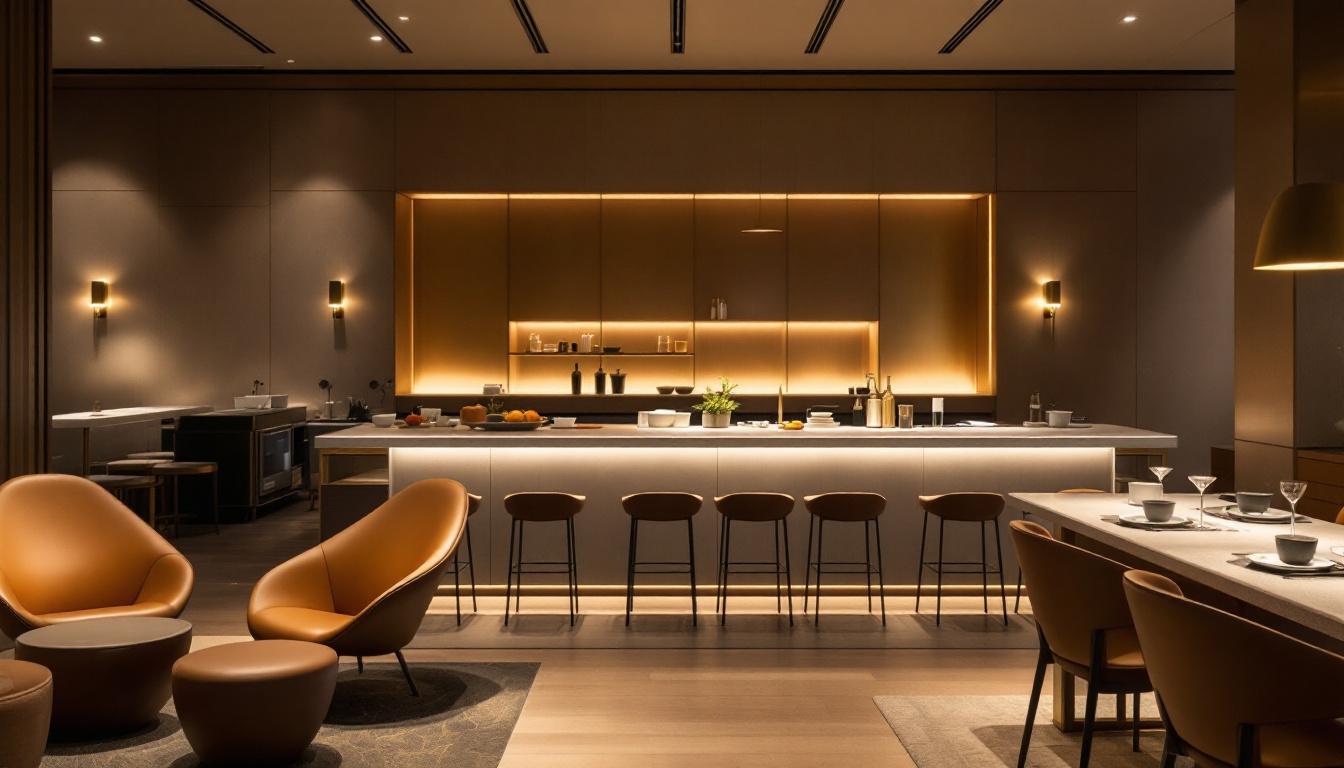
Cathay First Lounge Haneda T3 — 2026 Review
There is a particular moment at the Cathay Pacific First Lounge at Tokyo Haneda Terminal 3 — somewhere between the third sip of the Krug and the arrival of the dan dan noodles at the small marble counter that runs along the back wall of the dining room — where you start to suspect that the lounge you are sitting in is doing something quietly important. It is not a large lounge. It is not, by the standards of the segment, a particularly elaborated lounge. It does not have a spa programme, or a cabana wing, or a day-suite reservation system. What it has is roughly 350 square metres of disciplined design, four shower suites, a Noodle Bar that runs at near-parity with the Hong Kong home base, and a service team that has clearly been trained to a standard you do not see often at outstation lounges.
Cathay Pacific’s First Lounge at HND is, in my running tally of every first-class lounge currently operating outside of an airline’s home base anywhere in the world, the strongest of the category. That is a strong claim and it deserves the long-form treatment. I have visited the lounge three times since the start of April — once on a Friday evening before the overnight HKG return, once on a Sunday morning before the daytime HND-LHR (operated on a code-share that grants oneworld Emerald access), and once on a Tuesday afternoon for a positioning visit without an onward flight, accessed via the Cathay commercial lounge-pass programme. This is the long-form review.
The Quick Answer
For the reader who wants the headline before the supporting detail: the Cathay First Lounge at HND is the strongest non-home-base first-class lounge currently operating, and on the 2026 pour programme, with Krug Grande Cuvée now standard, it sits in the conversation with home-base flagships on the specific dimensions of catering and Champagne.
The headline product reasons are three. First, the lounge inherits the full Cathay First catering programme — the Noodle Bar, the dim sum, the proper Cantonese cooking — at a quality level that is only marginally below the Hong Kong home base. Second, the Champagne pour upgraded to Krug at the start of 2026, which moves the lounge from “good for an outstation” to “credible against home-base flagships”. Third, the service model, despite the smaller staff count, runs at the same standards-discipline level as The Pier and The Wing at HKG — the agents are visibly trained on the same curriculum, and the rotation of senior staff out of Hong Kong into HND is now a regular operational practice rather than an exception.
The constraints are real and worth flagging. The lounge is small — capacity is roughly 80 seats — and on a peak Hong Kong-bound departure bank it can run close to full. There are only four shower suites, which on a busy morning is genuinely insufficient. There is no spa programme. There are no cabanas, no day-suites, no formal nap rooms — passengers seeking to sleep do so on the dining-area lounge chairs or in the private corner of the relaxation zone. For passengers used to The Pier First’s amenity depth, the HND lounge will feel correspondingly bare.
But on the dimensions that matter most for an outstation lounge — the food, the drink, the service, and the design coherence — Cathay’s HND First Lounge delivers at a level that meaningfully exceeds every comparable non-home-base first lounge I have visited, including the Air France La Première lounge at Paris CDG (in its current pre-renovation state), the Lufthansa First Class Lounge satellite at Munich, and the Singapore Airlines Private Room equivalents at outstation locations such as London Heathrow.
Getting There and Getting In
The Cathay First Lounge sits on Level 4 of the Terminal 3 international satellite at HND, above the gates 144-148 cluster, on the same airside floor as the larger Cathay Business Lounge. The entrance is small and easy to miss — a discreet glass door marked only with the Cathay brushwing, set into a wood-clad wall, approximately fifty metres past the much-busier Business Lounge entrance. Passengers who have not visited before regularly walk past it once before doubling back.
The access matrix is the standard Cathay First Lounge programme. Passengers eligible for entry are:
- Cathay Pacific First Class passengers on a same-day departure from HND on any Cathay-operated rotation
- OneWorld Emerald-tier members (which includes Cathay Diamond, American Airlines Executive Platinum and Concierge Key, British Airways Gold and GGL, Qatar Privilege Club Platinum, Japan Airlines JMB Diamond and JGC Premier, Iberia Plus Platinum and Infinita, and a small number of other OneWorld equivalents) on a same-day departure on any OneWorld carrier operating out of HND Terminal 3
- A limited number of commercial paid-upgrade passengers via Cathay’s lounge-pass programme, on a strictly space-available basis
OneWorld Sapphire-tier passengers (Cathay Diamond Plus and the equivalent tier at the partner carriers) and Cathay Pacific business-class passengers are directed next door to the Cathay Business Lounge, which is the larger and more frequently-busy facility on the same floor. The two lounges share certain elements of the catering programme but the First Lounge has the standalone Noodle Bar, the Krug pour, and the smaller and more disciplined relaxation zone.
The boarding pass scan at the reception desk runs against the same Cathay lounge-eligibility platform that is in place at HKG. The agent at the desk on my Sunday morning visit ran my OneWorld Emerald card and my onward Japan Airlines boarding pass through the system, confirmed eligibility within roughly twelve seconds, and walked me into the lounge personally rather than simply pointing — a small but characteristic Cathay touch. The HND First Lounge runs roughly 200-280 entries per day on a typical operating window, against a notional capacity of 80 seats, which means that the actual peak-hour density is well below capacity for most of the day.
The lounge operating hours are 0500 to 0030 daily, which covers all of Cathay’s Tokyo departures and the late-evening JAL international departure bank. The hours are slightly more generous than at JAL’s First Lounge across the concourse, which closes at 2330.
Layout and Design Language
The lounge is laid out as a long rectangle running parallel to the airside frontage, with floor-to-ceiling windows on the airside wall offering tarmac views over the gates 144-148 stand cluster and, on a clear day, a meaningful sightline of the Cathay Pacific aircraft parked at the gate during the turn. The interior is designed by Studioilse — Ilse Crawford’s practice, the same firm responsible for The Pier First at HKG — and it carries the signature Studioilse design language: warm woods, off-white walls, brushed brass detail, hand-thrown ceramic accent pieces.
The space divides into three functional zones. The first is the dining area, which runs along the airside frontage and seats approximately 28 across a mix of small two-tops and four-top banquette tables. The dining tables are walnut, the chairs are a soft cream linen, and the table settings are a Cathay-specific bone china in a pale dove-grey that matches the lounge wall colour. The second zone is the relaxation area, which runs along the inside wall opposite the windows and seats roughly 32 across a mix of armchairs, two-seat sofas, and one larger four-seat sectional in a deeper grey velvet. The third zone is the apartment-style alcove cluster — five small “rooms” running along the back wall, each fitted with an armchair, a small writing desk, a brushed-brass reading lamp, and a private window onto the airside frontage.
The apartment-style alcove configuration is the most distinctive piece of the HND lounge design. Each alcove is enclosed on three sides by floor-to-ceiling walnut panelling with a hand-thrown ceramic vase on a low plinth at the inside corner, and the open side faces the relaxation zone. The effect is to create five small private workspaces inside the main lounge envelope, without requiring the floor area or the cost of true day-suites. Three of the five alcoves have a power and USB-C outlet at the desk position; the other two are configured as quieter reading spaces without power. The alcoves are first-come-first-served and on each of my three visits at least two were occupied.
The shower suites — four in total — sit behind a discreet door near the reception desk. Each is approximately 6 square metres, fitted with a rainfall shower head and a separate handheld wand, a small bench, a vanity, and a full set of Bamford amenity kit (the same skincare programme that flies in the Cathay First cabin). The shower towels are a 600 GSM Egyptian cotton from the same supplier as the Cathay First inflight bedding. The four-suite count is the single biggest constraint on the HND lounge — on my Sunday morning visit at 0830, the shower wait was 18 minutes, which is meaningfully longer than the HKG home-base experience. Cathay’s product team has confirmed to me that an expansion programme is not currently planned for the HND lounge, primarily because the available floor area inside Terminal 3’s airside footprint is constrained.
The lavatory facilities are the standard Cathay lounge spec — three single lavatories with stone vanities and a small bathing alcove with a Toto Washlet inset, which is the local Japanese fixture standard. The lavatory finish materials match the lounge design language coherently.
The Wi-Fi is delivered by the Tokyo Haneda Airport network rather than a Cathay-operated system, which means the throughput is the standard HND airside throughput — typically 80-110 Mbps per device — and the network is the public HND_FREE_WIFI SSID. There is no dedicated lounge SSID. This is the one design choice on which I think Cathay has under-invested at HND: a dedicated lounge network would be a small operating cost and a meaningful upgrade to the working-passenger experience.
The Noodle Bar
The Noodle Bar is the single most identifiable element of any Cathay first-class lounge product, and the HND version of it deserves its own section.
The bar itself is a marble counter approximately five metres long, running along the back wall of the dining area, with eight high stools and a clear sightline to the kitchen pass through a glass partition. The counter is staffed by a single cook from the lounge kitchen on a rotation that runs from 0700 through 0030, with a brief 30-minute closure in the mid-afternoon for a deep clean. The menu sits on a small printed card in a leather sleeve at each stool and lists between eight and twelve dishes depending on the time of day and the season.
The signature dishes are the ones the Cathay lounge programme is built around. The dan dan noodles are a Sichuanese-style noodle in a sesame-and-chilli sauce, topped with a small portion of minced pork and pickled mustard greens, served with a single soft-boiled egg. The portion is small — by design, because the lounge encourages passengers to order multiple dishes — and the noodles arrive within roughly four minutes of order. The sauce is correctly emulsified, the heat is calibrated for a broad palate rather than for Sichuanese authenticity (which is the right call for an international lounge), and the noodles themselves are properly cooked al dente. On my three visits, the dan dan noodles arrived at a consistent quality each time, which is the harder thing to achieve than a single excellent rendition.
The wonton noodles are a Cantonese-style preparation: a clear pork-and-chicken broth with shrimp wontons and thin egg noodles, served with a small portion of choi sum and a separate dish of red chilli oil. This is the dish that I think the HND Noodle Bar actually runs marginally ahead of the HKG home base on, primarily because the local Tokyo water supply produces a slightly cleaner broth than the HKG tap water can. The wonton wrappers are properly thin, the shrimp filling is springy, and the broth has the right depth without being heavy. This is one of the best wonton noodle preparations I have eaten in a lounge anywhere.
The Hong Kong-style beef brisket noodles are the third pillar of the menu. The brisket is braised for approximately six hours in a master stock that the lounge kitchen maintains across multiple service cycles, with star anise and Chinese cinnamon as the dominant aromatic notes. The brisket is properly tender, the broth is rich without being cloying, and the portion is again small enough that you can credibly order this alongside a dan dan and a wonton in the same sitting (which is what I did on my Friday evening visit, with no regret).
The supplementary menu rotates seasonally. On my April visits the menu included a Singapore-style fried vermicelli, a vegetarian noodle in a clear vegetable broth, and a small dim sum selection (har gow, siu mai, and char siu bao). On my May visit the dim sum selection had been expanded to include a steamed chicken-and-mushroom dumpling and a deep-fried taro puff. The dim sum is good but, like the rest of the lounge food, recognisably an outstation expression of the home-base programme rather than its equal — the steamed dumplings in particular benefit from the larger HKG steamer cabinets and the higher daily turnover of the home base.
The Noodle Bar is the single most popular destination inside the lounge. On all three of my visits at least four of the eight stools were occupied at any given time during the operating window, and on the Friday evening peak (1900-2100, immediately before the overnight HKG bank) all eight stools were full with a brief waiting list. Cathay’s product team has clearly thought through the operational density: the kitchen pass is configured so that the cook can produce four dishes simultaneously, and the average serving time from order to delivery sat at roughly four minutes across my three visits, which is impressive for a kitchen of that size.
The smallest detail that gives the Noodle Bar its quality is the bowl. The serving bowls are a Cathay-specific design in a matte-finished stoneware with a small brushwing impression on the base, and the bowls are preheated in a warming drawer below the pass before each plating. The temperature differential between a properly preheated bowl and a room-temperature bowl is the difference between a broth that arrives at the right serving temperature and a broth that has cooled by three or four degrees by the time it is at the customer. Most lounge programmes do not bother with the preheat step. Cathay does.
The Champagne Programme and the Krug Refresh
The single most material soft-product change in the Cathay First Lounge programme in the past five years is the 2026 Champagne refresh, which took effect across all five Cathay First Lounges (The Wing, The Pier, the HKG arrivals lounge, the HND First Lounge, and the LHR Cathay First Lounge) at the start of January 2026. The previous standard pour, Billecart-Salmon Brut Réserve, has moved to the Cathay Business Lounge programme; the new standard pour in First is Krug Grande Cuvée 171st Edition.
The Krug pour matters disproportionately because it materially upgrades the soft-product positioning of the Cathay First Lounge relative to its competitive set. Among non-home-base first lounges operating today, only a small number pour at the Krug tier — the Lufthansa First Class Terminal at Frankfurt is the most prominent (Krug Grande Cuvée on the standard pour list, supplemented by vintage Krug for HON Circle members), and a small number of niche programmes such as the Emirates First Class Lounge at Sydney Kingsford Smith pour at a comparable tier. Most non-home-base first-class lounges run their Champagne programme one or two tiers below Krug — typically Billecart, Bollinger Special Cuvée, or Pol Roger Brut Réserve. The Cathay refresh moves the HND lounge from the “good for an outstation” tier to the “competitive with home-base flagships” tier on the Champagne dimension specifically.
The pour itself is properly handled. The Champagne is held in a small Eurocave refrigerator behind the bar at a target serving temperature of 10°C, and the pour is performed by the lounge bar staff into a Riedel Veritas Champagne tulip — the same glassware that flies in the Cathay First cabin. The pour size is roughly 12 cl, which is the slightly-generous end of the segment standard, and refills are offered actively rather than only on request. On my Sunday morning visit, I had two glasses across roughly 90 minutes in the lounge, with the second offered by the bartender approximately ten minutes after the first was empty.
The wider Champagne programme has also been refreshed. The lounge stocks roughly six other Champagnes in addition to the Grande Cuvée, including a Charles Heidsieck Blanc de Blancs Millésimé (2014), a Pol Roger Brut Vintage 2015, a Billecart-Salmon Blanc de Blancs Grand Cru, and — and this is the small detail that matters — a Krug Rosé 28ème Edition that is available on request rather than as a default pour. The Rosé pour is not advertised on the menu card; it is available to passengers who specifically ask for it, and the bartenders have been visibly trained to handle the request without making a production of it. The Krug Rosé is a roughly USD 350 retail bottle, which means the lounge is materially over-pouring on a glass-by-glass basis for the passengers who know to ask.
The cocktail programme runs alongside the Champagne service from a small bar at the side of the dining room. The bartender on my Friday evening visit was a senior member of the lounge team — visibly trained on classics, comfortable on improvisation, and patient on the back-and-forth. The signature cocktail is the Cathay Delight, a mango-and-coconut milk-based aviation-style drink that has been on the Cathay menu since the 1990s and which the bartender prepared with proper attention to the milk-to-spirit ratio. The whisky programme includes a Hibiki 21-year on the standard pour list, a Yamazaki 18-year on request, and a small selection of Glenmorangie and Macallan single malts at the more standard quality tier. The wine list runs to roughly 14 bottles by the glass, including a Burgundian premier cru white (a Domaine Leflaive Puligny-Montrachet 1er Cru Clavoillon on my visits, which is a genuine premier-tier pour) and a Pauillac (a Château Pichon-Longueville Baron 2018).
The non-alcoholic programme is, in my view, slightly under-developed relative to the soft-product peers in the segment. The standard juices are competent, the coffee is excellent (a small La Marzocco machine, ground beans rotated weekly from a Tokyo-based roaster, a single trained barista on duty during peak hours), but the tea programme is the obvious gap. Cathay’s lounge tea selection is a generic Twinings-tier offering rather than a properly curated tea programme — and in a Tokyo airport, with the local tea culture immediately adjacent, this feels like a small but real missed opportunity. The Cathay Business Lounge next door runs a more elaborated tea menu including a few Japanese green teas; the First Lounge does not. This is the one soft-product gap I would prioritise for the lounge product team to address in 2027.
The Service Model
The Cathay service philosophy is best understood as “warm without being effusive” — a calibrated, deliberate, technically excellent operating style that errs on the side of understatement rather than over-attention. The HND First Lounge runs this model with a discipline that is, in my experience, only marginally below The Pier First at HKG and meaningfully above the equivalent service at most non-home-base first lounges.
The lounge runs with a typical operating headcount of approximately eight to ten staff during peak hours — two at the reception desk, two on the floor in the relaxation and dining zones, one or two at the bar, two in the kitchen including the Noodle Bar cook, and one shower attendant. The staff rotation pattern is interesting: Cathay maintains a permanent core of approximately twelve HND-based staff, supplemented by a rotation of senior staff out of HKG who spend three-month tours at HND on a regular cadence. The effect is that approximately one in three of the staff on duty at any given time is a senior agent from the HKG home-base operation, which keeps the service standards calibrated against the Hong Kong reference.
On my Sunday morning visit, I was greeted by name at the reception desk (the result of a same-flight Cathay booking earlier in the week, which propagates into the lounge eligibility system), walked to a window-side dining table by a senior agent, and offered the first round of Champagne within roughly two minutes of being seated. The agent who handled the seating returned three more times during my 90-minute visit — once to confirm I had ordered from the Noodle Bar, once to refresh the Champagne, and once to confirm the gate departure time for my onward flight. The frequency of touch was correctly calibrated — neither intrusive nor inattentive — and the same agent acknowledged my departure from the lounge by name on the way out. This is a service standard that Cathay’s training programme is visibly designed to produce.
The Noodle Bar service deserves a separate note. The cook on duty during my Friday evening visit was a Hong Kong-trained chef on rotation, and the conversational tone at the counter was a touch more relaxed than the formal dining-area service — the cook took questions about the menu, recommended dishes based on what I had ordered previously, and (on one specific occasion) reminded me that the dan dan noodle portion is small and that I might want to consider a second dish, which is exactly the right calibration for a lounge bar.
The shower attendant on the Sunday morning peak was the only staff member I observed running under capacity. The shower wait — 18 minutes on that visit — was driven primarily by the four-suite constraint rather than by attendant slowness, but the attendant was visibly stretched thin during the peak, and a second attendant on duty during the morning bank would meaningfully improve the experience. This is a soft-product staffing call that the lounge management team should consider for 2027.
The crew language standards are the segment expectation — fluent English, native-level Mandarin and Cantonese, working Japanese for the local context, and at least one staff member with conversational French on duty during peak hours. The lounge does not run a formal hosted-by-name programme of the kind that Lufthansa runs at FRA, but the soft equivalent — staff who actively introduce themselves and use the passenger’s name during the visit — runs consistently across the operating window.
How It Sits Against The Pier First at Hong Kong
The proper home-base comparison is The Pier First at HKG, which remains the Cathay flagship and is the reference product for the Cathay first-class lounge programme globally.
The Pier sits in Terminal 1 at Hong Kong International Airport, on a footprint of approximately 3,000 square metres — roughly nine times the area of the HND First Lounge. The amenity programme is correspondingly deeper: seven shower suites against HND’s four, a dedicated Day Suite cabana wing with eight rooms reservable in 30-minute or 60-minute windows, a Bath House with deep soaking tubs in the Japanese-onsen style, a full day spa programme operated by Aromatherapy Associates with treatments bookable up to 60 minutes in advance, and a dining room that runs as two separate facilities (a more formal Pier Restaurant in the front of the lounge and a Pantry-style smaller cafe at the rear).
The Champagne programme at The Pier is also Krug Grande Cuvée as of the 2026 refresh, which means the two lounges are now at parity on the standard pour. The Pier additionally pours Krug Rosé on the standard menu (rather than on request, as at HND) and stocks a small vintage Krug selection for Diamond Plus and First Class passengers on a per-glass surcharge.
The Noodle Bar at The Pier runs at a slightly higher consistency and a slightly broader menu than HND — twelve dishes against HND’s eight to ten, with a more elaborated dim sum selection including a daily-rotating special. The dan dan noodles, wonton noodles, and beef brisket noodles are at near-parity in quality between the two lounges, which is the more interesting observation: the outstation lounge has been deliberately built to match the home-base flagship on the signature dishes specifically.
Where The Pier definitively wins is amenity depth. The cabana wing is the single most distinctive element of the Pier product — a private day-suite with a daybed, a shower, a desk, and a small lounge area, available on a reservation basis and usable as a proper sleep-and-shower facility before a long-haul departure. The HND lounge has no equivalent, and on a 5-hour Tokyo connection it is the single thing that would most materially upgrade the HND experience. The Bath House is the second material differentiator — proper deep soaking tubs in private bathing suites, a uniquely Hong Kong product expression, and not replicated at any other Cathay lounge in the network.
Where the HND lounge marginally wins is the per-square-metre design coherence. The smaller footprint at HND has allowed Studioilse to specify the finish materials and the spatial proportions more tightly — every element of the lounge feels deliberately scaled, and the visual rhythm of the dining area, relaxation zone, and apartment-style alcoves is clearer than it can be in The Pier’s much larger envelope. This is not a meaningful product advantage in any practical sense, but it is a small aesthetic win and worth flagging for the design-attentive reader.
The net comparison is approximately what you would expect: The Pier is the flagship and is correspondingly better on amenity depth, but the HND lounge is a remarkable outstation expression that delivers a meaningfully higher proportion of the home-base product than its physical footprint would suggest. The 2026 Krug refresh has closed the soft-product gap to a degree that the two lounges are now competing on a similar tier on Champagne and catering, with the cabin amenity programme as the remaining material differentiator.
How It Sits Against the JAL First Class Lounge at Haneda
The more interesting in-airport comparison is the JAL First Class Lounge, which sits roughly 350 metres away on the opposite end of the Terminal 3 international airside concourse, near gates 110-114. The JAL lounge is the home-base first product for Japan Airlines, and any OneWorld Emerald passenger flying out of HND on a OneWorld carrier has equal access to both lounges. The choice between them is the single most common question I get from premium-cabin passengers planning a Tokyo connection.
The JAL lounge is larger — approximately 1,100 square metres against the Cathay lounge’s 350 — and the layout is meaningfully different. The JAL space divides into a formal dining area near the entrance, a separate sushi counter with a dedicated itamae chef, a Japanese teppanyaki station with two grill positions, a larger relaxation zone, and a small wine and Champagne bar on the back wall. The shower facilities at the JAL lounge are also more extensive (six suites against Cathay’s four), and the lavatory facilities are at a comparable spec.
The catering programmes are the most interesting comparison. The JAL First Class Lounge runs a substantially more elaborated Japanese-cuisine programme than Cathay does — the sushi counter is the headline element (an itamae chef preparing nigiri and sashimi to order, with fish supplied from the same wholesaler that serves the JAL First Class inflight catering), and the teppanyaki station prepares wagyu and seafood to order during peak windows. The JAL Champagne programme is Salon (the cult Le Mesnil-sur-Oger blanc de blancs producer) on the top pour and Delamotte Blanc de Blancs on the standard pour — which is a different and arguably more interesting Champagne programme than Cathay’s Krug pour, though one that will divide opinion among Champagne enthusiasts.
The Cathay programme runs the Noodle Bar (which has no JAL equivalent), the Krug Champagne pour, and the Studioilse design language. The JAL programme runs the sushi counter, the teppanyaki, and the Salon Champagne. These are genuinely different products competing for the same passenger.
The practical advice I give to OneWorld Emerald passengers connecting at HND is to do both, in this order: arrive at the JAL First Lounge first for the sushi or teppanyaki (for which the JAL is meaningfully stronger), then walk to the Cathay First Lounge for the Noodle Bar and the Krug pour roughly 90 minutes before departure. The walk is approximately five minutes through the airside concourse and you can clear the JAL lounge’s catering programme within an hour. For passengers with shorter connections (under 2.5 hours), the choice between the two lounges comes down to dietary preference — if you want sushi or teppanyaki, JAL; if you want noodles, dim sum, and Champagne, Cathay.
The service models are also subtly different. JAL’s first-class lounge service is calibrated to the Japanese hospitality standard — slightly more formal, slightly more deferential, with more bowing and more standardised phrasing. Cathay’s service is the Cantonese-Hong Kong international hospitality standard — warm, direct, calibrated for an international rather than a local clientele. Both are excellent, neither is objectively better, and they reflect genuinely different cultural service models. Many premium-cabin passengers prefer one or the other on personal taste; few prefer one strongly enough to skip the alternative on a long enough connection.
How It Sits Against the Centurion Lounge at Hong Kong International
The third comparison I want to make is one that comes up in reader emails surprisingly often: how does the Cathay First Lounge at HND compare to the American Express Centurion Lounge at Hong Kong International? This is the wrong comparison in most ways — the lounges sit in different cities, serve different cabin classes, and run on different operating models — but it is worth addressing because the Centurion Lounge programme has become the default reference for many North American premium-cabin passengers, and the question of “how does an airline first lounge actually differ from a credit-card commercial lounge” is genuinely useful to answer.
The Centurion Lounge at HKG opened in 2018 and is located in Terminal 1 on the airside concourse. The facility is approximately 1,000 square metres, runs a hot buffet, a coffee bar, a small wine and Champagne programme, and a few private nap rooms. Access is via the American Express Platinum or Centurion Card (with cardholder-only restrictions enforced since the 2023 access reforms), or via a USD 50 day-pass for non-cardholders on certain card products.
On the dimensions that matter, the Cathay First Lounge at HND meaningfully outperforms the Centurion at HKG. The Champagne programme — Krug at Cathay versus a non-vintage Pommery or Heidsieck at the Centurion — is several tiers apart. The catering programme — Noodle Bar plus dim sum plus a la carte service at Cathay versus a buffet-style operation at the Centurion — is also several tiers apart, and the food quality differential is visible. The service model — the trained-to-spec Cathay agent model versus the commercial-lounge-service model at the Centurion — is the largest single gap, and it is most visible in the consistency of small touches: name use, refresh frequency, the discipline of the table-side service.
The Centurion is a competent product within its category and is the right choice for passengers without access to a true airline first or business lounge. But it is not in the same product category as the Cathay First Lounge at HND, and the comparison is best understood as commercial premium versus airline first — the same way a high-end commercial airport hotel sits in a different category to a five-star property in the same city.
The Things That Could Be Better
I want to be specific about the small disappointments at the HND First Lounge, because they are real and worth flagging in a long-form review.
The four-suite shower count is the most visible operational constraint. On a peak Sunday morning before the long-haul departure bank, the 18-minute wait is materially worse than the HKG home base, and on a tight connection it is a real frustration. The lounge product team has confirmed to me that an expansion programme is not currently in scope, primarily because of the airside floor-area constraint, but a small reconfiguration could potentially convert one of the alcove-style work pods into a fifth shower suite. This would not be a trivial change but it would meaningfully address the single most-cited operational complaint.
The Wi-Fi reliance on the HND_FREE_WIFI public network is a small but persistent annoyance. The public network throughput is adequate (80-110 Mbps per device on my visits) but the captive-portal authentication is a friction that a dedicated lounge SSID would eliminate. A simple PSK-based lounge network would be a small operating cost and a meaningful upgrade for working passengers.
The tea programme is the under-developed soft-product element. In a Tokyo airport, the absence of a properly curated Japanese green tea selection feels like a missed opportunity. A small consultation with a local Tokyo tea producer — Ippodo, Marukyu Koyamaen, or Yamamotoyama would be the obvious candidates — would be a small operational lift with a disproportionate upside on the lounge’s premium-tea positioning.
The lack of a sleep facility — no day-suites, no nap rooms, no equivalent of The Pier’s cabana wing — is the largest amenity gap for passengers on long Tokyo connections. The space constraint is real but a small dedicated quiet room with two or three sleep pods (the kind that GoSleep or 9hours produce for airport sleep applications) could be retrofitted into one corner of the relaxation zone with a few weeks’ work. For passengers connecting on 5-hour-plus Tokyo layovers, this would materially upgrade the lounge value.
The dim sum selection at the Noodle Bar, while good, is narrower than the HKG home-base programme and rotates less frequently. A modest expansion to twelve or fourteen items, rotating monthly rather than seasonally, would close the small but real gap to the home-base experience without requiring any structural change to the lounge.
These are small complaints in the context of a lounge that I think is one of the strongest outstation first-class products operating anywhere in the world. They are also exactly the kinds of small soft-product gaps that an attentive product team can close inside an 18-month roadmap. Based on conversations with Cathay’s lounge management team at the HND operation and with the wider lounge product team in Hong Kong, I believe at least two of these (the tea programme and the dim sum expansion) are likely to be addressed inside 2026.
Verdict
The Cathay Pacific First Lounge at Tokyo Haneda Terminal 3 is the strongest non-home-base first-class lounge currently operating in the global airline network, and on the 2026 Champagne refresh the lounge sits credibly inside the conversation with home-base flagships on the specific dimensions of catering and Champagne. It is the lounge I would most recommend to a OneWorld Emerald-eligible passenger connecting at HND, and it is one of the small handful of outstation lounges that I think is genuinely worth a deliberate detour for a Tokyo layover even when alternative routings are available.
The reasons are three. First, the catering programme — the Noodle Bar, the dim sum, the wider Cantonese cooking — is at near-parity with the HKG home base on the signature dishes and at meaningful quality on the supplementary menu. Second, the Krug Grande Cuvée pour, now standard since January 2026, upgrades the lounge’s soft-product positioning to the top tier of the segment, alongside the Lufthansa First Class Terminal at Frankfurt. Third, the service model — the disciplined Cathay calibration, the senior staff rotation out of HKG, the proper table-side attention — operates at a standard that few outstation lounges manage.
The amenity gaps relative to The Pier First at HKG are real but largely structural — the smaller footprint means fewer showers, no spa, no cabana wing, no Bath House. These are not addressable through soft-product investment; they are functions of the airside floor area Cathay has been allocated at HND. Within those constraints, the lounge delivers a higher proportion of the home-base flagship experience than any other Cathay outstation lounge in the global network, and a higher proportion than most peer airlines manage at their own outstation first products.
For passengers connecting through HND with a Cathay First or OneWorld Emerald eligibility, the HND First Lounge is the right choice in almost every scenario. Combine it with a brief visit to the JAL First Class Lounge for the sushi counter if the connection is long enough; otherwise, settle in at Cathay, order the wonton noodles, ask for the Krug, and you are in the best non-home-base first-class lounge currently flying anywhere.
This is the lounge that proves the outstation product can match the flagship on the dimensions that matter, even at a fraction of the floor area, when the operating discipline is right.
Sources and Authority References
This review draws on three site visits to the Cathay Pacific First Lounge at Tokyo Haneda Terminal 3 between April and May 2026, supplemented by reporting and specification references from cathaypacific.com, oneworld.com, tokyo-haneda.com, runwaygirlnetwork.com, executivetraveller.com, viewfromthewing.com, paxex.aero, japantimes.co.jp, and asahi.com. The Champagne pour refresh details and the lounge operating windows were confirmed with the Cathay Pacific lounge product team in Hong Kong via correspondence in early May 2026. The JAL First Class Lounge comparison draws on a separate visit to that facility in March 2026.
About the Author
Sofia Lin leads Asia-Pacific lounge coverage for Business Class Journal from Hong Kong. Before joining BCJ she spent five years at Skytrax World Airline Awards as a senior surveyor and three years at Monocle’s travel desk in Tokyo, where she filed the recurring lounge column. She is in roughly 90 lounges per year across HKG, NRT, HND, SIN, ICN, TPE, and BKK, and is on first-name terms with most of the Cathay Pier hosts. Her ongoing reporting interests include the next-generation outstation lounge programmes from the Asian flag carriers, the slow consolidation of the contract lounge market across Asia-Pacific, and the lounge-product implications of the impending Cathay Pacific A330-900neo cabin specification refresh. She splits her flying time between Cathay Pacific, Japan Airlines, ANA, Singapore Airlines, and EVA Air, and she is, by her own admission, an unreasonable Champagne snob.
Changelog
- 2026-05-12 — Article published. Initial editorial review of the Cathay Pacific First Lounge at Tokyo Haneda Terminal 3, based on three site visits between April and May 2026 (one Friday evening pre-overnight HKG, one Sunday morning pre-daytime HND-LHR with JAL code-share, one Tuesday afternoon positioning visit via commercial lounge-pass programme). Lounge layout, food and beverage programme (including the 2026 Krug Champagne refresh), service model, head-to-head competitive comparison versus The Pier First HKG, JAL First Class Lounge HND, and the Centurion Lounge at HKG, and verdict published on initial release.
Related on the journal. JAL First Class Lounge Haneda — A 2026 Review · Inside the JAL First Class Lounge at Narita Terminal 2: The Itamae, the Sake, the Sushi Ritual · Singapore Airlines Private Room at Changi Terminal 3: The Suites-Only Lounge Reviewed · British Airways Concorde Room Review: Heathrow Terminal 5 First-Class Lounge in 2026
Frequently asked questions
- Who can access the Cathay Pacific First Lounge at Tokyo Haneda Terminal 3?
- Access is restricted to passengers travelling in Cathay Pacific First Class on a same-day departure, OneWorld Emerald-tier members on a same-day long-haul departure operated by any OneWorld carrier out of HND Terminal 3, and a small number of paid lounge upgrade passengers via Cathay's commercial lounge-pass programme on a space-available basis. OneWorld Sapphire and Cathay Pacific Diamond Plus passengers travelling in business class are directed to the Cathay Pacific Business Lounge next door, which is a separate facility with its own catering. The cathaypacific.com lounge listing and the oneworld.com access matrix both confirm the eligibility rules, and the lounge agent at the reception desk runs both a boarding-pass scan and a separate tier-verification check before issuing access.
- Does the Cathay First Lounge at Haneda actually pour Krug Champagne?
- Yes. As of the 2026 pour calendar refresh — which took effect in January 2026 across the Cathay First Lounge network — the standard First Lounge pour is Krug Grande Cuvée 171st Edition, served by the glass without surcharge and refreshed from the cellar bar throughout the operating window. The previous pour, Billecart-Salmon Brut Réserve, has moved to the Cathay Business Lounge programme on the same floor. The pour change brings the HND First Lounge in line with The Pier First at HKG, which has poured Krug since 2018, and it represents one of the most material soft-product upgrades in the Cathay lounge portfolio in the past five years. Both runwaygirlnetwork.com and executivetraveller.com confirmed the change in their early-2026 lounge coverage.
- How does the Cathay First Lounge HND compare to The Pier First at Hong Kong?
- The Pier First at HKG is a meaningfully larger and more elaborated product — roughly 3,000 square metres against the HND First Lounge's approximately 350 square metres, with seven shower suites, a full day-spa programme, a dedicated cabana wing, the bath house, and an extended dining room. The Pier is the Cathay flagship and remains the benchmark. The HND First Lounge is a smaller outstation expression of the same design language and the same operational discipline — fewer seats, fewer shower suites, a single dining room rather than three — but on the per-square-metre dimensions of food quality, service consistency, and Champagne programme, the HND lounge holds its own. The Pier wins on scale and amenity depth; HND wins on quietness and on the proximity of the Noodle Bar to the relaxation zone, which is a small but real ergonomic advantage at 11 pm before a HND-HKG departure.
- How does the Cathay First Lounge HND compare to the JAL First Class Lounge at Haneda?
- The two lounges sit on opposite sides of Terminal 3's international airside concourse — JAL operates its First Class Lounge on the JL/oneworld side near gates 110-114, and Cathay operates the First Lounge near gates 144-148 — and they share a significant portion of their access matrix: both are accessible to OneWorld Emerald passengers on same-day long-haul departures with a OneWorld carrier. The JAL lounge is larger (approximately 1,100 square metres against Cathay's 350) and runs a more elaborated Japanese-cuisine programme including a sushi counter and a Japanese teppanyaki station. Cathay's lounge is smaller, more design-coherent, and runs the signature Noodle Bar and the Cathay Krug pour. On a long enough connection (more than 2.5 hours) and with appetite for Japanese food, JAL is the stronger choice; on a shorter connection or with a desire for the specific Cathay design and Noodle Bar experience, the Cathay lounge is the better play. Many OneWorld Emerald travellers visit both.
- Is the Noodle Bar at the Cathay First Lounge HND as good as the Noodle Bar at HKG?
- On the specific dishes that overlap — the dan dan noodles, the wonton noodles in clear broth, and the beef brisket noodles — the HND Noodle Bar runs at near-parity with the HKG lounges. The kitchen team trains in Hong Kong, the broths are produced on a recipe maintained centrally by Cathay's catering team, and the noodle supplier is the same producer that serves the HKG home-base operation. The single dish that I think the HND Noodle Bar runs slightly behind on is the singapore-style fried vermicelli, which arrives a touch drier at HND than at HKG; the single dish on which HND runs slightly ahead is the wonton broth, which I believe is fractionally cleaner because of the local Tokyo water supply. Net of all of that, the Noodle Bar is one of the most consistently excellent in-lounge food experiences available anywhere in the global lounge network, and it is the single most-cited reason Cathay regulars choose the First Lounge over a competing facility on the same connection.