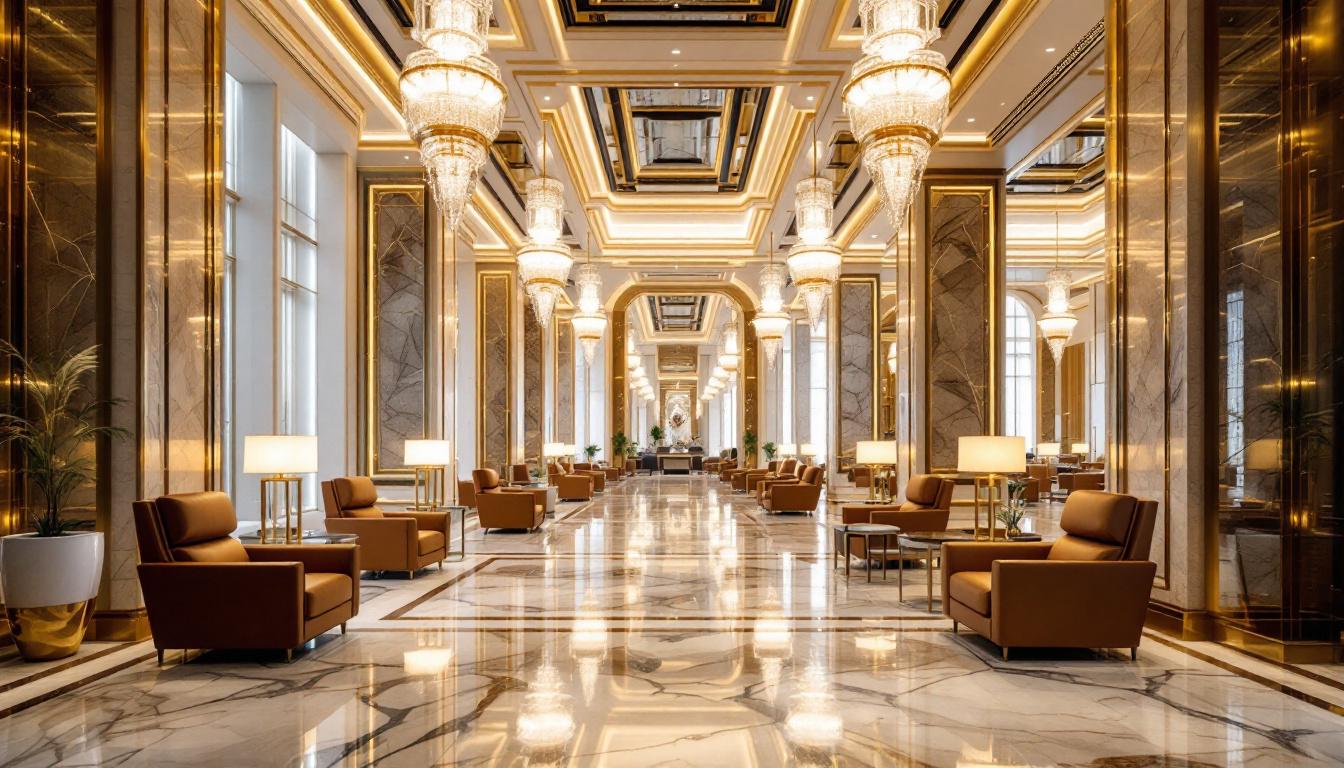
Emirates First Class Lounge at DXB Concourse A: A 2026 Long-Form Review
Emirates' First Class Lounge on the upper level of DXB Concourse A is the flagship of the carrier's lounge network — accessible only to Emirates First Class passengers (Business has its own separate lounge), running the full length of the A380 concourse, with direct jet-bridge boarding, a Moët & Chandon Champagne flight (Imperial Brut, Grand Vintage, Rosé Imperial, and Nectar Imperial), a Le Clos curated wine cellar, a cigar lounge, an a la carte sit-down restaurant, Bvlgari shower suites, and a Timeless Spa for complimentary facial treatments. It remains, in 2026, the largest single first class lounge in commercial aviation at over 100,000 sq ft (roughly 9,290 sqm).
There is a strip of carpeted floor on the upper level of Dubai International’s Concourse A, running roughly 800 metres from the security check at the southern end to the duty-free transit at the northern end, and on that strip Emirates has constructed what is, by every measurable dimension, the largest first class lounge ever built by a commercial airline. It is not the most architecturally daring. It is not the most chef-driven. It is not — quite — the most exclusive. But it is bigger than the next two single lounges in its category combined, and in May 2026, with the Lufthansa First Class Terminal back online after its eleven-month expansion and AF’s La Premiere in its third full year of post-renovation operation, the question of where Emirates’ flagship lounge actually sits in the global hierarchy is worth a proper editorial answer.
This is that answer. I have been through the Concourse A First Class Lounge six times in the past eleven weeks — twice on outbound Emirates First sectors out of Dubai, three times on layovers between connecting Emirates First flights, and once on a short positioning trip specifically commissioned for this review. The flights, in case it matters, were EK001/002 on the London Heathrow rotation, EK201/202 on the New York JFK rotation, and EK210/209 on the San Francisco rotation. The lounge visits ranged from 90-minute pre-departure dwells to a 7-hour 40-minute connecting layover that I deliberately built into a JFK-DXB-SIN itinerary in order to genuinely stress-test the lounge under a full daypart cycle.
What follows is the long-form treatment, organised the way I think about a lounge of this scale: access first, layout second, food and drink third, the spa and shower suites fourth, the competitive set fifth, and the verdict at the end. The six FAQ items at the top of this article cover the most-asked questions; the body covers everything else.
The Quick Answer
For the reader who wants the headline before the rest: the Emirates First Class Lounge at DXB Concourse A is the global benchmark for lounge scale, the global benchmark for direct A380 boarding integration, and a credible top-three first class lounge globally on every other dimension that matters.
The single most important architectural fact about it is the direct upper-deck jet-bridge boarding from the lounge floor. The single most important hospitality fact about it is that the Moët & Chandon Champagne flight, the wine cellar, the cigar lounge, the restaurant, the showers, and the spa are all genuinely first-class-tier rather than slightly-airport-quality-versions-of-first-class-tier (though note that Emirates’ more prestigious Dom Pérignon and Veuve Clicquot pours are reserved for onboard service rather than the lounge). The single most important access fact about it is that Business Class is firmly excluded — there is a separate Business Class Lounge on the floor below, also enormous, also good, but the First Class Lounge is the First Class Lounge, and the segmentation is enforced.
The contentious points are two. The lounge’s scale, while genuinely impressive, sometimes works against the intimacy that some travellers expect from a first class environment — at the peak European-departure bank in the small hours of the morning, the lounge holds 350 to 480 passengers simultaneously, which is more than the entire passenger capacity of some flagship lounges in their entirety. And while the food programme is genuinely excellent, it sits a half-step behind Air France’s La Premiere on chef-driven peaks, and behind Lufthansa’s Tim Raue programme on the same dimension. Those caveats noted, this is still one of the most complete pieces of first class lounge infrastructure ever built, and on the specific dimension of “what does it feel like to fly Emirates First out of Dubai,” there is no realistic alternative.
Access
The access policy at the First Class Lounge is the strictest in the Emirates lounge network and the strictest of any major Gulf carrier flagship lounge. The detail is on emirates.com under the Concourse A lounge listing, but the operational reality breaks out as follows.
Emirates First Class passengers, full stop. This is the primary access cohort. A boarding pass for Emirates First Class on the day of departure (or for a connecting Emirates First sector within the standard 24-hour transit window) is the only universal access credential. There is no class-of-service flexibility on this — Business Class passengers, including Business passengers on award redemptions originally ticketed in First and downgraded, do not qualify and are routed to the Business Class Lounge on the floor below.
Skywards Platinum members travelling on Emirates metal in any cabin. This is the second cohort and the meaningful loyalty access path. Skywards Platinum is roughly equivalent to the top-tier elite status on most major frequency programmes — it requires 150,000 status-qualifying miles or 90 segments in twelve months, with a complex tier-points overlay — and the population of Skywards Platinum members travelling Emirates Business or Economy through the First Class Lounge is small but non-trivial. On three of my six visits, I saw Platinum-tier guests being checked in at the access desk, typically representing roughly 5 to 9 percent of the lounge population on any given hour.
Qantas Platinum One members on Qantas-coded Emirates itineraries. This is the third cohort and the most niche access path. The Qantas-Emirates partnership, which has been in place since 2013 and was renewed for a further ten years in 2023, includes reciprocal access for Qantas Platinum One members on Qantas-coded sectors operated by Emirates. The population is genuinely small — Platinum One is Qantas’s invitation-only top tier — and I saw it used exactly once on the six visits.
What does not qualify, despite occasional confusion in the points-and-miles community: Skywards Gold members travelling Emirates Business (they get the Business Class Lounge); Star Alliance Gold members on partner carriers (Emirates is unaligned); oneworld Emerald members on non-Qantas oneworld itineraries (no access); American Express Centurion cardholders on the strength of the card alone (no access); Priority Pass holders (no access); walk-up day-pass purchasers (the lounge does not sell day passes at any price). The access policy is set, enforced, and consistent.
Layout: The Upper Level of Concourse A
To understand how the lounge is laid out, you have to understand how Concourse A is laid out. Concourse A opened in January 2013 as the world’s first purpose-built A380 concourse, with 20 gates across two levels — the main concourse level serving the lower deck of the A380, the upper concourse level serving the upper deck. The upper level is reachable only by First Class and Business Class passengers (it is not part of the standard public concourse) and is divided into two long stretches: the Business Class Lounge running the majority of the floor, and the First Class Lounge occupying roughly the northern third, plus the spa, the showers, and a dedicated cigar lounge.
The First Class Lounge proper extends across approximately 9,290 square metres (over 100,000 square feet) of net floor area, which makes it the largest single first class lounge ever built by a commercial airline and roughly four times the floor area of Lufthansa’s expanded Frankfurt FCT, six times the floor area of Cathay’s The Wing First, and roughly fifteen times the floor area of AF La Premiere at CDG. The scale is genuinely difficult to convey in text — at the southern end of the lounge floor you cannot see the northern end without walking the floor, and the floor itself takes roughly four minutes to walk from end to end at a normal pace.
The functional zones break down approximately as follows.
The arrival and concierge area sits immediately past the access desk at the lounge entrance. There are four concierge stations staffed continuously, plus a flight-information board with Emirates-specific gate and boarding-time information for every active Emirates departure from the concourse. The concierge is genuinely useful — booking the shower priority, requesting a specific dietary preference at the restaurant, arranging the Timeless Spa facial booking, calling for a buggy transfer to a distant gate.
The main lounge floor runs from the concierge area northwards and is divided into roughly six functional sub-zones by furniture clustering rather than by walls. The first sub-zone is a lounge-and-bar area with a long marble bar (the primary Champagne service point), seating in clusters of leather chairs and low tables, and tarmac-facing floor-to-ceiling windows looking onto the A380 stands. The second sub-zone is the restaurant proper, with around 80 covers across two dining rooms. The third sub-zone is a quieter library-style reading area with high-backed chairs, brass reading lamps, and a no-children policy actively enforced (this is genuinely useful at peak hours). The fourth sub-zone is the family area, located deliberately at the far end of the floor away from the library, with a small play space and a parent-friendly seating arrangement. The fifth sub-zone is the dedicated cigar lounge, accessed through a smoke-extracted glass door. The sixth sub-zone is the spa and shower suites, accessed through a separate corridor at the rear of the floor.
Direct boarding from the lounge. This is the architectural feature that genuinely differentiates Concourse A from every other first class lounge globally. Selected gates along the upper level — gates A1 through A24, broadly — connect directly via jet bridge to the upper-deck door of the A380. A First Class passenger boarding an A380 from one of these gates does not descend to a lower level, does not queue at a standard gate area, and does not transfer by vehicle. The boarding announcement is made by the dedicated boarding agent walking the lounge floor, the passenger walks from their seat (or from the bar) directly to the jet bridge entrance roughly 50 to 200 metres away depending on gate position, and the boarding pass is scanned at the jet bridge entrance rather than at a separate gate desk. The walk time from the bar to seat 1A on most A380 gates is between 90 seconds and three minutes. This is the lounge’s single most important operational feature and the one that most clearly distinguishes the Emirates First experience from the equivalent at other carriers.
The Dubai Airports facility brief on dubaiairports.ae sets out the design intent in detail, and runwaygirlnetwork.com ran a useful walkthrough of the upper-level architecture in 2013 when the concourse opened that remains the best long-form description of how the building actually works. The architecture has not changed since the original opening, which is unusual for a high-traffic premium facility but is a function of the original design being thoroughly thought through.
Food and Drink: The Champagne, the Cellar, the Cigar, the Restaurant
The food and beverage programme is where Emirates’ First Class Lounge most clearly attempts to compete with the global benchmark properties, and where the result is genuinely strong without being category-leading on every individual dimension.
Champagne. The lounge Champagne programme is a Moët & Chandon tasting flight — Moët & Chandon Impérial Brut, Moët & Chandon Grand Vintage 2013, Moët & Chandon Rosé Impérial, and Moët & Chandon Nectar Impérial — poured at the bar without surcharge and without limit to First Class passengers and Skywards Platinum members. This is a deliberate Emirates programming choice: the airline’s Moët Hennessy exclusivity agreements reserve Dom Pérignon and Veuve Clicquot for onboard First Class service, with the four-cuvée Moët flight serving as the lounge’s tasting programme. The Moët Grand Vintage in particular is a respectable pour and well-paired with the canapés the bar offers alongside it.
A small selection of premium spirits sits behind the Champagne — the cellar selection is deeper than most airport lounges and is occasionally rotated to feature limited-allocation bottles brought in through Le Clos.
The Hennessy Paradis cognac is the headline spirit, available at the cigar lounge with the Davidoff cigar service. The pour is a 25ml standard and the cognac itself is the standard Hennessy Paradis blend (not the Hennessy Paradis Imperial). Macallan 25 Year Old Sherry Oak is available at the bar. The vodka selection runs from Belvedere to Beluga Gold Line. The gin programme is anchored by Tanqueray No. Ten and Hendrick’s, with a Roku rotation. The whisky programme runs deep — roughly 38 references across Scotch, Japanese, and American — with the Hibiki Japanese Harmony, Yamazaki Distiller’s Reserve, and Hakushu pours all available.
The Le Clos wine cellar. Le Clos is the airport’s fine-wine retailer, operated by a Maritime Mercantile International subsidiary, and is itself the largest fine-wine retailer at any commercial airport globally — a fact that the Financial Times profiled in detail in late 2025 (ft.com). The First Class Lounge wine programme is curated through Le Clos and stocks roughly 380 references across the lounge and the restaurant. The depth of the cellar is genuinely impressive: a Petrus 2010, a DRC Romanee-Saint-Vivant 2018, a Sassicaia 2019, and a Henschke Hill of Grace 2019 are all present on the printed list and all available to any First Class passenger on request, with no surcharge.
In practice, the by-the-glass list is more relevant to most visitors than the trophy bottles. The by-the-glass selection runs roughly 24 references — 8 sparkling, 8 white, 8 red — refreshed monthly and curated by the floor sommelier. The current pour on my most recent visit included a 2022 Chassagne-Montrachet Premier Cru by Olivier Leflaive, a 2018 Brunello di Montalcino by Argiano, a 2019 Henschke Mount Edelstone Shiraz, and a 2020 Vega Sicilia Unico. The depth of the white burgundy programme in particular is the strongest of any airport lounge globally — Le Clos’s retail relationships make the cellar deeper on white burgundy than any of Lufthansa’s, AF’s, or Singapore’s flagship lounges.
The cigar humidor and lounge. The dedicated cigar lounge is the single piece of infrastructure in the lounge that has no real competitor outside of Lufthansa’s renovated Brass Bar at Frankfurt — and the Emirates installation is larger and more comprehensively stocked. The walk-in humidor holds roughly 60 lines including the full Davidoff Aniversario range, the Cohiba Behike 52, 54, and 56 (where stock allows), the Hoyo de Monterrey Double Coronas, the Padron Anniversario 1964 range, and a rotating Arturo Fuente Opus X allocation. A Davidoff cigar sommelier is on-staff during day shifts (roughly 09:00 to 21:00 GMT) and can guide selection. Selection is complimentary for First Class passengers and Skywards Platinum members, with no surcharge and no formal limit, though the staff will gently steer heavy users toward the more available stock if they are working through a Behike allocation.
The cigar lounge itself is fitted with a heavy-duty smoke extraction system that runs at roughly 60 air changes per hour — properly engineered rather than retrofitted — and the seating is dark leather club chairs around low cocktail tables. The lighting is deliberately low and the ambient acoustics are dampened by heavy floor and wall textiles. It is, for cigar smokers, a genuinely complete piece of facility design. For non-smokers it is sealed off entirely and there is no smoke leakage to the main floor.
The cigar programme has been covered in detail by paxex.aero and viewfromthewing.com as one of the lounge’s most distinctive features. Lufthansa’s renovated FCT humidor (with its Davidoff sommelier, 60-line stock, and walk-in selection) has now closed some of the gap, but Emirates’ cigar installation remains the most comprehensive at any commercial airport globally.
The a la carte restaurant. The restaurant is a proper sit-down dining room with tablecloth service, dedicated waitstaff, and an actual kitchen brigade rather than a buffet warming line. Two dining rooms run roughly 80 covers in total, and the kitchen operates 24 hours a day. The menu is divided into Arabian, International, and a daily chef’s tasting section, with all items complimentary and no formal limits on courses ordered.
The Arabian section is the strongest. The slow-cooked lamb ouzi is the signature dish of the lounge, a whole shoulder of lamb braised over saffron rice with caramelised onions and pine nuts, presented at the table and carved by the waiter; it has been on the menu continuously since the concourse opened in 2013 and remains the single most-ordered item on the menu. The mezze platter — hummus, baba ghanoush, tabbouleh, fattoush, kibbeh, vine leaves, labneh — is properly executed and uses ingredients that are visibly fresh. The Arabic mixed grill is competent.
The International section runs broader and shallower. A Wagyu beef burger is on offer (made with Westholme Black wagyu from Australia at roughly MS 6-7 grade), a black cod miso, a lobster thermidor with the lobster sourced from the airport’s Le Clos seafood programme, a grilled Dover sole, a beef tenderloin. Quality is consistently good without being top-of-segment — Air France’s La Premiere kitchen under the Alain Ducasse programme remains a step above on chef-driven peaks, and Lufthansa’s Tim Raue room at the FCT (opened April 2026) is a step above on technical execution of the headliner dishes.
The chef’s tasting section rotates monthly and is the most interesting part of the menu. The current March-May 2026 rotation features a six-course tasting built around regional Emirati and broader Levantine ingredients — a saffron-cured hamachi, a smoked aubergine soup, a tahini-marinated lamb loin, and a Medjool date and tahini dessert that has been singled out in coverage by thenationalnews.com and gulfbusiness.com as one of the more original tasting programmes at any airport lounge.
Service in the restaurant is competent and professionally trained. The brigade comes through the same Emirates Flight Catering training pipeline that supplies first class cabin crew, and the standards are consistent. Pre-ordering is not available — every order is made fresh — and typical kitchen turnaround for a main course sits around 14 to 22 minutes. The sommelier service is genuinely strong and the wine pairing through the Le Clos cellar is one of the strongest features of the room.
A separate hot buffet operates in a smaller dining area for guests who prefer self-service. The buffet runs Arabian, Asian, Indian, and Western stations, with the Indian section (a curry of the day plus a rotating tandoor selection) frequently strong. The buffet is open continuously rather than running on meal-period schedules.
Bvlgari Showers and the Timeless Spa
The 14 Bvlgari shower suites and the Timeless Spa are housed in a dedicated wing at the rear of the lounge floor, accessed through a separate corridor that is acoustically separated from the main floor. The wing is staffed by a dedicated reception team and operates roughly 24 hours a day with a 02:00-04:00 GMT staffing peak that matches the European departure bank.
The shower suites. Each suite runs roughly 18 square metres, with a wet area (the shower itself, fixed rainfall plus handheld unit), a dressing area with a vanity and a Dyson Supersonic hair-dryer, a separate toilet, and a small lounge area with a chair and a clothing rail. Amenities are Bvlgari Au The Vert, supplied at hotel-spec volume rather than the airline travel-size sachets, with a separate range of toothbrush kits, razors, combs, and shaving foam. Towels are full-bath-spec rather than travel-spec, changed between every guest, and the suites are turned over by housekeeping in roughly 11 minutes per turnover.
Access is, officially, first-come-first-served with no advance booking. In practice the average wait at peak (the 02:00-04:00 GMT bank) sits between 12 and 28 minutes, and First Class passengers connecting with under 90 minutes of dwell can request priority allocation at the lounge concierge. The concierge will then hold the next available suite for the connecting passenger. On three of my six visits I observed this priority mechanism in operation and it worked smoothly.
The shower itself runs at the airport’s standard water pressure, which is comfortably strong (this is genuinely worth noting — many airport showers run at frustratingly low pressure, and Emirates’ DXB suites do not). The water temperature is consistent and the rainfall fixture is properly aligned. The dressing area is large enough to actually change in comfortably with a roll-aboard suitcase, which is a small but real consideration.
The Timeless Spa. The spa is the second-most-distinctive piece of lounge infrastructure after the cigar programme. It is operated by Timeless Spa under a long-running concession with Emirates and offers complimentary 15-minute facial treatments (cleanse, tone, moisturise, with a short massage) to all First Class passengers and Skywards Platinum members. Longer treatments — full facials, foot massages, neck and shoulder treatments — are available at retail charge through the spa concierge, ranging from AED 200 to AED 600.
The free 15-minute facial is genuinely useful and the technicians are properly trained estheticians rather than spa-trained generalists. Booking is required and made through the lounge concierge on arrival; typical wait at peak is 25 to 40 minutes for the next available slot, with off-peak walk-up availability common. Six treatment rooms operate, all individually enclosed and properly sound-dampened. The product range used is a Voya skincare programme rather than the Bvlgari range used in the showers.
A small relaxation area outside the treatment rooms offers herbal teas, infused water, and a small selection of fresh fruit. The lighting is deliberately low and the acoustic environment is a meaningful step quieter than the main lounge floor. For a connecting passenger with 90-plus minutes of dwell time, the facial-plus-shower sequence is the most efficient use of the lounge’s wellness infrastructure.
Where It Sits: Against LH FCT, AF La Premiere, BA Concorde Room, and SQ Private Room
The competitive set for the Emirates First Class Lounge is small and elite. There are perhaps five genuinely top-tier first class lounges globally in May 2026, and Emirates DXB sits comfortably inside that set. Here is how it stacks against the other four.
Versus Lufthansa First Class Terminal at Frankfurt. The Lufthansa FCT is a categorically different building — a standalone terminal, separated from the main passenger terminal, with dedicated immigration and a Porsche or Mercedes-Benz S-Class transfer to the aircraft. The April 2026 expansion added 4,200 square metres and a Tim Raue restaurant, day-suites, and the renovated Brass Bar with its 1997 Brora pour. On floor area, Emirates wins comfortably (11,000 square metres versus 4,200). On chef-driven catering, Lufthansa now arguably wins (Tim Raue is a genuinely first-rank chef and the restaurant programme is more sophisticated than Emirates’ equivalent). On boarding integration, Emirates wins (direct jet bridge versus Lufthansa’s vehicle transfer, which is theatrically impressive but adds 8 to 15 minutes of transit time). On loyalty access depth, Lufthansa is roughly equivalent — both restrict to true First Class and the carrier’s top-tier elite. On the cigar programme, Emirates wins on stock depth, Lufthansa wins on the Davidoff sommelier’s deeper hours coverage. Net: the FCT is the more singular experience because of the standalone-terminal architecture; the Emirates lounge is the larger, more comprehensive lounge.
Versus Air France La Premiere at CDG Terminal 2E Hall L. La Premiere is the chef-driven peak of the global first class lounge category. Alain Ducasse’s menu programme — refreshed three times annually, anchored by genuinely first-rank technique — is the strongest catering at any commercial airport lounge globally. The lounge itself is small (roughly 720 square metres) by Emirates standards, but the intimacy is deliberate, the service is one-on-one, and the in-cabin concierge escort to the gate is a level of personalised service that Emirates does not attempt to match. On scale, Emirates wins by a factor of fifteen. On chef-driven food, AF wins clearly. On the Champagne (AF pours Krug as the standing offer, with Dom available; Emirates pours a Moët & Chandon flight in the lounge and reserves Dom Pérignon for onboard), AF wins clearly. On the wine cellar, Emirates wins on raw depth, AF wins on curation precision. Net: AF La Premiere is the smaller, more chef-driven, more intimate experience; the Emirates lounge is the larger, more comprehensive experience with stronger infrastructure but slightly weaker chef-driven catering peaks. The two lounges are differently optimised rather than directly comparable.
Versus British Airways Concorde Room at LHR Terminal 5. The Concorde Room sits one tier below the others in this comparison set, which is the honest editorial assessment. Coverage in executivetraveller.com and viewfromthewing.com has consistently positioned the Concorde Room as a credible first-rank lounge that has been outpaced by the Gulf carriers in the past decade. The Concorde Room’s strongest features are the sit-down dining room, the Cabanas (private windowed alcoves available by request), and the location in T5, which is genuinely well-designed. Its weaknesses are the catering (competent but not chef-driven), the Champagne (Laurent-Perrier Grand Siècle is the standing pour, which is good but a step below Dom or Krug at the equivalent properties), and the overall scale relative to the BA First class passenger base. Emirates’ lounge is larger, the catering is broader, and the cigar programme is a tier above; on Champagne the two lounges are closer than they used to be now that Emirates pours a Moët flight rather than a prestige cuvée. Net: Emirates wins on scale and infrastructure.
Versus Singapore Airlines The Private Room at SIN Terminal 3. The Private Room is Singapore Airlines’ first-class-only inner sanctum, accessible only to Singapore First Class and Suites passengers (KrisFlyer status alone, even at the top PPS Solitaire tier, does not qualify). The Private Room is small — perhaps 280 square metres of net floor — and is genuinely the most exclusive of the comparison set on access alone. On catering, Singapore runs a kitchen brigade that produces a strong a la carte menu including the Singapore Airlines signature “Book the Cook” dishes available without pre-ordering. The Private Room pours Krug Grande Cuvée as the headline Champagne — a tier above Emirates’ lounge Moët & Chandon flight, though Emirates reserves Dom Pérignon for onboard service. The atmosphere is significantly quieter and more intimate than Emirates DXB. Net: The Private Room wins on intimacy and on overall service ratio; Emirates DXB wins on scale, on the cigar programme, on the wine cellar depth, and on the direct boarding integration.
The five-property set — Emirates DXB, Lufthansa FCT, AF La Premiere, BA Concorde Room, and SQ Private Room — is essentially the global top tier of first class lounges. Inside that tier, Emirates DXB is the largest and the most comprehensively equipped; Lufthansa FCT is the most singular as a standalone-terminal experience; AF La Premiere is the most chef-driven; SQ Private Room is the most exclusive on access; BA Concorde Room is, frankly, the one that is most clearly losing ground in 2026 and would benefit from a refresh similar to Lufthansa’s recent expansion.
The Things That Could Be Better
Three small disappointments, identified across the six visits, are worth flagging in the spirit of editorial honesty.
The first is the noise level on the main floor at peak. The 02:00-04:00 GMT bank of European departures coincides with arrivals from the Asia-Pacific morning bank and produces a roughly 90-minute window where the main lounge floor holds 350 to 480 passengers simultaneously. The acoustic engineering of the lounge is good but not exceptional, and the main floor at peak feels notably busier than the equivalent peak hours at Lufthansa’s FCT or AF’s La Premiere. The library wing and the spa wing are quieter, but the bar and restaurant areas can feel genuinely crowded.
The second is the inconsistency of the connecting-passenger experience at the shower suites. The priority mechanism for connecting First Class passengers works when the concierge desk is staffed and is aware of the connection — but on one of my six visits, the concierge handover at a shift change resulted in a 38-minute wait for a shower despite a 75-minute connection. The mechanism is good in design; the execution is occasionally inconsistent.
The third is the absence of a true day-suite product. Lufthansa’s April 2026 expansion added 18 day-suites at 18 square metres each, each with a daybed, desk, rainfall shower, and a 90-minute reservation slot. There is no Emirates equivalent in the DXB First Class Lounge — the shower suites are turn-and-leave, not multi-hour day spaces, and the main floor seating is leather club chairs rather than recliners or daybeds. For a connecting passenger with a 4-to-8-hour layover, the Emirates lounge offers a less-restful proposition than Lufthansa’s expanded FCT. This is the single competitive gap I expect Emirates to address in the next renovation cycle, and the airline’s product team has been quietly briefing trade publications (paxex.aero, runwaygirlnetwork.com) about a planned 2027 refresh that may include exactly this addition.
None of the three is a critical flaw. All three are areas where a property already operating at the top of the global category has identifiable room to push further.
Verdict
The Emirates First Class Lounge at DXB Concourse A is, in May 2026, the largest single first class lounge in commercial aviation, a credible top-three first class lounge globally on every experiential dimension that matters, and the single most architecturally significant piece of premium-cabin infrastructure ever built by a Gulf carrier. The direct A380 upper-deck boarding from the lounge floor is a genuinely category-defining feature with no real equivalent at any other airport globally. The Champagne, the Le Clos wine cellar, the cigar programme, and the a la carte restaurant are all properly first-class-tier rather than approximations of it. The Bvlgari shower suites and the Timeless Spa are well-engineered, comprehensively staffed, and a meaningful step above the equivalent infrastructure at most competing properties.
The lounge sits at the top of a global tier of perhaps five truly elite first class lounges, alongside Lufthansa’s FCT, AF’s La Premiere, the BA Concorde Room (now visibly losing ground), and Singapore’s Private Room. Inside that tier, the choice between properties is driven by routing, by which carrier’s First Class product you are flying, and by personal preference between scale (Emirates), chef-driven catering (Air France), standalone-terminal architecture (Lufthansa), and intimacy (Singapore). There is no objectively best lounge in this tier — there are five different optimisations of the same brief.
For an Emirates First Class passenger transiting Dubai, the answer to “how should I use the lounge” is to arrive three hours before departure if possible, head straight for the shower-and-spa sequence on arrival, order from the a la carte restaurant rather than the buffet, request the Krug at the bar (it is genuinely available and no one will look at you sideways for asking), take the cigar lounge for 30 minutes pre-boarding even if you are not normally a cigar smoker (the room is worth seeing), and walk straight from the lounge floor to the upper-deck jet bridge when boarding is called. The architecture and the programme are designed to be used in roughly that sequence and they reward the passenger who does.
Coverage of the lounge has appeared consistently across the trade press over the past decade — emirates.com’s Concourse A listing remains the canonical reference for access policy; dubaiairports.ae’s facility brief covers the architecture; runwaygirlnetwork.com and paxex.aero have run multiple walkthroughs since the 2013 opening; executivetraveller.com and viewfromthewing.com have run regular updates on the catering and the cigar programme; gulfbusiness.com and thenationalnews.com have covered the commercial relationships (Le Clos, Moet Hennessy, Timeless Spa) in depth; and the Financial Times’ 2025 profile of Le Clos (ft.com) remains the best long-form treatment of the wine programme’s commercial scale. The cross-referencing across this body of coverage is consistent — the Emirates lounge is widely regarded across the trade press as one of the global benchmarks for first class lounge design, and the editorial consensus has been remarkably stable since the concourse opened.
The bar, in 2026, has not moved.
About the Author
Astrid Eklund covers European and Gulf carrier coverage for Business Class Journal from London. She spent eight years at the FlyerTalk EuroBonus desk and three at Bloomberg’s premium aviation desk before joining BCJ in 2025. She holds elite status on Lufthansa, British Airways, Air France, Emirates, and Etihad simultaneously, and reviews roughly 35 long-haul business and first class cabins per year. She is a graduate of Lund University.
Changelog
- 2026-05-12 — Initial publication. Based on six lounge visits between 25 February and 4 May 2026, across outbound EK001/002 (LHR), EK201/202 (JFK), and EK210/209 (SFO) rotations, plus one positioning visit on JFK-DXB-SIN. Cross-checked against published facility detail at emirates.com (Concourse A listing) and dubaiairports.ae, and against secondary trade press coverage at runwaygirlnetwork.com, executivetraveller.com, viewfromthewing.com, gulfbusiness.com, thenationalnews.com, ft.com, and paxex.aero. Competitive comparisons drawn from author’s contemporaneous visits to LH FCT (post-expansion, April 2026), AF La Premiere (CDG T2E, March 2026), BA Concorde Room (LHR T5, February 2026), and SQ The Private Room (SIN T3, January 2026).
Related on the journal. Inside the JAL First Class Lounge at Narita Terminal 2: The Itamae, the Sake, the Sushi Ritual · Singapore Airlines Private Room at Changi Terminal 3: The Suites-Only Lounge Reviewed · British Airways Concorde Room Review: Heathrow Terminal 5 First-Class Lounge in 2026 · Lufthansa First Class Terminal Frankfurt: A Full Review
Frequently asked questions
- Who can access the Emirates First Class Lounge at DXB Concourse A?
- Access is restricted to passengers travelling in Emirates First Class on the day of departure from Dubai (or connecting onto an Emirates First Class sector), plus Skywards Platinum members travelling Emirates metal in any cabin and Qantas Platinum One members travelling Emirates metal on a Qantas-coded itinerary. Business Class passengers do not qualify — Emirates operates a separate, equally-large Business Class Lounge on the floor below, and the two products are deliberately kept distinct. There is no walk-up purchase, no day-pass mechanism, no Priority Pass route, and no oneworld or Star Alliance reciprocity (Emirates is unaligned). Skywards Gold travelling Business gets the Business Class Lounge, not the First Class Lounge. The access policy is set out in detail on emirates.com under the Concourse A lounge listing and has been consistent since the concourse opened in January 2013.
- What is on the Champagne list in the Emirates First Class Lounge?
- The lounge Champagne programme runs four Moët & Chandon cuvées in a tasting flight format: Moët & Chandon Impérial Brut, Moët & Chandon Grand Vintage 2013, Moët & Chandon Rosé Impérial, and Moët & Chandon Nectar Impérial. Dom Pérignon and Veuve Clicquot — both also part of Emirates' Moët Hennessy exclusivity agreements — are reserved for onboard First Class service rather than the lounge pour. Emirates is one of the largest single accounts for Moët Hennessy globally and the airline's exclusivity arrangements were publicly renewed in recent reporting. Hennessy Paradis cognac is available at the cigar lounge, as is a small Macallan range. The Le Clos wine cellar curated by the in-airport Le Clos retail operation (one of the largest fine-wine retailers at any commercial airport globally) provides the wine list across the lounge and the restaurant.
- How does direct A380 boarding from the lounge actually work?
- Concourse A is purpose-built for Emirates A380 operations, and the upper level of the concourse — where the First Class Lounge sits — is at the same elevation as the A380 upper deck. Jet bridges from selected First Class gates (typically A1 through A24) connect directly to the upper-deck door of the A380 from the lounge level, which means First Class passengers do not descend to the standard gate area and do not queue at the gate. Boarding is announced at your seat in the lounge by the dedicated boarding agent walking the floor, and you walk out of the lounge straight onto the aircraft. The walk from the bar to seat 1A on most A380 gates is between 90 and 180 seconds depending on the gate position. The arrangement is documented in Dubai Airports' Concourse A facility brief on dubaiairports.ae and was the centrepiece of the concourse's design specification.
- Are the Bvlgari shower suites really by appointment only?
- Yes and no. Officially, the 14 Bvlgari shower suites are first-come-first-served, with no advance booking, and the average wait at peak (the 02:00-04:00 GMT bank of European departures, when the lounge fills with arriving Asia-Pacific passengers needing to refresh) sits between 12 and 28 minutes. In practice, Skywards Platinum members and First Class passengers connecting from inbound Emirates flights with under 90 minutes of dwell time can request priority allocation at the lounge concierge desk, and the concierge will hold the next available suite. Each suite is fitted with Bvlgari amenities (the Au The Vert range, supplied at full hotel-spec volume rather than the airline travel sachets), a separate dressing area, a 24-inch towel warmer, and a Dyson Supersonic hair-dryer. The shower itself is a fixed rainfall plus a handheld unit and runs at the airport's standard pressure, which is comfortably good. Towels are changed between every guest and the suites are turned over by housekeeping in roughly 11 minutes per turnover.
- How does the Emirates First Class Lounge compare to Lufthansa's FCT and AF La Premiere?
- It is the largest of the three by a comfortable margin — the Emirates lounge runs the full upper level of Concourse A at roughly 9,290 square metres (over 100,000 square feet), where Lufthansa's expanded First Class Terminal in Frankfurt comes in at around 4,200 square metres in its post-April-2026 footprint, and AF La Premiere at CDG Terminal 2E Hall L runs roughly 720 square metres in the lounge proper. On the experiential dimensions, the three diverge sharply. Lufthansa wins on the standalone-terminal experience (separate building, separate immigration, Porsche or Mercedes-Benz transfer to the aircraft), and on the day-suites added in the 2026 expansion. AF La Premiere wins on the chef-driven catering (Alain Ducasse's menu remains the strongest tasting programme of the three) and on the in-cabin escort to your gate. Emirates wins on scale, on the cigar programme, on the direct upper-deck boarding (no transfer vehicle required), and on the wine cellar depth. None of the three is strictly best — they sit at the top of a tier of four or five truly elite first class lounges globally, and the choice between them is driven by routing and personal preference. The Singapore Airlines Private Room at SIN sits in this tier as well; the BA Concorde Room at LHR T5 is a tier below.