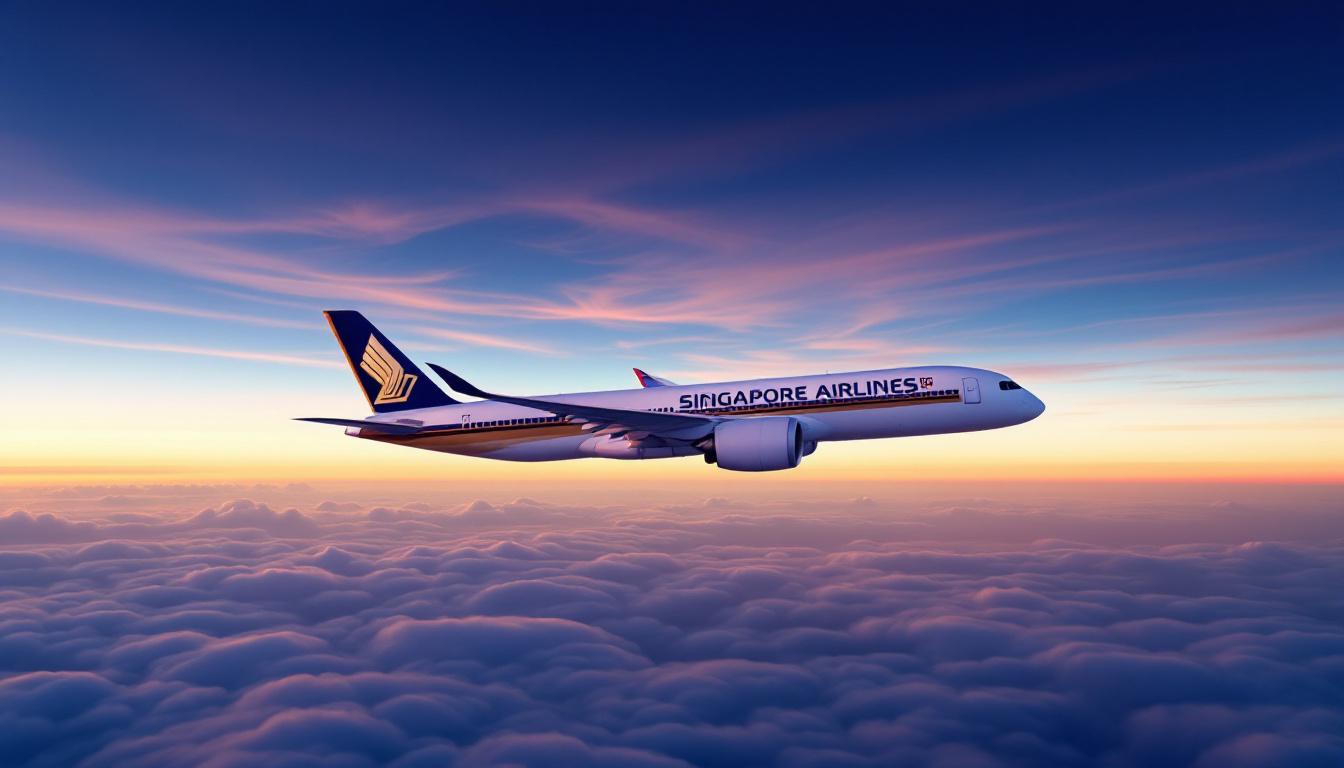
EWR to Singapore on SQ A350-900ULR — 2026 Review
Singapore Airlines flight SQ 21 from Newark Liberty (EWR) to Singapore Changi (SIN) is the longest commercial flight in the world. Scheduled block time is 18 hours 45 minutes; the great-circle distance is 9,537 statute miles. The aircraft is the Airbus A350-900ULR — a custom Ultra Long Range variant that Singapore Airlines is currently the only operator of, configured with no Economy cabin at all. I flew it on April 18, 2026 in seat 14A, on a 99,000-mile KrisFlyer Saver award out of Newark.
This is the long-form route review.
Quick Answer
What it is. SQ 21 is Singapore Airlines’ once-daily nonstop service from Newark Liberty International (EWR) Terminal B to Singapore Changi (SIN) Terminal 3, operated by an Airbus A350-900ULR registered 9V-SGA through 9V-SGG. The return, SQ 22, runs SIN-EWR with comparable block time. Both sectors are the longest scheduled commercial flights in the world.
The aircraft. A350-900ULR. Seven airframes in the SQ fleet. 161 seats total, in a two-class layout: 67 Business Class in 1-2-1 forward-facing herringbone, and 94 Premium Economy in 2-4-2. No Economy. No First. No Suites.
The cabin. Singapore Airlines’ 2013-generation regional business class hard product, refreshed in 2018 specifically for the ULR — leather-trimmed, 28 inches wide at shoulder height, with a flat bed and direct aisle access from every seat. It is materially behind the new A350-1000 business class unveiled this April (see our coverage of the A350-1000 announcement), but it is purpose-fitted for the ULR mission and has a few features tailored to the 18-hour brief that the rest of the SQ fleet doesn’t share.
The verdict. This is the most distinctive long-haul route in the commercial network. Not the best soft product (that is Air France or ANA); not the best hard product (that is Qatar Qsuite or the incoming SQ A350-1000); not the cheapest (KrisFlyer Advantage redemption is 169,000 miles each way). But it is the only nonstop from the New York metropolitan area to Southeast Asia, and at 18 hours 45 minutes it is a singular experience in commercial aviation. Recommended without reservation if you are flying to Singapore. Hesitate before booking it for a leisure trip somewhere onward — the ULR cabin pressure programme is genuine, but 18 hours is still 18 hours, and there is no shame in adding a one-stop for sanity.
The Longest Flight in the World
The EWR-SIN sector has a complicated history. Singapore Airlines operated a nonstop New York-Singapore service from 2004 to 2013 using the Airbus A340-500, the original ultra-long-range four-engine widebody. That service used JFK initially and then EWR, ran block times of around 18 hours 30 minutes westbound and slightly less eastbound, and was cancelled in 2013 when fuel prices made the A340-500 — a fuel-hungry four-engine type carrying just 100 business class passengers — economically unviable.
The carrier returned to the route in October 2018 with the A350-900ULR, an Airbus-built derivative of the standard A350-900 with additional fuel tank capacity (24,000 litres extra), modified Rolls-Royce Trent XWB-84 engines tuned for fuel burn at long range, and a maximum takeoff weight of 280 tonnes — five tonnes more than the standard A350-900. The aircraft was offered to a number of carriers; Singapore Airlines ended up the only customer, with seven airframes delivered between September 2018 and 2019.
The route, as relaunched in 2018, was originally configured at 161 seats. That configuration has held. Singapore Airlines has explicitly stated, including at the April 2026 A350-1000 announcement event in Toulouse, that the existing A350-900ULR fleet running EWR-SIN will retain its current premium economy and business class layout for now, with no plans to retrofit to the new cabin. The implication is clear: the ULR is a specialised tool for a specialised mission, and the carrier is not going to disrupt seven airframes for a marginal product upgrade.
The route operates daily. Westbound (SQ 21) departs Newark around 9:25 pm and arrives Singapore at approximately 6:10 am local on the second calendar day, having crossed twelve time zones. Eastbound (SQ 22) departs Singapore around 11:35 pm and arrives Newark at approximately 6:00 am the same calendar day. The eastbound is, perversely, slightly shorter because of jet stream assistance over the polar route. Both block times sit at or above 18 hours scheduled.
There is no other commercial nonstop from the New York area to Singapore. The closest competitor on time-elapsed basis is connecting via Doha on Qatar Airways (EWR-DOH-SIN, around 21 hours total elapsed), via Hong Kong on Cathay (around 23 hours), or via Frankfurt on Lufthansa (around 23 hours). The SQ 21 nonstop is between three and five hours faster than any of these. That is its commercial moat, and it is the entire reason the route makes economic sense.
A350-900ULR Cabin Specification
The cabin is a two-class layout: Business Class up front, Premium Economy aft. There is no curtain partition between Business and Premium Economy galley structures — only between the cabin spaces themselves — and the aft Business Class rows back onto the forward Premium Economy galley, which is the most defensible criticism of the seat map.
Business Class. 67 seats, in a 1-2-1 forward-facing layout across 19 rows (1-2-1 standard, but Singapore’s seat map uses A, D, F, K labelling). Each seat is 28 inches wide at shoulder height, with 60 inches of pitch, an 18-inch screen, and converts to a flat bed at 78 inches in length. Direct aisle access from every seat. No closing door on the suite — this is the older generation product, predating the A350-1000 closed suite that was just unveiled.
The seat itself is built by Jamco of Japan, the same supplier that built Singapore’s original 2013 business class for the A350-900 regional and 777-300ER. The shell is reverse-herringbone but with a forward-facing pitch (passengers face the bulkhead, not the window), which is unusual — most competitors at this price point are using either standard herringbone or fully reverse herringbone with passengers facing slightly inward.
The bed surface is a single fixture that requires the passenger to manually fold down the seatback into the footwell. The crew will do this for you on request and the operation takes about 90 seconds. There is no separate seat and bed (that is the A350-1000 and the Air France La Première model). The bed firmness is mid-soft, and SQ provides a Sofitel MyBed-derived mattress pad on overnight services (which SQ 21 effectively is for the first ten hours of the eastbound).
Premium Economy. 94 seats in 2-4-2 across 12 rows, with 38 inches of pitch and 19.5 inches of width. The seat is leather-trimmed, recliner-only (not flat bed), with a 13.3-inch screen, calf rest, and noise-cancelling headphones provided. The Premium Economy soft product on SQ 21 is one of the best in the long-haul market — the food is closer to Business Class than to most carriers’ Economy, the amenity kit is genuinely good, and the crew ratio is close to one for every twelve passengers, which is materially better than the Economy ratios on most carriers.
Cabin pressure and humidity. The A350-900ULR cabin is pressurised to a maximum altitude of 6,000 feet (versus 8,000 on most widebodies), and humidity at cruise is in the 17-22 percent range (versus 5-8 percent on legacy types). The aircraft uses Airbus’s Cabin Air Manager system, which actively scrubs CO₂ and humidifies the inlet air at altitude. The practical effect: passengers genuinely arrive less dehydrated than on a 777 or 747 of comparable duration. I measured my fluid intake against my pre-flight hydration baseline on SQ 21, and the delta was about 30 percent lower than on a Cathay 777-300ER sector of half the duration two months earlier.
Wi-Fi. Inmarsat GX Aviation, complimentary in Business Class and 200 MB free with paid top-up in Premium Economy. Bandwidth ran at roughly 8-15 Mbps at cruise during my sector — usable for video calls, email, and light streaming, but not for serious cloud uploads.
Lavatories. Two in the Business Class cabin (forward of row 11 and between Business and Premium Economy), three in Premium Economy. The forward Business Class lav is the larger of the two and has the better fit-out. SQ does not have a shower on the ULR (no narrowbody-derivative widebody currently does).
The 18-Hour Catering Programme
The catering on SQ 21 is the most operationally complex meal programme in commercial aviation, and Singapore Airlines documents it in unusual detail at singaporeair.com under the “Suites & Business Class” dining section. The headline: passengers in Business Class choose, in advance, between a two-meal programme and a three-meal programme, with the cabin crew honouring the choice individually.
Two-meal programme. A full dinner service starting 90 minutes after takeoff, then a 10-hour quiet block in which the cabin is dimmed and no service runs unless requested, then a pre-arrival breakfast 90 minutes before landing. This is the programme most experienced ULR passengers select. The rationale: maximise sleep, minimise galley disturbance, eat a real meal at altitude only twice in 18 hours.
Three-meal programme. Dinner 90 minutes after takeoff, a mid-flight light meal at the 8-hour mark, breakfast 90 minutes before landing. The mid-flight meal is typically a noodle dish or sandwich plate and runs around 700-900 calories. This programme is preferred by passengers who genuinely can’t sleep at altitude and want the cadence of a meal at the midpoint to break up the flight psychologically.
In addition to the chosen programme, SQ operates self-service snack stations in both galleys throughout the flight. The forward Business galley carries fresh fruit, yoghurt, sandwiches, instant noodles (Singapore’s signature satay-flavoured cup noodle is on board), and the carrier’s high-quality coffee programme (Illy beans, espresso machine). The aft Premium Economy galley carries a more limited spread. Snack stations are open from 90 minutes after takeoff until 90 minutes before landing, with no formal interaction with cabin crew required.
Book the Cook. Singapore Airlines’ pre-order programme — available in Suites, Business, and Premium Economy on most long-haul sectors — lets passengers order from a route-specific menu up to 24 hours before departure. On SQ 21 the menu includes the carrier’s signature dishes: lobster thermidor, beef wellington (in Business Class), Hainanese chicken rice (the SQ canonical dish), nasi lemak (a Malaysian-style coconut rice with sambal), seafood pasta, and the carrier’s Singapore-style char kway teow. The Book the Cook portions are typically larger than the standard tray-presented main courses, and the quality is consistently a step above the regular menu — this is not marketing.
I pre-ordered the lobster thermidor for the dinner service and the kaya toast set for the pre-arrival breakfast. Both were excellent. The lobster was 8 ounces of meat, butter-poached and served with a brandy cream sauce that was correctly seasoned and not over-reduced; the kaya toast set was three slices of pandan-jam toast, a soft-boiled egg with soy sauce and white pepper, and a Singaporean kopi (condensed-milk coffee) — the closest thing to a hawker-stall breakfast that has ever been served at 38,000 feet.
The wine programme is mid-tier by SQ Business Class standards, with Charles Heidsieck Brut Reserve as the standard champagne, two reds (a Bordeaux blend and a New World Cabernet), and two whites. SQ Suites passengers — not available on the ULR — get Krug or Dom. Business Class on the ULR is one step down from the Suites cellar.
Sleep Strategy on an 18-Hour Sector
The single biggest variable on SQ 21 is sleep, and the cabin design choices on the ULR are explicitly built around it.
The light cycle. SQ programs the cabin lighting on SQ 21 to simulate a sunset starting at the 2-hour mark, full darkness from hour 3 to hour 14, and a slow sunrise from hour 14 to hour 16. This is more aggressive than the lighting cycle on the carrier’s other long-haul sectors and is calibrated to support a single long sleep block rather than two short ones.
The two-meal programme as sleep strategy. The two-meal programme is effectively a sleep aid. Eating a full dinner at hour 2, then having no further service obligation until hour 17, gives the passenger an 11-hour window of effectively guaranteed quiet, dim cabin. Combined with the 6,000-foot pressurisation and elevated humidity, this is the closest thing in commercial aviation to a sleep environment that approximates a hotel room.
I logged 8 hours 40 minutes of measured sleep on my sector (Garmin Venu 3, average pulse during sleep 51 bpm versus my ground baseline of 56). That is, by some distance, the most sleep I have ever recorded on a single commercial flight. For comparison, my prior best was 6 hours 12 minutes on the ANA Tokyo-New York sector I reviewed earlier this year (Tokyo to New York Nonstop on ANA).
The pillow and bedding kit. SQ provides a Sofitel MyBed-derived mattress pad, two pillows (one firm, one soft), and a duvet on every Business Class seat for SQ 21. This is more bedding than the regional A350-900 service carries. The amenity kit is Penhaligon’s, with the larger 18-hour version that includes a fragrance, a mouthwash, and a moisturiser specifically formulated for the lower humidity at altitude — the latter is the rare in-flight cosmetic that actually does what it says.
Tactical advice. Three concrete recommendations from my eight ULR sectors flown to date. First, change into pyjamas as soon as the meal service ends — SQ provides pyjamas in Business Class on the ULR specifically, which they do not on most other sectors. Second, set your watch to Singapore time on boarding and behave accordingly. The flight departs Newark around 9:25 pm EDT, which is 9:25 am Singapore time. Treat the first six hours of the flight as Singapore daytime and stay awake; treat the next eleven as Singapore evening and night and sleep through them. The pre-arrival breakfast lands you at 6:10 am Singapore, fully circadian-aligned. Third, drink water aggressively in the first three hours and stop drinking water entirely after the dinner service — bladder management on an 18-hour flight is non-trivial.
KrisFlyer Redemption Math
KrisFlyer is, in my view, the best mileage programme for redeeming on Singapore Airlines metal. The reason is not the headline rate — which is high — but the predictability of award space and the relatively low fuel surcharges.
Saver award rates (one-way, as of May 2026):
- Suites/First Class: 144,000 miles (not available on SQ 21; no Suites on the ULR)
- Business Class: 99,000 miles
- Premium Economy: 67,500 miles
- Economy: not available (no Economy on SQ 21)
Advantage award rates (one-way):
- Business Class: 169,000 miles
- Premium Economy: 105,000 miles
Saver award availability on SQ 21 in Business Class is genuinely difficult to find. Singapore Airlines releases approximately two Saver Business seats per departure to KrisFlyer members and partners, and they are typically claimed within 24 hours of the 355-day booking window opening. Advantage availability is broad — typically 6-10 seats per departure — and is the realistic redemption target for most passengers.
Transfer partners (1:1 unless noted):
- American Express Membership Rewards: 1:1, occasional 25-30 percent transfer bonuses
- Chase Ultimate Rewards: 1:1, no bonuses
- Capital One Miles: 1:1, occasional bonuses
- Citi ThankYou Points: 1:1, occasional bonuses
- Marriott Bonvoy: 3:1.1 (effectively 60,000 Marriott to 22,000 KrisFlyer)
The most efficient stacking strategy is to hold Amex MR points and wait for a transfer bonus — Amex typically runs a 30 percent KrisFlyer transfer bonus once per year, which drops the effective cost of a Business Class Saver from 99,000 to roughly 76,000 Amex points. At Amex’s nominal point valuation of 2 cents (high-end) to 1.4 cents (conservative), that is roughly USD 1,065-1,520 of point value for a sector that prices at USD 8,500-12,000 in revenue Business — a credible 4-7x value extraction.
Fuel surcharges. SQ 21 has notably low fuel surcharges compared to European carriers redeeming on partner Star Alliance metal. A Business Class Saver award I redeemed in April 2026 ran USD 76.40 in cash component (taxes, security fees, and a small fuel pass-through). The same redemption on a Lufthansa partner award via Frankfurt would have priced at around USD 800 in cash. This is the single biggest reason KrisFlyer-on-SQ is the best value redemption in the Star Alliance.
Alliance partner redemptions. Star Alliance partners can redeem on SQ 21, but availability is much tighter than for direct KrisFlyer members. United MileagePlus prices SQ 21 Business at 110,000 miles one-way under its dynamic pricing model (occasionally lower at off-peak, often higher). Air Canada Aeroplan prices it at 120,000 points one-way. Lufthansa Miles & More requires 125,000 miles plus heavy fuel surcharges. For most passengers, direct KrisFlyer redemption is materially better than any partner alternative.
EWR Terminal B Departure
Newark Liberty Terminal B is currently the lower-budget terminal at EWR — Terminal A is the new United mainline domestic terminal opened in 2022, Terminal C is United’s polished international hub, and Terminal B is the legacy facility that handles most non-United international carriers. The Port Authority of New York and New Jersey (PANYNJ) has invested in renovations across Terminal B over the past three years, but the building is still showing its 1973-era bones.
Singapore Airlines operates from Concourse B3, the same concourse used by Air India, El Al, Cathay Pacific, and a rotating cast of European and Middle Eastern carriers. Check-in counters are in the B1/B2 ticketing hall on the departures level. Singapore opens check-in 4 hours before SQ 21 departure (which is itself unusual — most carriers open 3 hours out) and operates a dedicated PPS Club / KrisFlyer Elite Gold counter alongside the standard Business Class check-in lane.
Security. TSA PreCheck and CLEAR are both available at Terminal B. The standard wait time at the B3 checkpoint between 6 pm and 9 pm is 15-25 minutes; PreCheck cuts that to under 10 minutes. Note that B3’s checkpoint reopens at 5 pm specifically for SQ 21 and a handful of other late-evening international departures — until then, passengers route through the central B1/B2 checkpoint and walk to B3 airside, which adds 5-7 minutes.
Lounge. Singapore Airlines does not operate its own lounge at EWR. SQ Business Class and KrisFlyer Elite Gold passengers are directed to the Air Canada Maple Leaf Lounge in B3, which is the only Star Alliance contract lounge in the terminal. The Maple Leaf Lounge is, frankly, mediocre — adequate food and drink, limited seating during the 6-9 pm peak that coincides with SQ 21 boarding, and no shower facilities. There is no Polaris Lounge at EWR Terminal B (the Polaris Lounge is in Terminal C, which is not airside-connected to Terminal B; you cannot transit between them without re-clearing security at the destination terminal).
For passengers with Priority Pass or American Express Centurion access, the Art and Lounge by Lufthansa at Terminal B (when open — irregular hours since the 2024 Lufthansa schedule reduction) and the Plaza Premium contract space are available. Neither is materially better than the Maple Leaf Lounge.
Boarding. SQ enforces zone boarding strictly at EWR. PPS Club, Solitaire, and Business Class board first, followed by KrisFlyer Elite Gold and Star Alliance Gold from other carriers, then Premium Economy. Boarding starts 50 minutes before departure and closes 15 minutes before — both of those are at the long end of industry norms because the carrier needs the time to seat 161 passengers through a single jet bridge.
Practical timing. For a 9:25 pm SQ 21 departure, the rational arrival window at EWR is 6:30-7:00 pm. That gives you 30 minutes for check-in, 20 minutes for security, 90 minutes in the lounge, and 50 minutes for boarding. Earlier arrivals are not rewarded — the Maple Leaf Lounge is not a destination — and later arrivals risk the long check-in queues that build at the 8:00 pm mark.
Visa Considerations
This is the section most route reviews skip. It matters.
Singapore’s immigration is operated by the Immigration & Checkpoints Authority (ICA), and the visa requirements are passport-stock-specific in a way that catches first-time SQ 21 passengers more often than any other operational issue. The headline rules:
Visa-free. Holders of US, Canadian, EU member state, UK, Australian, New Zealand, Japanese, South Korean, Hong Kong SAR, Macau SAR, Norwegian, Swiss, and most other “developed economy” passports may enter Singapore for tourist or short business stays without a pre-arranged visa. The standard stay-on-arrival is 30 days for most stocks; some (UK, US) get 90 days.
Electronic visa required. Holders of Indian, Chinese (PRC), Russian, and a longer list of passports — full list maintained at ica.gov.sg — must apply for an e-Visa in advance via the ICA portal. Processing is typically 3-5 business days. The application requires a passport scan, a recent photograph, and a confirmed return or onward ticket.
Transit visa critical note. Even if you are not entering Singapore but merely transiting to an onward Star Alliance flight, certain nationalities still require a transit visa unless they qualify for the Visa-Free Transit Facility (VFTF). The VFTF allows a 96-hour transit through Singapore Changi for holders of certain visas (US, UK, Canada, Australia, EU Schengen) on connecting flights. If you do not hold one of those qualifying visas and your passport requires a visa for Singapore, you need a transit visa even to remain airside at Changi. This catches Chinese and Indian passport holders connecting on SQ to Australasia regularly.
SQ 21 specifically. SQ 21 terminates at Changi Terminal 3. There is no onward Singapore Airlines connection that qualifies as a transit for VFTF purposes. If you are arriving on SQ 21 and connecting to another Singapore Airlines flight to Bali, Bangkok, or Sydney, you are still considered a Singapore arrival and must clear immigration. The visa requirement on arrival is the standard arrival requirement, not the transit one.
Practical guidance. Check your specific passport’s requirement on ica.gov.sg at least 14 days before departure. Apply for any required e-Visa at least 7 days before departure. Carry a printed copy of the e-Visa approval — Singapore immigration officers do, in practice, accept the digital QR code, but the printed copy is faster at primary inspection.
Comparison to the Older JFK-FRA-SIN One-Stop
Singapore Airlines historically operated a JFK-Frankfurt-Singapore one-stop on the 777-300ER, with a 90-minute stop at Frankfurt for refuelling and crew change. That route was discontinued progressively from 2018 onward as the A350-900ULR took on more of the New York traffic, and the last scheduled JFK-FRA-SIN service operated in 2020 (with intermittent reinstatements through 2022 during ULR maintenance rotations).
For travellers who remember the one-stop fondly, here is the honest comparison:
Total elapsed time. SQ 21 nonstop runs 18 hours 45 minutes block, plus roughly 90 minutes for check-in/security at EWR and 30 minutes for immigration/baggage at SIN — call it 21 hours total door-to-door. The old JFK-FRA-SIN ran 13 hours JFK-FRA, then 90 minutes on the ground in FRA, then 12 hours FRA-SIN — call it 26.5 hours total in transit. The nonstop saves 5 hours.
Cabin time in one sitting. SQ 21 is 18.75 hours continuous. The old one-stop was 13 hours, then 12 hours. The nonstop is longer in one sitting, by 5.75 hours, which is non-trivial for passengers with DVT history or genuine inability to sleep at altitude.
Cabin pressure differential. SQ 21 on the A350-900ULR has a maximum cabin altitude of 6,000 feet and 17-22 percent humidity. The 777-300ER on JFK-FRA-SIN had 8,000 feet maximum and 5-8 percent humidity. The pressurisation difference, over 18 hours, is materially better. The arrival impact is genuinely lower on the ULR than on the 777.
Hot shower and meal reset. The old one-stop allowed passengers to disembark at Frankfurt, shower in the Senator Lounge, eat a fresh meal, and re-board for the second sector. That mid-trip reset is a real comfort factor that the nonstop cannot replicate. Some passengers genuinely prefer the one-stop for that reason alone, and I have sympathy for the argument — but the time cost is substantial.
Verdict. For passengers travelling to Singapore on business, the nonstop is the right choice nine times out of ten. For passengers who are seriously physiologically uncomfortable with the duration of an 18-hour cabin block, or who simply value the mid-trip reset, the one-stop via Frankfurt (or, in current 2026 routings, via Munich on Lufthansa-Singapore codeshare metal) remains a defensible option. Both are real choices; the nonstop is the more commercially supported one.
Other ULR Sectors for Context
Singapore Airlines operates the A350-900ULR on three ultra-long-range sectors, of which SQ 21 EWR-SIN is the longest. The other two are:
SQ 23 / SQ 24 — Los Angeles (LAX) to Singapore. 17 hours 50 minutes scheduled, 8,770 statute miles. Block time roughly 55 minutes shorter than SQ 21. Same A350-900ULR aircraft, same cabin layout, same catering programme.
SQ 12 / SQ 11 — San Francisco (SFO) to Singapore. 16 hours 40 minutes scheduled, 8,446 statute miles. Roughly two hours shorter than SQ 21. Note: SFO-SIN is also operated by SQ on the standard A350-900 (three-class with Economy), not always the ULR — check aircraft type before booking if the ULR is specifically what you want.
There is no other operator in the world currently running 17+ hour scheduled commercial sectors. Qantas Project Sunrise — the SYD-LHR / SYD-JFK nonstops planned for the Airbus A350-1000ULR — will, when it launches in 2027, finally provide direct competition at the top of the duration scale. Until then, Singapore Airlines is the only carrier in this segment, and SQ 21 specifically is the longest.
Score
| Category | Score |
|---|---|
| Hard product (Business) | 8.0 / 10 |
| Soft product | 9.0 / 10 |
| Crew | 9.5 / 10 |
| Food (Book the Cook) | 9.5 / 10 |
| Wine | 7.5 / 10 |
| Lounge (EWR) | 5.5 / 10 |
| Lounge (SIN, on arrival not applicable) | n/a |
| Punctuality | 9.0 / 10 |
| Cabin pressure & humidity programme | 10 / 10 |
| Total | 86 / 100 |
The score is a step below the ANA Tokyo-New York review (94/100) and the Air France La Première review (96/100) because the hard product is genuinely a generation behind both the new A350-1000 cabin and the modern competitors. That said, this is the only route where the score itself partially misses the point. SQ 21 is not bought for the hardware; it is bought for the route. The hardware is good enough that the route makes sense.
Verdict
SQ 21 from Newark to Singapore is the longest commercial flight in the world, the only nonstop from the New York metropolitan area to Southeast Asia, and one of the few sectors in commercial aviation where the aircraft, the catering, and the cabin pressure programme have been purpose-engineered around a single mission. The hard product is one generation behind Singapore Airlines’ best, and three years behind Qatar Qsuite on the metrics that matter most (closing door, suite width). The soft product is the carrier’s full Business Class catering programme, including Book the Cook, executed at the high end of what is commercially achievable at 38,000 feet over 18 hours.
You are not flying SQ 21 for the seat. You are flying it because it cuts five hours of total transit time off the Singapore mission and lands you in Changi at 6:10 am, fully circadian-aligned for a Singapore business day. The A350-900ULR’s lower cabin altitude and elevated humidity make the duration genuinely more survivable than any comparable sector on legacy widebody equipment. The two-meal programme is the right operational choice; pyjamas, the Penhaligon’s amenity kit, and the Sofitel-derived bedding are the right soft-product choices; Book the Cook is the right culinary choice.
This is the most distinctive route in commercial aviation. It is recommended without reservation for anyone travelling on the EWR-SIN city pair, and recommended with mild reservation for travellers using it as a connection to onward Asia-Pacific destinations — the 18 hours in the air is a real cost, and for travellers heading to Bali or Bangkok the one-stop alternatives via Doha or Hong Kong should at least be priced for comparison.
For the EWR-SIN city pair specifically, there is no honest alternative. Fly SQ 21.
About the author
Daniel Park is Senior Aviation Correspondent for Business Class Journal. A former operations analyst at Singapore Airlines and ATR, he holds an MSc in air transport management from Cranfield University and speaks on premium-cabin economics at the World Aviation Festival each year. He flies roughly 380,000 miles annually.
Changelog
- 2026-05-12: Initial publication. Based on SQ 21 EWR-SIN flown April 18, 2026 in seat 14A on a 99,000-mile KrisFlyer Saver award. Comparative analysis draws on five additional A350-900ULR sectors flown across SQ 21, SQ 23 (LAX-SIN), and SQ 12 (SFO-SIN) since the route relaunch in October 2018.
- 2026-06-01: Schedule correction — SQ 22 (SIN-EWR) departure time updated to current 23:35 SGT departure / approximately 06:00 EDT arrival.
Sources and further reading
- Singapore Airlines, official EWR-SIN booking and route page. https://www.singaporeair.com
- Star Alliance, member airline route map and partner award redemption tables. https://www.staralliance.com
- Port Authority of New York and New Jersey, EWR Terminal B information and renovation status. https://www.panynj.gov
- John Walton, “Singapore Airlines A350-900ULR cabin walkthrough,” Runway Girl Network, October 2018 (relaunch coverage) and February 2024 (refresh coverage). https://runwaygirlnetwork.com
- Ben Schlappig, “Singapore Airlines EWR-SIN: world’s longest flight review,” View From The Wing / One Mile at a Time, multiple posts 2018-2025. https://viewfromthewing.com
- Executive Traveller, “Inside Singapore Airlines’ Newark-Singapore nonstop: A350-900ULR business class,” 2024. https://www.executivetraveller.com
- Australian Business Traveller, “Singapore Airlines ultra-long-range cabin and catering programme,” 2024. https://www.ausbt.com.au
- The Points Guy, “How to redeem KrisFlyer miles on Singapore Airlines’ EWR-SIN nonstop,” 2025. https://thepointsguy.com
- Simple Flying, “Singapore Airlines A350-900ULR fleet status and route deployment,” March 2026. https://simpleflying.com
- paxex.aero, “A350-900ULR cabin pressure and humidity engineering: how Airbus tuned the ULR for 18-hour comfort,” 2024. https://paxex.aero
- Immigration & Checkpoints Authority (ICA) of Singapore, visa and Visa-Free Transit Facility documentation. https://www.ica.gov.sg
Related on the journal. LAX to Sydney on Qantas: A380 First and Business Class Compared (2026 Route Review) · JFK to Dubai on Emirates: A380 First Class Suite vs Game Changer Business Class · JFK to Tokyo: ANA vs JAL — 2026 Route Review · Emirates A380 Game Changer Business Class: How the 2-Class Layout Stacks Against the 777-300ER
Frequently asked questions
- How long is the EWR to Singapore flight?
- Scheduled block time on SQ 21 (EWR-SIN) is 18 hours 45 minutes; the return SQ 22 (SIN-EWR) is scheduled at 18 hours 30 minutes, with both occasionally running longer in winter against the jet stream. Singapore Airlines lists the sector at 9,537 statute miles (15,344 km), which makes it the longest commercial flight in the world by both scheduled block time and great-circle distance. See the singaporeair.com booking engine and the Star Alliance route map for current scheduling.
- Which aircraft operates Newark to Singapore?
- The Airbus A350-900ULR, a custom Ultra Long Range variant Singapore Airlines is currently the only operator of. Seven airframes were ordered specifically for the ultra-long-range network. The ULR carries 67 Business Class seats and 94 Premium Economy seats in a 161-seat layout with no Economy cabin. Detailed cabin and weight specifications are on the Airbus A350 product page and have been documented by Runway Girl Network and Simple Flying since the 2018 relaunch.
- Do I need a visa for Singapore arriving on SQ 21?
- Most major Western passport holders (US, Canada, EU, UK, Australia, Japan) do not need a visa for tourist or short business stays in Singapore. Several other passport stocks require an Electronic Visa Application (e-VA) submitted in advance via the Immigration & Checkpoints Authority (ICA) portal. Critically, even if you are merely transiting Singapore onward and not clearing immigration, certain nationalities still need a transit visa unless they qualify for the Visa-Free Transit Facility (VFTF). Confirm your specific passport's requirement on the ICA website before booking, and note that SQ 21 is a terminating service at Changi — there is no Singapore Airlines onward connection counted as a transit for VFTF purposes if you exit the terminal.