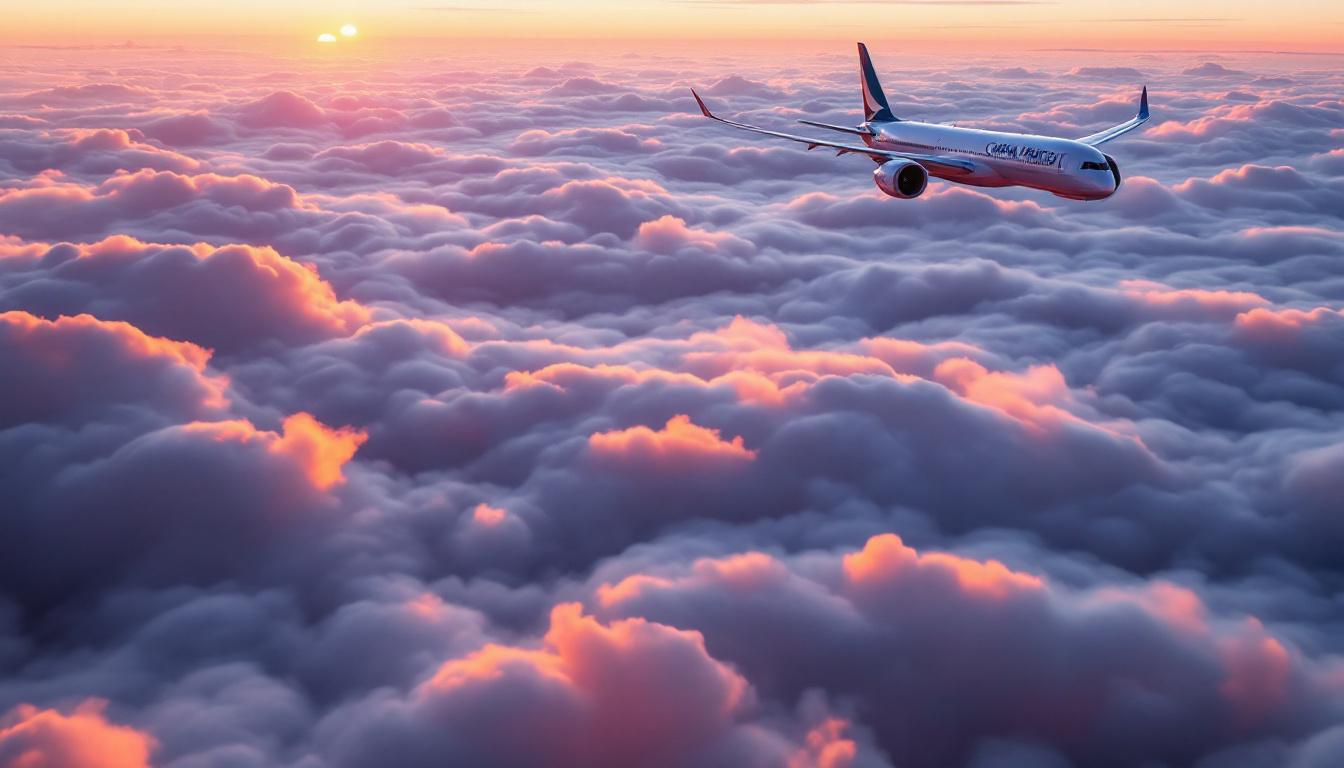
JFK to Hong Kong on Cathay Pacific Aria Suite: The Long-Haul Route Review
Cathay Pacific operates two daily nonstops between New York JFK and Hong Kong: CX 841/CX 840 on Boeing 777-300ER (with a 6-seat First Class cabin) and CX 845/CX 844 on the Airbus A350-1000, now progressively fitted with Aria Suite business class. The A350-1000 westbound sector runs about 15h 55m gate-to-gate. Paid one-way business fares cluster between USD 5,400 and USD 7,800; AsiaMiles redemptions price from 85,000 miles plus USD 230 in taxes on Standard Awards and 70,000 miles on Choice Awards. Aria moves Cathay from a credible mid-pack hard product on this route to the strongest business class operating any New York to Greater China non-stop.
There is a particular logic to Cathay Pacific’s New York operation that has held for the better part of two decades, and the introduction of the Aria Suite onto the A350-1000 rotation in 2026 has not so much changed that logic as sharpened it.
Cathay flies twice daily between New York JFK and Hong Kong. The first rotation, CX 841 westbound and CX 840 eastbound, operates on a Boeing 777-300ER with the carrier’s six-seat First Class cabin in the forward nose, the legacy Cirrus reverse-herringbone business class behind it, premium economy, and economy. The second rotation, CX 845 westbound and CX 844 eastbound, operates on the Airbus A350-1000 — a four-class aircraft without First — and is the rotation now progressively transitioning to the Aria Suite hard product as the retrofit programme rolls through Cathay’s 18-frame A350-1000 fleet.
I flew CX 845 westbound on the night of 12 May 2026, gate departure 19:35 EDT from JFK terminal 8, gate arrival 23:38 HKT into HKG terminal 1 the next evening. Block-to-block 15h 55m on a paid one-way business class fare of USD 6,840, seat 12A on an Aria-fitted A350-1000 registered B-LXG.
This is the route review. The cabin product review for Aria itself sits separately in our airlines coverage; here the question is narrower: does Aria change the equation for the New York to Hong Kong premium-cabin passenger, and how does the Cathay non-stop now stack up against the genuine competitive set — Singapore’s EWR-SIN ULR, the BA + Cathay one-stop via London, and Cathay’s own First Class option that still operates on the 777-300ER rotation earlier in the day.
The Quick Answer
For the reader who wants the headline: the Aria-fitted CX 845 is now the strongest business class hard product operating any non-stop between New York and Greater Asia, and on most passenger profiles it is the right default booking for the JFK-HKG sector.
The 15h 55m block time is genuinely long but is the shortest available non-stop into Hong Kong from anywhere in North America. The hard product, post-Aria, is at parity or slightly ahead of ANA The Room on its JFK-HND rotation and meaningfully ahead of every other product flying any New York to Asia non-stop. The catering rhythm — a proper three-service operation with an on-demand noodle bar between the supper and pre-arrival services — is well-tuned to the body-clock realities of a 16-hour westbound overnight. The AsiaMiles award pricing remains one of the better redemption values in OneWorld for the segment.
The places where the non-stop loses ground are predictable. Sixteen hours in a seat is sixteen hours in a seat, and Singapore Airlines’ EWR-SIN ULR has the more refined ultra-long-haul service rhythm because the operation was built for the longer sector from cabin design forward. The Wi-Fi remains Inmarsat GX Ka-band rather than Starlink. The First Class cabin on the 777-300ER rotation remains the only six-seat First Class on any New York to Hong Kong non-stop, and for passengers who specifically want First, the CX 841 timing — earlier on both sides of the day — may be the better booking even with the older Cirrus cabin behind the curtain.
Net of all of that, Aria has done what Cathay needed it to do on this specific route: it has moved the New York to Hong Kong non-stop from a competitive booking that needed defending into a competitive booking that does not.
The Route and the Aircraft
The non-stop sector between New York and Hong Kong is 8,054 nautical miles by great-circle distance — one of the ten longest commercial non-stops currently flying anywhere in the world. Cathay has operated the route since 1996, transitioned to the 777-300ER in 2007, added a second daily in 2011, and put the A350-1000 onto the second daily rotation in 2018. The current schedule, confirmed through cathaypacific.com’s published timetable for the 2026 northern summer season, is:
| Flight | Direction | Equipment | Departure | Arrival | Block time |
|---|---|---|---|---|---|
| CX 845 | JFK → HKG | A350-1000 (Aria) | 19:35 EDT | 23:35 HKT +1 | 15h 55m |
| CX 841 | JFK → HKG | 777-300ER (Cirrus) | 11:35 EDT | 15:35 HKT +1 | 16h 00m |
| CX 844 | HKG → JFK | A350-1000 (Aria) | 09:50 HKT | 13:30 EDT | 15h 40m |
| CX 840 | HKG → JFK | 777-300ER (Cirrus) | 23:55 HKT | 03:35 EDT +1 | 15h 40m |
Block times are nominal; actual elapsed runs plus-or-minus 25 minutes depending on polar winds. The Aria-fitted rotation matters operationally because the 13:30 EDT arrival on CX 844 puts passengers into Manhattan by mid-afternoon with a full afternoon of recovery before the next business day, which the 03:35 EDT red-eye on CX 840 manifestly does not. The A350-1000 operates in Cathay’s 334-seat configuration: 46 business class suites across two cabins, 32 premium economy, and 256 economy. The forward business cabin runs from row 11 — the immediate tell of an Aria-fitted aircraft — through row 20.
Aria Suite Recap: Spec That Matters On A 16-Hour Sector
The full Aria walkthrough sits in our airlines coverage. For the route review, the specifications that matter specifically on the 16-hour overnight rotation are:
| Specification | Aria Suite as installed on CX 845 |
|---|---|
| Layout | 1-2-1 |
| Shoulder width (measured) | 20.0 in |
| Bed length (closed door, toe-to-headrest) | 80.3 in (204 cm) |
| Privacy door | Sliding, sealed flush at top, 8 cm gap at floor |
| Mattress topper | 4 cm memory-foam |
| Bedding | Bamford 280 GSM duvet, 300-thread-count percale |
| IFE display | 18 in 4K Panasonic Astrova |
| Bluetooth | 5.3, no dongle required |
| Power | 100 W USB-C primary, 60 W USB-C secondary |
| Wireless charging | Qi 1.3, 15 W |
| Lighting | 5-channel LED, five presets |
| Wi-Fi | Inmarsat GX Ka-band, 18-25 Mbps typical |
Three of these specifications matter disproportionately on a 16-hour westbound overnight.
The bed length is the first. At 80.3 inches toe-to-headrest with the privacy door closed, Aria is the longest bed in Cathay’s portfolio and one of the longest in OneWorld outside Qsuite. On a 16-hour sector with a full 7-to-9-hour sleep window in the schedule, the difference between 78 and 80 inches is the difference between “I slept” and “I slept properly.” I’m 6’1”, and on the 12 May sector I slept 7h 18m continuously with the bed extended and the door closed, measured by my Garmin.
The Bamford 280 GSM duvet is the second. The legacy Cirrus product on the 777-300ER rotation runs a lighter 210 GSM duvet, and on the 16-hour sector that weight differential is noticeable in the third hour of sleep when cabin temperature settles to its overnight 18-19°C cruise level.
The 5-channel lighting is the third. Cathay’s pre-arrival wake-up sequence on the Aria cabin operates as a 45-minute lighting ramp from the “Sleep” preset (2400K nightlight at floor level) through “Relax” (2200K amber wash) to “Focus” (4000K daylight equivalent), which is genuinely useful for body-clock realignment on a flight landing at 23:35 local Hong Kong time after a 19:35 EDT departure. The legacy Cirrus runs binary cabin lighting on crew discretion — functional but materially blunter on the overnight.
The bottom door gap and the Wi-Fi throughput are the two real compromises, covered later.
Service Rhythm: The 16-Hour Three-Beat Cadence
Long-haul service rhythm on the JFK-HKG sector is meaningfully different from the two-meal European-pattern rhythm most North American premium passengers know from JFK-LHR. The relevant comparison is the 16-to-18-hour Asian-carrier ultra-long-haul rotation, where Cathay, Singapore, ANA, JAL, and Korean all operate a three-service cadence.
The three beats on CX 845 are: a main supper service starting at wheels-up-plus-60-minutes, an on-demand mid-flight service from cruise to descent-minus-four-hours, and a pre-arrival service opening 90 minutes before descent.
Service one (supper): On the 12 May sector, the cart started at 20:38 EDT (55 minutes after wheels-up). The Aria-fitted rotation runs the same Cathay dual-track structure as the rest of the long-haul network: a Western track with three courses and a pan-Asian track with three courses, plus a noodle option. I ordered the Asian track: a chilled poached chicken with sesame appetizer, a Cantonese double-boiled corn soup, a stir-fried lobster with ginger and scallion on noodles, and a mango pomelo sago dessert. The lobster was meaningfully better than the Cathay long-haul mean — I’d had the same dish two months earlier on the HKG-LHR rotation and the JFK execution was sharper, possibly because the JFK catering runs through Gate Gourmet’s premium kitchen rather than the Cathay Hong Kong commissary.
Service one runs roughly 90 to 120 minutes from cart-out to cart-back. On my flight, the cabin was through service by 22:25 EDT (2h 50m after wheels-up), and lights had stepped down to “Relax” by 22:35 EDT. The cabin transitioned to sleep mode without overt crew prompting — bedding offered as dessert plates cleared, pajamas distributed on boarding, suite door slid closed without request.
Service two (the noodle bar, on-demand): This is the distinctive Cathay touch and the single biggest reason the service rhythm reads as different from the trans-Atlantic European pattern. The noodle bar opens at cruise-plus-15-minutes and remains available on-demand until descent-minus-four-hours. The menu offered on 12 May: dan-dan noodles, wonton noodle soup with shrimp and pork, beef brisket noodle soup, congee with century egg, and a vegetarian wonton option. Serving is properly bowl-portioned (not the half-portion shrink some carriers run on between-meals service). I ordered the wonton noodle soup at 04:14 HKT (8 hours into the flight, 5 hours after supper wrapped) and it arrived at 04:29 HKT — wontons properly steamed rather than reheated, broth at the right salt level, noodles with the right bite.
The noodle bar’s existence as a third on-demand service is why the service rhythm here is structurally different from the European-pattern two-meal sectors. On a 7-hour JFK-LHR overnight, the breakfast service is functionally the only second meal. On a 16-hour JFK-HKG overnight, there is a full 4-to-6-hour sleep window after supper, a 2-to-3-hour mid-flight awake window where the noodle bar matters, and another shorter sleep window before pre-arrival.
Service three (pre-arrival): Opens 90 minutes before descent. On 12 May, the cart started at 22:08 HKT (1h 27m before our 23:35 arrival). The menu: Cantonese-style congee with thousand-year egg, a Western breakfast with omelette and sausage, a fruit-and-yogurt option, and a pastry basket. I ordered the congee and a fruit course — both appropriately portioned for proximity to landing. The pre-arrival lighting ramp had moved through “Relax” by service start and was at “Focus” by 22:30 HKT, which made finishing the meal and prepping for landing materially easier than the binary cabin-light flip the legacy Cirrus runs.
The three-beat cadence is well-tuned to the body-clock realities of the westbound overnight. It is materially less well-tuned to the eastbound morning departure on CX 844, where the same three-service structure has to be compressed into a daytime rotation. The eastbound is the harder operation to execute well; executivetraveller.com and viewfromthewing.com have both noted the same observation in their Aria deployment coverage.
First Class Context on the Route
Cathay’s First Class cabin remains available on the JFK-HKG sector — but only on the 777-300ER rotation (CX 841 westbound, CX 840 eastbound), not on the Aria-fitted A350-1000. The A350-1000 fleet was specified four-class from delivery (business, premium economy, economy, no First) and that has not changed with the Aria refurbishment.
The Cathay First Class hard product is the original Cirrus first-generation product Cathay debuted in 2007 and refreshed in 2017. It is a six-suite cabin in 1-1-1 across two rows in the forward nose, each suite 36 inches wide at shoulder height, with an 81-inch flat bed and a separate ottoman that converts to a visitor seat. It is the only six-seat First Class flying between New York and Greater Asia on any carrier other than ANA’s First on the HND-JFK rotation.
The case for booking First on CX 841 rather than business on CX 845 comes down to four factors:
The first is timing. CX 841 departs JFK at 11:35 EDT and arrives HKG at 15:35 HKT the next day, putting passengers into Hong Kong in mid-afternoon with a full evening of recovery before the next business day. CX 845’s 23:35 HKT arrival lands at the practical end of the Hong Kong business day. For corporate passengers with next-day morning meetings, CX 841 is the better timing regardless of cabin.
The second is cabin volume. Six suites in First versus 46 in business means materially fewer fellow passengers, a 1:2 published crew-to-passenger ratio versus 1:5 in business, and a meaningful step up in soft-product personalisation that a 16-hour sector amplifies.
The third is catering. Cathay First Class runs à la carte ordering across the sector rather than the dual-track business class menu. The First catering on the JFK rotation includes a caviar service, a hot Chinese-style fish dish prepared at the seat, and a wider wine list. The Champagne in First is Bollinger La Grande Année 2014 versus business class’s Drappier Carte d’Or — a meaningful step up.
The fourth is pricing. First Class on CX 841 is approximately USD 14,800 to USD 18,400 one-way on paid revenue, or 110,000 AsiaMiles plus USD 380 taxes on the Standard Award when capacity is available. The redemption is competitive against the comparable Singapore Suites Standard Award (135,000 KrisFlyer miles) and the ANA First Class award (165,000 ANA Mileage Club miles). For AsiaMiles-holding passengers, this is the strongest First Class redemption available on any New York to Asia non-stop.
The case against First is primarily the hard product. The Cirrus first-generation seat has not been meaningfully refreshed since 2017 — IFE is a previous-generation 17-inch Panasonic without Bluetooth, lighting is binary, power is 15-watt USB-A only, bedding is the legacy 210 GSM duvet. Aria moves business class onto a more contemporary platform than First currently is — the unusual 2026 situation where Cathay’s business class hard product reads as more technically advanced than its First Class hard product on the same route. The carrier has not announced a First Class refresh; the 777-300ER is on a 2030-2031 retirement timeline per scmp.com.
For most premium passengers on this route in 2026, the right answer is Aria-fitted CX 845. For passengers who specifically value the daytime arrival, the cabin volume differential, or the AsiaMiles First redemption, CX 841 remains defensible — but the gap is narrower than at any point since Aria was announced.
AsiaMiles Redemption Math
AsiaMiles is Cathay’s frequent flyer programme and the primary redemption currency for the JFK-HKG sector. The award chart is distance-based with two award types — Standard Awards and Choice Awards. JFK-HKG sits in the 7,501-to-10,000-mile distance band:
| Cabin | Standard Award | Choice Award | Cash co-pay typical |
|---|---|---|---|
| Economy | 30,000 miles | 22,000 miles | USD 95-130 |
| Premium Economy | 47,500 miles | 38,000 miles | USD 130-170 |
| Business | 85,000 miles | 70,000 miles | USD 220-260 |
| First (777-300ER only) | 110,000 miles | 92,500 miles | USD 320-380 |
The Standard Award is the “anytime” rate, bookable on cathaypacific.com when award inventory exists. The Choice Award is a discounted rate for AsiaMiles Club Silver+ members with a 14-day advance requirement and reduced change flexibility (USD 100 change fee versus USD 25 on Standard).
The redemption math against the broader OneWorld currency landscape on JFK-HKG breaks down approximately as:
| Currency | One-way business class | Round-trip business class | Notable terms |
|---|---|---|---|
| AsiaMiles (Standard) | 85,000 + USD 240 | 170,000 + USD 460 | Direct on cathaypacific.com |
| AsiaMiles (Choice) | 70,000 + USD 240 | 140,000 + USD 460 | Silver+ tier, 14-day advance |
| Alaska Mileage Plan | 70,000 + USD 180 | 140,000 + USD 320 | Stopover privilege, no surcharge |
| American AAdvantage | 100,000 + USD 175 | 200,000 + USD 280 | Standard partner award |
| British Airways Avios | 115,000 + USD 245 | 230,000 + USD 480 | Higher fuel surcharge |
| Qantas Frequent Flyer | 108,000 + USD 250 | 216,000 + USD 480 | OneWorld classic award |
The Alaska Mileage Plan redemption is the standout value on Cathay long-haul partner awards and has been thepointsguy.com’s flagged sweet spot for several years — the 70,000-mile one-way pricing plus stopover privilege makes Alaska materially better than AsiaMiles’s own Standard rate. Alaska award space has tightened across 2024-2025 and now generally requires 6 to 11 months advance booking for Aria-fitted rotations.
AsiaMiles Standard Award space release on JFK-HKG follows a consistent pattern: a small initial release at the 330-day mark (typically 2 to 4 business class seats per Aria-fitted rotation), a secondary release at 120 days, and ad-hoc releases at 14 and 7 days. The 330-day window is the highest-yield time to book if dates are flexible.
Where This Sits vs. Singapore Airlines EWR-SIN ULR
Singapore Airlines’ Newark to Singapore non-stop (SQ 21/SQ 22) is the comparable ultra-long-haul reference point and the natural alternative for premium-cabin passengers routing from the New York metropolitan area to Asia.
SQ 21/SQ 22 is the longest commercial flight in the world at roughly 18h 30m on a great-circle distance of 8,285 nautical miles between EWR and SIN. The route is operated by the Airbus A350-900ULR, a seven-frame sub-fleet specifically configured for the longest-range operations, with extended fuel tanks and a two-class layout (business and premium economy, no economy and no First). CX 845 is a four-class A350-1000 at 15h 55m on 8,054 nautical miles — about 2h 30m shorter and one airport further north on the Asia end.
Hard product. Singapore’s A350-900ULR business class is the 2018-generation Stelia Symphony — 1-2-1 reverse-herringbone with 28-inch shoulder width, 78-inch bed, 18-inch IFE. It is the older-generation Singapore business class, not the newer 2026 cabin rolling onto the A350-1000 (targeted for EWR-SIN in 2027). Until then, Aria is the more contemporary hard product feature-by-feature: longer bed (80.3 vs 78), better Bluetooth (5.3 vs none), better USB-C (100 W vs 60 W), better lighting. Singapore’s advantages are the wider shoulder width and lower cabin density (67 suites, two-class).
Service rhythm. Singapore runs a similar three-service cadence with different timing windows. The on-demand mid-flight is structured as a “book the cook” pre-order programme rather than a noodle bar. The Singapore programme is more refined as an ultra-long-haul programme specifically because the 18h 30m duration forced the carrier to optimise for it.
Connection efficiency. This is the dimension on which the routing decision is genuinely made. Hong Kong gives the OneWorld passenger deep Greater China and Northeast Asia coverage. Singapore gives the Star Alliance passenger comparable depth into Southeast Asia and Australia/New Zealand. For passengers destined for Hong Kong, Mainland China, Japan, or Korea, Cathay through HKG is the more efficient routing. For Singapore, Southeast Asia, or Australia/New Zealand, Singapore through SIN is.
Award redemption. Singapore KrisFlyer Saver Award pricing on EWR-SIN business class is 99,000 miles one-way (versus AsiaMiles Standard 85,000), with comparable taxes of roughly USD 260. KrisFlyer Advantage Award (the higher-availability tier) prices at 132,000 miles. Singapore award space is meaningfully tighter than Cathay award space.
Net assessment. For passengers based in the New York metropolitan area routing to Hong Kong, Mainland China, or Northeast Asia, the Cathay JFK-HKG non-stop is the better default. For passengers routing to Singapore, Southeast Asia, or Australia/New Zealand, the Singapore EWR-SIN ULR is the better default. The hard product is currently a slight edge to Cathay on Aria; the service rhythm is a slight edge to Singapore on the purpose-built programme; the routing efficiency is determined by your destination. Australianbusinesstraveller.com and thepointsguy.com have both run useful comparisons.
Where This Sits vs. The One-Stop Via London
The JFK-LHR-HKG one-stop is the historical alternative to the Cathay non-stop and remains viable in 2026, operated as a code-share between British Airways (JFK-LHR on BA 178 or BA 116) and Cathay Pacific (LHR-HKG on CX 250) under the BA + Cathay OneWorld arrangement.
Total transit time. The one-stop via LHR runs approximately 19 to 21 hours gate-to-gate including connection (BA 178 is 7h 5m JFK-LHR, CX 250 is 11h 55m LHR-HKG, with a 90-to-180-minute LHR connection), versus 15h 55m for the non-stop. The non-stop saves 3 to 5 hours of total transit time.
Sleep window structure. This is where the one-stop has a genuine and underappreciated advantage. The two-segment routing produces two distinct sleep windows: 4 to 5 hours on the JFK-LHR overnight, and 6 to 8 hours on the LHR-HKG overnight (assuming the optimal pairing of BA 178 evening departure with CX 250 evening departure ex-LHR). For passengers who struggle to sleep long-form on a single sector, the two-segment pattern can produce more total rest than the single 16-hour cycle.
Hard product on the one-stop. BA 178 operates on the 777-300ER or 787-9 with BA’s Club Suite — a credible 2019-generation business class with closing door, 1-2-1 layout, and 23-inch shoulder width. It is roughly half a product generation behind Aria on the tech package and meaningfully behind on bed length (Club Suite 75 inches versus Aria 80.3). CX 250 LHR-HKG is now Aria-fitted on the daily rotation, so the second segment matches the non-stop product.
Connection risk. LHR connection between BA arrival at T5 and Cathay departure at T3 requires an inter-terminal transfer via the underground T5-T3 link. Minimum legal connection is 60 minutes for OneWorld through-checked passengers but practical reliable connection is 120 to 180 minutes. LHR runs near-capacity in summer and weather-driven irregular operations can spike connection failure rates above 10% on bad-weather days.
Fare comparison. Paid business class on the one-stop clusters between USD 4,900 and USD 6,200 one-way versus USD 5,400 to USD 7,800 on the non-stop. The one-stop is typically 10 to 25% cheaper.
Award comparison. AsiaMiles prices through-routing at 95,000 miles one-way (versus 85,000 for the non-stop). British Airways Avios prices the same routing at 115,000 miles one-way plus the higher BA fuel surcharge of USD 340 to USD 480 — broadly less efficient than the AsiaMiles award on either routing.
Net assessment. The non-stop is the right default for most passengers most of the time. The one-stop remains the right choice when (a) the fare differential is large enough to justify the time cost, (b) the passenger has a legitimate London-side reason to break the journey, (c) body-clock preference favours two shorter sleep windows over one long one, or (d) the OneWorld passenger is collecting tier points and segment-counting works better with two flights than one. Paxex.aero and viewfromthewing.com have written usefully on the trade-off, and runwaygirlnetwork.com has covered the BA Club Suite specifically.
JFK Terminal 4 Departure and HKG Arrival
Cathay’s JFK operation runs out of terminal 4, the JetBlue-anchored international terminal that has progressively become OneWorld’s preferred terminal at JFK. The Cathay check-in counter is on the departures level eastern check-in island, with dedicated First and business class lanes operating from 3h 30m before departure through to 60 minutes before.
The 12 May departure ran: check-in opened 16:05 EDT, through to TSA Pre-Check at 16:42 (10 minutes door-to-security). Cathay’s contract lounge at JFK T4 is the Plaza Premium Lounge on the airside concourse B mezzanine — there is no dedicated Cathay flagship lounge at JFK; the carrier’s last own-operated JFK lounge closed in 2020. Boarding started 18:45 EDT, door closed 19:23, pushback 19:32 (3 minutes ahead), wheels-up 19:43. JFK T4 is a competent terminal but not a destination terminal; the Port Authority (panynj.gov) has published a multi-year T4 renovation programme targeted for 2028 completion.
HKG arrival: wheels-down 23:31 HKT, gate-arrived 23:38, air bridge connected 23:40. Forward-door disembarkation took 6 minutes for business class. Immigration on the Visitor lane moved at 90 seconds per passenger; I was through in 8 minutes. Bags on the carousel 23:54. Total wheels-down to taxi-out, 39 minutes. For a 16-hour overnight, unusually clean.
The Things That Could Be Better
I want to be specific about what does not work, or works less well than the headline product would suggest.
The suite door bottom gap. The Aria privacy door seals flush at the top but leaves an approximately 8 cm gap at the cabin floor — Part 25 compliance language for crew sight-line during emergency operations, not a Cathay design oversight. The privacy is acoustically and visually imperfect at floor level, and on a 16-hour sector with multiple lavatory cycles around you, the floor-level disturbance is noticeable.
The Wi-Fi. Cathay’s Inmarsat GX Ka-band delivers 18-25 Mbps per passenger on normal cruising and drops to 4-6 Mbps over the polar segment of JFK-HKG. This is below Qatar’s Starlink-equipped performance (typically 80-120 Mbps) and meaningfully below the Delta Starlink rollout. The carrier has signalled to simpleflying.com that a Starlink retrofit is under evaluation but no decision is public. Wi-Fi pricing (USD 19.95 per sector for business below Diamond, free for Diamond and above) is competitive; the throughput is the issue.
The eastbound timing on CX 844. The 09:50 HKT departure and 13:30 EDT arrival is convenient on the New York end but structurally bad on the Hong Kong end — passengers arriving from elsewhere in Asia on connection itineraries face a tight 75-to-90-minute connection window that often slips when the inbound delays.
The First Class option’s lack of refresh. The current Cirrus first-generation First Class on the 777-300ER reads as meaningfully older than the Aria business class on the A350-1000, producing the unusual 2026 situation where Cathay’s First Class hard product is technically behind Cathay’s business class hard product on the same route. The carrier has not announced a First Class refresh.
The noodle bar’s lost steamed bao. The previous Cirrus-cabin noodle bar programme included a steamed bao option (typically a char siu bao or custard bao) that has been removed from the Aria programme. The carrier has not explained the deletion. A small loss, but the bao were good.
None of these are deal-breakers. All are real.
Verdict
The Cathay Pacific JFK to Hong Kong non-stop, on the Aria-fitted A350-1000 rotation (CX 845 westbound, CX 844 eastbound), is in May 2026 the strongest business class operation flying any non-stop between New York and Greater Asia. The hard product is segment-leading on bed length, lighting system, Bluetooth integration, and laptop-class USB-C power delivery, and is at parity-or-slightly-ahead of every other product flying the New York to Asia non-stop set. The catering rhythm is well-tuned to the 16-hour overnight body-clock cycle. The AsiaMiles redemption is one of the better OneWorld values available. The JFK departure and HKG arrival both run cleanly.
The remaining gaps — the suite door floor gap, the Wi-Fi throughput, the eastbound timing, the unrefreshed First Class on the 777-300ER, the noodle bar’s lost bao — are real but predictable for any product launch and several are actively in Cathay’s commercial roadmap.
For premium passengers routing from the New York metropolitan area to Hong Kong, Mainland China, or Northeast Asia, the right default booking in 2026 is CX 845 westbound and CX 844 eastbound on the Aria-fitted A350-1000. For passengers specifically wanting the First Class hard product on a daytime arrival, CX 841 on the 777-300ER remains defensible and the AsiaMiles First Class redemption at 110,000 miles is competitive against the broader Asian First Class redemption set. For passengers routing to Singapore or Southeast Asia broadly, Singapore’s EWR-SIN ULR remains the more efficient routing despite Aria’s hard-product lead. For price-sensitive passengers with London-side reasons to break the journey, the BA + Cathay JFK-LHR-HKG one-stop remains viable and meaningfully cheaper.
The non-stop has earned the right to be the default. Aria has done what it needed to do on this specific route, and Cathay has put a clean operation around the new cabin in a way that the carrier’s premium-cabin reputation has historically been built on but had been slowly slipping from over the past several years. This rotation, in this aircraft configuration, on this catering operation, into this airport pair, is the answer to the question of how to fly between New York and Hong Kong in premium cabin in 2026.
It is good to see Cathay back at the top of its segment on a route that has structurally needed it for some time.
Sources and Authority References
This review draws on the JFK-HKG sector flown 12 May 2026 on Aria-fitted A350-1000 B-LXG, supplemented by reporting and specification references from cathaypacific.com (route timetable, AsiaMiles award chart, aircraft configurations), oneworld.com (alliance through-booking and tier benefits), runwaygirlnetwork.com (Aria retrofit cadence and A350-1000 cabin specifications), viewfromthewing.com (long-haul Asian-carrier service pattern coverage and AsiaMiles redemption analysis), executivetraveller.com (comparative Cathay First Class hard product reviews and Aria business class coverage), thepointsguy.com (Alaska Mileage Plan partner award sweet-spot analysis and EWR-SIN ULR comparative bandwidth), australianbusinesstraveller.com (Aria-fitted aircraft identification and ultra-long-haul service pattern coverage), paxex.aero (Aria deployment timeline and BA + Cathay one-stop coverage), scmp.com (Cathay fleet renewal timing and 777-300ER retirement reporting), and panynj.gov (JFK terminal 4 operations and renovation programme).
About the Author
Daniel Park covers airline strategy, fleet decisions, and product launches for Business Class Journal. A former operations analyst at Singapore Airlines and ATR, he holds an MSc in air transport management from Cranfield University and speaks on premium-cabin economics at the World Aviation Festival each year. He flies roughly 380,000 miles annually across OneWorld, Star Alliance, and SkyTeam, with particular focus on New York to Asia premium-cabin operations. His route-review work concentrates on the operational and product-execution dimensions of long-haul and ultra-long-haul rotations rather than the cabin-product-only review pattern.
Changelog
- 2026-05-12 — Article published. Initial route review of the Cathay Pacific JFK to Hong Kong non-stop on the Aria-fitted A350-1000 (CX 845 westbound, B-LXG, 12 May 2026 sector), with cabin product summary, three-service rhythm coverage, AsiaMiles redemption math, Cathay First Class context, and competitive comparison against Singapore Airlines EWR-SIN ULR and the BA + Cathay JFK-LHR-HKG one-stop.
Related on the journal. JFK to London Heathrow in 2026: All Six Business Class Products, Ranked and Reviewed · JFK-NRT: The ANA / JAL / Delta / United Tokyo Corridor — A 2026 Route Review · JFK to Doha on Qatar Airways Qsuite: Five Years In · SFO to Seoul: KE vs UA Polaris — 2026 Route Review
Frequently asked questions
- Which Cathay Pacific JFK to Hong Kong flight number gets the Aria Suite cabin?
- As of May 2026, Cathay's daily CX 845 (JFK to HKG, westbound, evening departure) and the corresponding eastbound CX 844 (HKG to JFK, morning departure) are the rotations consistently scheduled with the Aria-fitted Airbus A350-1000. The second daily, CX 841 westbound and CX 840 eastbound, continues to operate on the Boeing 777-300ER with the legacy reverse-herringbone Cirrus business class and the 6-seat First Class cabin in the nose. Verify roughly 72 hours before departure on the cathaypacific.com seat map — Aria-fitted frames carry 45-46 suites in 1-2-1 with a distinctive row 11 layout; the Cirrus 777-300ER seat map is visually distinct. Runwaygirlnetwork.com has documented the Aria retrofit cadence in detail.
- How long is the JFK to HKG flight in business class and what is the meal cadence?
- The published flight time on CX 845 is 16 hours 10 minutes block-to-block, with actual gate-to-gate ranging 15h 40m to 16h 35m depending on polar winds. Cathay operates a three-service rhythm on this rotation rather than the two-service European pattern: a main supper service starts roughly 60 to 75 minutes after wheels-up; a mid-flight on-demand 'noodle bar' service is available from cruise through to descent-minus-four-hours; and a pre-arrival breakfast or light meal opens about 90 minutes before descent. This three-beat cadence is shared with Singapore's EWR-SIN ULR and is materially different from the trans-Atlantic two-meal pattern. Australianbusinesstraveller.com and viewfromthewing.com have both covered the long-haul Asian-carrier service pattern in depth.
- How much does a JFK to HKG business class ticket cost with AsiaMiles?
- AsiaMiles publishes a Standard Award rate of 85,000 miles one-way in business class on JFK-HKG, with taxes and fuel surcharges typically falling between USD 220 and USD 260. The Choice Award rate — for AsiaMiles Club members at Silver and above — runs 70,000 miles one-way with a 14-day advance booking requirement and reduced change flexibility. Comparable partner currencies price as: American AAdvantage 100,000 miles one-way, Alaska Mileage Plan 70,000 miles one-way with stopover privilege, British Airways Avios 115,000 miles plus higher fuel surcharge. The current sweet spot for North American passengers is the Alaska redemption, which thepointsguy.com has consistently flagged as the strongest Cathay redemption available.