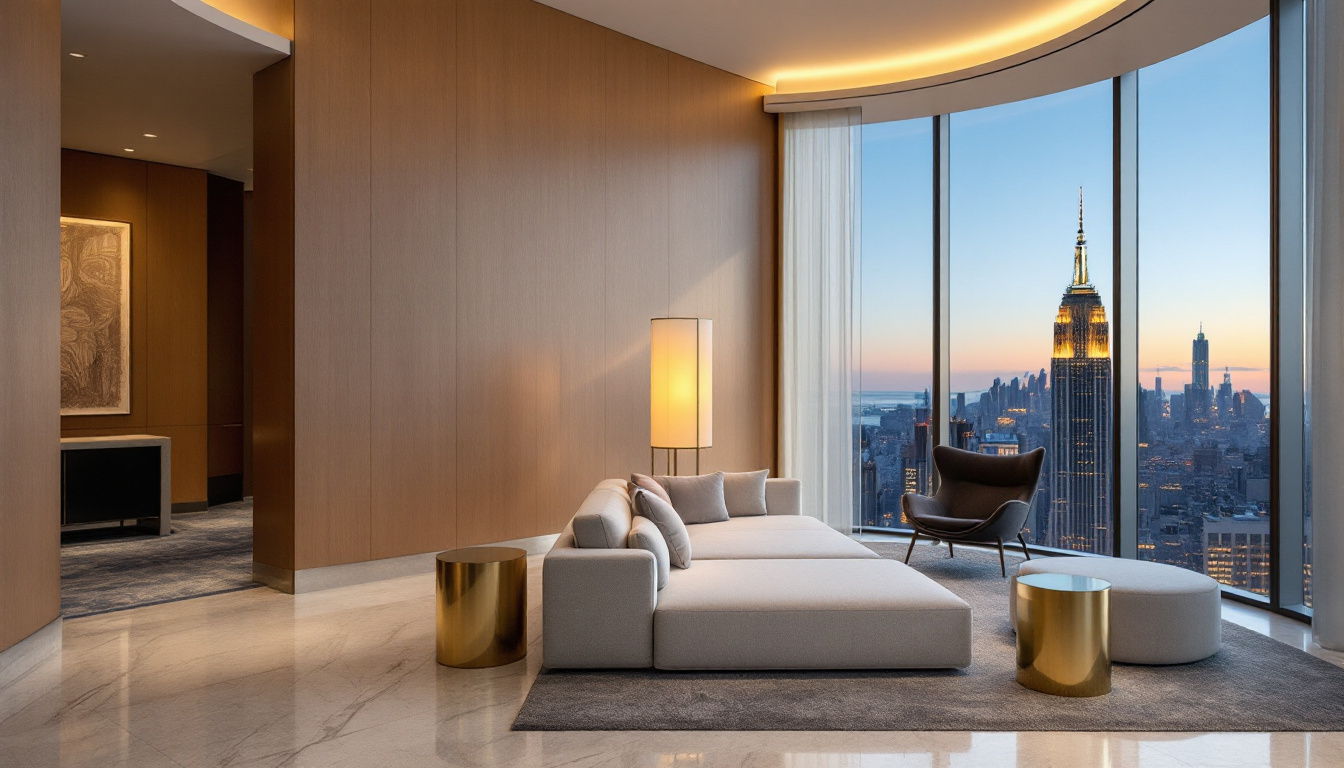
Park Hyatt New York at Eleven: The Two-Stay Retrospective
Park Hyatt New York at eleven is a property that has aged well in the public spaces and unevenly in the rooms. The 2024-2025 soft refresh covered the lobby, the Spa Nalai, and the Back Room bar but did not extend to the standard room category, where the original 2014 finishes are visibly dated against current Mandarin and Aman cabins. World of Hyatt Globalist treatment remains the strongest in the New York luxury hotel market for points-anchored stays.
Park Hyatt New York has been operating since August 2014, which means the hotel turns eleven this summer. That is roughly the age at which the early-2010s luxury hotel cohort (the post-financial-crisis wave of new builds that included the Mandarin Oriental Las Vegas, the Four Seasons Toronto, the St Regis Aspen, and a small handful of others) starts to show its design vintage. Some hotels in that cohort have aged remarkably well — the Four Seasons Toronto in particular has retained its Yabu Pushelberg interiors with only soft updates and still reads as a current 2026 luxury hotel — and some have aged poorly enough to require complete renovation cycles, which the Mandarin Oriental Las Vegas demonstrated in its 2023 closure-and-rebrand.
Park Hyatt New York sits somewhere in the middle of that aging spectrum at eleven. The public spaces have aged well; the 2024-2025 refresh of the lobby, the Spa Nalai, the Back Room bar, and the signature 57th-floor suite has the property’s most-visible elements reading as a credible 2026 luxury hotel. The standard room category has aged less well; the 2014 Yabu Pushelberg cabins are visibly dated against the current Mandarin and Aman New York standard rooms, and the next-cycle full room refresh is planned for 2027-2028 but has not been publicly confirmed.
I stayed at Park Hyatt New York for a six-night stay in March 2026 and a three-night follow-up stay in April. Both stays were booked on cash through hyatt.com on the corporate program rate; the second stay was a Globalist upgrade benefit redemption on a Suite Upgrade Award (confirmed at booking) from a standard king to a Park Suite. The room numbers were 802 (a standard Park King, 530 sq ft, west-facing view of West 57th Street with the One57 condo tower above) on the March stay and 1612 (a Park Suite, 825 sq ft, north-facing with a view across Central Park) on the April stay.
The pieces below are organized to cover, in sequence: the public-space refresh and what it accomplished; the standard room category and where it now sits against the comparison set; the F&B program (The Living Room, Back Room, and the in-room dining); the spa, the pool, and the wellness program; the World of Hyatt Globalist treatment; and the property’s competitive position in the 2026 NYC luxury hotel market.
The public spaces
The 2024-2025 refresh was confined to public spaces and to one signature suite, but within that scope it has materially improved the property’s first-impression experience. The lobby check-in vignette has been redesigned around a Damien Hirst commissioned piece installed behind the front desk — a hexagonal butterfly-print piece roughly 12 feet wide that anchors the visual line as you cross the lobby from the elevator bank — and the lobby seating has been refreshed with a more residential treatment that draws the lobby’s circulation toward the floor-to-ceiling window facing 57th Street. The lobby reads as a current 2026 luxury hotel; the prior treatment, which had been the original 2014 design with only minor soft updates, had begun to feel of-its-era by 2022 or so.
The Back Room bar — the property’s small but significant cocktail bar adjacent to the lobby — has been refreshed with a new chef partnership for the bar food program (the partnership is with chef Daniel Boulud’s group, a sensible NYC anchor) and a refreshed cocktail menu anchored on a six-cocktail Manhattan-themed signature list. The bar’s seating has been refreshed to about 28 seats from the prior 22, and the corner booth seating that was the bar’s signature configuration has been retained. The bar is operationally significant because it is the property’s only F&B option after The Living Room closes at 10 PM, and the refresh has converted it from a hotel-bar-of-last-resort into a credible standalone NYC cocktail bar that draws a meaningful non-guest clientele.
The Spa Nalai on the 25th floor has been completely refreshed. The equipment upgrade (new treatment beds, refreshed wet rooms, a redesigned circulation path between the treatment areas and the relaxation lounge) has brought the spa to current 2026 luxury hotel spec, and the partnership menu — Tata Harper, Augustinus Bader, and a separate facial program with the Joanna Vargas team — gives the spa a clear product positioning that the prior spa menu had lacked. Treatment pricing is at the upper end of the NYC luxury hotel spa range ($425 for a 60-minute massage at the standard, $625 for the 90-minute signature with the Joanna Vargas facial overlay) but is consistent with the comparable Mandarin and Four Seasons Downtown pricing.
The standard room
The standard Park King at 530 square feet is, by floor area, the largest standard room category in any New York City luxury hotel — meaningfully larger than the Mandarin’s 425 sq ft standard, the Aman’s 480 sq ft, The Mark’s 365 sq ft, and the Four Seasons Downtown’s 440 sq ft. The room layout is the original 2014 Yabu Pushelberg design with the bathroom along the corridor wall on entry, a generous walk-in closet immediately past the bathroom, the king bed centered on the wall opposite the window, and a small writing desk with the room’s only seating piece (a high-backed chair in a pewter-grey upholstery) facing the window.
The room reads as well-designed in the floor plan and dated in the finish materials. The headboard, the desk, and the closet doors are all in a pale walnut veneer that was the dominant finish material in 2014 luxury hotel design and now reads as period-specific — comparable to the way that a 2008 hotel room in red mahogany now reads as period-2008. The bedside table marble (a Calacatta with a busy grain pattern) is intact but feels of-its-era; the bathroom marble (a continuous Calacatta wrap on the walls and floor) is the strongest element in the room and remains genuinely beautiful.
The room’s soft updates since 2014 have been confined to the linens, the towels, the in-room amenity tray, and the in-room minibar. The linens are now a 600-thread-count Sferra product (an upgrade from the original 400-thread-count linen), the towels are a Frette product comparable to the property’s competitive set, the amenity tray includes a Le Labo Santal 33 sample set and a Park Hyatt-branded notepad, and the minibar has been moved from the original below-the-desk console to a small refrigerated drawer adjacent to the bed. None of these updates address the underlying room finish — they are appropriate cycle maintenance, not a room refresh.
The view from the standard Park King depends entirely on the room’s orientation. The west-facing rooms (the line we stayed in) have a view of the south side of 57th Street and the One57 condo tower above, which is interesting on the first day and uninteresting thereafter. The east-facing rooms have a similar but more constrained view. The north-facing rooms have a view across the One57 podium toward Central Park, which is the view to book if Central Park access matters to the stay. The south-facing rooms have the longest view (downtown over the Midtown skyline) and the most natural light. For repeat guests, the room request that produces the strongest view-to-floor-area trade-off is a high-floor north-facing room above floor 18, where the One57 podium has cleared and the Central Park view opens up.
The Park Suite
The April stay’s Park Suite on floor 16 was the property’s mid-tier suite category — 825 sq ft, with a separated bedroom and a sitting room, two and a half bathrooms (a primary, a powder room off the entry corridor, and a guest half-bath), and a fully fitted walk-in closet. The suite’s design language is consistent with the standard rooms (same finishes, same Yabu Pushelberg vocabulary) but has more breathing room and more pieces of furniture per square foot. The sitting room has a proper sofa (a low-profile pewter L-shape), two armchairs, a writing desk, and a dining table that seats four. The bedroom has the king bed plus a separate small reading chair.
The suite is excellent for stays of three nights or more, where the separation of bedroom and sitting room becomes operationally useful (the sitting room becomes the morning-work space; the bedroom retains its sleeping-room character). On stays of one or two nights, the suite is overkill — the standard Park King is the more sensible booking. The Suite Upgrade Award value at the property therefore depends meaningfully on stay length: a three-night Suite Upgrade Award use is worth approximately $1,200-$1,800 in implied paid-rate value (the suite premium over the standard king on cash bookings is roughly $400-$600 per night at peak season); a one-night use is closer to $400-$600.
The F&B program
The Living Room — the property’s second-floor lobby restaurant, which serves breakfast, lunch, and dinner — is the F&B program’s anchor. The breakfast offering is the strongest meal of the day at the property: a hot a la carte menu (the classic NYC luxury hotel breakfast plus a smaller selection of Asian-inflected dishes the kitchen developed for the property’s Japanese clientele) and a buffet station with fresh fruit, pastries, and a charcuterie selection. Globalist breakfast benefit covers the a la carte menu for the Globalist plus one guest, with no spend limit and no exclusion list.
The lunch and dinner menus at The Living Room are competitive but not category-leading. The kitchen runs an American-modern menu with French-technique anchors, and the execution is reliably good without being notable. The wine list is excellent — the property has a meaningful below-the-line investment in the wine program — but the food side is closer to a “good hotel restaurant” than a “destination NYC restaurant.” For dinner, the property’s better F&B option is to walk five blocks east to Marea, three blocks south to The Modern (at MoMA), or two blocks west to Per Se if a special-occasion meal is the goal.
The in-room dining is competitive. The full Living Room menu is available 24 hours; the kitchen turnaround is reliably good (most orders within 35 minutes of placement) and the presentation is at the level of a credible NYC luxury hotel in-room dining program. The breakfast in-room dining specifically is excellent — the property’s most-strongly-executed F&B touchpoint outside the Living Room’s breakfast service.
The Onyx Pool
The Onyx Pool on the 25th floor is the property’s signature amenity and one of the strongest hotel pools in New York City. The 65-foot indoor pool is heated, with an underwater audio system that plays a curated New York Philharmonic recording during operating hours. The pool deck has been refreshed twice (most recently in early 2025) and now reads as a current 2026 luxury hotel pool — comparable to the Aman New York pool, which is the only stronger hotel pool in the city.
Pool hours are 6 AM to 10 PM; the early morning window (6-8 AM) and the late evening window (8-10 PM) are reliably uncrowded, with the midday window the most heavily used. Pool access is restricted to in-house guests and to spa-treatment clients; the property does not operate a public day-pass program, which has been a deliberate decision to preserve pool density. The pool deck has approximately 16 chaise-lounge positions and 4 cabana-style nooks; even on the busiest weekend days the density does not reach the over-capacity threshold that has plagued the Mandarin pool on similar dates.
The Globalist treatment
World of Hyatt Globalist treatment at Park Hyatt New York is, in our experience, the strongest of any major-loyalty-program-participating NYC luxury hotel. The benefits package delivered consistently on both stays:
- Complimentary breakfast at The Living Room for the Globalist plus one guest, daily, with no spend limit and no exclusion list.
- Complimentary club lounge access (the 25th-floor Park Lounge) for the Globalist plus one guest, with continuous food service from 7 AM to 10 PM and an evening cocktail service from 5 PM to 8 PM.
- Suite Upgrade Award accepted at booking on the second stay, upgrading from a standard Park King to a Park Suite.
- 4 PM late checkout offered on both stays without requiring a request.
- Welcome amenity delivered to the room within 90 minutes of check-in on both stays — on the first stay, a plated chef’s-choice dessert (a chocolate-and-pistachio tart with a handwritten card from the on-duty manager); on the second stay, a small charcuterie plate with three cheeses, a fruit selection, and a chilled half-bottle of a German Riesling.
The Globalist benefits at Park Hyatt New York are deployed with operational consistency that I have not seen at any other Globalist-participating NYC luxury property. The front desk recognizes Globalists by name at check-in (without requiring the loyalty card), the in-room amenity is plated and presented rather than tray-delivered, and the late-checkout offer is automatic rather than request-driven. The training discipline behind this level of execution is real, and it makes Park Hyatt the most points-redemption-valuable NYC luxury property by a meaningful margin.
The 2026 chart adjustment that moved the property to the new Category 8 (45K peak / 35K standard / 30K off-peak) does not change the Globalist benefit package — it adds 5,000 points to a peak-night redemption and changes the math on a long-stay points-only booking. For Globalist stays at the property, the chart change is approximately neutral; for non-Globalist points-only bookings, the chart change extracts roughly 12 percent of additional point cost on peak dates.
The verdict at eleven
Park Hyatt New York at eleven is a hotel in a deliberate mid-life transition. The 2024-2025 public-space refresh has the lobby, the bar, the spa, and the pool at current 2026 luxury hotel standards. The 2027-2028 room refresh, when it lands, will close the remaining product gap. In the interim, the property continues to deliver the strongest Globalist treatment in the NYC luxury hotel market, the largest standard rooms of any NYC luxury hotel, and the most architecturally distinctive setting of any hotel in the Billionaires’ Row cluster.
The competitive position in the 2026 NYC luxury hotel market is clear: Park Hyatt is the second-tier property of choice for points-anchored stays, where the Globalist benefits stack to a value that no first-tier property can match (because no first-tier NYC luxury hotel participates in a major loyalty program). For cash-anchored stays where the loyalty redemption does not matter, the first-tier properties (Aman, The Mark, The Carlyle) deliver a more residential and more distinctive experience at a 30-50 percent price premium. The choice between Park Hyatt and a first-tier property is therefore a choice about whether the loyalty redemption value matters; for working travelers with substantial accumulated Hyatt balances, the answer is reliably yes.
The next twelve months will be telling for the property. If the 2027-2028 room refresh moves forward on schedule, Park Hyatt New York will close the standard-room gap to the competitive set and emerge from the cycle as the strongest second-tier NYC luxury hotel by a wider margin. If the refresh slips — which is a real risk given the broader Extell capital cycle and the property’s mid-decade renovation timing — the room category will continue to age out of competitive position and the property’s value proposition will narrow to the public spaces and the Globalist treatment.
We will be watching, and we will be back to log the next stay.
Related on the journal. Park Hyatt Tokyo Post-Renovation Review: Is the Lost in Translation Hotel Still Tokyo’s Reference? · Mandarin Oriental New York at Twenty-Two: A 2026 Review · The Carlyle, A Rosewood Hotel — A 2026 Review · The Faena Hotel Miami Beach — A 2026 Review
Frequently asked questions
- When did Park Hyatt New York open and what tower is it in?
- Park Hyatt New York opened on August 1, 2014, occupying the lower 25 floors of One57, the 90-story Extell Development tower at 153 West 57th Street. One57 was, at the time of completion in 2014, the tallest residential building in the Western Hemisphere and the headline property of what became known as Billionaires' Row — the cluster of supertall residential towers along West 57th Street that defined the 2014-2019 NYC luxury residential market. The hotel runs 210 guest rooms (including 92 suites) on the lower hotel levels; the residential condos above were developed and sold separately by Extell. Park Hyatt operates the hotel under a long-term management agreement; the property is owned by an entity affiliated with Extell.
- What did the 2024-2025 refresh cover at Park Hyatt New York?
- The 2024-2025 refresh covered the lobby (a new check-in vignette anchored on a Damien Hirst commissioned piece and a refreshed seating treatment), the Spa Nalai on the 25th floor (a complete equipment refresh and a redesigned treatment menu anchored on partnerships with Tata Harper and Augustinus Bader), the Back Room bar adjacent to the lobby (new cocktail menu, refreshed seating, a new chef partnership for the bar food program), and the 57th-floor signature suite designated 'The Manhattan Sky' (a complete renovation by Yabu Pushelberg). The refresh did not extend to the standard, premier, or club-room categories, which retain the original Yabu Pushelberg 2014 design with limited updates to the soft furnishings (linens, towels, the room's amenity tray). The hotel has signaled that a full room refresh is in planning for 2027-2028 but the timing has not been publicly confirmed.
- How does Park Hyatt New York compare to The Mark and The Carlyle in 2026?
- Park Hyatt New York competes in the same price band as The Mark and The Carlyle — peak-season nightly rates of $1,200-$2,400 on cash, with The Mark and The Carlyle pricing slightly higher on average — but the three hotels target different segments of the NYC luxury market. The Mark anchors on UES old-money clientele and on the F&B program (Jean-Georges runs the restaurant); the rooms are smaller than Park Hyatt's and the design language reads more European-residential. The Carlyle anchors on the historic NYC luxury hotel positioning (the property opened in 1930) and on the entertainment program (the Café Carlyle music room is the headline draw); the rooms are smaller still and design-conservative. Park Hyatt anchors on the supertall-tower architecture and on the modern luxury aesthetic; the rooms are the largest of the three properties at the standard category. For points-anchored stays, Park Hyatt is the only one of the three accepting hotel-loyalty redemption — The Mark and The Carlyle do not participate in any major loyalty program.
- Is the Onyx Pool on the 25th floor still operating?
- Yes. The Onyx Pool — a 65-foot, 25th-floor heated indoor pool with an underwater audio system supplied by the New York Philharmonic — is one of the property's signature amenities and has been continuously operated since the 2014 opening. The pool's underwater audio plays a curated New York Philharmonic recording during operating hours; the recording rotates seasonally. The pool deck has been refreshed twice in the property's history (2018 and 2025) but the pool itself, the underwater audio system, and the surrounding deck-level lounges have remained operational. Pool hours are 6am to 10pm; lounge towels and complimentary water service are provided. Pool access is restricted to in-house guests and to spa-treatment clients; it is not part of a public day-pass program.