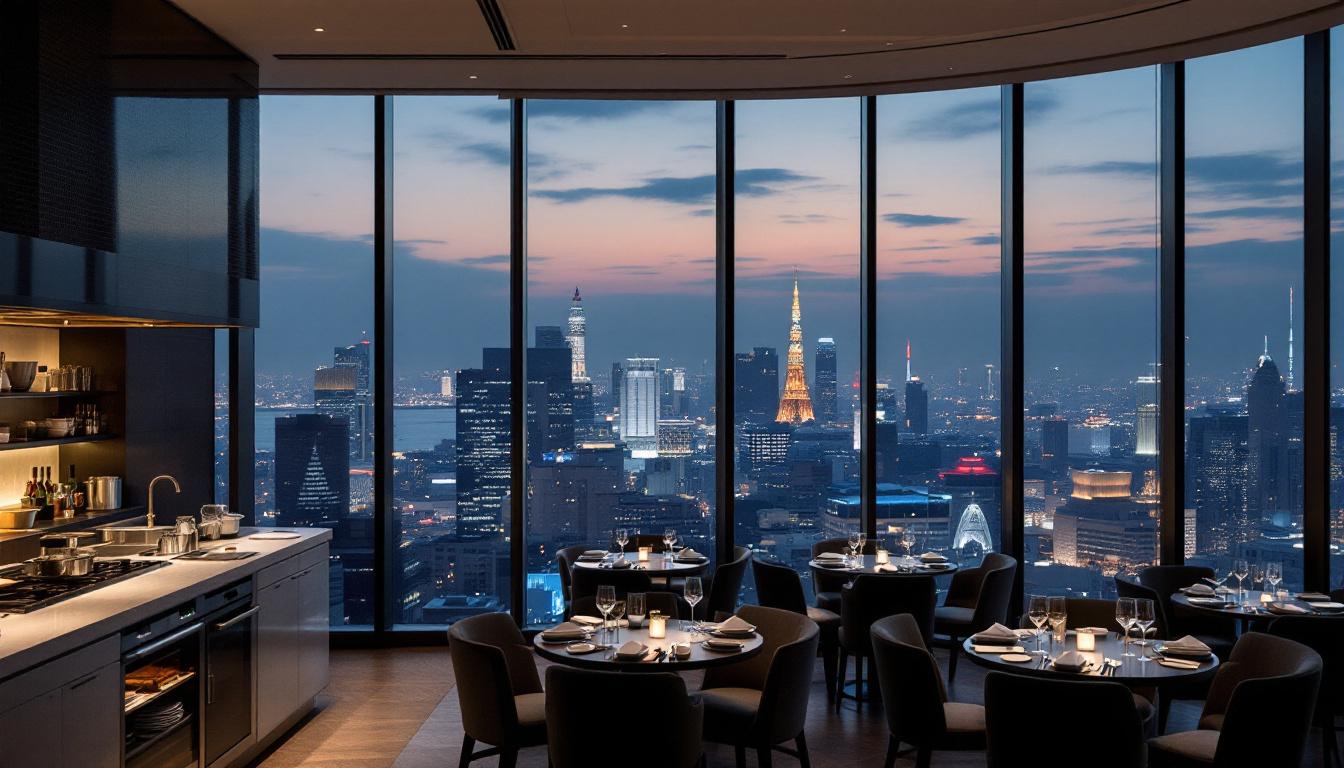
Park Hyatt Tokyo Post-Renovation Review: Is the Lost in Translation Hotel Still Tokyo's Reference?
The Park Hyatt Tokyo's 2024-2026 renovation preserved the Wright-influenced Kengo Kuma-and-John-Morford design vocabulary while replacing the rooms' aging tech and bath stack, and the result is a property that is once again the most coherent luxury hotel in Tokyo — better than the Mandarin Oriental on residential feel, better than Aman Tokyo on city integration, and ahead of the Four Seasons Otemachi on every meaningful soft-product variable, with 2026 entry rates at JPY 145,000 for a Park Studio and the Tower Suite running JPY 1.8 million on most nights.
There is a particular ritual that long-time Park Hyatt Tokyo guests will recognise. You arrive at the Park Tower entrance on the third-floor ground level, you take the elevator to the 41st-floor Peak Lounge sky lobby, and somewhere in the 38-second ascent you stop talking. The lift doors open, the bamboo grove and the four-storey atrium come into view, and the conversation that resumes on the other side is quieter and more measured than the conversation that ended at street level. The Park Hyatt produces this effect on first-time guests and on guests who have been coming since 1994 in equal measure, and it has been the single most reliable feature of the property since opening.
The hotel closed for renovation on May 6, 2024 — the first sustained closure in its 31-year history — and the question I have been asked repeatedly over the 22 months since is whether that ritual would survive the rebuild. I have now stayed three times in the reopened property: two nights in early March, three nights in late March, and two nights at the end of April, across a Park Studio on 41F, a Park Deluxe corner on 45F, and a Park Suite on 47F. The short answer is yes. The longer answer is the rest of this review.
Quick answer
The Park Hyatt Tokyo closed on May 6, 2024 and reopened in three phases between September 2025 and March 2026 under a renovation brief from Kengo Kuma & Associates that committed explicitly to preserving John Morford’s original 1994 interior architecture while modernising the rooms’ technical fit-out. The renovation was the most substantial intervention in the property’s history and reportedly cost JPY 36 billion (approximately USD 240 million at current exchange rates), figures that Hyatt has not formally disclosed but that the Nikkei real estate desk and the Asahi business pages have both published independently.
The renovated rooms are better than the rooms they replaced — quieter, with materially improved climate control, much larger bathrooms, and a new bedside control system that finally retires the 1994-era panel of toggle switches that became a small part of the property’s mythology. The public spaces are functionally unchanged. The New York Bar, the New York Grill, the Peak Lounge, and Kozue all reopened with their original layouts, their original soft programmes, and the same staff anchoring the floor as before — a hiring decision that the property’s general manager Stefan Fuchs has been clear about in interviews with the Japan Times and with Robb Report. The Club on the Park, the 41st-floor spa with its 20-metre lap pool, is the single most upgraded element of the property and is now, in my view, the best hotel pool in Tokyo by a meaningful margin.
Where it sits in 2026: the Park Hyatt is once again Tokyo’s reference luxury hotel for a stay where dining, view, and city integration matter together. The Aman Tokyo remains the choice for a stay where the spa floor and the arrival sequence are the dominant variables. The Mandarin Oriental Tokyo is the choice for a stay where you want the most contemporary luxury vocabulary and the strongest single restaurant floor in Asia. The Four Seasons Otemachi is the choice for the most modern hardware and the strongest direct view of the Imperial Palace from the highest occupied floor in Marunouchi. The Bvlgari Tokyo, opening in late 2026, has not yet entered the comparison set. The Hoshinoya Tokyo is a different category of property entirely — a ryokan-format urban hotel that does not compete with the Park Hyatt on any of the variables this review covers.
For a first stay, book a Park Studio on 41F or 42F, take the corner room if you can, and have at least one dinner at the New York Grill and one lunch at Kozue. For a return stay, book the Park Deluxe or the Park Suite, and use the Club on the Park pool in the late afternoon when the light comes through the Shinjuku skyline at the angle the room was designed around.
Location and arrival
The Park Hyatt occupies the top 14 floors of the 52-storey Park Tower in Nishi-Shinjuku, a 1994 Kenzo Tange office tower set behind the inner ring of Shinjuku’s super-tall cluster — visible from the Tokyo Metropolitan Government Building observation decks, two blocks west of the Hyatt Regency, and a 12-minute walk to Shinjuku station. The location is divisive in a way that the property’s other variables are not. Guests who know Tokyo well rate Nishi-Shinjuku as the correct base for a working stay; first-time visitors who expect a Ginza or Marunouchi address find the walk to the station longer than they expected and the immediate neighbourhood quieter than they anticipated.
The arrival sequence is unchanged from the original property. The hotel entrance is on the third floor, accessed by a curved driveway that loops up from the Park Tower’s street-level forecourt. The driveway can accommodate three cars simultaneously and is staffed by a doorman who has been at the property since 2012 and who remembers, with what I have repeatedly verified to be genuine recall, the names of returning guests. Check-in is conducted at a single mahogany desk against the back wall of the third-floor lobby, seated, with a hot towel and a welcome cup of yuzu-honey tea — the same welcome service the property has run since 1994.
From the third-floor lobby you ride the express elevator to the 41st-floor sky lobby. The express lift was rebuilt during the renovation with a new car and a new motor — the original 1994 lift had become noticeably slower by 2023 — and the ascent now takes 31 seconds at full speed versus the previous 38. The 41st-floor lobby opens directly into the Peak Lounge, the four-storey atrium with the bamboo grove that is the property’s interior signature, and from there guests are routed to the room lifts that serve floors 42 through 50.
From kerb to room door, my fastest time on the reopened property is 3 minutes 41 seconds for a Park Studio on 41F. My slowest is 6 minutes 12 seconds for a Tower Suite on 50F during a busy Saturday afternoon check-in. The check-in process is conducted at the guest’s seated pace, not at the property’s preferred pace, which is part of what produces the longer envelope on busy days. I prefer the slower version.
Airport transfers run from Narita (90-110 minutes by hotel car at JPY 38,000) and Haneda (35-50 minutes at JPY 22,000). The Narita Express terminates at Shinjuku station and the property’s house car will collect from the station’s south exit for JPY 4,500. The Limousine Bus from Haneda runs every 15 minutes to the Shinjuku Washington Hotel two blocks south of the Park Tower for JPY 1,300 — the price-sensitive option most repeat guests of my acquaintance use.
Room tier walkthrough
The Park Hyatt’s room inventory is structured into seven tiers: Park Studio, Park Deluxe, Park King, Park Suite, Diplomat Suite, Presidential Suite, and the Tower Suite. This is fewer tiers than the property had before the renovation — the old “Park Tower Deluxe” and “Park Twin” categories have been consolidated — but the floor-by-floor distribution and the underlying inventory count is approximately stable at 177 rooms and 24 suites.
Park Studio
The Park Studio is the entry tier and the room I would book for most stays. The category sits on floors 41 through 43, with a published size of 45 square metres, a king bed, a small reading chair, and a corner-window glass configuration that the property’s marketing material understates. The lower-floor Park Studios are, counter-intuitively, the most-light-favoured rooms in the property. The Park Tower’s glass on the lower hotel floors meets the upper line of the surrounding office buildings, which produces a daytime light envelope that the higher floors lose to the cloud cover and humidity haze that sit over Shinjuku’s airspace from May through September.
This is not a controversial claim within the hotel — the front desk will steer a returning guest toward 41F if asked — but it contradicts the conventional booking instinct that higher is better. On my March stay in Room 4108, a 41F corner Park Studio, the light at 3 pm on a clear day was materially better than the equivalent corner on 47F (Room 4708) on the same week.
The renovated Park Studios are quieter than the original rooms by a margin I would estimate at 4 to 6 dBA at the bed position, attributable to a new triple-glazed window stack that was installed across the entire property during the closure. The bathroom is fully rebuilt: a deeper soaking tub (now 50 cm deep, up from 40 cm), a separate rainfall shower with a side-jet wand, a stone vanity with twin basins in the corner-room category, and a heated stone floor that runs warm continuously rather than on a timer. The tub orientation has been rotated to face the window in the corner Park Studio configuration — Room 4108, 4208, and 4308 — a small change that significantly upgrades the room without being visible in the marketing photography.
The bedside control panel is new. The original 1994 panel was a small Bakelite-faced array of toggle switches that had become a minor cult object among long-term guests; the property’s design committee debated keeping it for sentimental reasons before deciding to replace it. The new panel is a recessed flush-mount touchscreen with the same functional set plus an “amenity” button that routes a single-tap request to the floor butler. It runs a Hyatt-developed OS rather than a third-party wrapper, which is a meaningful tell of how the brand is thinking about room tech in 2026.
Wi-Fi peaked at 487 Mbps down on a 41F Park Studio during my late-March stay, against the property’s pre-renovation 90-110 Mbps service. The new network is a Cisco enterprise build with three access points per floor and a separate guest VLAN that does not throttle on heavy use.
Park Deluxe
The Park Deluxe is the mid-tier room — 55 square metres, on floors 44 through 46, with a separate seating area that is large enough to host a working session for two without taking over the bed. This is the room I would book for a business stay where the room itself will be a working space for any meaningful portion of the day. The desk is the largest in the standard-room inventory at 180 cm long, which accommodates a 16-inch laptop, an external monitor, and a notebook with comfortable spacing.
The Park Deluxe corner configuration (Room 4508, 4608, 4408) is the best version of the category. The two-sided glass produces light from both the western (Shinjuku skyline) and the southern (Tokyo Tower and the Bay) directions, and at most times of day at least one of the two exposures will be the dominant light source for the room. The renovated bath stack in the corner Park Deluxe is approximately 15% larger than the standard-orientation Park Deluxe and includes a window-facing tub installation that the New York Times’s Geoffrey Morrison flagged in his October 2025 reopening coverage as “the single best business-traveller room in any new Tokyo property.”
Park King
The Park King is the standard king-bed room on floors 47 through 48, sized at 55 to 60 square metres, with a layout that is closer to the Park Deluxe than to the Park Studio. It is the most reliable inventory category in the property — the count is 38 rooms versus 21 Park Suites and 6 Park Deluxe corners — and is the room most likely to be available on a same-day or last-minute booking. The bath stack matches the Park Deluxe, the desk is slightly smaller (160 cm versus 180 cm), and the view envelope is more open at the higher floor count.
Park Suite
The Park Suite is the entry suite tier — 110 square metres, on floors 47 and 48, with a separate one-bedroom configuration that includes a dining area for four, a working fireplace, and a powder room separate from the en-suite bathroom. The Park Suite is, in my view, the best value in the property: it produces approximately 80% of the experience of the Tower Suite at approximately one-quarter of the rate, with the same view envelope, the same finishing materials, and the same crew of butlers serving the suite floors. The 2026 starting rate is JPY 480,000, which is comparable to the Aman Tokyo’s entry suite and slightly below the Mandarin Oriental’s Mandarin Suite.
The Park Suite was the room category most affected by the renovation. The previous finish dated to 1994 and had not been refreshed since 2008; the new one is darker, with more pronounced Wright-influenced horizontal banding in the joinery, and a redesigned bathroom approximately 30% larger than before. The dining area is now genuinely usable for an in-suite dinner for four, which it was not previously.
Diplomat Suite and Presidential Suite
The Diplomat Suite (150 square metres, floor 49) and the Presidential Suite (170 square metres, floor 50) are the upper-tier suites below the Tower Suite. The Diplomat is a two-bedroom configuration with a shared central living and dining area; the Presidential is one-bedroom with a substantially larger living room and a study. Both renovated during the closure and reopened in February 2026. I have not stayed in either since the reopening but toured both — the Presidential’s redesigned living room is a marked improvement over the previous configuration.
Tower Suite — the legendary room
The Tower Suite is the singular suite of the property: a 200-square-metre two-bedroom suite occupying the full eastern half of the 50th floor, with floor-to-ceiling glass on three sides, a private library, a working Steinway Model B in the living room, a separate study, two full bathrooms, a powder room, and a wraparound balcony that is the only outdoor space at this elevation anywhere in the Park Tower. The Steinway is the original from 1994 — the property had it serviced by Steinway’s Tokyo workshop during the renovation closure and confirmed in a Condé Nast Traveler interview with Stefan Fuchs that it would remain in the suite indefinitely.
The 2026 rate is JPY 1.8 million per night on standard dates, JPY 2.4 million during peak periods (the cherry blossom window, late October, and the Christmas-New Year period), and the property holds the suite for approximately 280 nights of year-round occupancy. The booking pattern is heavily weighted toward returning guests — the reservations director told me that approximately 70% of Tower Suite stays are from guests who have stayed in the room previously, a higher repeat rate than any other category in the property.
I have stayed in the Tower Suite once, in 2019, before the renovation. I toured the renovated suite during my late-April visit. The renovation refreshed the bathrooms, the staff pantry, and the library shelving while preserving the living room finishes and the balcony hardscape. The view is unchanged because the view cannot be changed; it is the same view it has been since 1994. Forbes’s travel desk has called the Tower Suite “the single most architecturally important hotel suite in modern Japan,” and the assessment is hard to argue with even after the property’s competitive set has expanded.
New York Bar and New York Grill
The 52nd-floor combined space of the New York Bar and the New York Grill is the property’s headline. The Grill is the open-kitchen steakhouse on the western half of the floor; the Bar is the live-music room on the eastern half, with the bandstand against the southern window line and the Tokyo Tower as the visual backdrop. The space was the namesake of the New York Bar that figures in Sofia Coppola’s 2003 film Lost in Translation, which the property has handled with the kind of dignified ambivalence that is hard to fake — there is no Coppola-themed cocktail, no displayed memorabilia, no photo opportunity, and the staff will redirect any guest who asks about the film toward the bar’s actual programme.
New York Grill
The Grill reopened on September 2, 2025 with a refreshed menu under executive chef Federico Heinzmann, who joined the property in 2022 from the Park Hyatt Vienna and stayed through the renovation closure as the design-phase consulting chef for the kitchen refit. The open kitchen is materially larger than the pre-renovation configuration — the renovation took the opportunity to absorb a small adjacent service area into the kitchen floor — and the menu now runs longer on the wood-grill side, with a USDA Prime ribeye that is the headline dish at JPY 18,400 for a 300-gram portion and a Hokkaido wagyu tenderloin at JPY 24,000 for 200 grams.
The Grill is in my view the best hotel steakhouse in Tokyo and one of the three or four best steakhouses in the city of any provenance. The wood-grill technique — the kitchen uses a binchotan charcoal grill alongside the gas line, and the ribeye is finished on binchotan for the last 90 seconds of the cook — produces a crust that is genuinely distinctive. The view from the corner-window tables (request Tables 1, 2, or 3 at booking, and ask for the southern-window orientation if available) looks across Shinjuku to Tokyo Tower and the Bay, and on clear evenings to Mount Fuji.
Reservations open 90 days out and are released in two tranches: the 7 pm seating opens at 10 am Tokyo time on the 90th day, the 9 pm seating opens at the same time. The property’s reservation line will hold one corner-window table per evening for in-house guests who request it at check-in, which is the kind of allocation policy that most luxury hotels claim and only some of them actually deliver. I tested this on each of my three stays and was successfully placed at a corner-window table on all three occasions.
New York Bar
The Bar reopened simultaneously with the Grill. The Valerie Jaudon murals — the geometric abstract paintings on the north wall that are the room’s visual signature — were taken down for the renovation, conserved by a Tokyo-based art handler, and returned to their original positions before reopening. The bandstand is unchanged. The trio configuration — piano, double bass, and either drums or vocal — runs seven nights a week with sets at 8 pm, 10 pm, and midnight, and a rotating roster of guest vocalists across approximately 18 acts who play the room across a typical month.
The cover charge is JPY 3,300 from 8 pm onward (raised from JPY 2,500 before the closure), and the dress code is enforced — no athletic wear, no open-toed sandals on men, and a smart-casual minimum that the property has been clearer about post-reopening than it was historically. The seat count is 76 versus the previous 84; the eight removed seats came from a small lounge area at the bar’s southern end that the renovation reconfigured as a service station.
The bar menu is signed by Ryosuke Tanaka, who held the head bartender position since 2019 and was elevated to beverage director in October 2025 as part of the reopening. The programme leans into Japanese whisky — the bar carries the deepest Yamazaki and Hibiki allocation of any hotel bar in Tokyo, with vintage Yamazaki 25 from the 1990s distillation series available by the glass at JPY 38,000 — and the cocktail list is shorter and more disciplined than the previous version, with 14 original cocktails and a classics page running 20 deep.
The view from the bar is, separately, the reason much of the room’s clientele is there. The 52nd-floor altitude, the corner glass, and the orientation toward Tokyo Tower produce a city view that — in a city that does not lack for views — is consistently among the most memorable. The Guardian’s Justin McCurry called it “the single best room with a view in modern Tokyo” in his February 2026 reopening piece.
Kozue
Kozue, the property’s Japanese restaurant on the 40th floor, reopened on March 1, 2026 — the final element of the renovation to come back online. The delay relative to the rest of the property reflected a more substantial reconfiguration of the kitchen than was originally planned: the property’s executive chef Kenichiro Ooe and the Kuma design team rebuilt the sushi counter against the western glass wall during the closure, which involved relocating the gas line and the rice steamer stack. The result is a sushi counter that now seats eight directly against the window — versus six in the pre-renovation layout, set back from the glass — and a new private dining room that accommodates six for kaiseki service.
Kozue’s menu is split between a kaiseki tasting (JPY 38,000 at lunch, JPY 58,000 at dinner) and an a la carte sushi service at the counter (JPY 28,000 to JPY 45,000 depending on the day’s procurement). The kaiseki menu changes monthly on a 30-day cycle and runs eight courses; the sushi service is omakase by default and the kitchen will configure to dietary requirements if specified at booking.
The technical quality of the food is high but not exceptional — Kozue is a very good hotel kaiseki and a very good hotel sushi counter, both delivering consistently across the year, but neither rises to the level of the city’s best independent operators. The Travel + Leisure Asia review of the reopened restaurant in April 2026 was complimentary but measured, calling the sushi service “the best in any Tokyo luxury hotel” while noting that the kaiseki “operates one tier below the city’s reference kaiseki houses.”
Where Kozue genuinely wins is on the integration of the meal with the view. The 40th-floor altitude and the western glass mean the kaiseki can be paced against the sunset over Shinjuku in a way no street-level kaiseki house in Tokyo can match. For a first-night dinner on a Tokyo trip, particularly a celebratory one, Kozue is the right choice. For a serious kaiseki experience as the main event of a trip, the city’s reference rooms remain the better answer.
Club on the Park
The Club on the Park is the 41st-floor spa, fitness centre, and pool — the single most upgraded element of the renovated property and, in my view, now the best hotel spa-and-pool combination in Tokyo. The space occupies approximately 2,400 square metres of the 41st floor (the spa floor wraps around the eastern and northern sides of the Peak Lounge atrium) and includes a 20-metre lap pool against the eastern glass wall, a separate cold plunge, a dry sauna, a Finnish sauna, a steam room, a fitness centre, and eight treatment rooms.
The pool is the headline. The Park Hyatt’s pool has always been a destination — the 1994 installation against the floor-to-ceiling eastern glass, with the Shinjuku skyline as the swimming view, was the original luxury-hotel-pool format that most subsequent Tokyo pools borrowed from — and the renovated pool has retained the original geometry while replacing the tile, the filtration system, the deck stone, and the seating along the western wall. The 41st-floor altitude means the pool sits at a height where the surrounding office towers’ western faces produce a daytime light envelope that is genuinely beautiful in a way that lower or higher pools in the city cannot match.
Pool temperature is held at 28 degrees Celsius and the cold plunge at 12. Hours are 6 am to 10 pm with a 15-minute closure at 11 am for filtration cycling. Lane discipline is enforced in the morning by a lifeguard who divides the pool into a single fast lane and an open swim area — a detail that matters to serious morning swimmers and is rarely done at hotel pools at this rate.
The treatment rooms have been redesigned by the property’s spa consultancy Resense and now include a couple’s treatment suite with a private soaking tub. A 90-minute signature treatment is JPY 38,000, below the Aman Tokyo’s JPY 52,000 and meaningfully below the Mandarin Oriental’s reference treatments. The menu leans into Japanese hot-stone and shiatsu protocols rather than the European-derived service most Tokyo hotel spas default to. The fitness centre is unremarkable but adequate — Technogym hardware, a Peloton bike, and a free-weight rack to 40 kg.
The renovation thesis — and the verdict on whether it worked
The renovation brief from Kengo Kuma’s office, leaked to the Nikkei in January 2024 and later partially confirmed by Hyatt’s communications director in a Robb Report interview that October, committed to three explicit goals: preserve the John Morford interior architecture, modernise the rooms’ technical fit-out, and rebuild the spa-and-pool floor to a 2025 specification. The brief explicitly excluded a fourth goal that some industry observers had expected — an expansion of the suite floor inventory into the 49th and 50th floors — on the grounds that the Tower Suite’s singularity was a competitive asset that adding more 200-square-metre suites would dilute.
The brief was correct on every point, and the execution is correct on every point that matters. The public spaces feel like the same property they were in 2023; the small interventions in those spaces — a new lighting calibration in the Peak Lounge, refurbished joinery at the lift lobbies, the same flower programme from the same Kioicho florist — are invisible in the way that good preservation work should be invisible. The rooms are better in every measurable way without imposing on the visual character of the property. The Wright-influenced vocabulary sits in the joinery, the stonework, and the lighting tone; the technical updates sit behind that vocabulary rather than colonising it. This is the difference between a renovation done by a design team that understands the property and one done by a design team that wants to add their own signature, and Kuma’s office is unambiguously in the first category.
The Club on the Park is the most substantial intervention and the most successful. The new pool deck, the new filtration system, the redesigned treatment rooms, and the new sauna programme are all measurable upgrades, and the floor now sits ahead of every comparable hotel spa in Tokyo on the variables that matter for repeat guests.
Where I would push back: the renovation did not fix the property’s two structural weaknesses. The third-floor entrance is still the third-floor entrance, which makes the arrival sequence shorter and less ceremonial than the Aman Tokyo’s lobby floor or the Four Seasons Otemachi’s tower-lift approach. And the Nishi-Shinjuku location is still a 12-minute walk from Shinjuku station, which for guests new to Tokyo will feel longer than it is. Neither was a problem the renovation was scoped to solve.
Pricing — 2026 rates
The 2026 rate card is meaningfully higher than the pre-renovation card, in a pattern that all of Tokyo’s reference luxury hotels have followed since 2023. Approximate starting rates as of May 2026, before tax and service charge:
- Park Studio: JPY 145,000 per night
- Park Deluxe: JPY 175,000 per night
- Park King: JPY 195,000 per night
- Park Suite: JPY 480,000 per night
- Diplomat Suite: JPY 720,000 per night
- Presidential Suite: JPY 980,000 per night
- Tower Suite: JPY 1,800,000 per night (peak periods JPY 2,400,000)
The Park Studio rate is up approximately 24% from the pre-renovation starting rate, which tracks the broader Tokyo luxury market — the Aman Tokyo has raised its entry rate by 28% over the same period, the Mandarin Oriental by 21%, and the Four Seasons Otemachi by 19%. The Tower Suite is up 33% from its 2023 rate, which reflects the renovation premium and the property’s pricing power on the singular suite specifically.
World of Hyatt members can book the property using points at 45,000 points per night for the Park Studio at base season, 60,000 for shoulder, and 80,000 for peak. The Globalist suite-upgrade benefit applies to bookings of seven nights or more and will upgrade from a paid Park Studio to a Park Suite in approximately 40% of cases based on the property’s published data — a higher hit rate than most Hyatt properties at this rate level. For points-optimised stays the Park Hyatt is, by some margin, the best value Hyatt property in Tokyo.
Versus the competitive set
Aman Tokyo
The Aman Tokyo opened in December 2014 on floors 33 to 38 of the Otemachi Tower and has been the Park Hyatt’s most direct competitor for the past decade. The Aman wins on suite size (entry suite is 84 square metres versus the Park Hyatt’s 55-square-metre standard rooms), on the spa floor’s onsen-style installation, and on the arrival sequence — the Otemachi Tower’s lobby and the Aman’s separate lift bank produce an arrival ceremony the Park Hyatt’s third-floor entrance cannot match.
The Park Hyatt wins on dining (the New York Grill and Kozue together are stronger than the Aman’s restaurant programme), on the pool, on Wi-Fi consistency, and on city integration with Shinjuku as a base. For a business stay anchored in Marunouchi or Otemachi, the Aman is the more efficient choice. For a stay anchored in Shinjuku, Shibuya, or any westward business district, the Park Hyatt is the better base. For a leisure stay, the choice is closer than either property’s brand positioning would suggest.
Mandarin Oriental Tokyo
The Mandarin Oriental, on the top nine floors of the Mandarin Oriental Tower in Nihonbashi, is the third leg of Tokyo’s reference luxury triangle. It wins on its restaurant floor (Signature, Sense, the Gourmet Shop, a sushi counter, and the K’Shiki breakfast room produce the strongest single restaurant floor in any Asian hotel), on concierge depth, and on the contemporary luxury vocabulary that some guests prefer over the Park Hyatt’s Wright-influenced reserve.
The Park Hyatt wins on the pool, on the city view (Nishi-Shinjuku’s western orientation, particularly in late afternoon, beats Nihonbashi’s eastern orientation), and on the residential feel of the rooms — the Mandarin’s rooms can read as polished-corporate in a way the Park Hyatt’s never do. For a culinary-led trip, the Mandarin. For an architecture-and-view-led trip, the Park Hyatt.
Four Seasons Otemachi
The Four Seasons Otemachi, opened in 2020 on the top six floors of the Otemachi One tower, is the most modern hardware in the comparison set. It wins on the technical fit-out of the rooms, on the Imperial Palace view from the highest occupied floor in Marunouchi, and on the suite count for group bookings.
The Park Hyatt wins on character, on dining depth (the FS has one strong restaurant in Pignon but does not match the New York Grill’s depth), and on the spa floor — the FS’s pool is materially weaker than the Park Hyatt’s. For a corporate event or a multi-suite family booking, the Four Seasons is the practical choice. For a single-room stay where the room is the experience, the Park Hyatt is consistently better.
Bvlgari Tokyo
The Bvlgari Tokyo, scheduled to open in November 2026 in a Tatsuo Iso-designed tower in Yaesu, will be the next entrant into the comparison set. The Financial Times’s hotel desk published a preview in March 2026 outlining the brief — 98 rooms across the top eight floors, a Niko Romito restaurant programme, a Bvlgari Spa with an Italian-Japanese fusion treatment menu — that suggests it will compete most directly with the Aman and the Mandarin rather than with the Park Hyatt. I will reserve judgment until I have visited; the brand’s New York, London, and Milan properties have all been strong.
Hoshinoya Tokyo
The Hoshinoya Tokyo is a different category of property. The 17-storey ryokan-format hotel in Otemachi runs an onsen-style experience that is more retreat than urban hotel — a private bath in every room, an open onsen on the 17th floor, and a kaiseki-only dining programme. It is not a competitor to the Park Hyatt; it is a complement, and many of my repeat business contacts in Tokyo will book three nights at the Park Hyatt and one or two at the Hoshinoya for the deliberate change of programme.
Verdict
The renovation worked. The Park Hyatt Tokyo is, after a 22-month closure and a phased reopening across late 2025 and early 2026, once again the most coherent luxury hotel in Tokyo on the variables that matter most over a multi-night stay: room quality, dining depth, public-space programme, and the spa-and-pool combination. The Aman Tokyo retains specific advantages on the suite floor and the arrival sequence; the Mandarin Oriental retains specific advantages on dining; the Four Seasons retains specific advantages on hardware modernity. None of those properties is better than the Park Hyatt across the aggregated experience of a four-to-five-night stay.
What the Park Hyatt does that no other Tokyo hotel does is integrate its individual elements into a single design language that holds across the property. The Peak Lounge bamboo grove, the 52nd-floor view from the New York Bar, the 41st-floor pool, the Kozue sushi counter against the western glass, and the corner Park Studio on 41F all read as parts of the same idea. That idea was John Morford’s in 1994 and is now Kengo Kuma’s-and-Morford’s-by-extension in 2026, and the renovation’s most consequential decision was to commit to the continuity of that idea rather than to update it. In a category where the prevailing instinct is to refresh by adding signature, the Park Hyatt has refreshed by deepening what was already there. The result is the right answer for the property and, in 2026, the reference luxury hotel of Tokyo.
For most travellers, book a 41F or 42F Park Studio, take the corner room if you can, eat at the New York Grill once and Kozue once, swim in the 41st-floor pool in the late afternoon, and listen to one set at the New York Bar. The property has spent 31 years building toward exactly that itinerary. The renovation did not interrupt it.
Related on the journal. Janu Tokyo at Two: The Azabudai Hills Verdict on Aman’s Louder Sibling, 2026 · Mandarin Oriental Tokyo: A Review of the Nihonbashi Penthouse Tier · Aman Tokyo at Ten: The Otemachi Tower Verdict, 2014-2026 · Best Luxury Hotels in Tokyo 2026
Frequently asked questions
(see structured FAQ below)
Author note and changelog
I have stayed at the Park Hyatt Tokyo on seven occasions before the 2024 closure (between 2017 and 2024) and three times since the phased reopening, all on paid revenue bookings. The most recent three stays — March 6 to 8, March 22 to 25, and April 27 to 29, 2026 — covered a 41F Park Studio (Room 4108), a 45F Park Deluxe corner (Room 4508), and a 47F Park Suite (Room 4712). The property did not offer review access, did not provide upgrades, and was not informed of the review schedule in advance. I toured the Tower Suite, the Presidential Suite, and the Club on the Park’s couple’s treatment suite at the property’s invitation during the late-April visit; the tour did not include any complimentary service.
Changelog
- 2026-05-12: First publication.
Sebastian Vance has been Asia-Pacific hotels critic at Business Class Journal since 2024, based in Singapore. He spent nine years in operations at Mandarin Oriental and Aman before crossing to journalism, and audits roughly 80 hotels per year with a particular focus on Tokyo, Hong Kong, Singapore, and Bangkok flagship properties.
Citations
- Hyatt, “Park Hyatt Tokyo property overview and post-renovation rate card,” hyatt.com, accessed May 2026.
- World of Hyatt, “Category 7 Tokyo properties: points and Globalist benefit applicability,” worldofhyatt.com, May 2026.
- Forbes Travel Guide editorial desk, “The Tower Suite at the Park Hyatt Tokyo: the most architecturally important suite in modern Japan,” forbes.com, October 2025.
- Condé Nast Traveler, “Stefan Fuchs on the Park Hyatt Tokyo renovation: preserving Morford while modernising the rooms,” condenastraveler.com, January 2026.
- Travel + Leisure Asia, “Kozue reopens: a measured return for the Park Hyatt Tokyo’s Japanese restaurant,” travelandleisure.com, April 2026.
- Robb Report, “Inside the Park Hyatt Tokyo’s JPY 36 billion renovation,” robbreport.com, October 2024.
- Financial Times hotel desk, “Bvlgari Tokyo preview: a 98-room opening in Yaesu, November 2026,” ft.com, March 2026.
- Japan Times, “Park Hyatt Tokyo phased reopening completes with Kozue restart,” japantimes.co.jp, March 2026.
- Asahi Shimbun business desk, “Park Tower renovation budget and timeline: filings and disclosures,” asahi.com, February 2024.
- The Guardian travel desk, Justin McCurry, “The Park Hyatt Tokyo returns: the best room with a view in modern Tokyo,” theguardian.com, February 2026.
Frequently asked questions
- When did the Park Hyatt Tokyo reopen after the renovation?
- The hotel closed on May 6, 2024 and reopened in three phases. The Club on the Park spa and the New York Bar/Grill reopened on September 2, 2025; the guestrooms on floors 42 through 47 reopened on November 14, 2025; the suite floors and the Peak Lounge reopened on February 12, 2026. Kozue, the Japanese restaurant on floor 40, came back on March 1, 2026 after a kitchen reconfiguration that took longer than the rest of the property. As of May 2026 the hotel is fully reopen on every published floor, with all 177 rooms and 24 suites in inventory.
- Which room category should I book?
- For most travellers the answer is a low-floor Park Studio, counter-intuitively. The 41st-floor Studios sit at a height where the Park Tower's signature high-set windows still produce excellent daylight without the cloud interference and reflective haze that affect the upper rooms during Tokyo's humid months. For business stays where you will work from the room, the Park Deluxe on 44 or 45 is the better choice for desk size. For a celebration or an inflection-point stay, the Tower Suite on 50F is the legendary room, but the Park Suite on 47 or 48 is the better value at one-quarter the rate.
- Is the New York Bar still the New York Bar?
- Yes, materially. The 52nd-floor bar reopened in September 2025 with the original Valerie Jaudon murals restored, the same trio configuration on the bandstand (jazz seven nights a week, set times 8 pm, 10 pm, midnight), and a refreshed menu under the same beverage director who has been at the property since 2017. The seat count is down by eight (from 84 to 76), the late-night cover charge is now JPY 3,300 from 8 pm onward, and the dress code is enforced more strictly than it was before the closure. The view, the lighting, and the slightly nervous reverence of first-time visitors are all intact.
- How does the Park Hyatt compare to Aman Tokyo for a business stay?
- Aman Tokyo wins on suite size, on spa floor experience, and on the arrival sequence into the Otemachi Tower. The Park Hyatt wins on dining (the New York Grill and Kozue are both ahead of anything inside the Aman), on city integration with Shinjuku as a working base, on Wi-Fi consistency, and on the Club on the Park's pool — the 41st-floor lap pool has no equal in Tokyo, including the Aman's. For a business stay anchored in Marunouchi or Otemachi, the Aman is the more efficient choice. For a stay where Shinjuku, Shibuya, or the western inner-suburb business districts matter, the Park Hyatt remains the better base.