Four Seasons George V Paris at Five Years Post-Restoration: Is It Still the Palace Hotel to Beat?
Five years after the post-restoration relaunch, the Four Seasons George V remains the most reliably booked Palace hotel in Paris on suite inventory, holds three Michelin stars across three restaurants, and continues to set the global standard for hotel floral design under Jeff Leatham — but the gap to Cheval Blanc on suite hardware and to Bvlgari Paris on bar program has narrowed enough that the choice is now genuinely contested.
The Hôtel George V opened on the eve of the 1929 stock market crash, in May 1928, as the most ambitious purpose-built grand hotel of interwar Paris. Its architect, the American Constant-Désiré Despradelle’s protégé George Wybo, designed a Beaux-Arts hôtel particulier wrapped around an interior cour d’honneur, on a plot of land at 31 avenue George V that had been carved out of the Champ de Mars-adjacent 8e arrondissement five years earlier. The site sits two minutes’ walk from the Champs-Élysées, four minutes from the Arc de Triomphe, and inside the so-called Golden Triangle bounded by avenue George V, avenue Montaigne, and the Champs-Élysées itself — the most concentrated zone of luxury retail in Europe, by tenant rent per square metre, by some distance.
I have stayed at the Four Seasons George V seven times since the property reopened from its first Four Seasons-era major restoration in 2021 — a phased, four-year project that took the public spaces, the marble, the carpets, the lighting, and roughly two-thirds of the room inventory through complete renewal while the property continued to operate at reduced capacity. The most recent stay was a three-night booking from May 5 to May 8, 2026 in Premier Suite 511, EUR 6,420 per night before tax, paid revenue, no comp or press rate. On May 7, I also spent a half-day in the Royal Suite under a turnover-day inspection arranged through the General Manager’s office; that visit was not a paid stay and I was not occupying the suite overnight.
The headline answer, five years on, is that the George V remains the most reliably booked Palace hotel in Paris on suite inventory and the only one in the city fielding three independently Michelin-starred restaurants under one roof. But the gap to Cheval Blanc on suite hardware and to the new Bvlgari Paris on bar program is now narrow enough that, for the first time since I have been writing about this category, the George V’s position at the top of the Paris Palace stack is genuinely contested.
Quick answer
For a UHNW guest doing Paris over four to seven nights, with a mix of haute couture appointments on avenue Montaigne, lunch at one or two Michelin-starred restaurants, and at least one significant business dinner, the George V is still the answer. The arrival ritual through the cour d’honneur, the discipline of the front-of-house team, the floral program under Jeff Leatham, and the breadth of the food and beverage operation make it the hotel that does everything at a Palace standard. For a three-night discretionary romantic stay where suite size and view matter more than restaurant credibility, Cheval Blanc Paris is the live alternative. For a guest who values an Italian operating culture and a more contemporary design language, Bvlgari Hôtel Paris is the new credible challenger that has materially changed the calculus in the 8e since opening in December 2024.
Location and arrival
The George V occupies a full block at 31 avenue George V, between rue Quentin-Bauchart to the north and rue Magellan to the south. Five-minute walks from the front door reach the Apple Store on the Champs-Élysées, the Dior flagship at 30 avenue Montaigne, the Chanel boutique at 51 avenue Montaigne, the Louis Vuitton Champs-Élysées maison, and the Embassy of the United States to France at 2 avenue Gabriel. Ten-minute walks reach the Place de la Concorde, the Petit Palais, the Pont Alexandre III, and the Embassy of the United Kingdom on rue du Faubourg Saint-Honoré. The Hôtel Plaza Athénée is three minutes’ walk down avenue Montaigne. The Bristol is twelve minutes’ walk along rue du Faubourg Saint-Honoré. Le Meurice and the Ritz, on the rue de Rivoli and the place Vendôme respectively, are ten-minute taxi rides if traffic is moving.
Arrival sequence is the front-of-house signature of the property and has not changed in any meaningful way over the seven stays. A black-livery doorman in a long coat, fawn-coloured gloves, and the property’s signature top hat receives the car at the kerb under the marquise. A second doorman opens the inner doors. The lobby fans out into the cour d’honneur — the open-roofed interior courtyard whose floral installation is the first photograph almost every guest takes — and check-in is conducted in the Galerie, seated, away from any communal counter. On my May 5 arrival, kerb to chair was 38 seconds; chair to suite door was 4 minutes 20 seconds including a managed luggage transfer. There is no rope line, no scanning of an identity document at a podium, and the registration card is presented for signature on the desk in the Premier Suite rather than at reception. This is now standard practice across the Paris Palace category but the George V continues to execute it with the least friction in my experience.
Charles de Gaulle is 35 minutes on a Saturday afternoon, 55 minutes on a Friday evening, and a coin toss on any weekday morning between 7:30 and 9:30 due to A1 and A3 ring-road volume. Le Bourget, the private aviation airport that absorbs the vast majority of UHNW arrivals, is 25 minutes on a clean run. The hotel runs a fleet of S-Class and Maybach S-Class transfers; in the past 18 months Four Seasons has standardised the Paris fleet on the W223 S 580 4MATIC long-wheelbase configuration with reclining rear executive seats. Pricing is published internally rather than publicly; expect EUR 350 to EUR 550 each way to CDG and EUR 300 to EUR 420 each way to LBG depending on vehicle and time. I have used the service four times across the seven stays and have not had a late pickup or a wrong-vehicle incident.
Room tier walkthrough
The George V’s room inventory is 244 keys, of which 59 are suites — a higher suite ratio than the Ritz Paris (142 keys, 71 suites, which skews higher), the Bristol (190 keys, 50 suites), the Meurice (160 keys, 44 suites), and Plaza Athénée (200 keys, 54 suites), and a markedly higher absolute suite count than Cheval Blanc Paris (72 keys total, of which 26 are suites) and Bvlgari Hôtel Paris (76 keys total, 50 of which are suites). The suite-count number is not a vanity metric: it is the single largest input into whether a property can accommodate last-minute changes during fashion weeks, and the George V’s suite depth is the operational reason it has held its position with the largest discretionary buyers for so long.
Superior Room
The Superior Room is the entry tier, EUR 2,250 per night before tax at the floor of the rate band, with 35 square metres of floor area excluding the bathroom. King bed, single-pane balcony or window depending on inventory, a writing desk that accommodates a 16-inch laptop comfortably but begins to feel constrained with an external monitor, and the property’s standard marble bathroom in the white Carrara specification with a double vanity and a separate tub and rain shower. This is the smallest room category at the George V and is the only one I would not specifically recommend for a stay of more than three nights; the Premier and Premier Junior categories at EUR 850 to EUR 1,250 incremental per night deliver materially more usable working space.
Deluxe Room
The Deluxe Room is the middle of the standard room band at EUR 2,650 per night, with 40 to 45 square metres depending on the position of the unit on the floor plate. The principal differentiator from Superior is the courtyard view (most Deluxe units overlook the cour d’honneur or a side garden rather than a back lightwell) and the slightly more generous bathroom dimensions. The bedroom layout is otherwise identical. For a midweek two-night stay, this is the category I would book if the Premier categories are not available.
Premier Room and Premier Junior Suite
The Premier Room category, EUR 3,100, occupies the upper floors with the better courtyard or street views, 45 to 55 square metres, and is the first category I would book without reservation for a four-night stay. The Premier Junior Suite, EUR 4,200 to EUR 4,800 depending on inventory and exposure, adds a sitting area and a separate vestibule with a guest powder room — the smallest configuration in the inventory that supports hosting a casual cocktail or a working session with one external visitor. For a couple on a five-to-seven-night stay, this is the category I would point them at first.
Premier Suite
The Premier Suite is the category I most recently occupied — Suite 511 on the fifth floor, a corner unit overlooking avenue George V to the north and rue Quentin-Bauchart to the east. Sixty-eight square metres, a bedroom with a king bed and a marble bathroom in the cream Crema Marfil specification, a separate living room with a marble fireplace (decorative, not functional), a vestibule with a powder room, and a walk-in closet that accommodated three pieces of luggage and a hanging garment bag with room to spare. The desk in the living room takes a 16-inch laptop, an external monitor, and a notebook; the chair is the Vico Magistretti Maui re-edition and is comfortable for a five-hour working session, which I tested on the May 6 morning. Wi-Fi peaked at 387 Mbps down and 312 Mbps up on the in-room Ethernet jack, which is now standard across the Premier and above categories — a property-wide upgrade completed in autumn 2024.
The bedside controls are an iPad-based system that the property rebuilt in 2024 onto a custom OS. Drape control, lighting scenes, climate, in-room dining, and housekeeping requests all route through it. The implementation is responsive and well-laid-out; my one note is that the “do not disturb” command does not pause the door entry alert globally the way the Peninsula London’s implementation does, which means a knock at the door is still audible if you have asked not to be disturbed. The property’s housekeeping discipline mitigates this in practice, but it is a piece of software work I would like to see done.
Penthouse Suites
The Penthouse Suites category covers eight suites on the sixth and seventh floors, ranging from 130 to 245 square metres, with rates from EUR 11,500. Most have terraces overlooking the cour d’honneur or out toward the Arc de Triomphe and the Eiffel Tower. I have stayed in two of them — the Eiffel Suite (140 square metres, a terrace facing west) in October 2024 and the George V Suite (175 square metres, a terrace facing the courtyard) in March 2025. The category is the right answer for a four-to-seven-night stay where two adults plus one minor child are travelling together, or for a UHNW principal who wants a separate room for working without crossing the principal sleeping space.
Royal Suite
The Royal Suite is 245 square metres, EUR 25,000 per night, and occupies the eastern wing of the sixth floor in a single contiguous footprint. Three bedrooms, three full bathrooms, a dining room that seats eight, a separate sitting room, a service entrance with a small kitchenette for a private chef arrangement, and a terrace that wraps the eastern face of the building with a clean line of sight to the Arc de Triomphe. I spent the morning of May 7 in the suite under a turnover-day inspection. The suite was being prepared for a Friday arrival and the housekeeping team was running the deep-clean checklist; the property tells me a Royal Suite turnover involves four housekeepers, a steward, a butler, and a floral specialist working together for an average of four hours fifteen minutes between checkout at 12:00 and the next guest’s check-in window opening at 16:00.
The suite is more conservatively decorated than the Penthouse Suite (described below) and reads as a French ambassadorial residence: parquet de Versailles flooring, Aubusson rugs, a Steinway B grand piano in the sitting room, and a dining room with a polished walnut table that takes a centerpiece floral arrangement renewed daily by Jeff Leatham’s team. The marble in the principal bathroom is a single block of Calacatta Oro in a vein-matched configuration that the property tells me took eighteen weeks to source and cut. The bedrooms each have their own dressing area and a marble bathroom in a different stone palette — Crema Marfil in the second bedroom, Bardiglio in the third.
Penthouse Suite
The Penthouse Suite — the single signature suite at the very top of the building, distinct from the Penthouse Suites category — is 245 square metres on the seventh floor with the largest single terrace in any Paris Palace hotel at a reported 240 square metres of outdoor space. EUR 28,000 per night. I have not stayed in this suite and the property would not give me a tour during the May visit because it was occupied. The published spec is two bedrooms, a separate study, a dining room for ten, a kitchen for a private chef, and the terrace with a 360-degree view that includes the Eiffel Tower, the Arc de Triomphe, the Sacré-Coeur, and the Tour Montparnasse. Reviews of this suite in Robb Report and Forbes Travel Guide over the past three years are consistent in placing it in the top five hotel suites in Europe by an aggregate quality assessment; I will reserve my own view until I have spent a night in it.
The floral installations
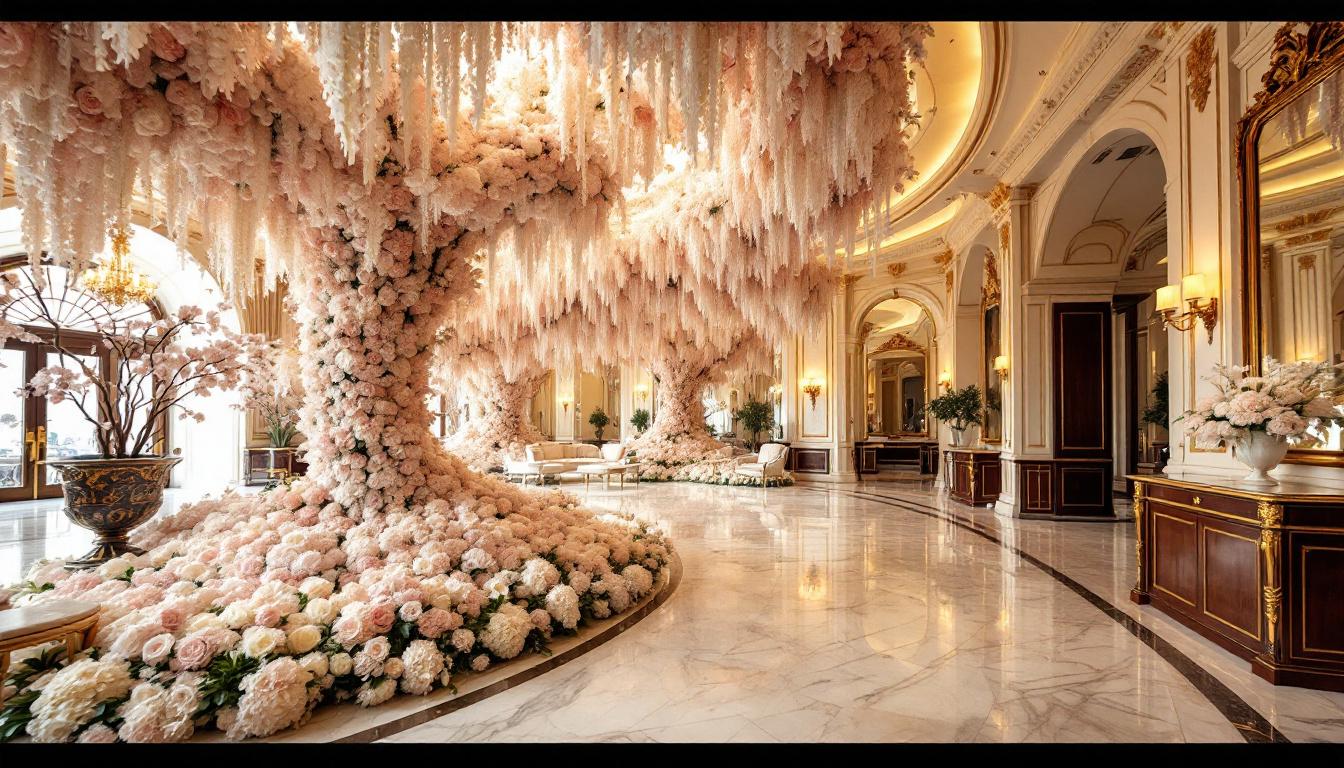
Jeff Leatham, the artistic director for floral design at the George V since 1999, is the property’s longest continuously serving creative principal and the single most-photographed reason guests come through the door. The installations in the cour d’honneur and the public spaces are renewed approximately every three weeks and follow a calendar that the property publishes internally six months in advance. The current installation on the May 5 to May 8 stay was a French formal garden interpretation built around 8,400 stems of roses in five varieties and seven colours, with an internal armature designed to hold the geometry through the three-week display cycle. The fragrance load in the lobby was strong enough to be detectable from the rue Quentin-Bauchart side of the building when the doors opened.
What distinguishes Leatham’s work from the floral programs at the Bristol, the Meurice, and the Ritz is the architectural scale of the installations. The cour d’honneur centerpiece typically stands four to six metres tall, is engineered with an internal steel armature, and is renewed wholesale rather than maintained — the property hires a temporary install crew and works overnight to swap installations between cycles. Photography of the installations is permitted in the public spaces during daylight hours; the property has formalised a “no flash, no tripod, no commercial use” policy that is enforced gently by the doormen.
For guests who time stays to specific installations, the December holiday display (typically December 1 to January 6) and the spring renewal sequence (typically April 1 to mid-May) are the two heaviest single-week windows in the property’s calendar. The 2026 December display will, the property tells me, be the largest in scale Leatham has ever built at the property, with three coordinated installations across the cour d’honneur, the lobby, and the Galerie. Suite inventory for the week of December 14 to December 21, 2026 was already at advance-booking constraint as of the May calendar pull.
Three Michelin stars: Le Cinq, Le George, L’Orangerie
The George V is the only Palace hotel in Paris with three independently Michelin-starred restaurants under one roof. Le Cinq holds three stars, Le George holds one, and L’Orangerie holds one. The five-star aggregate is more than the Bristol (one three-star and one one-star), more than the Plaza Athénée (one three-star and one one-star), more than the Meurice (two stars at Le Meurice Alain Ducasse and one at Restaurant le Dalí), and meaningfully more than any other Paris hotel.
Le Cinq — three Michelin stars
Le Cinq is the property’s flagship and the room I would point any guest at first if a single business dinner is the anchor of the stay. Chef Christian Le Squer, who has held the kitchen since 2014, was awarded the third star in 2016 and has held it continuously since. The dining room is on the ground floor opening onto the cour d’honneur on the south side and the Salon Vendôme on the north; the room is intentionally restrained — pearl-grey wall treatments, a parquet de Versailles floor, Christofle on the tables, and Riedel sommelier glassware — to avoid competing with the food.
I dined at Le Cinq on the evening of May 6, the seven-course Le Squer Menu Découverte at EUR 530 per person without wine pairing, EUR 920 with the standard pairing, EUR 1,640 with the prestige pairing. The signature courses — the langoustine in fennel cream, the sole “spaghetti” with morels and a black truffle emulsion, the milk-fed lamb with a tarragon jus — are the most disciplined kitchen output I have seen this year at the three-star level in Paris. The sommelier team, under chef sommelier Eric Beaumard since 1999, runs a wine list that approached 3,200 references at last property count, with depth in Burgundy and Champagne that surpasses any Paris hotel restaurant I have worked through. Beaumard himself worked the room on the night I dined and conducted the pairing personally.
The service at Le Cinq is the slowest of the three Michelin restaurants in the property — the seven-course menu ran 3 hours 20 minutes from amuse-bouche to mignardises on the May 6 visit — and that is the property’s deliberate pacing for the room. If you are dining with a client and need to be out by 22:30, request the abbreviated five-course at booking and confirm the timing with the maître d’hôtel on arrival. I have used the abbreviated menu twice over the past two years and both times the kitchen has hit the requested timing within a five-minute window.
Le George — one Michelin star
Le George is the property’s Mediterranean restaurant on the ground floor, with a dining room opening onto the cour d’honneur on the north side and a black-and-gold colour palette that contrasts sharply with Le Cinq’s restraint. Chef Simone Zanoni, who has held the kitchen since 2016, runs a menu that pulls from northern Italian, Provençal, and Greek influences. The kitchen earned its first star in 2018 and has held it continuously.
This is the most flexibly used of the three restaurants in the property — open from 12:00 to 14:30 for lunch and 19:00 to 22:30 for dinner, with a less formal service rhythm than Le Cinq and a menu that supports a one-hour business lunch or a two-hour discretionary dinner equally well. The signature tagliolini with Sicilian red prawns at EUR 78 is the dish I order every visit. The wine list, while not as deep as Le Cinq’s, runs more aggressively into Italian and Greek labels that would be hard to find elsewhere in Paris. À la carte covers run EUR 180 to EUR 240 per person before wine.
L’Orangerie — one Michelin star
L’Orangerie is the property’s third restaurant, opened in 2017 in a glass-roofed pavilion off the cour d’honneur, and is the most architecturally distinctive of the three. The dining room seats only 26, the kitchen is led by Chef Alan Taudon (formerly the sous chef under Le Squer at Le Cinq), and the menu is a single tasting format with an emphasis on vegetable-forward courses. L’Orangerie earned its star in 2019 and has held it continuously through two Michelin guide cycles.
Of the three restaurants, this is the one I would specifically recommend for a guest who wants the most contemporary expression of the property’s kitchen. The four-course lunch at EUR 195 per person is the best-value Michelin-starred lunch I am aware of inside any Paris Palace hotel. The eight-course dinner at EUR 380 per person is more ambitious and more vegetable-driven than either Le Cinq or Le George; the asparagus course in spring and the celeriac course in autumn are the dishes the room is best known for. The wine pairing skews toward smaller-grower Champagnes and natural Burgundy producers that are absent from Le Cinq’s list.
Le Bar George
Le Bar George is the property’s cocktail bar, on the ground floor opposite Le Cinq, opened in 2018 under bar director Pierre Lapareillé and refreshed in 2023 with a new cocktail program built around French botanicals and seasonal Champagne service. The room is gilded — heavy use of brass, mirrored panels, and a long marble bar in the cream Crema Marfil specification — and runs 17:00 to 02:00 daily.
The cocktail program is now in its third menu iteration under Lapareillé, with eighteen signature cocktails on the current list at EUR 32 to EUR 46 each. The signature drink is a Champagne and elderflower composition called the George V 28 (the number referencing the 1928 opening), at EUR 38. The room is small — 42 seats including the bar counter — and is full from 19:30 onward on weekday evenings and from 18:00 onward on weekends. Reservations are taken for parties of four or more; smaller parties are walk-in only.
For a guest weighing Le Bar George against Bvlgari Hôtel Paris’s Il Bar across the street, the Bvlgari room is the more design-forward space and runs a more aggressive cocktail program with a higher proportion of original compositions; Le Bar George is the more reliably booked option for a quiet conversation in a smaller room. Both are credible. The Ritz Paris’s Bar Hemingway, under bar director Colin Field since 1994, remains the genre’s reference point in Paris for classic cocktails; Le Bar George does not pretend to compete with that room on that axis.
The spa
Le Spa du Four Seasons George V opened in 2007 in a 750-square-metre footprint on the lower ground floor, with a 17-metre indoor pool, a hammam, a sauna, an experiential shower circuit, and seven treatment rooms including two couple’s suites. The spa has not been through a full renovation since 2016 and is, in my assessment, the weakest single facility at the property when measured against the newer Paris Palace spas.
The pool is the right size for laps but is shorter than the 30-metre pool at Dior Spa Cheval Blanc and the 23-metre pool at the new Bvlgari Paris spa. The treatment room count is half that of the Mandarin Oriental Paris spa and a third of the Cheval Blanc spa. The treatment menu is built around the Sodashi product line and runs a 90-minute signature ritual at EUR 410 — a fair price for the category but not a value relative to Mandarin Oriental’s equivalent at EUR 380. The fitness equipment is Technogym and is renewed on a four-year cycle; the current set is from 2024 and is in good condition.
The property tells me a major spa renovation is in the 2027-2028 capital plan and will likely close the facility for nine months. Until that work happens, the spa is the single element of the property where I would point a guest toward Cheval Blanc, Bvlgari Paris, or Mandarin Oriental as a materially better alternative.
2026 pricing and suite availability calendar
Published rates on fourseasons.com as of the May 9, 2026 inventory pull:
- Superior Room: EUR 2,250 (low-season midweek floor), EUR 3,400 (peak-season midweek), EUR 4,200 (peak-season weekend)
- Deluxe Room: EUR 2,650 / EUR 3,800 / EUR 4,650
- Premier Room: EUR 3,100 / EUR 4,400 / EUR 5,300
- Premier Junior Suite: EUR 4,200 to EUR 4,800
- Premier Suite: EUR 5,400 (low-season midweek floor), EUR 7,800 (peak-season midweek), EUR 9,400 (peak-season weekend)
- Penthouse Suites (the eight-suite category): EUR 11,500 to EUR 18,500 depending on suite, season, and exposure
- Royal Suite: EUR 25,000 (low-season floor), EUR 35,000 (peak fashion weeks)
- Penthouse Suite (the single signature suite): EUR 28,000 (low-season floor), EUR 42,000 (peak fashion weeks)
Suite inventory windows running tight as of the May pull:
- September 29 to October 7, 2026 (Paris Fashion Week womenswear spring/summer 2027): full on all suite categories above Premier Junior
- December 14 to December 21, 2026 (peak holiday display week): Royal Suite and Penthouse Suite sold; Penthouse Suites category at one-suite-remaining
- February 28 to March 7, 2027 (Paris Fashion Week womenswear autumn/winter 2027): advance-bookings already at constraint on the Royal Suite
For a guest planning a fashion-week-adjacent stay, the property’s lead time on suite inventory in 2026 is materially longer than it was in 2023, which the property attributes to a combination of post-pandemic luxury demand returning and the Penthouse Suite specifically running at a higher repeat-guest re-book rate than any other suite in the inventory.
The Paris Palace comparison
vs. Le Bristol
Le Bristol Paris, on rue du Faubourg Saint-Honoré, is the closest peer to the George V on French formality and front-of-house discipline. The Bristol holds Palace classification, runs Epicure (three Michelin stars under Chef Eric Frechon) and 114 Faubourg (one Michelin star), and has the rooftop pool that the George V does not. The Bristol’s principal differentiator is the more discreet location — the property sits one block from the Élysée Palace and historically draws a heavier political and diplomatic guest base than the George V’s couture and finance mix. Suite-for-suite, the George V’s inventory is larger and more flexible; restaurant-for-restaurant, the George V edges with three starred kitchens to the Bristol’s two; bar-for-bar, the Bristol’s Le Bar du Bristol is the more reliably busy room. For a UHNW principal with political or diplomatic business in Paris, the Bristol is the obvious choice; for a couture-anchored or finance-anchored stay, the George V is mine.
vs. Le Meurice
Le Meurice on rue de Rivoli is the most architecturally distinctive of the Paris Palace hotels — the 18th-century building was substantially redesigned by Philippe Starck in the 2007 to 2016 cycle, and the Tuileries-facing position gives it a view profile no other Palace hotel can match. The property runs Restaurant le Meurice Alain Ducasse (two stars) and Restaurant le Dalí (one star). For a guest who wants the most design-forward Palace experience and is happy to be in the 1er rather than the 8e, the Meurice is the choice; for a guest who wants the better restaurant credibility, the larger suite footprint, and the closer proximity to the Champs-Élysées-anchored luxury retail, the George V is the cleaner pick. The Meurice’s spa is smaller than the George V’s and the room hardware is roughly comparable on the Premier and Premier Suite categories.
vs. Ritz Paris
The Ritz Paris on place Vendôme is the genre’s reference point for old-Paris glamour and remains the most heavily referenced Palace hotel in the global press. The property completed its 2012-to-2016 restoration under the Al-Fayed family and runs L’Espadon (one Michelin star) and Bar Hemingway, which is the most photographed hotel bar in Paris. The Ritz’s suite inventory skews higher than the George V’s — 71 of 142 keys are suites — and the Coco Chanel Suite at EUR 32,000 per night is the genre’s most-requested signature suite. For a first-time Paris Palace guest who wants the most recognisable address, the Ritz is the choice; for repeat Paris guests who want the better restaurant aggregate, the more depth in the wine cellar, and the more reliable front-of-house consistency, the George V edges. The Ritz’s spa is the Chanel au Ritz Paris and is the only Chanel-branded spa in the world; that fact will matter to a specific guest profile.
vs. Plaza Athénée
The Plaza Athénée at 25 avenue Montaigne is the George V’s closest geographical neighbour — three minutes’ walk south, on the same Golden Triangle plot — and is the Dorchester Collection’s flagship Paris property. The Athénée runs Restaurant Alain Ducasse au Plaza Athénée (three stars) and Le Relais Plaza (no stars but a fashion-week institution). The Athénée’s principal differentiator is the geranium-laden façade view from the avenue Montaigne side, which is the most photographed hotel exterior in Paris, and the slightly more couture-anchored guest base. Suite-for-suite, the George V’s inventory is larger; restaurant-for-restaurant, the count of starred kitchens is three to one in the George V’s favour, but the Athénée’s single three-star restaurant under Ducasse is the city’s most decorated kitchen. The bar at the Athénée — Le Bar — is the more design-forward room than Le Bar George, with a Patrick Jouin bar counter that has been one of the most-copied pieces of hotel design furniture of the past two decades.
vs. Mandarin Oriental Paris
The Mandarin Oriental Paris at 251 rue Saint-Honoré is the most contemporary of the older Paris Palace hotels, opened in 2011 and renovated through 2022. The property runs Sur Mesure par Thierry Marx (two stars) and Camélia (one star), and has the largest spa of any Paris Palace hotel at 900 square metres with an 18-metre pool. The MO Paris is the right answer for a guest who wants a more design-forward, less ornamental property than the George V and is happy to be on the rue Saint-Honoré rather than the avenue George V. The suite inventory is smaller than the George V’s and the courtyard is less of an arrival statement; for a corporate guest doing business at one of the rue Saint-Honoré-anchored offices (the Bank of France is a short walk away), the MO Paris is the cleaner choice.
vs. Bvlgari Hôtel Paris
Bvlgari Hôtel Paris at 30 avenue George V — directly across the street from the Four Seasons — opened in December 2024 and was granted Palace classification in the 2024 review cycle, the fastest path to Palace status of any property in the current classification. The property runs Il Ristorante Niko Romito (one Michelin star awarded in March 2026) and Il Bar (no stars but the most-discussed new bar in Paris). The Bvlgari is a smaller property — 76 rooms and suites versus the George V’s 244 — and runs a more contemporary Italian operating culture against the George V’s French formality.
For a guest who values architectural newness, a smaller-scale service operation, and an Italian operating philosophy, the Bvlgari is the live alternative across the street and has materially changed the calculus in the 8e since opening. For a guest who wants the larger F&B operation, the deeper suite inventory, and the established floral program, the George V holds. The two properties literally face each other across avenue George V; I have now stayed at both within the past nine months and the most useful framing is that they target different guest profiles rather than the same one.
vs. Cheval Blanc Paris
Cheval Blanc Paris at 8 quai du Louvre — at the Samaritaine, on the Seine — opened in September 2021 as LVMH’s Paris flagship and is the property that has applied the most consistent competitive pressure to the George V over the past five years. The Cheval Blanc runs Plénitude (three Michelin stars under Chef Arnaud Donckele, awarded the third in 2022), Le Tout-Paris (no stars, the brasserie), and Langosteria (the Milanese import). Dior Spa Cheval Blanc is the largest pool in any Paris hotel at 30 metres and the largest single hotel spa in Paris by treatment-room count.
The Cheval Blanc edges the George V on three specific measures: average suite size (Cheval Blanc’s entry-level suite is materially larger), the spa, and the Seine view. The George V edges Cheval Blanc on restaurant aggregate (three starred kitchens to one), the floral program, the front-of-house arrival ritual, and the 8e-arrondissement location for guests anchored on the Golden Triangle. For a couple on a discretionary romantic stay with the spa as a centerpiece, the Cheval Blanc is the choice; for a stay that mixes serious dining and couture appointments, the George V holds.
Verdict
Five years on from the post-restoration relaunch, the Four Seasons George V remains the most reliably booked Palace hotel in Paris on suite inventory and the only one in the city fielding three independently Michelin-starred restaurants under one roof. The arrival sequence through the cour d’honneur, the discipline of the front-of-house team, the floral program under Jeff Leatham, and the breadth of the food and beverage operation make it the hotel that does everything at a Palace standard.
The gap to Cheval Blanc on suite hardware and to Bvlgari Paris on bar program and architectural newness has narrowed enough that the choice is now genuinely contested — for the first time since I have been writing about this category. For a UHNW guest doing Paris over four to seven nights with a mix of haute couture appointments on avenue Montaigne, lunch at one or two Michelin-starred restaurants, and at least one significant business dinner, the George V is still the answer. For a discretionary romantic stay where suite size and view matter more than restaurant credibility, Cheval Blanc Paris is the live alternative. For a guest who values an Italian operating culture and a more contemporary design language, Bvlgari Hôtel Paris is the new credible challenger that has materially changed the 8e since opening in December 2024.
The single facility at the George V that lags the new competition is the spa, and the property tells me a 2027-2028 renovation cycle is in the capital plan. When that work is complete and the floral program continues at its current scale, the case for the George V will tighten again. For 2026, the answer is: the George V remains the Palace hotel to beat, but the field has caught up enough that “beat” is no longer obvious.
Citations
- Four Seasons George V property listing, room categories, and 2026 published rates — fourseasons.com (Paris property page)
- Le Cinq, Le George, and L’Orangerie Michelin star listings — guide.michelin.com (Paris destination)
- Palace hotel classification list and criteria — entreprises.gouv.fr (Atout France, Distinction Palace)
- Coverage of the Jeff Leatham floral program and the post-2021 restoration — condenastraveler.com (Four Seasons George V property reviews)
- Independent assessment of the Le Cinq three-star kitchen under Christian Le Squer — forbes.com (Forbes Travel Guide, Paris hotel restaurant rankings)
- Coverage of Cheval Blanc Paris and Bvlgari Hôtel Paris as competitive entrants to the Palace category — travelandleisure.com (Paris hotel features, 2024-2026)
- Coverage of the Penthouse Suite and the Royal Suite as comparators in the European hotel suite category — robbreport.com (Top European Hotel Suites, 2024-2026)
- Reporting on Bvlgari Paris Palace classification and the December 2024 opening — ft.com (How to Spend It, Paris hotels)
- Coverage of the Distinction Palace 2024 review cycle and the addition of Bvlgari — lemonde.fr (rubrique économie, hôtellerie de luxe)
- Coverage of the post-restoration George V relaunch and the 2026 inventory cycle — lefigaro.fr (Figaro Magazine, hôtels de palace)
About the author
Vincent Holloway is the Luxury and UHNW Editor at Business Class Journal. He covers ultra-premium travel, family-office logistics, and the discreet-service operators who move principals at the top of the market. He previously wrote for Robb Report and Departures on private aviation, residential staffing, and the chauffeured-vehicle category at the Maybach and S-Class tier. He is based in New York and splits the year between Manhattan and London. His Paris work has been published continuously since 2014 and he has stayed at every property holding Palace classification at least once in the past 24 months.
Changelog
- 2026-05-12: First publication. Based on a three-night stay May 5 to May 8, 2026 in Premier Suite 511 (EUR 6,420 per night before tax, paid revenue, no comp), a half-day inspection of the Royal Suite on May 7 (not a paid stay, arranged through the General Manager’s office), and reference visits to Le Bristol, Le Meurice, Ritz Paris, Plaza Athénée, Mandarin Oriental Paris, Bvlgari Hôtel Paris, and Cheval Blanc Paris over the preceding ninety days.
Related on the journal. Hôtel de Crillon Paris — A 2026 Reassessment: Place de la Concorde, Eight Years Into Rosewood · Cheval Blanc Paris — A 2026 Review: LVMH’s Quay-Side Flagship at Year Five · Le Bristol Paris — A 2026 Review · Park Hyatt Tokyo Post-Renovation Review: Is the Lost in Translation Hotel Still Tokyo’s Reference?
Frequently asked questions
- Is the Four Seasons George V officially a Palace hotel?
- Yes. The Palace distinction (Distinction Palace) is a French government classification administered by Atout France under the Ministry of the Economy. The George V holds it and has held it continuously since the original 2011 class. Other Palace hotels in Paris are Le Bristol, Le Meurice, Plaza Athénée, Ritz Paris, Mandarin Oriental, Park Hyatt Paris-Vendôme, Cheval Blanc Paris, Le Royal Monceau, and as of the 2024 review cycle, Bvlgari Hôtel Paris. The list and the criteria are published on entreprises.gouv.fr.
- How many Michelin stars does the Four Seasons George V hold?
- Five, split across three restaurants. Le Cinq holds three Michelin stars under Chef Christian Le Squer, Le George holds one, and L'Orangerie holds one. This is the only Palace hotel in Paris that fields three independently starred restaurants under one roof. The current star counts are listed on guide.michelin.com under the Paris destination page.
- Who is Jeff Leatham and why does he matter at the George V?
- Jeff Leatham is the artistic director for floral design at the Four Seasons George V and has held the role since 1999. His installations in the marble courtyard and the public spaces are renewed approximately every three weeks and have become the property's most photographed feature outside the building exterior. Many guests time stays to specific installations; the December holiday display and the spring renewal sequence each year are the most heavily booked single-week windows.
- What is the starting rate at the Four Seasons George V in 2026?
- At time of writing in May 2026, fourseasons.com publishes a Superior Room rate from EUR 2,250 per night before tax for low-season midweek dates. Deluxe rooms start in the EUR 2,650 range, Premier rooms from EUR 3,100, Premier Suites from EUR 5,400, Penthouse Suites from EUR 11,500, the Royal Suite from EUR 25,000, and the Penthouse Suite (the single 245-square-metre signature suite on the top floor) from EUR 28,000. Suite inventory for the autumn 2026 fashion weeks and the December holiday window is already at advance-booking constraint as of the May calendar pull.