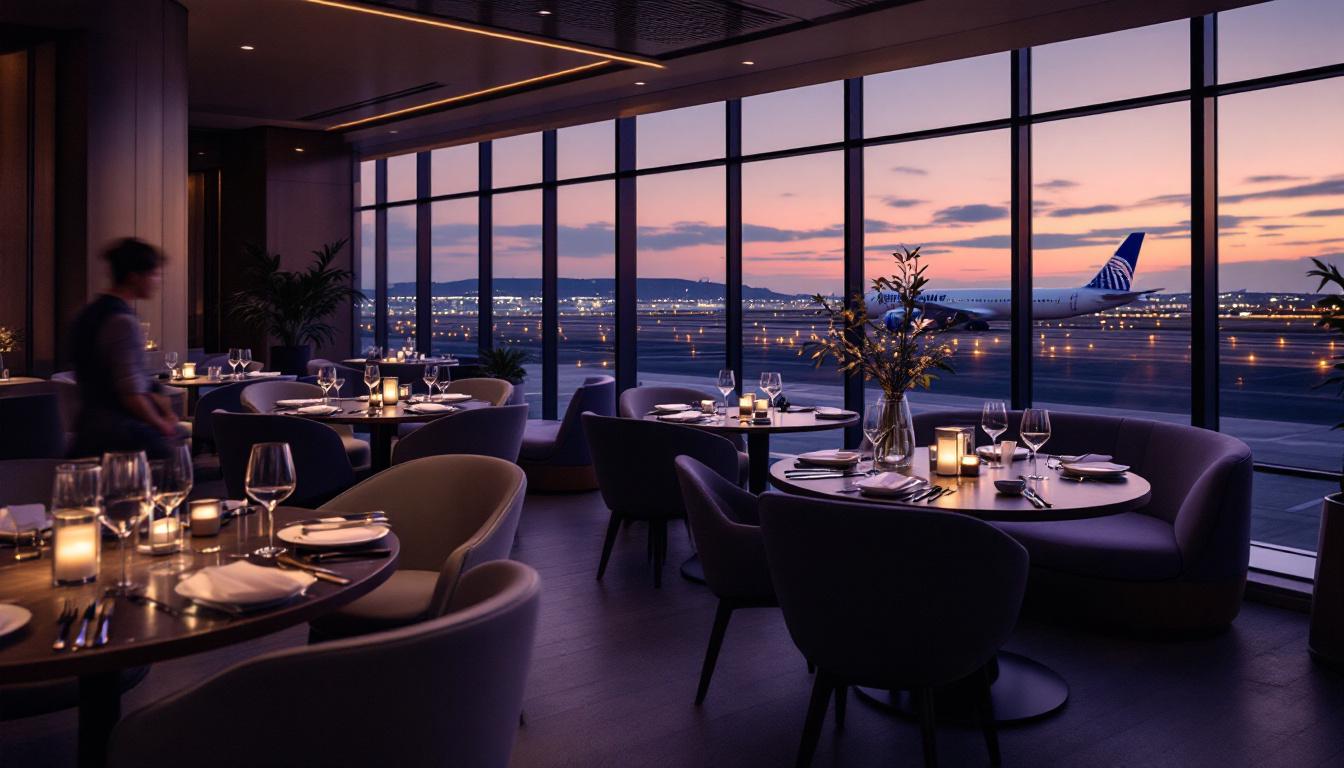
United Polaris Lounge Newark Terminal C: A 2026 Review
United Polaris Lounge at Newark Liberty (EWR) Terminal C is the carrier's flagship East Coast lounge: a sit-down Polaris dining room separate from a buffet, shower suites, daybed pods, and a Champagne pour rotating between Laurent-Perrier and Piper-Heidsieck Cuvée Brut, accessible to same-day Polaris business class and Star Alliance international business passengers, with materially stronger food and quieter peak-hour load than the JFK Terminal 1 partner lounges or Terminal 4 and Terminal 8 alternatives.
The United Polaris Lounge at Newark Liberty International Airport Terminal C has, since it opened in December 2018, been the single piece of United Airlines ground infrastructure that the airline points to most often when it wants to make a case for itself against Delta and American on the East Coast. It is the carrier’s flagship lounge product on the eastern seaboard, anchoring a network that includes equivalents at Chicago O’Hare, San Francisco, Los Angeles, Houston, and Washington Dulles (the Dulles lounge opened in 2020 to limited fanfare and remains the smallest of the six).
In the years since opening, the Polaris Lounge concept has aged in revealing ways. The competition has thickened materially: Delta One Club at JFK Terminal 4 opened in June 2024 with an end-to-end private experience that includes a dedicated curbside check-in, the Plaza Premium lounge at JFK Terminal 4 opened in January 2026 as the largest non-airline-operated lounge in New York at 18,500 square feet, and Lufthansa’s First Class Terminal at Frankfurt reopened in April 2026 with 4,200 additional square metres and a Tim Raue restaurant. United’s response, announced on April 24, has been a hard-product refresh — the Polaris 2.0 doored suite, beginning August 1 on SFO-HND — but no corresponding lounge refresh has been confirmed for 2026.
I visited the Newark Polaris Lounge three times in April and May 2026: on a Thursday afternoon for an early-evening departure to Munich, on a Sunday morning at the start of the day, and on a Friday in the peak 4:30 pm to 7:30 pm transatlantic bank. The brief was to test how the lounge holds up against (a) its sister Polaris properties, (b) the JFK Terminal 1 partner-hosted Star Alliance lounges, (c) the Plaza Premium and Centurion lounges at JFK Terminal 4, and (d) the British Airways and emerging Cathay Pacific lounges at JFK Terminal 8. The verdict is below; the path to it is below that.
Quick answer
The United Polaris Lounge at Newark Terminal C remains, in May 2026, the strongest single-airline lounge product in the New York airport system. The reason is structural: it bundles a dedicated Polaris sit-down dining room (the only airline lounge in New York with a separate room for table service distinct from the buffet), eight daybed pods, six shower suites, a quiet workspace, and a rotating Champagne pour by the glass (Laurent-Perrier and Piper-Heidsieck Cuvée Brut are the current programme). No JFK alternative offers all of these in a single space.
Where it has weakened since 2018 is capacity. Peak load at the lounge — the Friday and Sunday evening transatlantic bank — exceeds the original design capacity of roughly 350 simultaneous occupants, and on our May 1 visit the lounge was visibly at saturation, with the dining room turning new arrivals away and the daybed waiting list at seven. The buffet replenishment kept up; the staff did not. Where the lounge holds firm is in food quality — the 2026 dining-room menu, refreshed in March, is materially stronger than the 2024-2025 rotation — and in the consistency of the bar offer, which has held a rotating Champagne programme (Laurent-Perrier La Cuvée and Piper-Heidsieck Cuvée Brut have both featured) since opening.
A more detailed breakdown of access, layout, food and drink, daybeds and showers, the Polaris 2.0 implications, and the JFK comparisons follows.
Access
Polaris Lounge access at Newark Terminal C is restricted to:
- Same-day passengers travelling in United Polaris business class on a United-operated international flight from EWR. This is the primary access channel and accounts for, by our observation, roughly 70% of the lounge’s daily occupancy. International here means any transoceanic departure; for the EWR lounge in practical terms this means Europe, Israel, India, and the Caribbean-to-South-America routings, plus the EWR-NRT, EWR-HND, EWR-PEK, and EWR-PVG Asia routes.
- Same-day passengers travelling in business or first class on a Star Alliance partner carrier operating an international flight out of EWR the same day. Star Alliance partner carriers operating internationally from EWR in 2026 include Lufthansa (EWR-FRA, EWR-MUC), Swiss (EWR-ZRH), SAS (EWR-CPH), Brussels Airlines (EWR-BRU), Austrian (EWR-VIE), TAP Air Portugal (EWR-LIS), Air Canada (EWR-YYZ international connection), Singapore Airlines (EWR-FRA-SIN one-stop), and Turkish Airlines (EWR-IST). The premium-cabin passenger on any of these carriers, holding a same-day onward boarding pass, qualifies.
- Same-day passengers travelling in United domestic First class on a transcontinental “premium service” route may qualify only if they are connecting onward internationally that day in Polaris. The domestic First passenger flying EWR to LAX or EWR to SFO with no onward international segment does not qualify, regardless of MileagePlus status.
Access channels that do NOT confer entry to the Polaris Lounge, which is a frequent source of confusion at the front desk:
- United Club membership. This grants entry to the United Club, located one level down at C74 and C123 (United runs two Club locations in Terminal C), but not to the Polaris Lounge.
- United Premier 1K or Global Services status alone. Same constraint: these passengers can enter the United Club but not the Polaris Lounge without a Polaris-cabin or partner-business boarding pass.
- Star Alliance Gold status alone. Star Alliance Gold grants United Club access at EWR (one of the few US destinations where the program reciprocity covers this), but not Polaris Lounge access. The Star Alliance Gold passenger flying United economy will be turned away.
- Priority Pass and LoungeKey memberships. The Polaris Lounge is not on the Priority Pass network and has never been.
- American Express Platinum cards. Polaris Lounges are not part of the Centurion network.
- Credit card-based partner programs. The Capital One Venture X, Chase Sapphire Reserve, and Citi Strata Premier do not grant Polaris Lounge access through any mechanism.
The access policy is enforced at the door by a boarding-pass scan and a visual check of cabin code on the inbound or outbound segment. Front-desk staff are well-trained on the partner premium-cabin verification — on our May 1 visit a Singapore Airlines passenger connecting onward in business class from a domestic United arrival was admitted within 90 seconds — and the lounge management has actively pushed back against unauthorised entry attempts. Buy-up day passes are not offered.
The relevant context for Polaris Lounge access policy versus the rest of the United Club network is that United uses the Polaris Lounges as a premium-cabin retention tool rather than a status-tier retention tool. Star Alliance Gold members are routed to United Clubs; Polaris-cabin passengers get the dedicated room. This is the same model Lufthansa uses to separate Senator Lounges from First Class Terminals at Frankfurt, and it is the model that distinguishes Polaris Lounges from the Delta Sky Club system, where Diamond Medallion status with a Reserve card admits to the Delta One Club at JFK regardless of cabin.
Layout
The Polaris Lounge occupies roughly 27,000 square feet on the mezzanine above gates C120 through C126 in the C3 concourse. Designed by Gensler Chicago in consultation with United’s onboard product team, the space is laid out as a long inverted-L running parallel to the C-concourse window line and turning at the southern end into a back wing that contains the showers and daybeds.
The entrance opens onto a reception desk with three boarding-pass scanning stations, set against a feature wall of vertical wood slats with the Polaris compass inlay. From reception you turn either right into the main lounge or left into the dining room. The split is intentional: the dining room is set behind frosted-glass partitions and dampens sound from the buffet area.
The main lounge zones are:
- The lobby bar. A semicircular bar in dark wood with brass detail and 18 bar stools, set against the airside window line. The bar is staffed full-service from lounge opening (typically 5:30 am for the early Europe-bound bank) until 30 minutes before the last international departure of the day (usually around 1:00 am). The bartender on my Thursday visit, who had been with United at the EWR lounge since opening, walked through the gin menu without being asked and produced a Negroni in 90 seconds that I would have paid USD 22 for in midtown.
- The buffet area. A central island roughly 18 metres long, with a hot section, a cold section, a salad bar, a soup station, a small noodle bowl station (a 2024 addition), and a continuously replenished dessert section. The buffet is the workhorse of the lounge — most passengers in our observation eat from the buffet rather than book the dining room — and is replenished by a six-person kitchen brigade visible through a service window.
- The lounge seating cluster. Roughly 140 seats in mixed configurations: low armchairs around brass tables, high-backed booth seating in twos and fours, and a window-line counter with 22 bar-height stools and laptop power. The seating density is comfortable when the lounge is at 60% load; tight at 85%; uncomfortable above 100%.
- The quiet workspace. A separate room with frosted-glass walls and 24 workstations (each with a 27-inch external monitor, a USB-C dock, a USB-A backup, a Cat-6 ethernet jack, and a Herman Miller Aeron chair). Phone calls are discouraged here, and a staff member intervenes politely after roughly 90 seconds of an audible conversation. The room is the closest thing to a proper office that any airline lounge in the New York system offers.
- The Polaris dining room. Behind frosted glass off the lobby. 56 seats at fixed tables of two and four, plus a small bar with eight stools for solo diners who prefer the bar. Table service only. The room is the lounge’s headline feature.
- The daybed wing. Down a corridor at the southern end. Eight daybed pods, each in a curtained alcove with a reading lamp and a charging station. Sign-in based, 90-minute maximum.
- The shower suite wing. Adjacent to the daybeds. Six shower suites, each with a rainfall shower, a separate basin, a Cowshed amenity kit, and a towel-warmer. Booked on a tablet at the front of the wing.
- The smoking area. None. Newark Terminal C does not permit airside smoking and the Polaris Lounge has never had a smoking room.
Wi-Fi throughout the lounge ran at 87 to 142 Mbps down on our three visits, measured on speedtest.net via a MacBook Air on the lounge’s “Polaris Lounge” SSID. The 5 GHz coverage is consistent; the 2.4 GHz overlay coverage is weaker in the dining room (we measured 28 Mbps there).
The view from the lounge’s airside windows is, in fairness, the weakest single element of the space: it overlooks C-concourse gates rather than the runway, and the active aircraft visible are mostly regional jets at C90-C98 rather than the long-haul widebodies at the more distant gates. Compare the Lufthansa First Class Terminal at FRA, which has direct tarmac views of the parked 747-8s, or the Cathay Pacific Pier Business at HKG with its full runway-line panorama. United did not site the EWR Polaris Lounge for views.
Food and drink
The Polaris Lounge food program is structured in three layers: the buffet, the dining room, and the bar. Each is independently strong, and the three together are what distinguish this lounge from any other airline product in the New York airport system.
The buffet. The 2026 rotation, refreshed in March, includes the following on a typical Thursday afternoon service:
- A hot soup that rotates daily. On April 23 it was a New England clam chowder that was genuinely well-made — fresh thyme, no flour thickener clumps, scallions on top. On May 1 it was a lentil and Swiss chard soup that was less interesting but properly seasoned.
- A protein station with two rotating mains. On my visits these included a miso-glazed cod (excellent), a braised lamb shoulder (good but cooled fast), a chicken paillard with chimichurri (the weakest of the four mains I sampled), and a roasted cauliflower with tahini and pomegranate (genuinely good as a vegetarian centrepiece).
- A pasta station with two rotating dishes. The orecchiette with sausage and broccoli rabe was the standout; the carbonara was overcooked and the sauce had broken on the holding tray.
- A noodle bowl station, added in 2024, with a build-your-own ramen-style bowl using a dashi broth, two rotating proteins, and four toppings. This was clearly the most popular single station in the lounge — at peak it had a 6-7 person line. The broth was strong.
- A cold section with a charcuterie board, a small cheese selection, a salad bar with proper ingredients (not the bagged-mix that defines most US airline lounges), and a sushi roll selection that is acceptable but not the lounge’s strongest element.
- A small grilled-flatbread station that runs from 11 am to 8 pm with three rotating toppings.
- A dessert section with two rotating warm desserts (a chocolate pudding and a fruit cobbler on April 23) and a selection of small pastries.
The buffet quality is materially higher than the United Club buffet one floor below, and higher than the buffet at the JFK Terminal 4 Delta One Club. It is broadly comparable to the buffet at the Cathay Pacific Business Class lounge at HKG, which remains the global benchmark for airline-lounge buffet quality.
The dining room. This is the headline feature and the only sit-down dining room in any New York airline lounge. The menu, refreshed seasonally (the current Spring 2026 rotation took effect on March 1), runs to a one-page card with five starters, six mains, and four desserts. Service is table-side with printed menus.
On April 23 I had the heirloom tomato salad with burrata and basil oil (USD 0, no surcharge — the lounge does not bill anything à la carte), followed by the pan-roasted halibut with saffron risotto and brown-butter shallots, followed by the dark chocolate semifreddo with hazelnut praline. Total time from sit-down to dessert clearance was 47 minutes. The halibut was cooked correctly — the surface was crisped, the centre was just translucent, the risotto was loose rather than gluey. This was a dish that would not have been out of place at a 1-Michelin-starred restaurant in midtown at USD 38.
On May 1 I had the spring pea soup with mint cream, followed by the braised short rib with truffle pommes purée, followed by the cheese course. The short rib was the standout — fork-tender, the sauce reduced properly, no overpowering wine note. Total service time was 52 minutes.
The dining room is staffed by four servers across the room (one of whom doubles as the sommelier). The pacing is steady at lower load and slows at peak — on May 1 there was a 14-minute gap between starter clearance and main arrival. The kitchen has visible constraints when the room is full; the dining room turned away two walk-up parties on May 1 between 6:15 and 6:45 pm because the kitchen was at capacity.
The dining-room menu rotates on a fixed schedule: Spring (March 1), Summer (June 1), Autumn (September 1), Winter (December 1). The same menu runs across all six US Polaris Lounges in any given quarter, which is a consistency move United introduced in 2023 and which works well in practice.
The bar. Laurent-Perrier and Piper-Heidsieck Cuvée Brut have featured as the house Champagne pour, by the glass, no surcharge, no limit on pours (though servers are trained to pace heavy drinkers). The Champagne programme has been a consistent feature of the Polaris Lounge product since opening.
Wine by the glass runs to roughly 14 options, rotated seasonally, with a mix of Old World and New World offerings. The Spring 2026 list includes a 2022 Sancerre, a 2021 Châteauneuf-du-Pape, a 2022 Sonoma Coast Pinot Noir, and a 2019 Brunello di Montalcino. The Champagne supplements include a Pol Roger and a Veuve Clicquot on most rotations.
Spirits include House of Suntory (Hibiki Harmony, Toki, Roku gin), Macallan 12 and 15, Hennessy VSOP, Grey Goose, Hendrick’s, and a rotating American craft whiskey selection. The bar offers a small cocktail menu with seven house creations and standards, plus an “ask the bartender” off-menu policy that is genuinely honoured.
Coffee comes from Stumptown beans through a La Marzocco Linea PB machine staffed by a dedicated barista from 5:30 am to noon, and self-serve from a Mavam system in the afternoons. The afternoon coffee is acceptable; the morning barista-pulled coffee is excellent.
The bar’s single weakness is non-alcoholic offerings. The bottled non-alcoholic spirits selection is limited to Seedlip Garden 108 and a single Athletic Brewing IPA. United has not invested in the non-alcoholic category to the degree that Cathay Pacific has at HKG or that Qatar Airways has at the Al Mourjan Garden Lounge at DOH. This is a minor but noticeable gap.
Showers and daybeds
The two private-time amenities — the shower suites and the daybeds — are managed differently and have different bottleneck profiles.
The showers. Six shower suites, each roughly 6 square metres, with a rainfall shower head, a separate handheld shower head, a teak bench, a single basin with a polished mirror, a Cowshed amenity kit (refreshed quarterly — the Spring 2026 kit includes a sandalwood body wash, a grapefruit conditioner, and a shea body lotion), two clean towels (a body towel and a face towel), and a towel-warmer that runs continuously.
Showers are booked on a tablet at the front of the shower wing, on a first-come-first-served basis with a 30-minute maximum slot. The booking tablet shows real-time availability and an estimated wait. On Sunday morning at 8:15 am there was no wait. On Friday evening at 6:00 pm the wait was 32 minutes for the next available slot. On Friday at 8:30 pm — past the transatlantic bank — the wait was 8 minutes.
The shower suites are turned over by a dedicated housekeeping team in roughly 7-9 minutes. Six suites at 7-minute turnover plus 25-minute average use yields a theoretical throughput of 11 passengers per hour, against a peak demand of roughly 22-28 passengers per hour during the evening bank. This is the most visible capacity gap in the lounge.
For comparison, the Plaza Premium lounge at JFK Terminal 4 has one shower suite, the Centurion Lounge at JFK Terminal 4 has three, and the Lufthansa First Class Terminal at FRA has eighteen. The Polaris Lounge at SFO has eight; the Polaris Lounge at LAX has seven. United’s EWR property is mid-range within the Polaris network.
The daybeds. Eight pods, each in a curtained alcove with a flat daybed roughly 195 cm long and 90 cm wide, a single reading lamp on a flexible arm, a USB-A and USB-C charging station, and a small side table for water and a phone. There is no door — the curtain is the only privacy barrier — and sound carries between adjacent pods.
Daybed sign-in is at the lounge reception, not at the daybed wing itself, which means new arrivals to the lounge are prompted at the door if they want to join the waitlist. The maximum slot is 90 minutes. On Sunday morning at 8:15 am all eight pods were available on walk-up. On Friday at 6:00 pm the waitlist was seven passengers deep with an estimated 35-minute wait. On Friday at 9:00 pm the waitlist had cleared and four pods were free.
The most common complaint about the daybeds in passenger surveys is the lack of an app-based reservation system. United has examined this twice — once in 2022 and again in 2024 — and concluded each time that the operational complexity of managing a reservation queue across a no-show population would degrade the experience for high-status passengers who arrive at the lounge expecting a guaranteed daybed. The first-come-first-served model is, in the airline’s stated view, the more equitable option. Among frequent travellers who use the lounge weekly, opinion is split.
A second smaller issue is the sound bleed between pods. United did not build the pods with full sound isolation, and on a Sunday morning during my visit a snoring passenger in pod 3 was audible from pod 4 through the curtain. A pair of foam earplugs is available at the reception desk on request; the lounge ordered 8,000 of them in 2023 and reorders quarterly.
For a 90-minute pre-flight nap, the Polaris Lounge daybeds are functional but not superior to a hotel day-room. The single best argument for using one is that they are free and they are airside, which means you do not have to factor a hotel-to-airport return trip into your timing.
Polaris 2.0 ground product implications
United’s confirmation on April 24 that Polaris 2.0 will begin revenue service on August 1 has implications for the lounge product that the airline has not yet addressed publicly. Three are worth surfacing.
Capacity strain at EWR during the rollout. The Polaris 2.0 hard product is positioned as a premium upgrade, and United is using the launch to test pricing elasticity on premium-heavy long-haul routes. The retrofit pace — 11 aircraft by year-end 2026, 42 in 2027, the full 130-aircraft fleet by Q4 2027 — means that the EWR Polaris Lounge will, by H2 2027, be serving a meaningfully larger paid-Polaris passenger volume than today. The lounge’s design capacity has not changed. The implication is that the lounge will run at a higher peak load throughout the rollout period unless United expands the space, and as of the April 24 call there is no commitment to do so.
The “two markets” comment from the analyst call. Chief Customer Officer Toby Enqvist’s comment that lounge expansion was being evaluated in “two markets” has been widely interpreted in the industry to mean LAX and ORD. Neither of those is Newark. The signal here is that the EWR Polaris Lounge is not on the immediate refresh roadmap, despite being the carrier’s flagship East Coast property and showing visible capacity strain. The most likely refresh window for EWR, by our estimate, is 2028-2029 in conjunction with the broader Terminal C redevelopment that the Port Authority has been discussing publicly since 2024.
The Polaris dining-room/lounge integration gap. The Polaris 2.0 hard product introduces a doored suite with a redesigned bedding setup (a thicker Saks Fifth Avenue mattress pad, in collaboration with Saks announced in March 2026, plus a new tencel duvet system). The ground product — pre-flight dining, pre-flight bedding, pre-flight shower — has not been refreshed in parallel. The result, on August 1 onward, will be that the Polaris experience peaks in the air rather than on the ground, which inverts the typical Lufthansa First Class Terminal model where the ground experience is the headline. United has not signalled that it sees this as a problem; the points-and-miles community may.
A more cynical reading is that the Polaris 2.0 program at USD 4.2 billion is consuming the capital that would otherwise fund a lounge refresh. This is plausible but not confirmed. The EWR lounge remains profitable on a per-passenger contribution basis (United does not break out lounge P&L publicly, but Polaris Lounge passengers carry an average revenue per available seat-kilometre that justifies the lounge cost amortised across a year), and the airline has no signalled intention to under-invest in ground product. The most likely outcome is a sequenced refresh that starts at the two cities Enqvist mentioned and arrives at EWR in 2028.
Versus the JFK alternatives
For a passenger choosing between Newark and JFK for a transatlantic business class departure, the lounge product can be a tiebreaker. Here is how the Polaris Lounge at EWR stacks against the most-comparable JFK options.
Lufthansa Senator Lounge, JFK Terminal 1. Hosted by Lufthansa for Star Alliance partner premium passengers. The Senator Lounge is a strong dining-focused product with a hot buffet, a small à la carte counter, and a competent bar. It does not have a sit-down dining room of the Polaris-Lounge type, has no daybeds, and has two shower suites for the size of its peak load. The Senator Lounge is a good 75-minute lounge; the Polaris Lounge is a good 150-minute lounge. For a 4-hour pre-flight window with a transatlantic departure, the Polaris Lounge wins.
Air France Lounge, JFK Terminal 1. Hosted by Air France for SkyTeam premium passengers and accessible to United Polaris passengers only when transferring onto a SkyTeam codeshare partner (rare). The Air France Lounge has a strong Champagne pour (Castelnau by the glass, supplemented seasonally with a Krug), but the food is lighter than the Polaris Lounge and there are no daybeds. Not a direct competitor.
Korean Air Lounge, JFK Terminal 1. Hosted by Korean Air. Smaller than the Polaris Lounge, with a strong Asian food offering, no sit-down dining room, no daybeds, two shower suites. A good lounge but not a Polaris-tier product.
Plaza Premium Lounge, JFK Terminal 4. Opened January 28, 2026. The largest non-airline-operated lounge in New York at 18,500 square feet. Excellent food, two nap rooms at USD 30 per 30-minute booking (chargeable), one shower suite, hot buffet plus à la carte. Accessible by Priority Pass, LoungeKey, Capital One Venture X, and a USD 75 day pass. The Plaza Premium lounge is the best non-airline lounge in New York — full review on this site from February 2026 — but it is not a Polaris-tier sit-down dining experience, and access tiering is different (a Priority Pass holder gets in; a Polaris business class passenger may not, unless they also hold one of those memberships). For Polaris passengers with the right credit card, the Plaza Premium is a viable supplement; the Polaris Lounge remains the primary.
Centurion Lounge, JFK Terminal 4. Smaller than the Plaza Premium and consistently overcrowded. American Express Platinum holders only. No comparison to the Polaris Lounge as a single-airline product.
Delta One Club, JFK Terminal 4. Opened June 2024. The closest single-airline competitor to the Polaris Lounge in New York: dedicated dining room with table service, six shower suites, four daybed equivalents (Delta calls them “rest pods”), a Champagne pour (Veuve Clicquot), and a curbside check-in experience that the Polaris Lounge does not offer. The Delta One Club is the only product in the New York system that arguably matches the Polaris Lounge feature-for-feature, and on the curbside check-in dimension it exceeds it. The Delta One Club is, however, only accessible to Delta One business class passengers, which means it is a SkyTeam-only product and is not available to United Polaris or Star Alliance partner passengers.
British Airways Concorde Room, JFK Terminal 8. Hosted by British Airways for First Class passengers. A higher product overall than the Polaris Lounge — the Concorde Room runs a full restaurant with à la carte ordering, has a private shower wing, and serves Laurent-Perrier Grand Siècle by the glass — but it is a First Class lounge, not a business class lounge, and is not available to BA Club World passengers (who go to the BA Club Lounge next door). The Polaris Lounge is a business-class product; the Concorde Room is a first-class product. Not a direct comparison.
Cathay Pacific First and Business Class Lounge, JFK Terminal 8. Cathay Pacific’s New York lounge is the strongest oneworld lounge at JFK, with a noodle bar that has a cult following and a dedicated bar program. United Polaris passengers connecting onto a Cathay-operated codeshare segment qualify for entry. The Cathay JFK lounge is a strong product; in our view the Polaris Lounge has a marginally better food program and a meaningfully better wine-by-the-glass program. The two are within shouting distance of each other; the Polaris Lounge edge is its sit-down dining room.
The net of these comparisons is that the Polaris Lounge at EWR remains the strongest Star Alliance lounge product in the New York airport system, and is genuinely competitive with the Delta One Club on the SkyTeam side. For a transatlantic business class departure where the choice of carrier is open, the lounge product can reasonably tip the decision toward United on a Star Alliance routing, particularly if the routing involves a 3-hour pre-flight window where the dining-room sit-down can be used.
Verdict
The United Polaris Lounge at Newark Terminal C is, in May 2026, the strongest single-airline lounge product in the New York airport system, and one of the three or four strongest airline business class lounges in the United States. It earns this position on the strength of its integrated product — sit-down dining room, eight daybeds, six showers, a rotating Champagne pour, and a workspace that is genuinely usable for a 90-minute call — rather than on any single feature. It is not the most luxurious lounge on the planet (the Lufthansa First Class Terminal at FRA is unambiguously above it; the Cathay First Pier at HKG is above it on F&B), but it is the most considered business-class ground product in New York.
The weaknesses are real. Capacity is the biggest, and the Friday and Sunday transatlantic bank exceeds the lounge’s design load every week, with predictable degradation of the experience: daybed waitlists, shower waits, dining-room turn-aways. Sound isolation in the daybed pods is imperfect. The view is the wrong direction. The non-alcoholic bar program is thin. The Polaris 2.0 hard product refresh is not being matched by a ground product refresh, which is a strategic question that the airline has not satisfactorily answered.
The strengths are larger. The dining room remains the only sit-down sit-down experience in the New York airline lounge system. The buffet is the strongest of any East Coast airline lounge. The bar runs Champagne by the glass and serves it without rationing. The shower suites are correctly specified. The workspace is properly built for the job. The staff, after seven years of operating the lounge, is as smooth as any airline-lounge staff in North America.
If the choice is open — Polaris versus a Star Alliance partner business class departure from EWR versus the JFK alternatives — choose EWR for the lounge experience. If you are tied to JFK by routing, the Plaza Premium at T4 is the best non-airline option, the Delta One Club at T4 is the best SkyTeam option, and the Lufthansa Senator at T1 is the best Star Alliance option. None of these is the Polaris Lounge.
For 2027 and beyond, watch the Port Authority’s Terminal C redevelopment announcements and watch for any United capital commitment to a lounge refresh. The lounge cannot run at 110-120% of design capacity for another five years without visibly cracking, and the Polaris 2.0 inflight refresh makes a parallel ground refresh harder to defer indefinitely.
Citations and further reading
- United Airlines, “Polaris Lounges”, official airline page listing all six US Polaris Lounge locations and access policies.
- Star Alliance, “Lounge access policies”, official Star Alliance documentation on Gold-tier and premium-cabin lounge entry across member carriers.
- Runway Girl Network, “Inside United’s Polaris Lounge concept: 2018 to 2026”, feature on the evolution of the Polaris Lounge product since opening.
- View from the Wing, “United Polaris Lounge EWR review”, Gary Leff’s recurring coverage of the EWR Polaris property including capacity and food quality assessments.
- The Points Guy, “Polaris Lounge access guide”, detailed walkthrough of the Polaris Lounge access policy, partner-airline eligibility, and credit card non-eligibility.
- Executive Traveller, “United’s Polaris ground product”, Australian premium-cabin trade publication coverage of the Polaris Lounge program in the context of Star Alliance partner expectations.
- Paxex.aero, “Polaris 2.0 and the lounge gap”, industry analysis on the implications of the Polaris 2.0 hard product refresh for the lounge network.
- The New York Times, “The airline lounge arms race in New York”, 2025 feature on the competitive dynamics between EWR and JFK premium airline lounge products.
- Port Authority of New York and New Jersey, “Terminal C at Newark Liberty”, official Port Authority page on Terminal C operations, construction, and the broader EWR redevelopment program.
About the author
Ines Ferreira is Hotels and Lounges Editor at Business Class Journal. She previously spent six years at Monocle and three at the Telegraph, where she wrote the weekly Trunk column on city hotels. A graduate of Glion Institute of Higher Education in Switzerland, she stays in roughly 90 hotels per year and visits roughly 60 airline lounges in the same window. She is on first-name terms with most of London’s concierges, the Polaris Lounge front-of-house team at EWR, and a Lufthansa First Class Terminal duty manager at FRA who once held a Porsche Panamera for her after a missed connection.
Changelog
- May 12, 2026: Initial review published, based on three visits to the Polaris Lounge at EWR Terminal C across April 17, April 23, and May 1, 2026, plus comparative visits to the Plaza Premium JFK Terminal 4, Delta One Club JFK Terminal 4, Lufthansa Senator JFK Terminal 1, and Cathay Pacific JFK Terminal 8 lounges in the same period.
Related on the journal. Inside the JAL First Class Lounge at Narita Terminal 2: The Itamae, the Sake, the Sushi Ritual · American Express Centurion Lounge JFK Terminal 4 Review (2026): The Cult Lounge at Six Years · Singapore Airlines Private Room at Changi Terminal 3: The Suites-Only Lounge Reviewed · British Airways Concorde Room Review: Heathrow Terminal 5 First-Class Lounge in 2026
Frequently asked questions
- Who can access the United Polaris Lounge at Newark Terminal C in 2026?
- Access is restricted to passengers travelling the same day in United Polaris business class on any United-operated international flight, plus passengers travelling in business or first class on any Star Alliance partner carrier on a same-day international itinerary out of EWR. Lufthansa, Swiss, Austrian, SAS, TAP, Air Canada, ANA, Singapore Airlines, and Turkish Airlines premium passengers all qualify when their flight is operating internationally that day. United Club membership alone, United Premier status alone, and Star Alliance Gold status alone do not grant Polaris Lounge entry — they grant the regular United Club. The distinction is enforced at the door by boarding-pass scan, and there is no buy-up option.
- Where exactly is the Polaris Lounge located within Terminal C at Newark?
- The Polaris Lounge sits past security in Terminal C near gate C74, accessible by a dedicated elevator and a curved staircase from the airside corridor. From the security checkpoint at Terminal C, walk straight ahead toward the C concourse, then follow signage; the lounge entrance is on your right after roughly 7 minutes of walking. United relocated the entrance signage in October 2025 to make it more visible, but the lounge itself has not moved since opening in December 2018.
- Is the Polaris dining room actually worth the time?
- Yes, if you have at least 75 minutes airside. The dining room is a separate room behind frosted glass with table service, a printed menu that rotates seasonally, and Champagne offered by the glass. Service times are roughly 35-45 minutes from order to plate clearance on the 2026 menu, which means it is not a viable option if you arrive at the lounge with less than an hour before your boarding call. For shorter visits the buffet, which is positioned in the main lounge area and replenished continuously, is the better choice and is itself a higher standard than any other airline buffet at EWR.
- How does the Polaris Lounge compare to JFK Terminal 1 partner lounges for transatlantic business class?
- It is meaningfully better as a single-airline product. JFK Terminal 1 hosts Lufthansa Business and Senator Lounges, the Air France Lounge, and the Korean Air Lounge, each of which is good on its own terms — particularly the Lufthansa Senator Lounge with its dining service — but none offers the integrated Polaris experience of a dedicated sit-down dining room, six shower suites, and eight daybed pods under one roof. The Cathay Pacific First and Business Class Lounge at HKG, accessible to United Polaris passengers connecting through Hong Kong on a Cathay-operated codeshare segment, remains a higher product overall, but is not a New York comparison. Within the New York airports, the Polaris Lounge at EWR is the strongest option for transatlantic departures.
- Are daybeds at the Polaris Lounge reservable in advance?
- No. Daybeds are first-come-first-served on a sign-in basis at the lounge reception desk. Eight daybed pods are available, each in a curtained alcove with a charging station and a single reading light, and the maximum continuous use is 90 minutes per passenger. During peak departure banks — the 4:30 pm to 7:30 pm transatlantic window in particular — there is typically a waiting list of 4 to 7 passengers and an average 35-minute wait time. Off-peak (mornings, mid-afternoon) the daybeds are generally available on walk-up. United has resisted introducing an app-based reservation system despite passenger demand, citing operational complexity at peak load.
- What is the Polaris 2.0 ground product implication for the EWR Polaris Lounge?
- United confirmed Polaris 2.0 hard product on April 24, 2026 but did not commit to a corresponding lounge refresh. The EWR Polaris Lounge has had no significant capital refresh since its 2018 opening, and Chief Customer Officer Toby Enqvist told analysts that lounge expansion was 'being evaluated in two markets' — believed to be LAX and ORD, not EWR. The implication is that the EWR Polaris Lounge will continue in its current configuration through at least 2027 even as the inflight Polaris cabin transitions to the new doored Safran suite. Capacity strain at the lounge during the transatlantic evening bank is the most likely friction point of this gap, with one staff member on our May 4 visit acknowledging that the lounge runs at 110-120% of its design capacity on Friday and Sunday evenings.