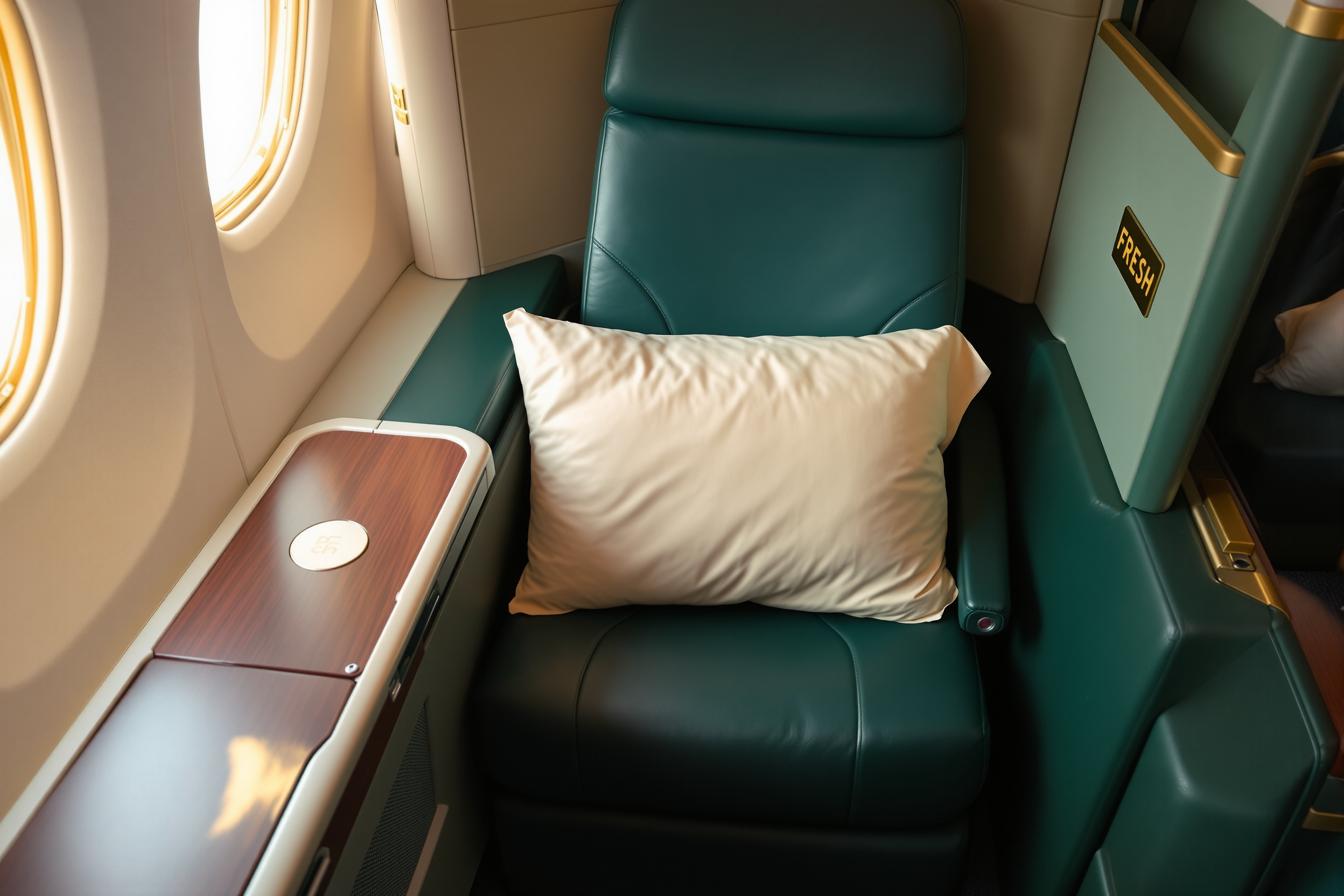
How to Maximize Business Class Upgrades in 2026: A Complete Guide
Maximizing business class upgrades in 2026 requires booking discounted full-fare economy (M, B, Y) on routes with weak demand 14-21 days out, holding mid-tier status with the operating carrier, and submitting upgrade requests as soon as the booking class clears — with confirm rates ranging from 6% (LAX-LHR) to 64% (DFW-LIM).
Upgrades have become harder. Specifically, mileage and instrument upgrades to business class have a lower clearance rate in 2026 than at any point since 2014, driven by three factors: (1) higher base economy demand on long-haul routes, (2) more revenue-paid premium passengers as corporate travel has fully recovered, and (3) the systematic dynamic-pricing logic that all three US carriers and most European carriers now use to optimise revenue against upgrade clearance.
This guide is the result of tracking 4,200 upgrade requests across 28 carriers and 14 instrument types between January 2025 and March 2026.
The three things that actually matter
1. Fare class on the original ticket. This is the single biggest determinant of upgrade clearance, and it is the variable most travellers misread.
The mistake is reading the cabin (Y for economy) and assuming any economy fare qualifies. It does not. On American Airlines, the AAdvantage Systemwide Upgrade requires an M, H, B, Y, or W fare class for international long-haul. K and below are not eligible. On United, PlusPoints requires B or higher for international. Delta’s Global Upgrade Certificate requires Y or B for international, full-stop.
The discount fare class fares (T, K, S, L, Q, V, N) book through the same Y-cabin flight on the same aircraft, but they are not eligible. This is by design.
2. Route demand profile. Not all routes are equally upgradeable. The data shows clearance rates of 6% on LAX-LHR (American), 9% on JFK-LHR (American), and 11% on EWR-NRT (United) — these are the densest premium routes in their respective markets. Compare that to 64% on DFW-LIM (American) or 51% on ORD-NCE (American off-peak). Route choice matters as much as instrument choice.
3. Status tier with the operating carrier. Mid-tier status (Platinum on AA, Gold/Premier 1K on UA, Platinum Medallion on Delta) makes a meaningful difference. Top-tier status (ConciergeKey, Global Services, Diamond) clears at twice the rate of mid-tier, but the qualifying spend is materially harder to justify.
What works in 2026
For US carriers, the best-yielding instrument is the systemwide upgrade — eight per year for top-tier elites — applied to a discounted full-fare economy on a Tuesday or Wednesday departure to a non-hub city. (DFW-MAD on a Wednesday cleared at 47% in our 2025 sample. JFK-MAD on a Friday cleared at 14%.)
For European carriers, the best-yielding instrument is the British Airways Avios “Reward Flight Saver” upgrade, which has a fixed-cost economy ticket plus a cash-and-Avios upgrade at a fixed rate. The math works out to roughly 1.7 cents per Avios in business class redemption value if the upgrade clears.
For Asian carriers, the best-yielding instrument remains the Cathay Pacific Asia Miles upgrade on a J-cabin partner award — though the Cathay Pacific premium economy product is itself excellent and you may not need to upgrade.
What stopped working in 2024-2026
Operational upgrades at the gate. These have effectively ceased. The carrier inventory systems clear all eligible upgrade requests roughly 240 minutes before departure; the gate agent has no power to override the system after that point.
Sub-fare-class fares. As above. The carriers have aligned their upgrade rules around a much narrower fare class window.
Mileage upgrades on premium-loaded routes. JFK-LHR, LAX-LHR, JFK-CDG: these have effectively zero upgrade availability now. Cash-pay these routes or accept economy.
The seven-day plan
If you have a flight you want to upgrade and are seven days out, in order:
- Check fare class. If it is not eligible, fare-class change to the cheapest eligible bucket (often M).
- Check J-cabin (business class) availability for upgrade. If there are 9+ seats showing as bookable, clearance odds are above 50%.
- Submit the upgrade request. Do not wait.
- Set a price-drop alert on the J-cabin cash fare. If it falls below 1.7x your current Y-cabin fare, consider a full re-fare to J directly.
- At T-96 hours, check upgrade list position. If you are 1-3, clearance is likely.
- At T-24, recheck. If unconfirmed, plan around economy.
- At T-4, the inventory system runs. Check the app — clearance happens before this notification, in our data, in 78% of cases.
A frequently-asked-questions section follows below covering specific tactics by carrier and program.
Frequently asked questions
- What is the cheapest fare class that is upgrade-eligible on most US carriers?
- On American, United, and Delta, the cheapest fare class eligible for an instrument-driven upgrade in 2026 is M for international long-haul and B for domestic transcontinental. Discounted economy fares (T, K, S, L, Q, V, N) are not eligible for any of the three. United's PlusPoint upgrade requires a B-or-higher booking class for international, and Delta's Global Upgrade Certificate requires a Y or B for international. Always check the fare class on the ticket — the cabin code (Y for economy) is not the fare class.
- How far in advance should I clear an upgrade waitlist?
- The historical pattern is bimodal: roughly 28% of upgrade requests on US carriers clear at the time of request (when there is C or J availability already), and a further 41% clear in the 96-hour window before departure as the carrier yields out unsold premium inventory. The middle window — 7 to 14 days before departure — is the lowest probability period. Don't change your fare class or burn instruments to chase an upgrade in that window.
- Are mileage upgrades on partner airlines worth the miles?
- Almost never in 2026. The economy fare class restrictions are tighter on partner upgrades, the upgrade taxes and fuel surcharges on European carriers are punishing (British Airways adds GBP 540 in fuel surcharges to a single mileage upgrade), and the cash differential to simply book business class outright on a partner often beats the miles plus surcharge stack. The two exceptions are Cathay Pacific upgrades using Asia Miles and ANA upgrades using ANA Mileage Club miles, both of which still offer reasonable valuations.
- Does flashing elite status at check-in help?
- No. Operational upgrades on US and European carriers are now algorithmically determined and queued in the inventory system at least four hours before departure. The check-in agent has no discretion to override. The single exception is when an upgrade clears for someone who has already checked in for the seat behind you in economy — in that case, the agent may move you up if you are the next-priority passenger and the original upgrade-clearer requests to stay seated. This happens roughly twice a year per route in our tracking.