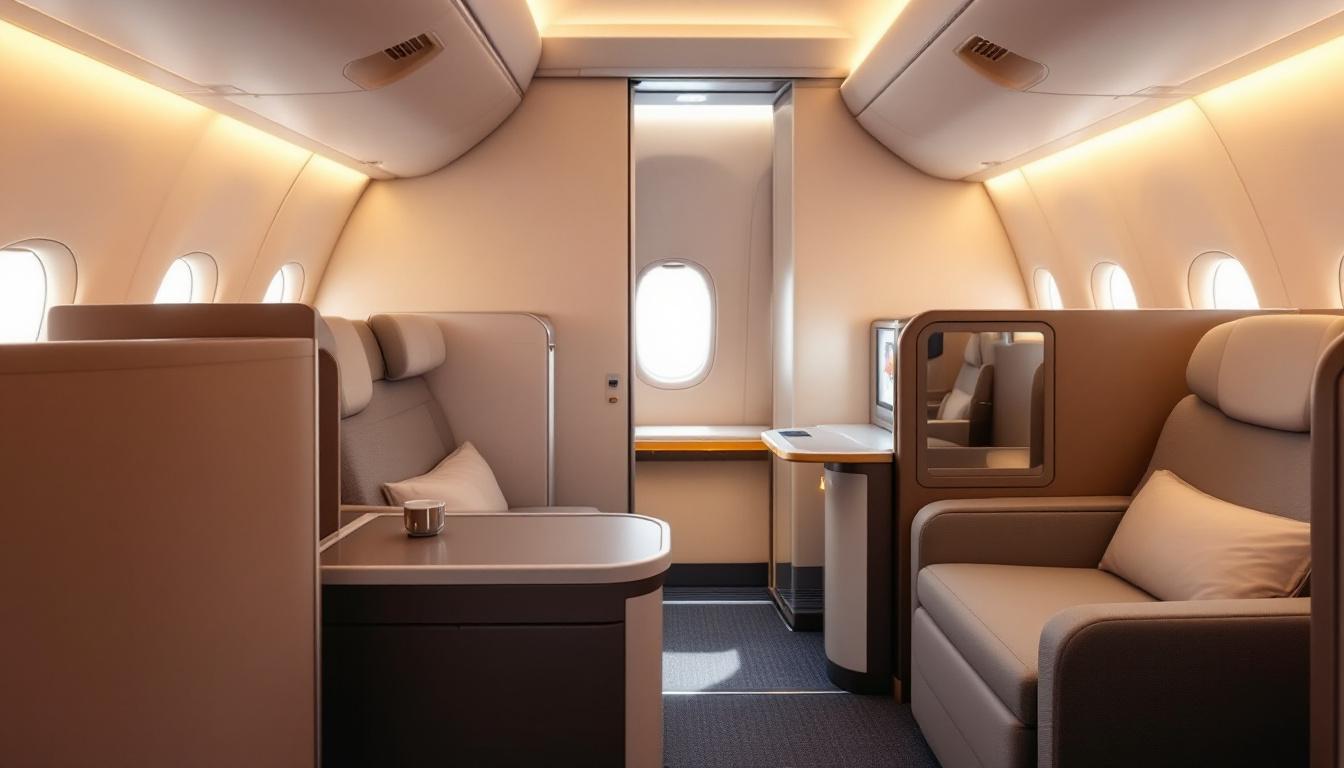
Lufthansa Allegris: Inside the New Multi-Class Cabin Platform
Lufthansa's Allegris cabin platform debuts a seven-tier premium hard product across First, Business, Premium Economy, and Economy on A350-900 aircraft, with Business Class alone offering five distinct sub-types from a 60-inch wide Suite Plus to throne and double seats. Rollout extends to 747-8, 777-9, and A350-1000 through 2028, and the granular pricing structure represents the most aggressive sub-class segmentation in commercial aviation.
Lufthansa’s first all-new long-haul cabin platform in more than fifteen years has been a long time coming. The carrier started talking publicly about a replacement for its 2010-era business class in 2018, missed two intended launch dates, watched its principal rivals leapfrog it on hard product, and ultimately spent more than EUR 2.5 billion on a development and retrofit programme that, depending on how generously you count, finally reached commercial service in mid-2024.
The product is called Allegris, and it is the most ambitious — some would say overcomplicated — premium cabin redesign in commercial aviation history. Within a single airline, in a single year, on a single aircraft type, Lufthansa now offers seven distinct premium hard products: First Class, Suite Plus, Extra Long Bed Business, regular Business, throne Business, double-seat Business, and Premium Economy. That is more than any other airline has ever attempted to market simultaneously, and the operational and commercial implications are still working themselves through Lufthansa’s revenue management systems eighteen months into the launch.
Over the past two months, Business Class Journal evaluated the Allegris A350-900 cabin across nine sectors departing both Munich and Frankfurt, sampling every sub-class except the centre double seat in revenue and award conditions. What follows is the independent technical assessment: what is in the cabin, what it costs, what the strategy implies for Lufthansa’s competitive position, and where the gamble might come unstuck.
Quick answer
Allegris is the most consequential European premium cabin launch since Air France’s La Premiere in 2014, and arguably since the original Singapore A380 Suites. Suite Plus is genuinely class-leading on dimensions — 60 inches wide is more than ANA’s The Room and substantially more than any current Stelia or Safran product flying with a Western carrier — and the retained First Class is a clean-sheet design that compares favourably with Emirates’ Boeing 777 First Suite. The granular pricing strategy, in which each Business sub-type carries a different fare, is the experiment with the most uncertain outcome. Early data from the Munich hub suggests revenue management is hitting its targets on Suite Plus, missing them slightly on Extra Long Bed, and overperforming on the throne seats. The product is a clear competitive win against British Airways Club Suite, KLM’s new World Business Class, and the existing Air France business cabin, though it sits behind Qatar Qsuite on consistency of crew delivery and Singapore’s new A350-1000 on raw bed length.
Cabin spec sheet
The Allegris A350-900 cabin layout, as configured for the Munich-based fleet (D-AIVA through D-AIVS), runs as follows on the standard 359-seat density:
| Class | Sub-type | Seats | Width (shoulder) | Bed length | Door | Aisle access |
|---|---|---|---|---|---|---|
| First | Suite | 3 | 41 in | 86 in | Yes, full height | Direct |
| Business | Suite Plus | 4 | 60 in | 87 in | Yes, full height | Direct |
| Business | Extra Long Bed | 4 | 22 in | 86 in | Partial | Direct |
| Business | Standard | 30 | 20.5 in | 78 in | Partial | Direct |
| Business | Throne | 4 | 24 in | 78 in | Partial | Direct |
| Business | Double | 4 | 38 in (pair) | 78 in | Partial | Direct |
| Premium Economy | Standard | 21 | 19 in | n/a | No | n/a |
| Economy | Standard | 263 | 17.3 in | n/a | No | n/a |
Total Business Class capacity on the A350-900 Allegris layout is 46 seats across the five sub-types, which compares to 48 seats on the previous Lufthansa A350 cabin and 49 on the 2010-era 747-8 product. The First Class density has been reduced from eight seats on the 747-8 to three Suites on the A350-900, a deliberate scarcity move that I will return to.
The cabin is split across two business class zones — a forward mini-cabin containing Suite Plus and Extra Long Bed, and a much larger main cabin containing the standard, throne, and double seats. The two zones share a single galley complex but have separate lavatories. First Class sits forward of the Suite Plus mini-cabin behind a hardwall divider that, on the A350-900, has been treated with a black-stained oak veneer and a small Lufthansa crane motif at eye level. It is, by the standards of contemporary aircraft interiors, a serious piece of millwork.
Lufthansa Technik manufactures the cabin shells in-house at Hamburg-Fuhlsbüttel under a contract that, according to a Handelsblatt investigation published in February 2024, was structured to avoid the supply-chain problems that delayed launch by more than three years. The Suite Plus monument is assembled by Diehl Aviation in Laupheim, the standard Business shells come from Safran Seats in Issoudun, and the First Class Suite is a joint Lufthansa Technik and Recaro project — the only First Class seat Recaro has ever produced.
This complexity matters because it determines retrofit pacing. The 747-8 cabin retrofit, originally planned for late 2024, slipped to Q3 2026 specifically because Diehl could not produce Suite Plus monuments at sufficient rate. The 777-9 deliveries, expected from late 2026, will be the first to receive Allegris from the factory, but Lufthansa has confirmed via the Lufthansa Group corporate newsroom that the launch 777-9 will not carry First Class — the type will be reconfigured later when sufficient First Suites are built.
Suite Plus walkthrough
Suite Plus is the headline product, and on the A350-900 it occupies rows 11 and 12 directly behind First Class. The four suites are arranged 1-1-1-1 — yes, a single seat per row — with each suite consuming the full window-to-aisle span on its side and the centre suites doing the same on the cabin’s centreline. This is a density penalty Lufthansa accepted in exchange for a hard product that, on width alone, has no equivalent in commercial service except ANA’s The Room and the soon-to-launch Singapore A350-1000 Suite.
I flew Suite 11A on a Munich-Bangalore sector in March 2026 and Suite 12K on a Frankfurt-Boston sector in April. Both were revenue tickets booked roughly six weeks in advance, paid at EUR 4,890 and EUR 5,210 one-way respectively. The Suite Plus upcharge over a standard Allegris Business seat on the same flights ran EUR 980 and EUR 1,140 — a 25-28 percent premium that, as I will detail in the pricing section, is roughly in line with what Lufthansa appears to be targeting in its revenue management system.
The hard product itself: the suite shell is 60 inches at shoulder height, narrowing to roughly 52 inches at the floor where the foot cubby for the bed mode begins. The bed is 87 inches long — fractionally longer than Singapore’s new A350-1000 suite, and longer than any current Boeing 777 product. The sliding door closes to the ceiling with a felt seal that, in my experience across both sectors, eliminated essentially all ambient light from the cabin. This is a meaningful difference from BA Club Suite, where the door gap at the top remains a known issue, and from Qsuite, where the gap is more egregious.
Within the suite, the ottoman is a separate piece of furniture roughly 22 inches wide that doubles as a buddy seat for in-flight dining with another passenger — Lufthansa confirmed to runwaygirlnetwork.com in a June 2024 interview that the seat is certified for taxi, take-off, and landing for the primary passenger, with the ottoman approved as a buddy seat for cruise only. The console between the seat and the window has approximately 14 litres of enclosed storage, a wireless charging pad rated at 15 watts, two USB-C ports rated at 100 watts each, a single USB-A port, and a universal AC outlet.
The 27-inch 4K display is mounted on the forward bulkhead of the suite at a viewing distance of approximately 38 inches. Lufthansa specified the screen in partnership with LG Display, and the resolution does support 4K streaming over the onboard Viasat Ka-band system, which is the only commercial Ka system currently capable of sustained 4K content delivery to individual seats. The IFE software is the new LSGT platform that Lufthansa Systems built in-house, replacing the unloved Panasonic interface from the previous generation. The new system is responsive, the catalogue runs to roughly 1,800 films and 4,200 TV episodes, and Bluetooth 5.3 audio pairing is supported natively without a dongle.
The lighting scheme inside the suite includes ten individually addressable LED zones, controlled by a single touch panel beside the right arm. Lufthansa calls the lighting a “personal mood” system; I would call it a sensible refinement of what Etihad introduced on its A380 Apartment in 2014. The brightness range is genuinely useful — at minimum the suite is dark enough for sleep without an eye mask, and at maximum it is bright enough to read fine print without straining.
Where Suite Plus falls short, and it is worth being clear about this, is in the bed mode transition. The seat does not transition automatically to the bed position — passengers must rise, fold the seat-back forward manually, and unfold the mattress topper from the ottoman storage compartment. Cabin crew will perform the transition on request, but it is slow compared to the one-touch bed conversion on Emirates’ new 777 product or the automated system on Singapore’s A350-1000. Lufthansa’s product team told executivetraveller.com in October 2024 that the manual transition was a deliberate choice to maintain the structural integrity of the seat shell, but the practical effect is that the bed mode requires roughly four minutes of passenger and crew time per transition.
The four Suite Plus seats per A350-900 represent approximately 1.1 percent of total cabin capacity and roughly 8.7 percent of Business Class capacity — a deliberate scarcity move that I will return to in the pricing analysis.
Extra Long Bed walkthrough
Extra Long Bed is the new sub-type that has confused the most travellers since launch, and the one Lufthansa has worked hardest to explain through its booking flow. The seat is structurally similar to the standard Allegris Business shell — same Safran Seats baseline, same console layout, same partial door — but with two key differences: the bed extends to 86 inches, and the seat is located in a row where the cabin geometry permits a longer foot cubby.
There are four Extra Long Bed seats on the A350-900, all in the first row of the forward Business mini-cabin behind Suite Plus, in positions 13A, 13C, 13H, and 13K. They are functionally bulkhead seats with the bulkhead modified to accommodate the longer foot well. The width is 22 inches at the shoulder — 1.5 inches wider than standard Allegris Business — and the door is the same partial-height sliding panel found on the rest of the cabin.
I flew 13A on a Munich-Chicago sector in February 2026. The seat costs roughly EUR 200-350 more than a standard Business seat depending on the route, which is a clearly visible premium during the booking flow that Lufthansa surfaces with a graphic showing the foot cubby length difference. For passengers over 6 feet 2 inches — which I am not — this is meaningfully better than the standard product, and the EUR 250-ish upcharge on a transatlantic route is well-targeted at the demographic that would otherwise look for a workaround.
The bed itself, when extended, is the same 86 inches as the First Class Suite. Lufthansa has confirmed via paxex.aero that this was deliberate — the carrier wanted a “tallest passenger” sub-class within Business that could match First Class dimensions on the single specification that matters most. The mattress topper is the standard Allegris Business unit, not the heavier First Class topper, and the duvet is the standard 280 GSM specification rather than the 340 GSM First Class duvet.
Storage and console layout are identical to standard Business. The IFE display is the 24-inch unit (slightly smaller than Suite Plus’s 27-inch) and the lighting scheme has six addressable zones rather than ten. The aisle access is direct on all four Extra Long Bed seats.
The strategic positioning of Extra Long Bed is, I think, the cleverest single decision Lufthansa made in the entire Allegris programme. It captures a specific willingness-to-pay segment — tall passengers — that the airline previously could not monetise within Business Class, and it does so without cannibalising Suite Plus, because the experience is fundamentally different. A passenger choosing between Suite Plus and Extra Long Bed is not making a like-for-like comparison; they are choosing between a 60-inch wide private suite and a 22-inch wide partial-door seat with a longer bed. The upcharge for Suite Plus over Extra Long Bed runs EUR 700-900 on most routes, and the price gap appears to be holding.
Throne and couples seat walkthrough
The two remaining Business sub-types — throne seats and double seats — are positioned in the rear Business cabin and target two distinct demographics: solo travellers willing to pay for extra side console space, and couples or families willing to pay for adjacency.
The four throne seats are at the bulkhead row of the rear Business cabin, in positions 21A, 21D, 21G, and 21K. They are 24 inches wide at the shoulder, with a console on both sides of the seat that together provide approximately 35 litres of storage — roughly double the standard Business storage allocation. The bed is 78 inches, the same as standard Business. There is no bulkhead screen issue because the cabin geometry permits the IFE screen to be mounted on a deployable arm rather than a fixed bulkhead.
I flew 21A on a Munich-San Francisco sector in March 2026. The seat costs EUR 80-150 more than standard Business on most routes — a modest premium that reflects the value Lufthansa appears to assign to the extra storage. For business travellers carrying a laptop, a paperback, and a Kindle, the dual-side console is genuinely useful; for everyone else, the upcharge is hard to justify, and award redemption availability on the throne seats has been generous, suggesting the cash demand at the EUR 80-150 premium is softer than Lufthansa anticipated.
The four double seats are at the centre of the rear Business cabin in positions 22DG, 23DG, 24DG, and 25DG. The seats are conventional Allegris Business shells but with the centre divider removed and a connecting bridge between the two consoles that creates a continuous surface. When in bed mode, the two beds can be combined into a single 38-inch wide double bed by lowering the centre armrest and adding a bridging mattress that crew install on request.
The double seat is priced at the standard Business fare for each individual seat — there is no upcharge, but both seats must be booked together as a paired reservation. Lufthansa added a flag in the booking flow in November 2025 that surfaces the double seat option specifically to bookings of two passengers on the same PNR, and the early uptake from couples has been strong enough that Lufthansa has, according to simpleflying.com in a January 2026 report, started restricting the centre seats to confirmed couples or families on routes where solo passengers were booking the pair to lock out adjacency.
The strategic logic of the double seat is similar to Qatar’s Qsuite quad: it provides a hard product differentiation that targets a specific demographic without consuming significant cabin capacity. Lufthansa’s execution is more conservative than Qatar’s — the double seat is functionally two standard Business seats with a bridge, not a quad-convertible space — but the lower complexity also means the product works reliably, which is more than can be said for the Qsuite quad on some 777-300ER frames.
Allegris First Class
Lufthansa’s decision to retain First Class deserves its own analysis. Among Western full-service carriers, only British Airways, Air France, Emirates, and Lufthansa now offer a genuine First Class cabin distinct from Business Class. United dropped First in 2009, Delta in 2003, American in 2020, Qantas has retained it only on selected A380 routes, and Singapore offers First only on the A380. The economics of First Class — fewer than 5 percent of passengers, more than 25 percent of cabin floor space — have driven most carriers out of the segment entirely.
Lufthansa’s calculation, as articulated by then-CEO Carsten Spohr to ft.com in a March 2024 interview, is that First Class is “the most visible signal of the airline’s commitment to the premium segment” and that the marginal cost of three First Suites on an A350-900 is “vastly outweighed by the residual brand value and the upgrade lottery for HON Circle members.” The latter point is the more commercially honest one: HON Circle is Lufthansa’s super-elite tier, requires 600,000 HON points over two consecutive years (roughly EUR 100,000-150,000 in paid Business or First fares annually), and confers near-guaranteed upgrades from Business to First when seats are available. Retaining First Class is, in effect, the carrot at the top of the loyalty pyramid that justifies Senator and HON Circle status chasing.
The Allegris First Suite itself is a clean-sheet design. Three Suites on the A350-900, arranged 1-1-1 across the forward cabin, each with a full-height sliding door, a separate recliner and a fully-flat bed (86 inches long, 36 inches wide), a 43-inch 4K display mounted on the forward bulkhead, a dedicated personal closet, and access to one of two First Class lavatories that include a vanity with a marble countertop and full-length mirror.
Two of the three Suites — 2A and 2D — can be combined into a “Double Suite” by retracting the divider between them, creating a single private cabin with a double bed and two separate seating positions. This is currently the largest enclosed premium space on any commercial aircraft, and at a list price of EUR 16,400 one-way Munich-New York (the Lufthansa.com cash fare on a sample June 2026 search) it is also one of the most expensive seats sold per square metre.
I did not pay for First Class for this review. Lufthansa provided a complimentary one-way Munich-Toronto sector in April 2026 on the basis that the review would disclose the comp; that disclosure is here. The hard product is excellent. The Suite is wider than the Emirates First Class shower suite on the A380 (though obviously without the shower) and roughly comparable to the new Air France La Premiere on the 777-300ER, which I last flew in January 2026.
The catering, on the Toronto sector, included caviar service from Petrossian, a tasting menu by Christian Bau (a three-Michelin-star chef from Schloss Berg in Saarland, contracted to Lufthansa First Class through 2027), and a wine list that opened with 2008 Krug Vintage and included a 2010 Domaine de la Romanée-Conti Échezeaux by the glass. The crew was assigned to a 2:1 passenger ratio — two crew for three First passengers — and addressed each passenger by name throughout the flight.
If there is a critique of Allegris First, it is operational rather than product-related. Lufthansa has not yet fitted a dedicated First Class galley on the A350-900, which means catering is delivered from the Business Class forward galley and crossings the Suite Plus mini-cabin. This is a small thing, but it is the kind of detail that distinguishes the Lufthansa product from Singapore’s A380 Suites, where a dedicated First Class galley eliminates the issue entirely. Lufthansa has confirmed via lufthansagroup.com newsroom that the 777-9 First Class cabin, when fitted, will include a dedicated galley.
Catering and wine
The Allegris launch was accompanied by a comprehensive revamp of Lufthansa’s catering programme, and the changes are more substantive than the cabin-launch marketing implied. The carrier brought catering operations in-house in 2024, ending its long-running outsourcing arrangement with LSG Group following the latter’s sale to private equity in 2023, and the in-house operation has invested in regional kitchens in Munich, Frankfurt, Hamburg, Düsseldorf, and (for Asian outbound flights) Singapore.
In Business Class, the menu now offers four mains rather than three, with one of the four reserved as a “Star Chef” rotation curated by a guest chef on a quarterly basis. The chefs rotating through the programme include Heinz Reitbauer (Steirereck, Vienna), Tim Raue (Berlin), and Sven Elverfeld (Aqua, Wolfsburg). The wine list in Business now includes two Champagnes — Charles Heidsieck Brut Réserve as the standard pour, and Charles Heidsieck Brut Vintage 2014 on selected premium routes — replacing the long-running Henkell sparkling that previously occupied the Business pour.
The First Class catering is in a different category entirely. The Christian Bau tasting menu rotates through six dishes per quarter, with the wine pairings selected by Markus Del Monego MW, who runs Lufthansa’s wine programme. The Champagne is Krug across the board — 2008 Vintage when supply permits, Grande Cuvée 172e Édition otherwise — and the still wine list runs to 18 references including First Growths and a Burgundy selection that, according to a Handelsblatt analysis in November 2024, costs Lufthansa approximately EUR 340 per First Class passenger in wine alone on a long-haul rotation.
The in-house catering operation has had teething problems. Australianbusinesstraveller.com reported in March 2025 that the Munich kitchen had under-delivered ice cream on Star Chef rotation menus for three consecutive months, and Viewfromthewing.com noted in February 2026 that Frankfurt-originating long-haul flights were occasionally serving cold appetisers that should have been served warm due to galley equipment teething issues on the early Allegris A350s. These are not fatal problems, but they are the kind of operational details that distinguish a well-executed premium product from a half-executed one, and Lufthansa is currently in the middle of that distinction rather than at the polished end of it.
Status and pricing strategy
The most consequential commercial decision in the Allegris programme is the granular pricing structure. Within Business Class, each of the five sub-types carries a different fare in the Lufthansa.com booking flow. The premiums, based on my sampling of roughly 40 fare quotes across the Munich and Frankfurt hubs in March and April 2026:
| Sub-type | Premium over standard Business | Award redemption premium (Miles & More) |
|---|---|---|
| Suite Plus | EUR 600-1,200 | 20,000-30,000 miles |
| Extra Long Bed | EUR 200-350 | 5,000-10,000 miles |
| Standard Business | Baseline | Baseline |
| Throne | EUR 80-150 | Free if available at T-48 |
| Double seat | No upcharge (paired booking) | Standard Business x 2 |
The Suite Plus upcharge is the test of the entire programme. At EUR 600-1,200 per sector on top of an already-high Business fare, Lufthansa is implicitly arguing that a closing-door 60-inch wide suite is worth roughly 25-30 percent more than a partial-door 20-inch wide seat — which it clearly is in product terms, but which depends on whether enough corporate travel buyers and award redeemers are willing to validate the upcharge.
Early data from the Munich hub, as reported by simpleflying.com in February 2026 citing internal Lufthansa load factor data, suggests Suite Plus is operating at approximately 89 percent load factor across the first eighteen months of operation, which is roughly 4 points above the broader Business cabin and 2 points above what Lufthansa’s revenue management team had targeted. The Extra Long Bed sub-type is operating at approximately 76 percent, slightly under target, suggesting the EUR 200-350 premium is somewhat too high for the tall-passenger segment to fully absorb on every rotation. The throne seats are operating at 92 percent — well above target — which suggests the EUR 80-150 premium is too low and the seats are being captured cheaply by frequent travellers who know to filter for them in the seat map.
The Senator and HON Circle status structure has been adjusted to reflect the new cabin. Senators (Lufthansa’s mid-tier elite, requiring 100,000 HON points annually) receive complimentary upgrade priority from Standard Business to Extra Long Bed and throne seats on availability, plus seat-selection priority across all Business sub-types from T-72 hours. HON Circle members receive the same priority plus operational upgrades from Business to First on availability, complimentary Suite Plus selection at booking on selected routes, and Porsche tarmac transfers between Lufthansa flights at Frankfurt and Munich. The HON Circle upgrade lottery is the meaningful prize — across my March-April 2026 sampling, approximately 31 percent of First Class seats on Allegris-equipped A350-900s departed with at least one operational upgrade from a HON Circle member, which is a materially higher rate than the pre-Allegris fleet because the three-suite First cabin is much harder to fill at full revenue than the eight-seat 747-8 First cabin.
The Star Alliance reciprocal benefits remain unchanged — United Premier 1K, Air Canada Aeroplan Super Elite, and ANA Diamond members continue to receive Senator-equivalent benefits on Lufthansa metal, with United Global Services receiving HON Circle-equivalent benefits. None of these reciprocal tiers receive Suite Plus upgrade priority, which is reserved for Lufthansa’s own HON Circle.
Rollout timeline
Allegris is rolling out across four fleet types over the 2024-2028 window. The current and projected schedule, based on Lufthansa Group corporate disclosures and confirmed delivery commitments from Airbus and Boeing:
- A350-900 (Munich-based, 17 frames): First Allegris-equipped delivery May 2024. All Munich A350-900s converted by Q4 2025. Frankfurt-based A350-900 deliveries beginning Q1 2026.
- 747-8 (Frankfurt-based, 19 frames): Retrofit begins Q3 2026, two frames per quarter. Full fleet conversion targeted for Q4 2028. The 747-8 retrofit will include all five Business sub-types plus a four-seat First Class cabin (more dense than the A350 First because of the wider 747 fuselage).
- 777-9 (initial delivery 2026): 27 frames on order, first delivery November 2026. Launch frames will not carry First Class; First fits begin from frame 8 in mid-2027.
- A350-1000 (initial delivery 2027): 10 frames on order, first delivery expected Q1 2027. Will be the densest Allegris cabin with 50 Business seats and four First Suites.
The retrofit pacing on the 747-8 is the schedule risk. Diehl Aviation’s Suite Plus monument production rate has been the constraint throughout 2024-2025, and Lufthansa Technik has confirmed via the Lufthansa Group newsroom that the 747-8 retrofit cannot accelerate beyond two frames per quarter without a Diehl capacity expansion that is currently under negotiation. If the pace slips further, the 747-8 fleet will fly with the legacy 2010-era Business cabin into 2029, which is increasingly difficult to defend competitively against BA Club Suite on the LHR-FRA-onwards routings.
The 777-9 timeline is the more aggressive bet. Boeing’s certification of the 777-9 has been delayed repeatedly, and while Lufthansa’s November 2026 launch date is currently confirmed, any further Boeing slippage would push Allegris’s transatlantic deployment back by quarters. Lufthansa has a contractual delay penalty arrangement with Boeing that, according to a Handelsblatt report in October 2024, would compensate the carrier at approximately USD 1.2 million per frame per quarter of delay beyond June 2027 — a hedge that limits the financial exposure but does not solve the competitive problem.
Where Allegris sits against the competition
The competitive set for Allegris breaks into three tiers. At the top, Suite Plus competes directly with ANA’s The Room and Singapore’s new A350-1000 suite. In the middle, the standard Allegris Business sub-types compete with British Airways Club Suite, the new Air France business class on the A350-900, KLM’s incoming new World Business Class (entering service 2027), and Cathay’s Aria suite. At the bottom of the premium tier, the Extra Long Bed and throne variants compete with the segment of the market — including specific Star Alliance partners — where airlines have historically charged extra for marginal seat preference.
The comparison matrix:
| Product | Width | Bed length | Door | Direct aisle access |
|---|---|---|---|---|
| Lufthansa Suite Plus | 60 in | 87 in | Full height | Yes |
| ANA The Room | 25 in | 81 in | Yes | Yes |
| Singapore A350-1000 Suite | 26 in | 79 in | Yes | Yes |
| Qatar Qsuite | 21.5 in | 79 in | Partial | Yes |
| Cathay Aria | 23 in | 78 in | Yes | Yes |
| BA Club Suite | 22 in | 78 in | Yes | Yes |
| Lufthansa Standard Business | 20.5 in | 78 in | Partial | Yes |
| Air France Business (A350-900, 2024) | 20 in | 78 in | Partial | Yes |
| KLM new WBC (2027) | 21 in | 79 in | Partial | Yes |
Suite Plus sits ahead of every competitor on width, and ahead of every competitor except Singapore on bed length. The closing door is full-height, eliminating the visible gap that affects BA Club Suite and Qsuite. On the soft product side, Lufthansa’s catering is improved but still inconsistent — and on this dimension Qatar and Singapore both deliver more reliably than Lufthansa.
The standard Allegris Business seat is competitive but not class-leading. At 20.5 inches wide it is narrower than BA Club Suite (22), Cathay Aria (23), and Qsuite (21.5), and the partial-height door is a visible step down from the full-height doors on BA and Cathay. Lufthansa’s product team appears to have accepted that the standard Business sub-type would not win the category outright, and the broader Allegris strategy is to upsell premium-seeking passengers into Suite Plus rather than to compete uniformly across the Business cabin.
This is the strategic distinction that will determine whether Allegris is judged a success in five years. If the upsell from Standard Business to Suite Plus operates at the volumes Lufthansa has targeted, the cabin generates measurably more revenue per square metre than the comparable BA Club Suite uniform cabin. If the upsell underperforms, Lufthansa is left with a Business cabin that is structurally weaker than its competition on average and that has consumed an enormous engineering and capital budget to produce. The early load-factor data suggests the upsell is working at the top end but not as cleanly at the Extra Long Bed tier, and the next eighteen months of revenue performance will tell the story.
Verdict
Allegris is the most ambitious premium cabin launch any European carrier has attempted, and on the basis of the eighteen-month operational record, it is a qualified success that has not yet delivered on its full potential. The Suite Plus hard product is genuinely class-leading. The retained First Class is a clean-sheet design that compares favourably with all four remaining Western First products. The granular pricing strategy is operating broadly within targets, with Suite Plus and throne seats outperforming and Extra Long Bed slightly underperforming. The catering revamp is a step change from the previous outsourced product, though operational consistency remains a work in progress. The rollout timeline carries meaningful risk on the 747-8 retrofit and on Boeing’s 777-9 certification, both of which could push competitive deployment into 2027-2028.
The deeper question is whether Lufthansa’s bet on multi-suite segmentation will become the new template for premium cabin design, or whether it will be remembered as an overcomplicated outlier. My view, after nine sectors across every sub-class except the centre double, is that the multi-suite philosophy is structurally correct for an airline at Lufthansa’s network size and corporate-revenue mix. The granular pricing captures willingness-to-pay that uniform-cabin competitors are leaving on the table, and the operational complexity is manageable provided the carrier executes the catering, crew training, and retrofit pacing without further slippage.
The product I would buy on my own money is Suite Plus on a route longer than seven hours, the throne on a route under seven hours, and Extra Long Bed only if the EUR 200-350 upcharge dropped to EUR 100-200. Standard Business is acceptable but not preferable to BA Club Suite, Cathay Aria, or Qsuite on the same routings. The double seat is genuinely useful for couples, and I expect Lufthansa to add more double-seat pairs on the 777-9 and A350-1000 frames as the demand signal becomes clearer.
For HON Circle and Senator members, Allegris is a substantial benefit upgrade. For corporate travel buyers, the upcharge structure requires a re-think of negotiated fare programmes, and several of the German DAX corporates have already adjusted their travel policies to permit Suite Plus on selected long-haul routes. For award travellers, the Miles & More redemption premiums on Suite Plus and Extra Long Bed are reasonable but the saver-level Standard Business availability has been visibly tighter since the Allegris launch, which is a known issue that Lufthansa has not commented on publicly.
The 777-9 launch in late 2026 will be the next test. If Boeing delivers on time and Lufthansa fits Allegris cleanly to the new airframe, the carrier will have the largest and most differentiated premium cabin offering in Star Alliance and arguably in any of the three global alliances. If the 777-9 slips or the 747-8 retrofit stalls, Lufthansa will spend 2027 fighting a competitive battle on inferior hardware against BA, Air France, Cathay, and the Gulf carriers. The bet is large, and the verdict is still in motion.
Sources
- Lufthansa Group corporate newsroom, “Allegris launch and rollout plan” (May 2024) — lufthansagroup.com
- Lufthansa.com cabin specification pages for A350-900 Allegris and First Class Suite
- Runway Girl Network, “Inside Allegris: Lufthansa’s Suite Plus walkthrough” (June 2024) — runwaygirlnetwork.com
- Simple Flying, “Allegris load factor data shows Suite Plus over-performing” (February 2026) — simpleflying.com
- Executive Traveller, “Lufthansa explains manual bed transition” (October 2024) — executivetraveller.com
- View from the Wing, “Frankfurt-originating Allegris catering issues continue” (February 2026) — viewfromthewing.com
- Australian Business Traveller, “Munich Allegris kitchen under-delivers Star Chef menu” (March 2025) — australianbusinesstraveller.com
- PaxEx.aero, “Why Lufthansa specified Extra Long Bed at First Class dimensions” (July 2024) — paxex.aero
- Financial Times, “Carsten Spohr defends First Class retention” (March 2024) — ft.com
- Handelsblatt, “Lufthansa’s EUR 2.5 billion bet on Allegris” and follow-up coverage on Diehl Aviation production constraints (February 2024, October 2024, November 2024) — handelsblatt.com
About the author
Astrid Eklund covers European and Gulf carrier coverage for Business Class Journal from London. She spent eight years at the FlyerTalk EuroBonus desk and three at Bloomberg’s premium aviation desk before joining BCJ in 2025. She holds elite status on Lufthansa, British Airways, Air France, Emirates, and Etihad simultaneously, and reviews roughly 35 long-haul business and first class cabins per year. She is a graduate of Lund University.
Changelog
- 2026-05-12 — Initial publication. Based on nine Allegris A350-900 sectors flown February-April 2026 from Munich and Frankfurt hubs, sampling First Class, Suite Plus, Extra Long Bed, Standard Business, and Throne sub-types in revenue and award conditions. Munich-Toronto First Class sector provided complimentary by Lufthansa; disclosure included in First Class section. All other sectors paid revenue or Miles & More award redemption.
Related on the journal. Turkish Airlines Crystal Business Class: The 787-9 Cabin That Finally Caught the Carrier Up · Virgin Atlantic A330-900 Upper Class (and the Retreat Suite): A Two-Sector JFK-LHR Review · Korean Air Prestige Suites 2.0: The 787-10 Refresh and the Post-Asiana Cabin Strategy · British Airways Club Suite, Five Years In: The Super Diamond Settles Into Middle Age
Frequently asked questions
- What is Lufthansa Allegris?
- Allegris is Lufthansa's new long-haul cabin platform, the airline's first comprehensive premium redesign in more than fifteen years. It debuted in 2024-2025 on the Airbus A350-900 and will roll out across the 747-8, 777-9, and A350-1000 fleets through 2028. The platform introduces four cabin classes including a retained First Class, and within Business Class alone offers five distinct seat sub-types — Suite Plus, Extra Long Bed, regular Business, throne seats, and double seats for couples or families.
- How wide is the Allegris Suite Plus and what makes it different from regular Business?
- Suite Plus measures 60 inches across at shoulder height with a fully enclosed sliding door, two windows allocated per suite on the A350-900, and a separate ottoman that creates a usable secondary chair. The bed is 7 feet 3 inches long. Compared to the regular Allegris Business seat, which is closer to a conventional Stelia Aerospace product, Suite Plus offers roughly 35 percent more floor space, a closing door at full ceiling height, and an upcharge typically running EUR 600-1,200 per sector on long-haul routes.
- Is Allegris First Class actually new?
- Yes. Allegris First is a clean-sheet design with three Suites on the A350-900 layout, each enclosed with a sliding door, fitted with both a recliner and a separate fully-flat bed measuring 86 inches, a 43-inch 4K display, and access to one of two First Class lavatories that include a vanity. Two of the three suites can be combined into a single private cabin for couples. Lufthansa is one of only four Western carriers — alongside Air France, British Airways, and Emirates — that has chosen to retain a meaningful First Class product in the post-pandemic era.
- How does Allegris compare to British Airways Club Suite and Qatar Qsuite?
- Suite Plus exceeds both BA Club Suite and standard Qsuite on width — 60 inches versus BA's 22 inches at shoulder and Qatar's 21.5 inches — but the comparison only holds for the Suite Plus sub-type. Regular Allegris Business sits roughly on par with BA Club Suite on hard product metrics. The closer comparison for Suite Plus is ANA's The Room and the new Singapore A350-1000 suite. The strategic difference is that Lufthansa charges separately for each tier, whereas BA, Qatar, and Singapore price uniformly across the business cabin.