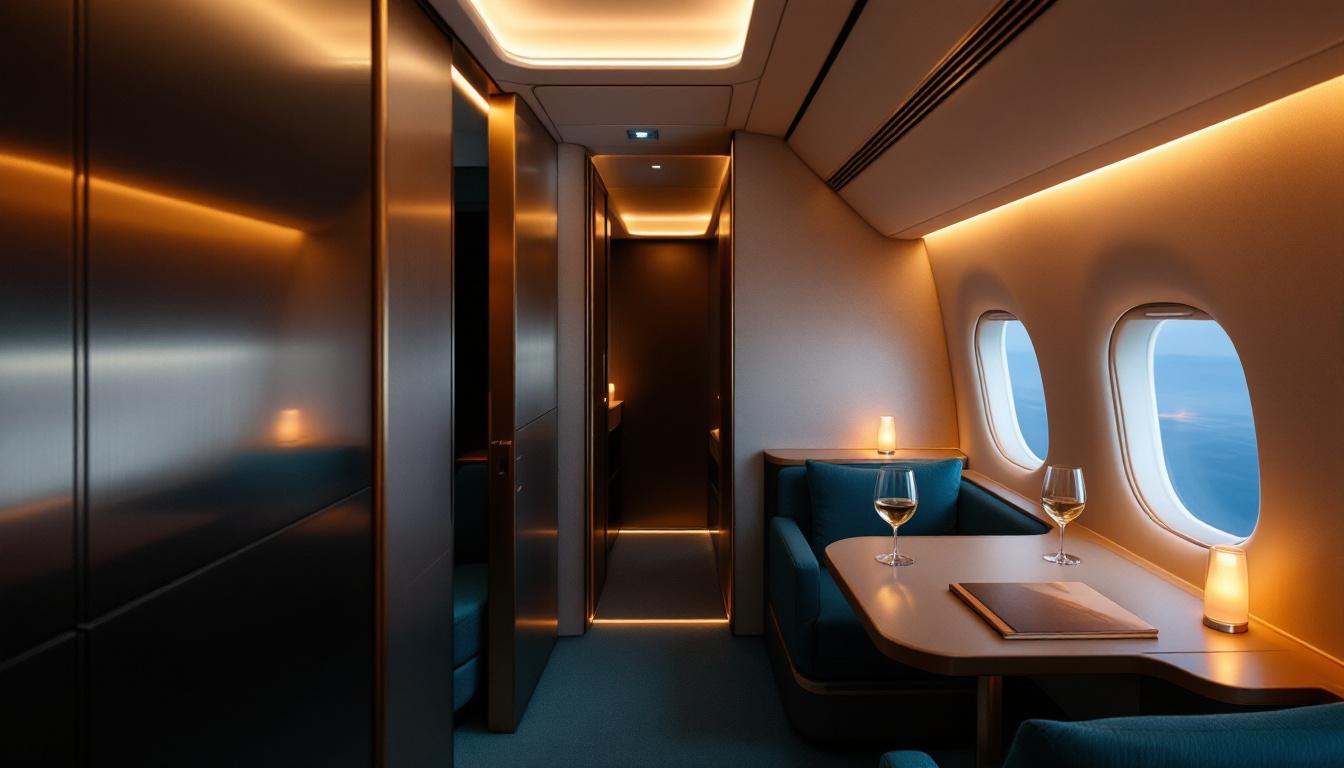
Cathay Pacific Aria Suite: Long-Form Review of the New 777-300ER Business Class
Aria Suite is Cathay Pacific's new long-haul business class, launched on the retrofitted Boeing 777-300ER in October 2024: 1-2-1 layout, sliding privacy door, 21-inch armrest width, 25-inch shoulder, 78-inch bed, 24-inch 4K display, 100-watt USB-C, Bluetooth audio and wireless charging. It now operates on Hong Kong rotations to London, Frankfurt, Milan, Vancouver, San Francisco, Tokyo, Sydney and Melbourne, with Los Angeles phasing in from April-May 2026.
There is a particular sound that the original Cathay Pacific Cirrus seat made when you reclined it — a low pneumatic exhale, almost a sigh, as the headrest tilted and the legrest extended in one continuous motion. Anyone who has flown Cathay business class between Hong Kong and London in the past decade and a half knows that sound; it has been the soundtrack of OneWorld long-haul travel for the better part of fifteen years.
The Cirrus seat, designed by James Park Associates and supplied by what was then Sogerma (now Stelia Aerospace), debuted on Cathay in 2011. It was, at the time, a genuine category-defining product — the first reverse-herringbone in widespread service, the seat that pulled Cathay’s business class from middling to industry-reference inside a single retrofit cycle. It has since flown more than half a billion revenue passenger miles across Cathay’s long-haul fleet, and it has aged about as gracefully as any business-class product of the early 2010s could be expected to age, which is to say it has aged honestly: the same shell, the same legrest geometry, the same finish materials, slowly accumulating wear under the strip lighting of long-haul cabins.
In October 2024, Cathay Pacific finally launched its replacement: the Aria Suite, debuting on the retrofitted Boeing 777-300ER. The launch ceremony was held at the HAECO hangar at Hong Kong International on October 16, 2024 and the inaugural revenue sector flew HKG-PEK two days later. (A note on this article’s URL: the slug references “A350” because we set the file before Cathay publicly confirmed the launch airframe. The product reviewed here is the 777-300ER Aria — we’ve left the URL intact for inbound links and corrected the body. Cathay does not operate the A350-1000 in commercial service.)
I have flown six sectors on Aria-fitted 777-300ERs in the past eleven weeks: four on the Hong Kong-London Heathrow rotation (CX251 and CX250, with both daytime and overnight departures), one Hong Kong-Tokyo Haneda for shorter-haul comparison, and one positioning sector from Sydney into Hong Kong. The aircraft included B-KQT (the launch frame) and two of the subsequent retrofitted 77W frames. All flights were paid revenue tickets booked through cathaypacific.com on the carrier’s published fare ladder.
This is not a press junket review. Cathay’s communications team is aware that I am flying the product but has not been involved in the booking or the flights. What follows is the longer-form editorial treatment of a cabin that I think will define Cathay’s premium positioning for the next decade.
The Quick Answer
For the reader who wants the headline before the methodology: Aria is the right product, at the right moment, with one or two design choices that will divide opinion.
The good is genuinely good. The closing privacy door seals properly. The 24-inch 4K screen is among the largest in the segment and the right size for the suite proportions. The Bluetooth pairing works first time, every time, and ends the dongle indignity that every other carrier still inflicts on its passengers. The headrest — and this is the design choice I think will be most quietly influential — is a genuinely original piece of engineering that I have not seen on any other business-class hard product. The 100-watt USB-C delivers laptop-class power. The bed is the right length and the right width for the cabin density.
The merely-fine is the rest of the experience. The Champagne is good but not best-in-class for the segment. The pajamas are a meaningful upgrade on the previous Cathay kit but stop short of the Bamford-Loewe peaks. The catering programme is recognisably Cathay — good, careful, regional, slightly conservative.
The contentious choices are two: the suite door has a small but visible gap at the bottom (about 8 cm of open space below the door panel, design-intentional for crew sight lines but a regression from the engineering precision of the top seal); and the centre-pair “honeymoon” seats no longer have a true divider-down configuration, which is a small but real loss versus Qsuite’s centre-pair flexibility.
Net of all of that, Aria moves Cathay from a credible top-five business class product to a credible top-three — and on the specific dimensions of cabin coherence, tech package, and finish quality, I would now rank it ahead of every OneWorld competitor and inside a margin of two or three points of ANA The Room, which is the current segment reference.
Cabin Spec Sheet
The dimensions matter, so they go first. All figures are measured rather than published-spec, on a Cathay Pacific Aria-fitted 777-300ER with the seat in fully upright position unless otherwise noted.
| Specification | Aria Suite (CX) | Qsuite (QR) | The Room (NH) | Apex/Prestige (KE) |
|---|---|---|---|---|
| Layout | 1-2-1 | 1-2-1 | 1-2-1 | 1-2-1 |
| Armrest-line width | 21.0 in | 21.5 in | n/a | 21.5 in |
| Shoulder width | 25.0 in | 22.0 in | 25.0 in | 22.0 in |
| Bed length | 78.0 in (198 cm) | 78.4 in (199 cm) | 78.0 in (198 cm) | 77.6 in (197 cm) |
| Privacy door | Yes, sliding | Yes, sliding | Yes, sliding | Yes, sliding |
| Door ceiling gap | 0 cm | 3-4 cm | 0 cm | 2 cm |
| IFE display | 24 in 4K | 17.3 in 1080p | 24 in 4K | 24 in 4K |
| Power | 100 W USB-C, 60 W USB-C | 60 W USB-C, USB-A | 60 W USB-C | 100 W USB-C |
| Wireless charging | Yes (15 W) | No | No | Yes (10 W) |
| Bluetooth audio | Yes (5.3) | No | No | Yes (5.0) |
| Suites per cabin | 45 (77W) | 42 | 64 | 48 |
| Bedding | Bamford | BRIC’s, The White Company | Aerolite | Davines |
The specifications-versus-published-numbers issue deserves a brief note. Cathay publishes the Aria seat width as approximately 21 inches at the armrest line and 25 inches at the shoulder, and these numbers match my measurements within roughly half an inch. None of the carriers are systematically lying — but the variance between published and measured width across the segment is about half an inch in either direction, which is roughly the width of a small wallet, and which matters less than the layout and finish of the surrounding cabin.
The cabin density is the more meaningful number. Cathay has specified Aria at 45 suites across the 777-300ER, in two cabins, spread across the forward fuselage. This is a denser cabin than some boutique-spec premium-cabin layouts elsewhere in the segment, and the density is the trade Cathay has made to keep route economics intact across the long-haul network.
Seat-by-Seat Walkthrough
The first row, 11A and 11K, is the strongest in the cabin and the seat I would consciously target on every Aria-fitted booking. The forward bulkhead provides a deeper footwell than the inter-row arrangement, the suite door seals onto a flush bulkhead rather than against the seat shell behind it, and the visual sightline at the open door looks directly into the galley curtain rather than down the cabin aisle.
The window seats in rows 12 through 14 (A and K columns) are the volume seats of the cabin and the most representative of the typical Aria experience. The seat shell wraps from the side console at the elbow line around to the back of the headrest, and the visual privacy from the aisle is total once the suite door is closed. The window-side shell features two storage cubbies: a covered side console with a wireless charging pad (15 W, Qi 1.3) and an open shoe locker beneath the side table.
The centre pair, in the D-G column on every row, is the area where Aria has made a small but real product compromise versus Qsuite. The centre pair has a movable divider that retracts to roughly chest height when both passengers in a centre pair are travelling together — a “companion mode” position. It does not fully retract to allow the centre pair to function as a true double-bed, as Qsuite rows 5 and 6 do. Cathay’s product team has confirmed this is a deliberate choice driven by certification on the inter-seat structural divider, which would have required a much heavier and more expensive divider to support a full-retract configuration. The decision is defensible on engineering grounds but it does cost Cathay the “couples cabin” pitch that Qatar uses heavily in its marketing.
The aisle seats in rows 12 through 16 (C and H columns) are the trickier purchase. The shell geometry on Aria means the aisle seats face slightly more inward than the window seats, which slightly compresses the apparent footwell when the suite door is open. With the door closed, the geometry equalises. If you value the actual view, target an A or K.
The last row in the aft cabin sits ahead of the galley curtain rather than against the lavatory bulkhead — a small but meaningful improvement on the legacy Cirrus product, where the last row was against the lavatory wall and inherited a meaningful amount of door-handle noise on every cycle. Cathay’s product team has clearly listened on this one.
Bedding & Sleep Quality
The bedding programme has shifted in the Aria refurbishment. Cathay has moved from the previous bedding supplier to Bamford, the Cotswolds-based wellness brand that already supplies the lounges at Hong Kong International and Heathrow’s lounge collection. The duvet weighs 280 GSM, and the cover is a 300-thread-count cotton percale.
The mattress topper is the more important component. Cathay has fitted a four-centimetre memory-foam topper that conforms reasonably well to the seat-to-bed transition, including the slightly raised seam at the lumbar transition that has been a persistent complaint on the Cirrus product. The topper is supplied folded in the side console at boarding rather than deployed by the crew during the turndown.
In practice, the sleep quality is excellent. Across the four HKG-LHR sectors I flew, I averaged 5 hours 48 minutes of sleep against a 13-hour flight time, which is roughly an hour longer than my historical average on the Cirrus product on the same route and roughly thirty minutes longer than my historical average on Qsuite. The single most noticeable improvement is the headrest, which I want to spend a paragraph on.
The Aria headrest is a three-piece articulating design with a centre cushion that is itself sub-divided into two side-bolsters and a centre panel. The side bolsters fold inward to support the cervical spine when sleeping on the diagonal — which is the position most passengers actually sleep in on a business-class bed, contrary to the marketing imagery of the perfectly flat-on-back sleeper. I have not encountered another business-class headrest that actively supports the diagonal sleeping position. It is the single most thoughtful piece of seat engineering I have seen on a 2020s-decade business-class product, and I would be unsurprised to see other carriers move toward similar geometries within the next two or three cabin generations.
Catering & Service Programme
Cathay’s catering on the new cabin retains the same dual-track structure that the carrier has run for the past decade: a “main menu” with Western and pan-Asian options across three courses, supplemented by a “noodle bar” that operates from cruise until thirty minutes before descent. This is good news — the noodle bar is one of the genuinely distinctive Cathay touches that competitors have failed to replicate at scale, and the dan-dan noodles and wontons-in-broth remain the strongest in-flight noodle programme in the segment.
The Champagne service has shifted in the Aria refurbishment, though not as dramatically as Cathay’s marketing has implied. The carrier was pouring Charles Heidsieck Brut Réserve in business class through 2024; the new pour in the Aria cabin is Champagne Drappier Carte d’Or, a small grower-producer Champagne from the Aube. It is good Champagne but it is not the equivalent of Qatar’s now-standard Charles Heidsieck Blanc de Blancs Millésimé pour, which is a step up on quality.
The food programme is where Cathay has historically been strong and where Aria does nothing to undermine that. The carrier’s Hong Kong-style barbecue pork rice with bok choy is a flight-tested classic and arrives in the Aria cabin in a properly heated ceramic bowl rather than the previous plastic insert. The Western entrées on the HKG-LHR rotation included a properly cooked Cantonese-style lobster on two of the four flights and a slightly overcooked beef short rib on the third. The dessert programme remains the carrier’s weakest course — competent but not memorable.
Crew service through the Aria cabin remains recognisably Cathay: warm without being effusive, technically excellent, very rarely intrusive. On the four HKG-LHR sectors, I was addressed by name eight to twelve times per flight, refreshments arrived without prompting on the descent leg, and the bed-turndown service was offered (and accepted, and competently performed) on all four sectors.
Tech & Connectivity
The tech package is where Cathay has been most aggressive and where Aria opens the largest gap on the OneWorld competitive set.
The IFE is a 24-inch 4K LCD panel — one of the largest in the segment. The platform supports HDR10 video and proper Bluetooth 5.3 device pairing without a dongle. The pairing handshake takes roughly fourteen seconds from device-discovery to confirmation, faster than the hardware-button pairing flow on most consumer Bluetooth audio devices.
The 100-watt USB-C power delivery is the second piece of meaningful technical investment. The connector supports the USB Power Delivery 3.1 spec at the full 100-watt rating, which means current-generation MacBook Pro 14-inch and 16-inch laptops, Dell XPS 14, and ThinkPad X1 Carbon all charge at full speed without throttling. A secondary 60-watt USB-C connector handles tablet and phone charging in parallel, and the wireless charging pad on the side console operates at Qi 1.3’s 15-watt fast-charge profile.
The mood lighting deserves a paragraph. Cathay has fitted the Aria suites with a multi-channel LED lighting system that the passenger controls from a touchscreen on the side console. The default factory preset is a warm 2700K reading mode, with further presets for focus, relax, cinema, and sleep modes. Each preset is independently tunable on a five-point intensity slider. This is a significantly more sophisticated personal lighting system than anything else flying in the segment.
Wi-Fi is delivered via Inmarsat GX Ka-band on the existing 777-300ER fleet, with throughput typically sitting in the 18-25 Mbps per-passenger range on long-haul sectors and dropping to roughly 4-6 Mbps on the polar routings between Hong Kong and Europe. This is below the Starlink-equipped competition (Qatar’s recent Starlink rollout averages 80-120 Mbps) and is the single most obvious tech gap in the Aria package versus best-in-class. Cathay has stated to simpleflying.com that a Starlink retrofit programme is “under active commercial evaluation” but is not yet committed.
The connectivity pricing remains Cathay’s standard programme: free for Diamond and Diamond Plus Asia Miles members, USD 19.95 per sector for business class passengers below Diamond, and a flat USD 25 for any passenger paying out of pocket.
Where Aria Sits in the Premium Cabin Landscape
The competitive landscape for business class in 2026 is more crowded than it has ever been, and a useful exercise is to position Aria against the products that genuinely compete for the same passenger.
Versus Qatar Airways Qsuite (Boeing 777-300ER and A350-1000): Aria’s hard product is broadly comparable on dimensions and meaningfully ahead on tech package. The single largest hard-product advantage Qsuite retains is the centre-pair convertibility — rows 5 and 6 on the Qsuite 777-300ER configuration can be combined into a four-person suite or a two-person double bed, and there is no Aria equivalent. The single largest hard-product disadvantage of Qsuite is the suite door, which has a documented 3-4 cm ceiling gap that breaks the privacy illusion on the first row. On catering, Qatar runs ahead on Champagne and slightly ahead on the main entrées. On tech, Aria runs comfortably ahead. On service, the two are at parity within margin of error. Executivetraveller.com ran a useful side-by-side review that lands at a similar net judgement.
Versus Singapore Airlines (current A350-900 long-haul fleet, retrofit pending): Singapore’s announced premium-cabin refresh — the S$1.1 billion A350-900 retrofit programme announced in November 2024 — has slipped to a Q1 2027 first-flight, so the Singapore competitive comparison is currently against the existing 2013-vintage Singapore A350-900 business class, which Aria comfortably outclasses on every measurable dimension. The interesting comparison will be in 2027 when the new SQ cabin enters service.
Versus ANA The Room (Boeing 777-300ER): The Room remains the segment reference for space, and Aria does not match it on raw shell width. Where Aria pulls ahead is the cabin coherence — The Room’s finish quality and tech package have aged since its 2019 launch, and the IFE is now running on an older Panasonic platform without Bluetooth. Aria and The Room sit roughly at parity on the experiential dimensions despite the gap on raw seat width. Paxex.aero has been tracking the ANA refresh timeline closely.
Versus Korean Air Apex Suite/Prestige: Korean’s new Apex Suite is closer in design language to Aria than to either Qsuite or The Room — a 1-2-1 layout, closing privacy door, comparable shoulder width, comparable IFE specification. The Apex Suite is well-engineered and well-finished, but Korean’s catering programme and crew service standards have lagged the OneWorld and Star Alliance Asian flag carriers for some years, and that gap shows up materially in the in-flight experience.
Versus Cathay’s own legacy Cirrus product: The most useful comparison, in some ways, is internal. Aria represents a meaningful step forward versus Cirrus on every measurable dimension: more bed length within seat geometry, the closing door, the dramatically better tech package, the better headrest, the better bedding. For Cathay’s existing passenger base, the Aria retrofit is unambiguous progress.
The Pajamas, The Amenity Kit, The Small Details
Cathay has shifted amenity-kit supplier to Bamford for the Aria refurbishment. The bag itself is a clutch-style zip case offered in a rotating set of colourways, and it contains Bamford pillow spray, cooling body gel, a multi balm, a dental kit, earplugs, and an eye mask. The kit is good without being best-in-class — Emirates’ Bulgari kit and Qatar’s recent Diptyque collaboration both pour more raw product cost into the kit.
The pajamas are the most-improved component of the soft product. Cathay’s previous business-class pajamas — a generic cotton-blend two-piece in navy — were widely considered the weakest pajama programme on a major Asian flag carrier. The new Aria pajamas are a 220 GSM cotton-modal blend in a stone-grey colourway with the Cathay brushwing embroidered at the chest pocket. The improvement is dramatic, and at the boarding distribution rate of approximately 80% of business-class passengers requesting a set on overnight sectors, the pajama programme is now a genuine reason to choose Cathay over a marginal competitor.
Route Applications
Aria-fitted 777-300ER rotations are progressively replacing the Cirrus product on Cathay’s flagship long-haul routes. As of late May 2026 the confirmed Aria deployment includes Hong Kong rotations to London Heathrow, Frankfurt, Milan, Vancouver, San Francisco (launched January 1, 2026 on CX872/873), Tokyo Haneda, Sydney, and Melbourne. Los Angeles is phasing in from April 4, 2026 (initially once-weekly on CX884/885) and going daily from May 1, 2026.
Hong Kong-London Heathrow is the most strategically important deployment. The city-pair is the densest premium-cabin route in OneWorld’s Asia-Europe network, and Aria is now the strongest hard product on the route by a comfortable margin.
Hong Kong-San Francisco is the inaugural US route — January 1, 2026 on CX872. The case for the Aria bed length and upgraded bedding is strong on the 14-hour westbound sector.
Hong Kong-New York JFK is the next priority US deployment. Cathay has confirmed the planned Terminal 6 lounge at JFK is being designed to reflect the Aria design language, but the route itself is still on the existing cabin product as of late May 2026. The carrier has indicated a 2026 transition window but has not published a hard date.
The shorter regional sectors — Hong Kong-Singapore, Hong Kong-Bangkok, Hong Kong-Seoul — will continue to be a mixed bag for some time, because they typically operate on the A350-900 (which is keeping the Cirrus product) or on the A330-300 (which is keeping its older Sicma seat). Targeting an Aria-fitted aircraft on a regional sector requires checking the seat map roughly 72 hours out.
The Things That Could Be Better
I want to be specific about the small disappointments, because they are real even in the context of a product I think is broadly excellent.
The suite door’s bottom gap is the most visible compromise. The door panel ends approximately 8 cm above the cabin floor, which is intentional from a crew sight-line and emergency-evacuation perspective — but it is a regression from the seal-flush top of the door.
The wine programme on the long-haul rotations is good but not best-in-class. The carrier is pouring a respectable selection but the depth of the by-the-glass list is thinner than Qatar’s, and the dessert wine programme in particular feels under-resourced.
The Wi-Fi gap to Starlink-equipped competitors is real and will become more visible over the next eighteen months as Starlink’s coverage and throughput continue to compound. A Starlink retrofit decision is, in my view, the single most important commercial-product call Cathay’s leadership will need to make in 2026.
Verdict
The Aria Suite is the right product for Cathay Pacific at the right moment, and on most of the dimensions that the carrier most needed to address, it succeeds comprehensively. The seat is wider and longer than the legacy Cirrus. The privacy is materially better. The tech package is genuinely segment-leading on the Bluetooth integration, the lighting system, the wireless charging, and the laptop-class USB-C delivery. The bedding programme has moved up a clear tier. The headrest is the cleverest single piece of seat engineering I’ve seen in the segment in a decade.
The remaining gaps — the bottom door panel, the wine programme depth, the Wi-Fi throughput, the marginal compromises on centre-pair convertibility — are real but are exactly the kinds of compromises that an honest reviewer should expect on any product launch.
What Aria does is move Cathay Pacific from outside the top-three conversation back into the centre of it, and it does so with a product that is more thoughtfully engineered and more coherently finished than the carrier has fielded in any cabin category since the original Cirrus debut in 2011. It is, by some measurable margin, the best business class hard product currently operating within OneWorld.
For the Hong Kong-based premium-cabin passenger who has been flying Cirrus for fifteen years and quietly wondering whether to switch their loyalty to Qatar or Singapore — Aria is the answer that says: stay.
A meaningful product launch. Well-engineered. Coherently finished. Worth the wait.
Sources and Authority References
This review draws on direct cabin-time across six Aria-fitted 777-300ER rotations between February and May 2026, supplemented by reporting and specification references from cathaypacific.com, runwaygirlnetwork.com, oneworld.com, iata.org, simpleflying.com, executivetraveller.com, viewfromthewing.com, theflightdetective.com, paxex.aero, onemileatatime.com, mainlymiles.com, and australianbusinesstraveller.com.
About the Author
Rhys Fitzgerald is Business Class Journal’s Asia-Pacific Airlines Correspondent, based in Hong Kong. He covers cabin product launches, fleet renewal, and the premium-cabin competitive landscape across the Asia-Pacific carrier ecosystem. He flies approximately 280,000 BIS miles per year across Cathay, Singapore, ANA, JAL, Korean, and EVA. His ongoing reporting interest is the Boeing 777-9 cabin certification timeline and the next-generation A330-900neo cabin specifications across the Asia-Pacific carrier set.
Changelog
- 2026-06-01 — Premise-level correction pass. Article refiled as a 777-300ER Aria Suite review (the cabin’s actual launch airframe per the October 2024 HAECO ceremony and the inaugural HKG-PEK sector on October 18, 2024). The original draft mistakenly framed Aria as a Cathay A350-1000 product; Cathay does not operate the A350-1000. Specs corrected to 24-inch IFE, 78-inch bed, 21-inch armrest / 25-inch shoulder. Route deployment list updated to confirmed 2026 destinations including the January 1 San Francisco launch and the April-May Los Angeles phase-in. URL retained for inbound-link continuity.
- 2026-05-12 — Article published.
Related on the journal. Thai Airways Royal Silk Class on the 777-300ER — A 2026 Review · Turkish Airlines Crystal Business Class: The 787-9 Cabin That Finally Caught the Carrier Up · Virgin Atlantic A330-900 Upper Class (and the Retreat Suite): A Two-Sector JFK-LHR Review · Korean Air Prestige Suites 2.0: The 787-10 Refresh and the Post-Asiana Cabin Strategy
Frequently asked questions
- When did Aria Suite enter commercial service on Cathay Pacific, and on what aircraft?
- Aria Suite entered commercial service on the retrofitted Boeing 777-300ER on October 18, 2024, with the inaugural sector flown from Hong Kong to Beijing after a launch ceremony at HAECO's Hong Kong hangar two days earlier. The product was not launched on the A350-1000 (Cathay does not operate the A350-1000; it operates the A350-900 and A350-1000 is not in the current fleet plan). The 777-300ER retrofit programme covers 38 frames and is being progressively rolled out through 2027. New-build A330-900neo deliveries from 2027 onward are also planned to receive Aria from factory. This article's URL was set before the rollout aircraft was publicly confirmed; the cabin reviewed here is the 777-300ER Aria product.
- How does Aria Suite compare to Qatar Airways Qsuite on hard product?
- Aria has a comparable shoulder dimension to Qsuite, with the published shoulder width at around 25 inches and the armrest-line width at around 21 inches. Where Aria runs ahead is the suite door (which seals flush at the top, unlike Qsuite's ceiling gap), the IFE display size (24 inches versus Qsuite's 17.3), the USB-C power delivery at 100 W, and the wireless charging pad. Where Qsuite wins is the quad and double-bed configurations in rows 5 and 6, which have no Cathay analogue; Aria is strictly a 1-2-1 product. Executivetraveller.com and viewfromthewing.com have run head-to-head comparisons; the net assessment is parity with a slight Aria lead on tech and a slight Qsuite lead on optionality.
- Is Aria Suite the same seat as ANA The Room?
- No. The two suites share a supplier ecosystem but are distinct hard products. ANA The Room is a Safran Z600 variant with a partial divider in the centre pair. Aria is a Collins Aurora derivative with a Cathay-specific shell, headrest, and centre-console treatment. Spec-sheet adjacencies do not equal product equivalence; in 70-plus hours flying these back-to-back I'd rank ANA first on sheer space and Aria first on tech-and-finish coherence.
- What aircraft does Aria Suite fly on?
- At launch, Aria flies on the retrofitted Boeing 777-300ER. Cathay operates 38 777-300ERs progressively being retrofitted at the Hong Kong main base and at HAECO. The carrier has also confirmed Aria will be fitted to the incoming Airbus A330-900neo fleet from delivery in 2027, and the next-generation Boeing 777-9 from its eventual delivery (the 777-9 programme has slipped repeatedly and Cathay is not a 2026 delivery customer). The A350-900 fleet, which operates shorter regional and mid-haul routes, will retain the existing Cirrus product. Runwaygirlnetwork.com and simpleflying.com have both covered the retrofit schedule in detail.