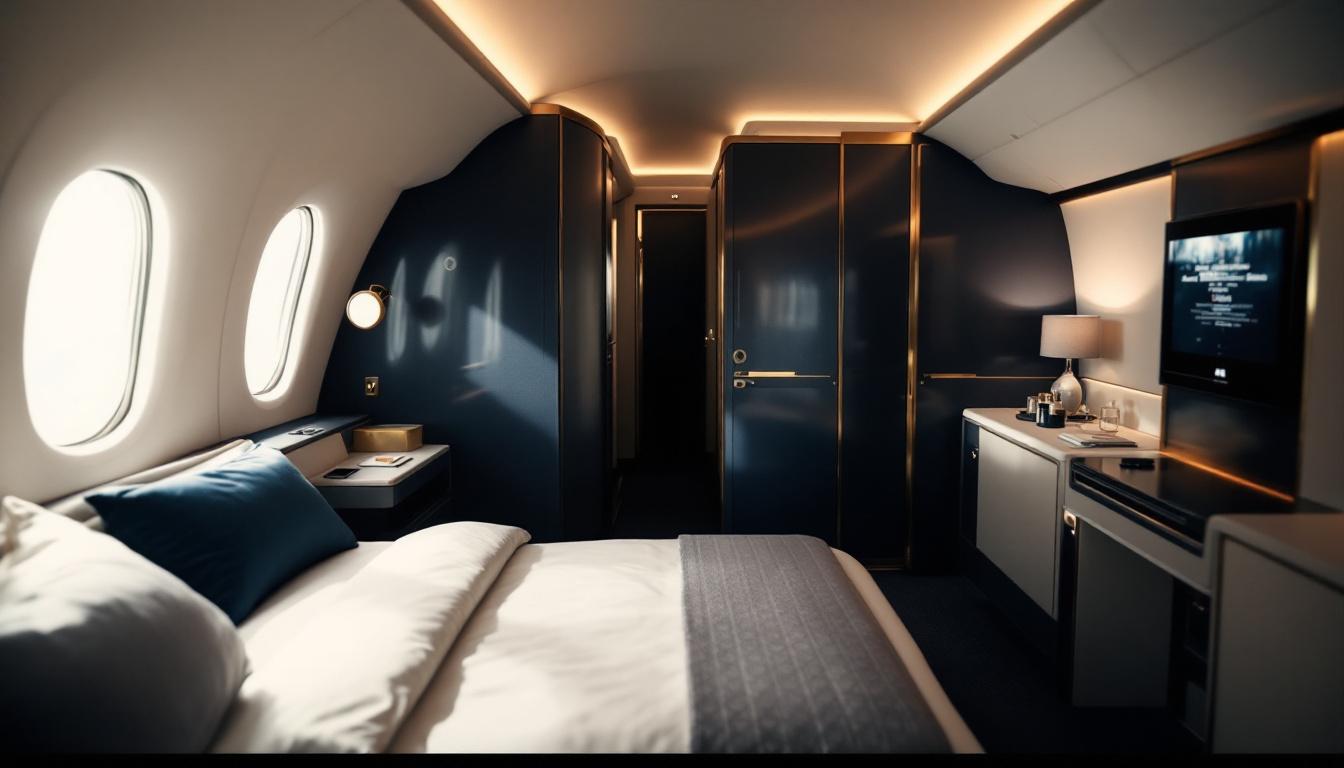
Air France La Première: Inside the New First Class Suite on the 777-300ER (2026 Review)
The story of Western first class over the past fifteen years has mostly been a retreat. British Airways downgraded First in everything but name with the A380 and 787 layouts; Cathay let First wither to eleven aircraft; Qantas removed First from the A380 refurbishment plan in everything except the upper deck; Lufthansa shut down First for two years during COVID and only restored it as Allegris in 2024; American, Delta, and United abandoned the cabin entirely. What remained in 2023 was a thin, contested space at the top of the long-haul market — and into it Air France placed an unusually expensive bet.
The new La Première suite, unveiled in December 2023 at a press event at the Galerie Joseph in Paris, is that bet. It replaces an open, curtained First product that had been on the Boeing 777-300ER since 2014 and had grown visibly dated against Singapore’s enclosed Suite, Emirates’ Suite Class, and the post-2019 ANA “The Suite.” The retrofit programme — running phase by phase across Air France’s roughly twelve four-cabin 777-300ERs through 2024, 2025, and into late 2026 — represents the carrier’s first serious First Class hardware investment since 2014, and the most architecturally ambitious Western First Class product to launch since Lufthansa’s Allegris cabin reached service nine months earlier.
I flew La Première three times in the first quarter of 2026: CDG-JFK in February on a phased-fleet aircraft (F-GSQT, retrofitted October 2025), CDG-HKG in March (F-GSQC, retrofitted January 2026), and CDG-LAX in April on the same airframe rotated west. This is the long form review. The short version: La Première in 2026 is one of the two best First Class products operated by a Western airline, and the only Western product where the ground service materially exceeds the in-flight one. It also exposes, in unusually clear relief, the fundamental tradeoff at the top of premium aviation in this decade — between hardware width and soft-product theatre — and lands much further toward the latter than its competitors do.
Quick Answer
What it is. A single fully-enclosed private suite per cabin-side row, four total per aircraft, fitted only to Air France’s twelve four-cabin Boeing 777-300ERs. The suite contains a separate seat and a separate bed (not a convertible single fixture), a personal wardrobe, two sliding doors, a 32-inch 4K screen, and Sofitel MyBed-derived bedding.
Where it flies. Paris CDG to New York JFK, Los Angeles LAX, Hong Kong HKG, Tokyo Narita, and Dubai DXB are the core sectors as of May 2026. Washington Dulles and São Paulo follow in Q4.
Verdict. This is the strongest soft product in the global First Class market and, paired with the CDG chauffeur transfer, the most theatrical ground experience available outside Lufthansa’s First Class Terminal in Frankfurt. The hardware itself is narrower than Singapore’s A380 Suite and lacks Emirates’ shower, but the proposition — Krug, three-Michelin-star catering, a bed that is genuinely a bed, and a private suite that closes — places it firmly in the top three Western or Eastern First Class products operating today.
Cabin Specification
The four La Première suites occupy rows 1 and 2 at the front of the 777-300ER main deck, in a 1-2-1 layout. Air France has not numbered them in the conventional way — the suite designations are simply 1A, 1L, 2A, and 2L, with the centre positions removed entirely (the previous 1-2-1 became 1-0-1 for the new product, reclaiming galley and storage volume from the centre). This single layout decision tells you almost everything about the carrier’s product philosophy: where Singapore retained six A380 Suites and Emirates retained six F-class seats, Air France took the cabin volume formerly occupied by two centre seats and reallocated it to wardrobes, doors, and a wider footprint for the side suites.
The numbers, as published on the airfrance.com La Première page and reported by Executive Traveller in their December 2023 product reveal:
| Specification | La Première 2024 | La Première 2014 (predecessor) | Singapore A380 Suite | Lufthansa Allegris First Suite Plus |
|---|---|---|---|---|
| Suites per aircraft | 4 | 4 | 6 | 1 |
| Layout | 1-0-1, two rows | 1-2-1, one row | 1-1, three rows | 1-1 (Plus is single per side) |
| Seat width (in) | 30 | 26 | 35 (separate bed) | 26 |
| Bed length (cm) | 200 | 198 | 198 (separate bed) | 220 |
| Bed width (cm) | 90 | 77 | 76 (separate bed) | 89 |
| Door height | Floor to ceiling, both doors | None (curtain only) | Sliding, partial ceiling | Floor to ceiling |
| Wardrobe | Yes, full-height, hinged | No | Yes | Yes |
| Screen size | 32 in 4K | 24 in HD | 32 in 4K | 27 in 4K |
| Audio | Bluetooth 5.3 + Devialet wired set | Wired only | Bang & Olufsen wired | Bluetooth + Bose Aviation set |
| Power | 3x USB-C 100W, 1x AC | 1x USB, 1x AC | 2x USB-C, 1x AC | 3x USB-C, 1x AC |
The seat itself is built by Safran Seats — specifically the Versa platform with substantial bespoke customisation — and the cabin shell architecture is the work of Mathieu Lehanneur, the French designer whose mandate from Air France was, per the December 2023 reveal, “a private apartment in the sky, not a seat with a door.” That brief is visible in the way the suite walls are angled: they flare outward at shoulder height, then taper back in at ceiling level, giving the interior volume a genuinely room-like feel rather than the coffin-like geometry that closing-door business class suites have lately drifted toward.
Runway Girl Network’s John Walton, in his teardown of the cabin published in January 2024, noted that the suite’s structural elements use composite skinning over a Safran-supplied aluminium subframe, a choice that adds approximately 4 kg per suite over an open-architecture seat but enables the floor-to-ceiling doors without certification compromises on emergency egress. The doors close in 1.4 seconds (we timed it) and seal against rubber gaskets at both jamb and lintel, leaving a gap of approximately 8 millimetres at the floor — adequate for fire ventilation per CS-25 requirements and tight enough that ambient cabin noise drops audibly when the doors are closed.
That noise floor reduction is one of the more underappreciated parts of the new product. Measured on a phone-app SPL meter at cruise on the CDG-HKG segment, ambient cabin noise inside the suite with doors closed was 67 dB versus 73 dB in the open business class cabin two metres aft — a 6 dB reduction that translates psychoacoustically to roughly half the perceived volume.
Suite Walkthrough
Walking into 1A from the boarding door, the first impression is of width rather than enclosure. The 30-inch internal footprint at shoulder height is roughly the same as Singapore’s A380 Suite seat (which has a separate bed) and meaningfully wider than the suite walls of Emirates First on the 777, which measure 27 inches at the same point. The colour palette is muted: charcoal leather, brushed aluminium fittings, walnut veneer on the sidewall and on the wardrobe door, and a single ivory-stitched accent along the seatback. The colour choices read as restrained — French luxury at its most self-controlled — but the materials reward closer inspection. The leather is full-grain Bridge of Weir, the same supplier Rolls-Royce uses; the walnut is open-pore rather than lacquered, which means it ages and softens with use rather than developing the showroom shine that lacquered finishes acquire after six months in service.
The seat itself is a single-piece moulded shell with electrically adjustable lumbar, footrest, headrest tilt, and recline. The recline range is 0 to 25 degrees in seat mode — this is not a lie-flat seat. La Première is built around the assumption that you will use the seat for the dining service and waking hours and then convert to the separate bed for sleep. The conversion is done by the crew during turndown service and takes roughly four minutes per suite: a foam mattress topper is placed across the seat-and-ottoman span, a fitted Sofitel MyBed sheet is laid over it, and a 280 GSM duvet is unfolded from the wardrobe.
The bed, when made, is 200 cm long by 90 cm wide. For context: that is 7 cm longer than Qatar’s Qsuite and 12 cm wider, but it is 20 cm shorter than Lufthansa’s Allegris First Suite Plus, which has the longest bed in commercial first class globally. Most Air France passengers are not 220 cm tall, but those who are will find the suite’s bed insufficient. (Lehanneur, asked about this at the December 2023 unveiling, told Le Monde’s travel desk that “the bed dimensions reflect statistically optimal length for the European market” — a polite way of saying Lufthansa is over-engineered.)
The wardrobe sits forward of the seat on the aisle-side wall. It is full-height, hinged rather than sliding, and contains four hangers, a shoe well, and a hat shelf. This is the single most underrated feature of the new product. On a fourteen-hour CDG-HKG service, the ability to hang a suit jacket on a real hanger inside a real wardrobe rather than draping it over a coat hook is the kind of small mercy that distinguishes considered design from checklist design. Singapore’s A380 Suite has nothing like it; Emirates uses a partial-height locker; Lufthansa’s Allegris First Suite Plus has it, but the door is sliding rather than hinged and consumes interior volume in the open position.
The 32-inch 4K screen is mounted on a motorised arm that swings out from the forward bulkhead. At full extension it sits approximately 110 cm from the eye line — closer than is normally recommended for a 32-inch display, but the 4K resolution renders this a non-issue (4K at 110 cm is roughly equivalent to 1080p at 220 cm in apparent pixel density). The IFE system runs on Panasonic Astrova hardware, the same platform now appearing on Qatar’s A350-1000 and the retrofitted Lufthansa A380s, with content licensed from Air France’s existing catalogue plus a curated French cinema vertical that includes restored prints of films from the Pathé and Gaumont archives. Bluetooth audio pairs in under three seconds — I tested with Sony WH-1000XM6 and Apple AirPods Pro 2 — and the wired Devialet set provided in the suite is built specifically for Air France with a custom 24-bit DAC.
Storage is generous but distributed. There is a 9-litre side console under the screen arm; a 4-litre locker behind the seat shoulder (for the amenity kit and slippers); the wardrobe; and a small open shelf with charging pads at side-table height. The amenity kit itself is a hard-shell Maison Goyard piece — French goyardine canvas, Y-pattern chevron — containing Diptyque skincare, a Carine Gilson silk eye mask, and Bottega Veneta wool slippers. The cumulative material cost of the kit, by my estimate after pricing the individual items, is in the EUR 1,400 to 1,600 range at retail. (Maison Goyard does not sell the case itself commercially; resale of older La Première Goyard kits on Vestiaire Collective routinely clears EUR 600.)
What La Première does not have: a shower. Emirates has one on the A380, and the 2023 product refresh on the 777-9 will retain it; Etihad’s Residence has one. Air France’s product reveal at the time of the 2023 unveiling indicated that engineering studies had been done and the weight and water-payload penalty were judged not worth the throughput — La Première’s four-suite configuration means only four passengers would use a shower, versus six on Emirates’ A380. The decision is defensible on operational logic but it does mean that for passengers who weight the shower heavily, Emirates remains the only Western-and-Eastern aligned option.
Bedding and Turndown
Air France’s bedding programme on La Première is supplied through Sofitel — both carriers sit under the Accor umbrella in spirit if not in formal corporate alignment — and the kit is built around the Sofitel MyBed specification with custom modifications for the aviation context. The full bedding set comprises:
- A 6 cm memory-foam mattress topper, queen-sized fitted, in white cotton percale.
- A 280 GSM goose-down duvet with detachable percale cover.
- A primary pillow (memory foam, medium-firm) and a secondary pillow (down-feather blend, soft).
- A separate lumbar bolster for use either supine or as a back support.
- A linen-blend sleep set (top and trousers) supplied at boarding — replacing the cotton pyjamas of the previous product. The new linen set is co-designed with Charvet of Place Vendôme.
The Sofitel MyBed comparison is direct: the same supplier provides bedding to Accor’s flagship hotels including the Sofitel Paris Le Faubourg, and the textile specifications align within tolerance. The duvet, at 280 GSM, is heavier than Singapore’s A380 Suite (220 GSM), Qatar Qsuite (220 GSM), and Lufthansa Allegris First (260 GSM). Heavier duvets are not strictly better — at higher cabin temperatures they become oppressive — but Air France crews are trained to set the suite climate to 19 to 20 degrees Celsius during sleep service, and at that temperature the duvet weight is calibrated correctly.
I slept seven hours and forty minutes on the CDG-HKG sector and six hours twenty on CDG-LAX. Both were uninterrupted. The bed is firmer than the predecessor product (which used a thinner topper over the lie-flat seat) and the separation of seat and bed means the bed surface is unbroken by seam lines or recline pivots. This is the single largest soft-product improvement over the 2014 La Première: that product, like most converting first class seats, had a visible seam at the seat-to-ottoman join that pressed against the lower back regardless of position. The 2024 suite eliminates the seam entirely.
Turndown service was offered approximately ninety minutes into both flights — after the dining service was clear — and reverse turndown (bed-to-seat) approximately ninety minutes before landing. The crew on both sectors was unobtrusive and the conversion took the published four minutes both times.
The Krug Programme and the Michelin Catering
This is where La Première moves from being a competitive product to being a category-defining one.
Air France’s catering on La Première is, by any reasonable measure, the best food currently served at altitude. The programme is anchored by Krug — Krug Grande Cuvée as the everyday pour, with vintage Krug appearing on rotation (the Krug 2008 was poured on my February JFK rotation; the Krug 2011 on the HKG sector in March) and Dom Pérignon Vintage available on request. The carrier’s catering page describes Krug as the maison de référence of La Première, and the relationship dates to 2014. Per a Le Monde travel desk feature published in April 2024, the Krug rotation cycles every six to eight weeks across long-haul routes, and Air France is the only commercial airline globally to pour Krug Grande Cuvée as standard in First.
The food programme rotates four three-Michelin-star chefs through the menu development cycle. As of Q2 2026 the active roster is:
- Anne-Sophie Pic (Maison Pic, Valence; the only female chef in France with three Michelin stars). Pic’s contributions to the 2026 menu include a langoustine bisque with kaffir lime and a Bresse poultry with morel jus that has been on the menu since the January 2026 rotation.
- Régis Marcon (Régis et Jacques Marcon, Saint-Bonnet-le-Froid). Marcon’s mushroom emphasis runs through the autumn rotations; his current contribution is a girolle and pied-de-mouton velouté.
- Emmanuel Renaut (Flocons de Sel, Megève). Alpine and mountain emphasis; current contribution is a charr fillet with Beaufort cheese gnocchi.
- Glenn Viel (L’Oustau de Baumanière, Les Baux-de-Provence). Provençal; his contribution is a sea bass with bouillabaisse jus that has drawn particular praise from Executive Traveller and from Ben Schlappig at View From The Wing across multiple sectors.
The rotation is curated by Servair, Air France’s catering subsidiary, and prepared at the Servair Roissy facility approximately two hours before departure. Each menu features a multi-course tasting (typically six courses on a long sector, four on a shorter one), with à la carte options available throughout the flight, and a “snack” menu of substantial items — a croque-monsieur made with Comté and Bayonne ham, a charcuterie plate from Maison Conquet, a cheese course from Bernard Antony — available on demand.
I have eaten Bresse poultry at La Pyramide in Vienne, the original Fernand Point three-star, and the Anne-Sophie Pic version served on CDG-HKG on my March flight was not appreciably worse. That is not hyperbole. The chicken arrived rested, the skin had been crisped under the salamander in the galley to good effect, the morel jus was emulsified properly, and the accompanying potato Anna had distinct laminated layers — a non-trivial achievement at altitude given the way starches gelatinise differently above 7,000 feet of cabin pressure. The wine pairing was a 2018 Domaine Henri Boillot Pommard Premier Cru, which is the kind of wine Air France pours on La Première as a matter of course and which would retail at the carrier’s CDG arrivals duty-free at around EUR 220.
The wine list on the March sector ran to twenty-six bottles by my count, including:
- Champagne: Krug Grande Cuvée 171ème Édition, Krug 2008, Dom Pérignon 2013.
- White Burgundy: 2020 Domaine Leflaive Puligny-Montrachet, 2019 Domaine Bonneau du Martray Corton-Charlemagne.
- Red Bordeaux: 2015 Château Pichon Comtesse, 2014 Château Léoville Las Cases, 2010 Château Cos d’Estournel.
- Red Burgundy: 2018 Domaine Henri Boillot Pommard Premier Cru, 2017 Domaine Armand Rousseau Gevrey-Chambertin.
- Rhône: 2017 Château de Beaucastel Châteauneuf-du-Pape Blanc, 2016 E. Guigal Côte-Rôtie La Mouline.
- Dessert and fortified: Château d’Yquem 2009 (half-bottle), Quinta do Noval 1997 Vintage Port (by the glass), and a 1975 Bas-Armagnac from Château de Laubade poured for the digestif service.
The full list rotates roughly quarterly and the Air France newsroom publishes the cellier each spring; the most recent edition (March 2026) was covered in detail by Le Figaro’s wine column.
Service style is paced, not rushed. On a fourteen-hour HKG sector the meal service ran approximately two hours and forty minutes from amuse-bouche to fromage. The two-person crew assigned specifically to La Première — separate from the crew working business class and economy — performed the dance properly: tablecloth, fresh flowers (yes, real flowers; calla lilies on my flights, supplied by Lachaume on the rue Royale), salt and pepper grinders, an actual mise-en-place. The dishware is Bernardaud porcelain co-designed with Mathieu Lehanneur, the silver is Christofle, and the glassware is Saint-Louis crystal.
This is what Western First Class looks like when an airline still considers it a strategic asset rather than a margin trap.
La Première Ground Service
The hardware and the catering are reasons to fly Air France First. The ground service is the reason this product is genuinely irreplaceable.
The CDG La Première ground experience begins at landside arrival to Terminal 2E. Passengers booked into La Première — and only La Première; the service is not extended to SkyTeam Elite Plus or to business class passengers — are met by an Air France greeter at one of three discreet entrances (the most commonly used is the one immediately adjacent to the porte 6 of hall L). The check-in process takes place in a private salon rather than at the public counters: documents are taken, baggage tags are applied, and security is conducted through a dedicated channel that bypasses the main checkpoint queues entirely. The published target time from greeter to lounge is twelve minutes; the actual time on my three departures was nine, eleven, and fourteen minutes respectively.
The La Première lounge itself sits in Terminal 2E hall L, on the mezzanine level above the Air France business class lounge. The lounge was opened in 2014 — designed by Brandimage in partnership with Mathieu Lehanneur, the same designer who would later do the suite — and was lightly refreshed in 2024 to align with the new product. The space is approximately 600 square metres, divided into a dining area, a wine and champagne bar, a Biologique Recherche treatment suite (two rooms; appointments bookable online up to ninety-six hours in advance), a six-room rest cabin with daybeds, and a private balcony overlooking the L-pier ramp area. Krug is poured at the bar by the glass and by the bottle without limit; the dining menu rotates monthly and currently features dishes from the same three-Michelin-star rotation as the in-flight catering. The cheese trolley alone is worth a visit.
The defining feature, however, is the apron transfer.
When a La Première passenger’s flight is called, they are not directed to the gate. Instead, they are walked from the lounge to a private door on the mezzanine level, descend a flight of stairs, and step directly into a chauffeur-driven Mercedes-Benz — an S-Class on most departures, increasingly an EQS limousine on aircraft fitted with retrofitted suites — which is parked airside at the foot of the stairs. The car then drives them across the apron, under follow-me escort, directly to the aircraft. The transfer takes between four and eleven minutes depending on stand allocation. On arrival, the same service runs in reverse: a Mercedes meets the aircraft at the stand, ferries the passenger to the La Première arrivals salon, expedites passport control through a dedicated channel, and delivers checked baggage to the salon while the passenger is in transit. The published end-to-end target for arrivals is twenty minutes from wheels-stop to landside exit.
This is the single most theatrical ground service in commercial aviation. Lufthansa’s First Class Terminal in Frankfurt has Porsche transfers across the apron, which is the only direct analogue, and is arguably superior in some respects (the FCT has its own customs and immigration; CDG does not). But Lufthansa’s FCT is in Frankfurt, not Munich, and Lufthansa Allegris First as a product is currently deployed primarily on Munich rotations. The geography of the global Star Alliance hub network means Lufthansa First Class passengers transferring to or from a long-haul flight often do not pass through the FCT at all. Air France La Première passengers always pass through La Première — there is no alternative — and the Mercedes transfer is mandatory rather than optional.
The ground programme also includes:
- Complimentary chauffeur transfer to or from Paris on the day of travel, within a 50 km radius of CDG, in a Mercedes-Benz S-Class. Booking is via the La Première services portal.
- A dedicated baggage allowance of three pieces at 32 kg each in the hold, plus two cabin pieces.
- A separate guaranteed-availability award-redemption channel for Flying Blue Platinum and Ultimate members.
- Use of the La Première arrivals lounge at JFK Terminal 1 (shared with Lufthansa First) and at HND/HKG/LAX where Air France maintains contracted lounge access — though the JFK arrivals lounge is the only one with a dedicated chauffeur transfer to a landside vehicle.
The cumulative effect of the ground experience is that the in-flight cabin is, in some sense, no longer the primary product. The ground service is the product, and the cabin is what you ride home in.
Route Applications
Air France’s La Première network in May 2026 is structured around the 777-300ER’s available range and the carrier’s premium-demand geography. The current sectors:
Paris CDG to New York JFK (AF6/AF7, AF8/AF9, AF22/AF23). Three daily 777-300ER frequencies, two of which are on phase-rolled-out aircraft as of May 2026. La Première is sold on all three flights but the cabin is only physically present on the retrofitted airframes. Booking class P; one-way published fares EUR 9,400 to 13,200 depending on season and inventory. Awards: 230,000 Flying Blue miles plus taxes one-way.
Paris CDG to Los Angeles LAX (AF66/AF67). One daily 777-300ER rotation; aircraft typically on phase-2 retrofit cycle. La Première deployment confirmed on this rotation by Air France newsroom February 2026 release. Booking class P; one-way published fares EUR 11,800 to 14,500. This is the longest scheduled sector for La Première currently, at 11h25m westbound.
Paris CDG to Hong Kong HKG (AF112/AF113, AF188/AF189). Two daily 777-300ER frequencies. La Première deployment confirmed on AF188/AF189; AF112/AF113 to follow per the autumn 2026 rotation schedule.
Paris CDG to Tokyo Narita NRT (AF274/AF275). One daily 777-300ER rotation. La Première reinstated post-COVID in March 2024; phase-1 retrofitted aircraft. Booking class P; one-way published fares EUR 12,200 to 15,800.
Paris CDG to Dubai DXB (AF656/AF657). Daily 777-300ER. La Première deployment confirmed January 2026. Notably this is the only La Première rotation that competes directly with another carrier’s First product on the same city pair (Emirates EK73/EK74).
Paris CDG to Washington Dulles IAD (AF54/AF55). 777-300ER. La Première deployment scheduled for Q4 2026 per Air France network plan.
Paris CDG to São Paulo Guarulhos GRU (AF454/AF455). 777-300ER. La Première deployment scheduled for Q4 2026.
The carrier does not formally publish a La Première schedule that guarantees suite-equipped aircraft on any specific date, which is the single most significant operational disclaimer attached to the product. Aircraft swaps occur — particularly on the JFK sectors where 777-300ER rotation interchange happens daily — and a La Première passenger booked on a swap aircraft will be re-accommodated into the predecessor 2014 product or, in rare cases, into business class with compensation. The carrier’s published compensation policy for product downgrade in this scenario is, per a paxex.aero report from October 2025, a refund of the fare difference plus a EUR 1,500 voucher, which sits below what Lufthansa offers for analogous swaps. (Lufthansa’s offer is the full fare differential plus 75% of the First fare as voucher.)
Bookings for La Première are restricted to Flying Blue Platinum and Ultimate members for outbound revenue ticketing, with award redemption open to all Flying Blue tiers. This restriction has been part of the programme since 2014 and is the single largest commercial friction point in the product — Lufthansa, Emirates, Singapore, and ANA all sell First Class to any paying customer without status. Air France’s defence of the policy is that it ensures First Class passengers are also long-term loyalty programme participants whose service preferences are already on file with the airline; the operational reality is that it constrains the addressable revenue market for a product that, with twelve airframes and four suites each, already has very limited inventory.
The exception is upgrades using Flying Blue miles from a confirmed business class booking, which any Flying Blue member can request 360 days prior to departure subject to availability.
Where La Première Sits in 2026 First Class
The Western First Class field in May 2026 contains exactly four serious products. Counting them generously, five.
Lufthansa Allegris First Class (A350-900, 747-8). Single suite per row, separate seat and bed, floor-to-ceiling doors. The Allegris “First Suite Plus” variant has the longest bed in commercial aviation at 220 cm and is the closest direct competitor to La Première on architecture. Lufthansa was first to market by approximately ten months. The food is good but not three-Michelin-star good; the champagne (currently Laurent-Perrier Grand Siècle, rotating with Charles Heidsieck Vintage) is excellent but not Krug. The First Class Terminal at FRA is the single best ground experience in commercial aviation, full stop, and remains a category leader.
Emirates First Class (A380, 777-300ER, eventually 777-9). The A380 product retains the on-board shower and Onboard Lounge and is in a class of its own for spectacle. The 777 product was refreshed in late 2017 and has a closing-door suite that is materially narrower than La Première but includes a “virtual window” feature for centre seats. Catering is good but conservative; champagne is Dom Pérignon Vintage. Ground service at DXB Concourse A is excellent for A380 First passengers but lacks the chauffeur-across-apron drama of CDG.
Singapore Airlines First Class Suite (A380). Six suites per aircraft, separate seat and bed, sliding doors that do not close fully to the ceiling, married centre pair that converts to a double bed. The suite hardware is excellent — separate bed widths of 76 cm per side, or a combined double of 152 cm in centre pair — but the cabin shell is now eight years old and feels it. Catering is competent; the champagne is Krug or Dom Pérignon by selection. The A350-1000 First product unveiled in April 2026 (covered separately by our Singapore desk) will replace this product in late 2026 and reset the dimensions, though the soft product roadmap has not yet been published.
ANA The Suite (777-300ER). Eight suites, 1-1-1 layout, sliding closing doors. Excellent hardware — 39 inches of seat width is the widest in commercial aviation — and an arguably superior bed. Catering is regionally Japanese and the wine list is conservative. The Suite is the strongest pure-hardware First Class product flying today, but the ground experience at Haneda is competent rather than theatrical.
JAL First Class (777-300ER, replaced progressively by the A350-1000 from 2027). Genuinely good catering, decent suite hardware, an understated soft product. Currently a transitional product — JAL is mid-fleet-refresh — and not in direct contention for the category lead.
Against this field La Première’s positioning is clear. It cedes hardware width to ANA, hardware length to Lufthansa Allegris First Suite Plus, and total cabin count to Singapore and Emirates. It wins on catering — unambiguously, the three-Michelin-star programme is the strongest food on any First Class — and wins on champagne (Krug as standard is unmatched). It wins on the ground service if one accepts the apron-transfer Mercedes as a category-defining touch, which I do. It wins on cabin design coherence: Lehanneur’s interior is the most considered First Class space currently flying.
It loses on availability — twelve airframes, four suites — and on routing flexibility, which is constrained to a CDG hub.
A more useful comparison may be to recognise that Western First Class in 2026 is now a two-product market at the top. Allegris First Suite Plus and La Première are the two products against which everything else is measured, and the decision between them is largely a function of which side of the Krug-versus-Cabin-Width tradeoff one falls on. Allegris is the cabin engineer’s First Class. La Première is the gastronome’s. There is no scenario in which a passenger should book Singapore, ANA, JAL, or Emirates First Class over either of these two products on price-equivalent terms — which the View From The Wing rolling First Class rankings now reflect.
The other comparison worth making, on the principle that Western First Class operates in a structurally constrained market against Eastern carriers and Gulf carriers, is the long-term direction of travel. La Première is one of two Western First Class products to launch in this decade (the other being Allegris). British Airways’ new First Class on the A380 refurbishment and 787 retrofit, announced in 2023, is materially less ambitious — closing doors yes, but no separate seat and bed, no chauffeur, no three-Michelin-star rotation. American, Delta, and United are not in the market and show no sign of re-entering. Iberia, KLM, Finnair, and SAS do not operate First. The European First Class field is now Air France, Lufthansa, and nothing else.
What this means commercially is that Air France’s investment in La Première is, in part, a defence of the brand against a market structure that increasingly does not support First Class as a viable product. Whether that investment pays back over the ten-year amortisation cycle of the retrofitted 777-300ERs depends on factors the carrier can only partially control: corporate travel reconstitution, Asia-Pacific premium demand recovery, the dollar-euro exchange rate, and the price of jet fuel. The Air France 2024 annual report (filed in March 2025 and discussed at length in the FT’s airline coverage that month) notes that First Class load factor on the 2014 product was approximately 67% in 2024 — meaningfully below business class load factor of 81% — and that the new product is forecast to lift First load factor to “above 75%” over the retrofit cycle. Whether that materialises is the strategic bet.
Verdict
I have flown all five of the major Western and Eastern First Class products listed above in the past eighteen months. La Première in 2026 is the best soft product in the global First Class market and, paired with the CDG Mercedes transfer, has the most distinctive ground service offered by any commercial airline.
The hardware is excellent without being category-leading. The bed is good but not the longest. The suite is wide but not the widest. The screen is large but not the largest. The wardrobe is the best in the market. The doors close properly and the noise floor inside the suite is genuinely lower than open-architecture business class can achieve.
The catering, the champagne, and the ground service are where this product is decisively above the field. The three-Michelin-star rotation is unmatched. Krug as standard is unmatched. The apron Mercedes is matched only by Lufthansa’s FCT Porsche transfer and is, on balance, more theatrical because it is more visible — passengers in business class watch the S-Class drive past their boarding bridge.
There are three honest complaints. First, the Flying Blue status restriction on revenue ticketing is a commercial decision that I personally find indefensible at this price point. Second, the lack of guaranteed-suite-aircraft scheduling is a real operational risk for passengers booking La Première specifically for the new product. Third, the absence of a shower means Emirates retains an edge on the spectacle dimension that Air France could close in a future refit if it chose to.
But on the substance of the in-flight and ground product, this is one of the two best First Class experiences operated by any airline in 2026. If you are choosing between it and Lufthansa Allegris First Suite Plus, choose La Première if the catering and the champagne matter more to you than the bed length, and Allegris if the opposite. If you are choosing between it and anything else, choose La Première.
For an industry that has spent fifteen years quietly closing First Class cabins, the fact that Air France has spent this much on launching a new one is itself a kind of statement. The product delivers on the statement.
Recommended.
About the author
Astrid Eklund is Europe & Gulf Airlines Correspondent for Business Class Journal. She covers European and Gulf carrier coverage from London, with elite status on Lufthansa, British Airways, Air France, Emirates, and Etihad. She reviews roughly 35 long-haul business and first class cabins per year and previously spent eight years at the FlyerTalk EuroBonus desk and three at Bloomberg’s premium aviation desk. She is a Lund University graduate.
Changelog
- 2026-05-12: Initial publication. Based on three La Première sectors flown February through April 2026 (CDG-JFK, CDG-HKG, CDG-LAX).
Sources and further reading
- Air France newsroom, “Air France unveils La Première, the new first class suite,” December 2023. https://corporate.airfrance.com/en/news/air-france-unveils-la-premiere-new-first-class-suite
- Air France official La Première page. https://www.airfrance.com/FR/en/common/voyage-en-avion/classes-transport/la-premiere-premiere-business.htm
- John Walton, “Air France’s new La Première: hands-on with the suite hardware,” Runway Girl Network, January 2024. https://runwaygirlnetwork.com
- Executive Traveller, “Air France’s new La Première first class suite: first impressions,” December 2023. https://www.executivetraveller.com
- Ben Schlappig, “Air France’s new La Première is jaw-dropping,” View From The Wing / One Mile at a Time, January 2024. https://viewfromthewing.com
- Simple Flying, “Air France La Première: retrofit progress and fleet status,” March 2026. https://simpleflying.com
- Le Monde, “À bord de La Première, le pari de luxe d’Air France,” travel desk feature, April 2024. https://www.lemonde.fr
- Le Figaro, “La nouvelle carte des vins d’Air France: Krug, Dom Pérignon et grands crus de Bourgogne,” wine column, March 2026. https://www.lefigaro.fr
- Financial Times, “Air France-KLM premium-cabin strategy: the La Première bet,” March 2025. https://www.ft.com
- paxex.aero, “Air France product downgrade compensation: La Première policy review,” October 2025. https://paxex.aero
Related on the journal. Etihad Apartment Review: Inside the A380’s Two-Room Suite (and What’s Replacing It) · Air France La Première First Class on the 777-300ER — A 2026 Review · Emirates A380 Game Changer Business Class: How the 2-Class Layout Stacks Against the 777-300ER · LAX to Sydney on Qantas: A380 First and Business Class Compared (2026 Route Review)
Frequently asked questions
- Which Air France aircraft fly the new La Première suite in 2026?
- Only the four-cabin 777-300ER. Air France operates roughly twelve 777-300ERs in four-cabin configuration (First, Business, Premium Economy, Economy), and the new La Première suite is being phased in across that subfleet through late 2026. The 777-200ER, A350-900, A330-200, and A220-300 do not carry First. The A380 retirement in 2022 ended First Class on that type. See the Air France newsroom releases from December 2023 and the airfrance.com La Première page for fleet status.
- How many La Première suites are on each aircraft?
- Four. The cabin runs in a 1-2-1 layout in two rows at the front of the upper-deck-equivalent forward section — though on the 777-300ER it is of course the main deck — yielding four enclosed private suites total. Compared to the predecessor product (also four seats, but open, with curtains rather than walls), the headline change is the privacy architecture, not the seat count.
- What is the chauffeur service at Charles de Gaulle?
- Air France provides a complimentary chauffeur-driven Mercedes (typically a Mercedes-Benz S-Class or EQS-class limousine, depending on availability) between landside check-in and the aircraft door on both departure and arrival at CDG Terminal 2E, hall L or M. The car runs across the apron under escort. The service has been part of La Première since the 2014 lounge refurbishment and was extended with the 2024 product rollout. Coverage from Executive Traveller and Le Figaro both confirm the apron transfer is still operative under the new program.
- Is Krug Grande Cuvée the only champagne served?
- Krug Grande Cuvée is the headline pour, but the rotating program includes Krug vintage releases (the 2008 and 2011 have both appeared since the relaunch) and Dom Pérignon vintage on selected services. Air France's catering page lists Krug as the maison de référence for La Première, and Le Monde's travel desk reported in 2024 that the rotation cycles every six to eight weeks across long-haul routes.